Point I/O vs. Flex I/O: Which is right for your system?
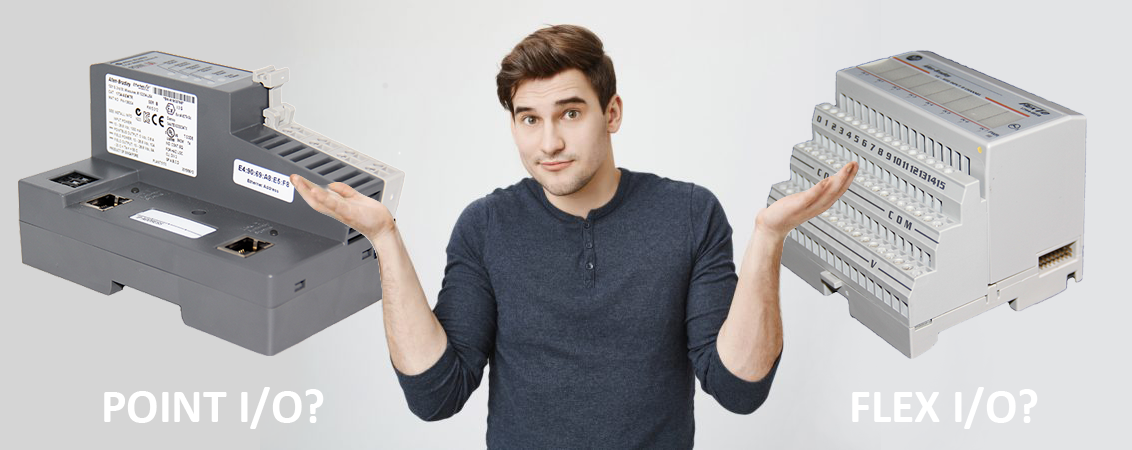
Having the correct I/O module for your application is crucial to keep the communication and information flowing effectively and safely. Point and Flex I/O modules are both distributed I/O systems designed for use with modular Allen-Bradley automation systems but there are many models that are particularly suited for specific applications. Here you can compare and contrast the two, so you can make the best purchase decision.
Point I/O
Allen-Bradley provides a large selection of models that will fit any type of system to meet the needs of anyone using I/O systems. Here are a few key features of the Point I/O modules:
- Easy to Install, and have a small footprint
- Comes in digital, analog, specialty, and safety-rated models
- Choice of Termination in Input and Output
- Modular Network Interface
- Independent I/O Selection
The installation of the Point I/O modules are super easy. They are designed to be put together and have an outer shell that provides many places and ways to attach it to wherever it needs to be. It has a ton of other great features that network maintenance loves, including:
- A Removable Wiring Harness – Instead of working electrical in cramped spaces, the entire harness can be removed and fixed easily and efficiently, cutting down on time and cost
- Customizable Diagnostic System – The interface is always ready to find and fix problems to make fixes as easy as possible on the technician
- RIUP-Enabled – The technician can replace the I/O module while the system is still in operation quickly
- Mounts in Any Direction – It can be placed horizontally or vertically, or anywhere in between and doesn’t require de-rating
Digital Point I/O Module –
- Digital Input/Output and Relay
- Many Voltage Variations
- Easy Field-Side Hardware Diagnostics
- Works in Both Direct-Connect and Rack/PLC
- Uses Point Guard I/O for Safety Apps
- DeviceLogix Technology
- Choice of DC Input/Output
Analog Point I/O Module –
- 8 Connections per Module
- Choice of RTD or Thermocouple Module
- Individually Customizable Connections
- Input Filters
- Over/Under Range Detection
Specialty Point I/O Module –
- Choice of Encoder and Counter Modules
- Synchronous Serial Interface Absolute Encoder Module
- Serial Interface Modules (RS-232, RS-485/RS-422)
- Address Reserve (ARM) Module
- Supports Connecting I/O-Linked Devices
Flex I/O
The Flex I/O module is also made by Allen-Bradley. The name of the devices fits it well because these types of modules are more flexible in their nature. Check out the features below to see how the Flex I/O offers a few more capabilities than others.
- Offered in Digital, Analog, and Specialty Models
- Supports a Great Many Applications
- RIUP-Enabled Technology
- Flex I/O-XT Technology
- Withstands Temperatures Ranging from -4 Degrees to 158 Degrees Fahrenheit.
- ControlLogix-XT Supported
- Conformal Coating Available on Supported Modules
Digital Flex I/O Modules
The digital modules have a varied electrical range that make them very flexible in their application. The densities can range anywhere from 8 to 32 points depending on what module you purchase.
- Isolated Connections
- Output Protection
- Electronic Fusing
- Diagnostics Available (Model Dependent)
Analog Flex I/O Modules
The analog version of the Flex I/O modules have easily configurable channels and input filters on many of the analog modules.
- Differential Inputs
- Internal Calibration
- Thermocouple Models Available
- RTD Models Available
- HART (Highway Addressable Remote Transmitter) Models Available
Specialty Flex I/O Modules
The specialty modules have excellent features that are great for special applications. There are three models of specialty modules available:
- Pulse Counter Model
- Frequency Model
- Very High-Speed Counter Model
Point I/O and Flex I/O Similarities
Well, their differences aren’t many, and they are one in the same in a lot of ways. Both are in-cabinet, modular distributed I/O systems designed specifically for distributed I/O use.
Neither the Flex I/O or the Point I/O have its own controller which can support several local modules at a time.
Both module styles look quite different, but still use the same terminal block base design they’ve used for years. As indicated above, the designs of both modules provide technicians an easy way to replace modules without upsetting the field wiring.
Both types of modules are able to be mounted either vertically or horizontally. Both Flex I/O and Point I/O support DeviceNet, ControlNet, Ethernet, and Profibus DP distributed I/O networks.
What Are The Differences Between Point I/O and Flex I/O?
Upon first glance, you’ll notice that these types of modules look very different. Flex I/O modules are rectangular, and wide, because they plug into a terminal base. This actually helps reduce the footprint of the overall system.
Point I/O modules are narrow, and tall, which is why many use the name “Slice I/O” when referring to the Point I/O systems.
Point I/O systems are generally easier to install, customize, and configure than Flex I/O. Putting the modules together is literally a “snap.” A downside to their design is that it only provides din-rail mounting options where Flex I/O offers more choices.
Both I/O modules support bus extensions, but Point I/O offers cables that are horribly large and bulky, which is nearly impossible to organize neatly or fit it into a tight space. Flex I/O offers a much more practical bus extension cable that works very well and is as flexible as the system itself is.
Limits of Both Systems
Flex I/O can only support up to 8 modules per one adapter. While this is perfectly fine for smaller systems, it usually isn’t even an option for larger applications. Point I/O manages up to a staggering 63 modules per adapter.
However, while the numbers seem quite damning, the Point I/O generally has much fewer I/O points per module. And, it also doesn’t have as many terminals per point as opposed to Flex I/O. The numbers don’t quite balance out, but it is good to be aware of these differences when choosing your system components and for installation.
Point I/O and Flex I/O can be a difficult choice
DO Supply Inc. makes no representations as to the completeness, validity, correctness, suitability, or accuracy of any information on this website and will not be liable for any delays, omissions, or errors in this information or any losses, injuries, or damages arising from its display or use. All the information on this website is provided on an "as-is" basis. It is the reader's responsibility to verify their own facts.