Safety First! – MSR vs GSR Safety Relays – Hardware Comparison
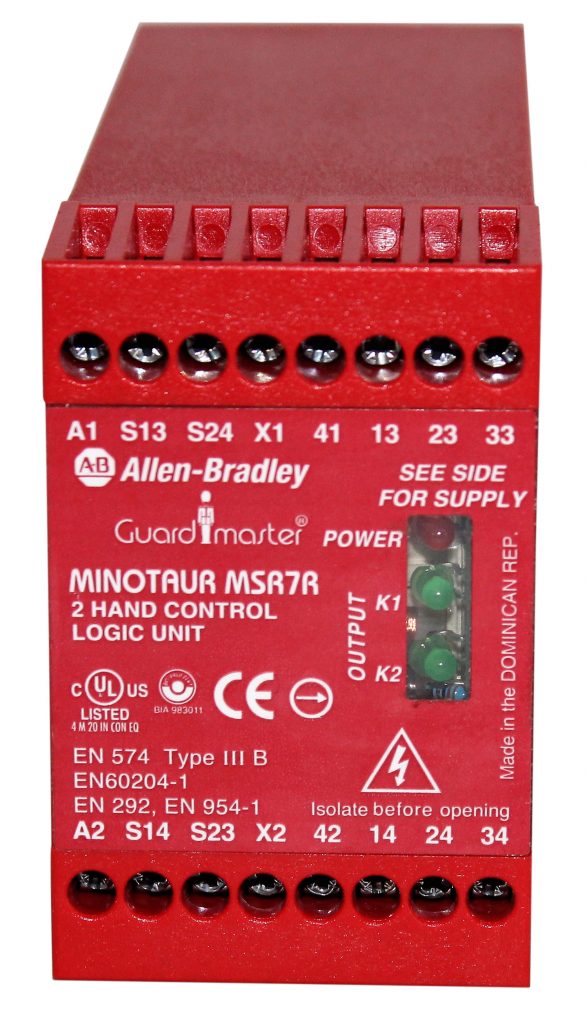
In today’s manufacturing environments, few companies can remain competitive without extensive industrial automation. Automation speeds processes, reduces errors, allows for precision manufacturing and ensures factory level control and maintenance over the system of production. It also reduces operator fatigue by eliminating manual tasks thus improving quality.
Just as important as the automation functions are the safety features built into the controllers that drive this automation. These safety features are created by use of safety circuits within the automation control panels themselves and are first and foremost designed to provide safe operation for equipment operators and technicians.
Aside from reducing risk of injury to those performing tasks on the equipment, safety circuits within control panels also reduce risk by allowing for safe operation to protect damage to expensive capital equipment and to reduce waste through loss of material caused by equipment malfunction. As a result, safety circuits are the watchdogs for the control system and are an integral part of those control functions.
Safety Relays
Within the control system for automation, programmable logic controllers (PLC) operate to send instructions to the various mechanical elements of the equipment to instruct them to perform a task. Safety relays are used to build safety circuits so that in the event of an error, an instruction is given to the component of the machine to reduce risk at that point.
Common safety relay tasks include:
- Emergency Stops
- Interruption of the opening or closing of a gate, valve, door or other flow mechanism
- Depowering when a guard is removed or disrupted
- Depowering in a safe and reliable way to protect life and equipment condition
These tasks can be used to control a variety of devices within the safety circuitry to enable devices such as:
- Light Curtains – Light curtains often use infrared beams to hold the circuit open. If operators or technicians break the beam, the circuit is broken, and a stop signal is sent to the machine.
- Safety Mats – Safety mats are pressure sensitive and can be used to trigger stop signals if presence is detected in a critical zone. They can also be used to prevent overloading of material as well.
- Two-Handed Controls – If operators cannot reach nip points or other danger zones, safety controls can be developed for one-hand operation. However, some equipment may require hands and limbs near the danger zone. In these cases, two-handed controls are used, and the safety relay will trigger if the operator removes one hand from the controls.
- Magnetic Switches – For gate, door and valve closures, magnetic switches can be used to signal the gate to open or close, or in the event of error, it can prevent the opening or closure for safety considerations.
- E-Stops – One of the most common safety features of any machine, E-stops depower the whole machine through the manual or automatic trigger of a stop that depowers the entire machine.
- Interlock Safety Switches – These safety switches are required for systems where machine components are locked together. The relay requires that certain parameters be met before allowing the component to unlock.
MSR vs GSR Safety Relays
Just as control systems and PLCs have evolved over the years to provide better, faster and more accurate controls, safety relays have evolved as well to reduce risk even further while provided higher levels of functionality and precision for safety functionality. Allen-Bradley, a leader in a suite of control system components such as PLCs, I/O modules, sensors, switches and other components, produces safety relays renowned for their reliability, familiar structure and control. The two most common safety relays are the MSR and the GSR.
The legacy model is the MSR, or Minotaur Safety Relay. Allen-Bradley’s newest safety relay is the GSR, or Guardian Safety Relay. While both provide safety functions within control systems, there are some comparisons that should be made for those using legacy MSR components or those considering an upgrade to GSR’s greater slate of functionality.
- Size – One differentiator is the size of MSR vs GSR. MSRs typically use between 45 and 90 mm of cabinet space whereas GSRs take up half the space. The common GSR replacement for an older 45 mm MSR is 22.5 mm and the GSR replacement for larger 45 mm MSRs is 45mm. This reduction allows more space for other critical features in a control panel or for a size reduction in equipment where real estate is at a premium.
- Response Time – Depending on the module of both MSR and GSR, response times may vary. In some modules, an MSR will have a comparable or lower response time in milliseconds (ms) compared to GSR modules while in others the GSR response is faster. This may be related to the fact that MSRs offer one dedicated safety function for one safety circuit and actuator while GSR units utilize configurable safety functions. Because their capabilities are not apples to apples, using response time alone is not an indicator for which component works best for an application.
- Load Capacity – With the exception of a small number of GSR modules, GSRs generally draw less load DC or an equivalent load DC compared to MSR. The thermal (non-switching loads are significantly less in GSRs as well.
- Channel Inputs – In the older MSR family, dual input versions allowed some diagnostic capability through use of a “hot” and a “common” input where the hot channel looked for voltage and the common channel sought out current. GSRs allows pulsed voltage on each channel input. This allows the controller to detect errors such as cross-channel shorts, open circuits and overriding voltages. It also allows for streamlined wiring as well as superior diagnostics.
- Connectivity – As mentioned in response time in number 2 above, MSRs have less connectivity to one another than GSR units. When using MSRs, adding additional safety circuits requires more safety relay modules. On the other hand, the GSR family utilizes a single-wire-safety (SWS) control system that allows the interconnection of multiple units more easily than MSRs.
- Configuration – One key advantage for GSR over MSR is that GSRs have configurable safety functions and consolidated safety circuits. This configurable logic scheme allows modules in the GSR family to take on greater loads for higher levels of functionality. This reduces component cost, uses less space and results in fewer units used.
- RoHS Compliance – Explosive Growth in machine automation through the adoption Industrial IoT for Industry 4.0 applications has seen a dramatic increase in automation capabilities. This has directly correlated to an increase in control and safety functions. Compared to MSRs, GSR family components comply with the Restrictions on Hazardous Substances (RoHS) in their construction. This standard reduces or eliminates certain materials for use in component construction. It has been a standard for the EU for all products marked with the CE designation in EU countries.
While MSR legacy modules are useful and reliable for simpler safety controls on specific types of equipment and functions, GSRs are more capable and carry higher functionality to deal with the proliferation of new plant automation and the safety requirements associated with them. The GSR family is not intended as a one to one replacement for MSR modules. Rather, GSRs are intended to add flexibility and agility in adapting control systems and their safety functions to rapidly changing machine designs associated with the global digitization of manufacturing and logistics. It allows for harmonized standards that add to the new push for ever increasing productivity and flexibility in both control systems and their safety functionality.
DO Supply Inc. makes no representations as to the completeness, validity, correctness, suitability, or accuracy of any information on this website and will not be liable for any delays, omissions, or errors in this information or any losses, injuries, or damages arising from its display or use. All the information on this website is provided on an "as-is" basis. It is the reader's responsibility to verify their own facts.