Hardware Comparison: MicroLogix 1500 Selection Guide
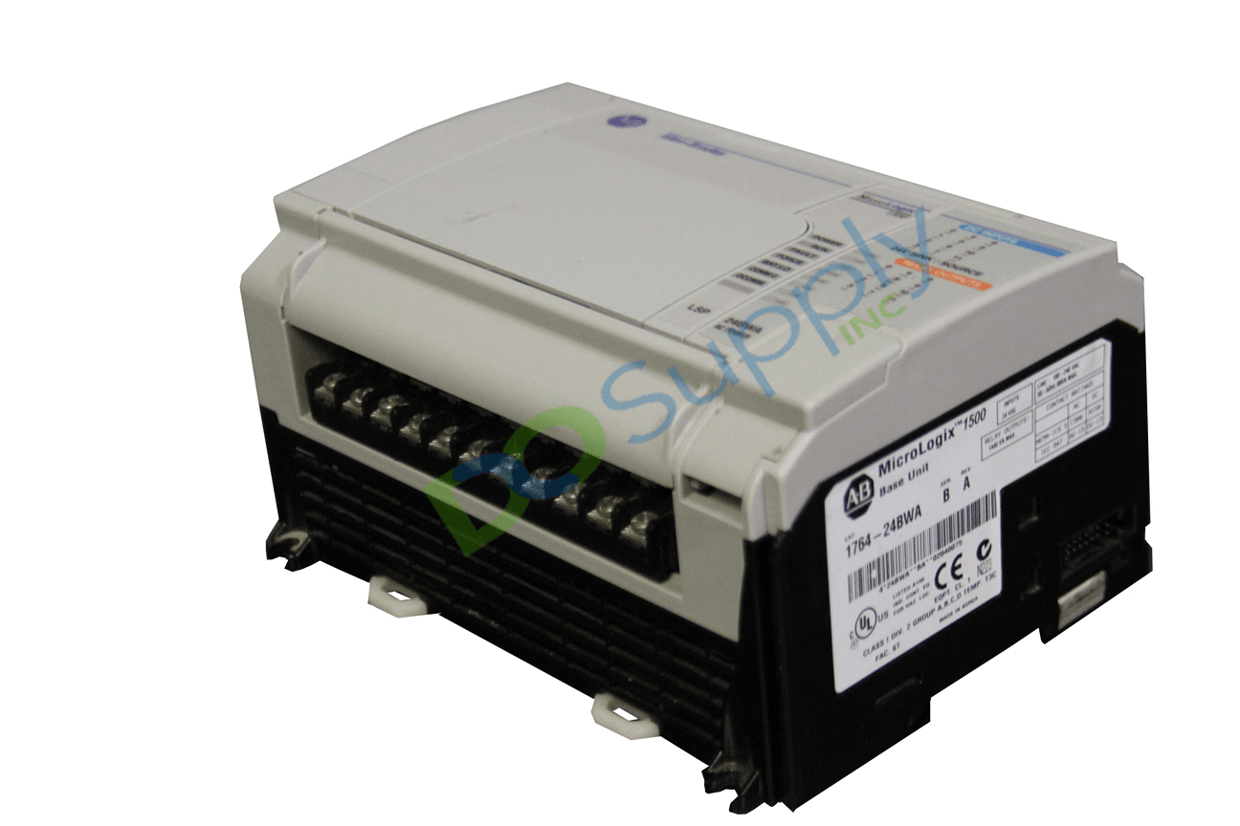
Like the other entrants in the MicroLogix series, the MicroLogix 1500 is small and can be expanded to fit a wide range of control and communication requirements. The 1500 is also expandable to 512 I/O points and is the most powerful in the MicroLogix family in terms of capabilities.
Comparing the MicroLogix 1500 to Other MicroLogix Controllers
As an addition to the MicroLogix 1100 and 1200 series family members, The MicroLogix 1500 has three base options with a removable processor and an updateable flash OS. With its numerous embedded as well as expandable I/O, the 1500 is a workhorse within the MicroLogix family. Main differences between the 1500 and other MicroLogix family members include:
- Central Processing Unit – Perhaps the biggest distinction between the MicroLogix 1500 and the other members of the MicroLogix Family is that the 1500 is a two-part system. One component consists of the controller, of which there are three base models, the 1764-24BWA, the 1764-24AWA and the 1764-28BXB. The second component is the central processing unit. Depending on the memory required for the end use of the controller, there are two choices of CPU for the MicroLogix 1500. The first CPU uses the catalog number 1764-LSP. This CPU provides 7.65K words of memory that can be configured by the user for both programs and data. The second CPU option is an enhanced version under the catalog number 1764-LRP. This CPU provides 14K words of memory that can be configured by the user for both programs and data.
- Expanded I/O – The 1500 series has 28 digital embedded I/O compared to 16 on the 1100 series and 40 on the 1400. However, the 1500 series allows local expansion of up to 512 I/O whereas the 1100 does not offer expansion of I/Os and the 1400 is capped at 96. The 1500 does not have any embedded analog I/Os but it does allow for network expansion when using a DeviceNet network with a 1769-SDN scanner, a feature not available with the 1100 and in the 1400 limited to 256 I/Os.
- High Speed Counters – The MicroLogix 1500 has two high speed counters at 20kHz. Both counters have 8 modes of operation. There are two high speed outputs for configuration as Pulse Train Outputs (PTO) or Pulse Width Modulated (PWM). The 1400 series offers up to six high speed counters at 100 kHz while the 1100 utilizes a single high-speed counter at 20 kHz.
- Motion Functionality – The 1500 series is limited in onboard motion functionality compared to the 1400. The 1500 carries 2 PWM motion controls at 20 kHz while the 1400 offers 3 PWM at 40 kHz. The 100 is a bit more flexible as well as it carries two 40 kHz PWM as well as two 40 kHz PTO.
- Communication – The MicroLogix 1500 controller has two RS-232 ports compared to a single RS-232 port for the 1400 (although the 1400 carries an additional single RS-232/RS485 port. The 100 carries only a single RS-232/RS-485 port. For EtherNet/IP, both the 1100 and 1400 series have a single EtherNet/IP port while EtherNet ports on the 1500 series are available only on the base 1761-NET-ENI and 1761-NET-ENW.
- Communication Networks – The MicroLogix 1500 uses several communication networks including RS-232, RS-485, SCADA RTU (both DF1 half-duplex and DF1 radio modern), ASCII read/write. The 1500 does not support ModBus or CIP serial, while the 1400does support ModBus.
Advantages of MicroLogix 1500
For users looking for a small footprint with powerful functionality, the MicroLogix 1500 is designed for applications such as industrial equipment, commercial equipment, warehouse automation and other building automation needs. There are many advantages for using the MicroLogix 1500 including:
Communication Protocol Flexibility
The MicroLogix 1500 has a lot of flexibility to accept a wide range of communication protocols. These include RS-232, RS-485, DeviceNet peer to peer messaging, EtherNet/IP, SCADA RTU DF1 half-duplex and SCADA DF1 radio modern and read/write for ASCII. The 1500 DeviceNet operability can be achieved using a 1769-SDN DeviceNet scanner which allows the 1500 to operate as either a server, client, or peer device.
Memory and Program Flexibility –
The 1500 series has a large memory capacity to provide application solutions. This memory ranges from 7KB of programming capacity in the 1764-LSP base model to 14 KB of programming capacity in the base 1764-LRP.
Data Logging and Recipe
Data logging on the 1500 can be either time-based or event-triggered, depending on the base model chosen. Data records can be stored with a time stamp for review of alarms and I/O status later.
Data Change and Monitoring
Sometimes, data requires changing on the fly. The MicroLogix 1500 offers a Data Access Tool (DAT) as a plug-in so data can be changed locally. This eliminates the need for a computer or an HMI for such changes.
Comparison Among MicroLogix 1500 Variants
There are three different base unit variants within the MicroLogix 1500 family. These variants are identified with different catalog numbers and each have some variation in functionality.
The 1500 series variants are:
Common Features
Base units within the MicroLogix 1500 family carry many identical features. These features include:
- I/O Expansion – The MicroLogix 1500 uses a compact I/O system to achieve expandability of I/O. Not only does this reduce cost, but it is also rackless and modular. The system allows module replacement to occur at the front of the panel which reduces maintenance time.
- Data Integrity and Protection – The three base units all allow download protection for data files. This means that during maintenance, vital user data won’t be able to be overwritten. It also provides static data file protection as well so that communication protocols cannot alter data.
- Analog I/O – While the MicroLogix 1500 family does not have embedded analog I/O. Analog I/O can be achieved via an expansion module using compact I/O. This greatly improves flexibility when needing specific analog requirements or in tying in legacy equipment for machine automation. Analog modules can be added for either 2-channel current or voltage output or a 4-channel current or voltage input.
- Communication – All base units carry a single RS-232 port with additional ports available on some models. 1500s also allow TRS/CTS and RTS/CTS/DCD hardware handshake capability as well as connection to modems. ASCII messaging is standard and allows for dial-out functionality. The models can also connect to both DH485 and DeviceNet networks. All 1500s can be uses as a remote terminal unit (RTU) to support half-duplex DF1 Communications. This allows them to be used as either a client, server, or peer.
- High Speed Counters – Modern equipment works at extremely fast speeds and requires a control system to handle it all. The MicroLogix 1500 group of base controllers each utilizes two high speed counters operating at 20kHz. As counters reach the programmed target preset, outputs can be programmed for the next step. Because the two high speed counters allow eight modes of operation, 1500 controllers can be programmed with selectable time interrupts (STI). There are also four event interrupts which enable the 8 high-speed inputs to act as interrupts for inputs.
Base Model Differences
Feature and function differences within the 1500 family base models include:
- Input Power – For incoming line power, the 1764-24BWA and the 1764-24AWA utilize 85 to 265V AC operating at 47-63 Hz. The 1764-28BXB uses 20.4 to 30V DC power.
- Power Consumption – There are differences in power use for all three base variants within the 1500 family. The 1764-24BWA uses 88VA of power while the 1764-24AWA uses 70VA. The low power user in this group is the 1764-28BXB base which only uses 30W. The 1500 family power supplies are also built to handle short losses of power without compromising system operation.
- Power Inrush – For power inrush, again the 1764-24BWA and the 1764-24AWA operate at the same inrush rate. At 120V AC, each of these units use 25A for 8 ms, while at 240V each use 40A for 4 ms. Again, setting itself apart in this group is the 1764-28BXB which uses 4A for 150 ms at 24V DC.
- Power Output – There is a power rating distinct for the 1764-24BWA. This base unit does have a user power output of 24V DC at 400mA. The other two base unit models do not utilize user power output.
- Number of I/O – Both the 1764-24BWA and the 1764-24AWA have 12 inputs and 12 outputs. The 1764-28BXB carries 16 inputs and 12 outputs.
Series Differences
The MicroLogix 1500 controllers use a series number in addition to catalog number. These series numbers indicate upgrades most often related to firmware, cabling, and software version upgrades. There are a few differences in series numbers across the catalog numbers within the 1500 family vase units.
- Upgrade Capability – One key difference in the 1500 family is that series A controllers are not field upgradable. This capability only begins with series B controllers and later.
- Software Release
- Firmware – Firmware releases enable functionality on existing controllers. These are not required but depend on each user’s requirements for the control system.
Additional Considerations
In addition to choosing the base CPU for the appropriate memory volume mentioned earlier, the Allen-Bradley MicroLogix 1500 is also built with additional modular functionality. To increase the flexibility of the 1500, the unit was designed to take an extensive array of plug-in modules to add functionality. There are over 40 expansion modules compatible with the MicroLogix 1500 and are carried under the catalog number prefix 1769 for use with the 1500 family.
DO Supply Inc. makes no representations as to the completeness, validity, correctness, suitability, or accuracy of any information on this website and will not be liable for any delays, omissions, or errors in this information or any losses, injuries, or damages arising from its display or use. All the information on this website is provided on an "as-is" basis. It is the reader's responsibility to verify their own facts.