Power Density Calculator: What is Power Density and How is it Calculated?
Power Density Calculator
What is Power Density?
Power density is the rate of energy flow per unit mass, area or volume. Most often, it is defined as the time rate of energy transfer per unit volume. The International System of Units (SI) for power density are Watts per cubic meter ( W / m3 ). Other common metric units include: Watts per square meter ( W / m2 ), Watts per kilogram ( W / kg ), Horsepower per cubic inch ( hp in3 ).
While power density is not commonly used as a form of measurement as energy density, it is still a useful performance parameter for most energy systems. For example, in energy transformers including fuel cells, batteries, power supply units, motors etc., power density is measured in terms of volume, often referred to as volume power density, expressed as W/m3 .
Hence, the more an engineer knows about power density, its importance, and how it’s calculated, the better he/she will be prepared to leverage the emerging power-dense technologies to meet the ever-increasing demands of modern power management systems. This article presents a general introduction on how to calculate the power density for different systems.
Power Density vs. Energy Density
As stated previously, power density is defined as the amount of energy flow rate per unit mass, volume, or area. Whereas, energy density is the amount of energy stored per unit mass, volume, or area. In simple terms, power density is the amount of power drawn from a given mass, while energy density is the amount of energy stored in a given volume or mass. The contrast between the two is similar to the difference between power and energy. Also, while power density is expressed in Watts per meter cubic ( W / m3 ), the SI unit for energy density is Joules per cubic meter ( J / m3 ).
To better understand the difference between energy density, let’s consider capacitors and batteries. In batteries, energy density correlates with the amount of energy that can be stored per battery unit size, whereas power density relates to the maximum amount of energy that can be delivered or discharged per battery unit. Since batteries are able to store more energy than capacitors, they have a higher energy density.
On the other hand, capacitors can discharge energy more quickly, so they have a higher power density than batteries. By comparison, capacitors offer low energy density but very high-power density. Hence, you can use batteries to provide lower currents for longer periods of time and capacitors for short bursts of very high current.
Why is Power Density Important?
- Smaller is better: Over the past few years, the trend in all electronic products has been to make them smaller, but still, they are capable of performing better with fewer power requirements. Power density serves as a measure of the amount of energy that can be processed in a given area or space in the context of power management in electronics. It allows more power to be processed even in a smaller unit while enhancing the functionality of the energy system, at reduced costs. A camera flash is a good example of power density applications in a space-constrained energy storage system. This is because the camera flash is designed to be small enough to fit inside a cell phone, but it has a high-power output enough to light up the subject of your photograph. This shows just how ideal a system with a high-power density is.
- Comparison Factor: You can use the power-density value as a way of directly comparing Switch-Mode Power Supplies (SMPS) or any other power product including audio power amplifiers, dc-dc converters, etc. If a power supply has a high-power density, then it can output large amounts of energy depending on its mass. For example, a small capacitor can output the same power as a large battery. This is because even though the capacitor is tiny, it has a higher power density than the large battery.
- Power-Supply Volume: Generally, whenever you purchase a new electric/electronic product you’ll always be concerned about its power-supply volume. This is because thermal considerations (i.e., overheating) are primarily so critical. Also, power density determines how long a product will take to recharge. For instance, high-power density systems can recharge quickly as they release their energy much faster.
- Efficiency Concerns: Improving the efficiency of power supplies for electronics generally improves their power density. In addition, power density is closely related to efficiency in power delivery applications, and efficiency continues to be the driving force in modern engineering systems. In fact, to some engineers achieving higher power densities when designing power systems is the ultimate achievement. A good example is in the design of data centers, which need to efficiently occupy fewer spaces with as much processing power as possible. Also, as the processing speed of processors continues to grow by leaps and bounds, these power-hungry devices need great amounts of power. This means that efficient power supplies with higher power density are becoming ever-more critical for such processors.
Limitations in Power Dense Solutions
Previously, we have discussed the importance of having systems with high power density. However, there are specific factors which limit how much power density can be realistically improved. These include:
- Conduction/ Transmission line losses
- Thermal issues
- Reverse power recovery losses
- Battery/Capacitor charge related losses
- Turn-off and turn-on losses
Note, with the exception of thermal issues, all the aforementioned factors relate to power converter losses.
Keys to Achieving High Power Density
Having a general idea of the factors that limit power density, can assist an electronics designer to shift focus on how to achieve high power density in spite of those limitations. A lot of progress has been made in understanding the trade-offs involved in achieving higher power density solutions. Here are some fundamental aspects included in modern power management solutions in an effort to achieve high power densities:
- A switching element that significantly reduces conduction and switching losses.
- An optimized power converter topology operating at high switching frequencies. This converter is usually combined with an appropriate control method.
- More passive methods of integrating power and control, often achieved monolithically or via multichip module technology which integrates multiple semiconductor chips, thus reducing the overall footprint.
- Excellent thermal performance capabilities that minimize the temperature gradient between the silicon temperature (internal cooling) and external cooling surfaces.
How is Power Density Calculated?
The details of calculating the exact value of power density can be fairly explicit. But the basic concept used in estimating power density in most power systems is quite straightforward. Most power density measurements are based on either area or volume. Power density is generally associated with power ICs (Integrated Circuits), power supplies, or any circuit that generates power.
In terms of volume, power density would be the output power processed by the system ( Vo × Io ) divided by the rectangular area of the circuit board (in case of a semiconductor) given as ( L × W ) multiplied by the height( ×H ) of the tallest component on that circuit board. This can be expressed mathematically as:
PD = ( Vo × Io ) / ( L × W × H )
PD = Power Density
Vo = Output Voltage in Volts(V)
Io = Output Current in Amperes(A)
L = Length
W = Width
H = Height
In terms of area, power density would simply be the output power processed by the system ( Vo × Io ) divided by the rectangular area of the board ( L × W ).
Hence, power density is commonly quantified as the amount of output power processed per unit volume or per unit area. The most typical units used are: Watts per cubic meter ( W / m3 ), Watts per cubic inch ( W / in3 ), Watts per square meter ( W / m2 ), or Watts per square inch ( W / in2 ).
Different ways of calculating Power Density
You notice that power density can be expressed in a variety of different units, similarly, different methods can be used to calculate power density depending on the type of application at hand. Some of these applications include:
A) Power Density in Motors and Power Supplies
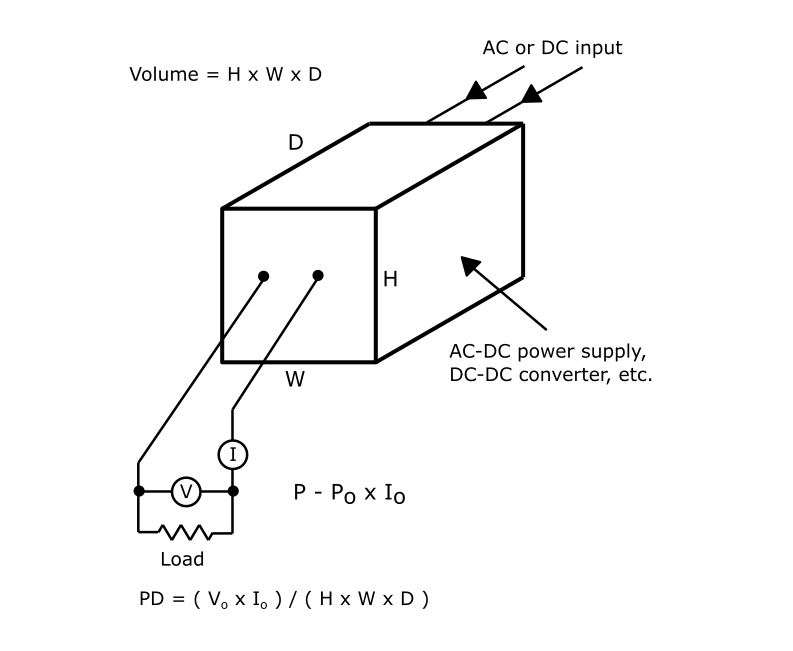
In motors and power supplies, power density is often referred to as volume-specific power or volume power density. It is the time rate of energy transfer or rather the amount of power generated per unit volume of the motor/power supply.
For example, if you assume that your power supply is a rectangular package as shown in the diagram below, the volume would be the product of its Width (W), Depth (D) and the Height (H) of the power source.
Therefore, the Power Density (PD) of the power supply would be: PD = ( Vo × Io ) / ( W × D × H )
The resulting value of power density can be given in Watts per cubic meter ( W / m3 ), or Watts per cubic inch ( W / in3 ). The more powerful and (or) the smaller the power supply is in envelope size; the higher will be its power density.
B) Power Density in Batteries
The power density of a battery is a measure of how fast the battery can deliver energy. In other words, you can equate it to the maximum current that can be drawn from a battery of a given size. It is calculated by dividing the amount of power delivered by the battery ( Vo × Io ) with its mass (kg).
PD = ( Vo × Io ) / ( kg )
The resulting value is expressed in Watts per kilogram( W / kg ). For example, if you have a battery with an average (nominal) voltage of 3V and an output current of 1 Ampere. Then, the power output will be 3V × 1A = 3W. You can divide this value by the mass of the battery in litres or kg to find the battery’s power density in W / kg.
Note, you can also calculate the power density of a battery in terms of volume as with the power supply discussed above. In that case, the battery power density will be expressed in Watts per cubic meter ( W / m3 ).
C) Power Density in Radar Applications
In radar applications, power density is the measure of the non-directional power radiated (in space) from the center of the antenna. This space is represented as a sphere with a radius “R”, which is a specific distance from the center point of the antenna. Assuming that the antenna radiates power in all directions, then the power density can be defined as the measure of the power transmitted from the antenna to a certain distance “D”.
To calculate the power density of a practical(actual) antenna, the following formula is used:
Power Density (PD) = ( Pout × Gtx ) / ( 4 × π × D2 )
where,
PD = Power density
Pout = Output power transmitted from the antenna. Give in Watts (W) / Milliwatts (mW) / Decibel-Watt (dBW) / Decibel-milliwatt (dBm)
Gtx = Power gain of the antenna, which can be Linear / Decibels (dB). It is dimensionless.
D = Distance measured from the center of the antenna. Given in meters (m) / Centimeters (cm) / Kilometers (km) / Feet (ft) / Yards (yd) / Miles (mi) / Inches (in).
Usually, the power density of an antenna in radar applications is measured in Watts per square meter ( W / m2 ). But other units like milliwatts per square centimeter ( mW / m2 ), Watts per square feet ( W / ft2 ), Decibel-Watt per square meter ( dBW / m2 ) …etc are still used. Decibel units are used when the Gain ( Gtx ) is not linear but is rather given in decibels.
Note, the distance D is an exponential component to the above equation, this is because of the three-dimensional “spreading” of the Radio Frequency (RF) waveform from the antenna as it propagates through space.
Sometimes, you may need to calculate the power density of an isotropic antenna. In antenna theory, an isotropic antenna is a theoretical (i.e., practically doesn’t exist), lossless isotropic radiator which radiates power uniformly in all directions. Thus, the output power from the isotropic antenna will be uniform per unit area no matter where you measure it from. In other words, an isotropic antenna would equally radiate out Radio Frequency (RF) waves with the same intensity in all directions. The power density of an isotropic radiator is calculated using the following formula:
Power Density (PD) = ( Pout ) / ( 4 × π × D2 )
You can notice that the only difference between the power density formulas for a practical and isotropic antenna is the gain. In an actual antenna, the gain represents the maximum radiation intensity from or the absorption incident power in a given direction when compared with a theoretical isotropic antenna.
Gain (G) = Maximum radiation intensity of a practical antenna / Radiation intensity of an isotropic antenna with the same power input
Hence, the power density of a practical antenna is the power density of an isotropic antenna multiplied by the gain (G) of the practical antenna. Therefore, the power density of an isotropic radiator is the reference for all other antennas.
Examples of Antenna Power Density Calculations
Example 1: Calculate the power density for a given antenna transmitting 100 Watts with a gain of 10 at a distance of 100 feet.
Solution: We’ll use the formula for calculating power density of a practical antenna,
Power Density (PD) = ( Pout × Gtx ) / ( 4 × π × D2 )
Given that: Pout = 100W, Gtx = 10, D = 100ft
Substitute the given values in the above equation to obtain:
Power Density (PD) = ( 100 × 10 ) / ( 4 × π × 1002 ) = 7.9577 × 10⁻³W / ft2
Thus, the power density of the antenna can be approximated to 0.008 W / ft2
Example 2: An engineer is trying to determine whether a jammer will disrupt the circuitry of a missile carried onboard a fighter aircraft. Given the following:
Output power of the Jammer ( Pout ) = 500W
Antenna gain ( Gtx ) = 2
Jammer line loss = 3dB
Missile antenna diameter = 10ft
Compute the power density at the missile antenna as a result of the jammer.
Solution: First, let’s convert the missile antenna diameter from feet to meters: 10ft × 0.384(m/ft) = 3.048m
Then, using the power density formula of a practical antenna, the power density at the missile antenna will be:
Power Density (PD) = ( Pout × Gtx ) / ( 4 × π × D2 ) = ( 500W × 2 ) / ( 4 × π × 3.048m2 ) = 8.5656 W / m2
Power Density Calculator
This is a tool designed to compute the value of the power density of an antenna. By providing the gain and output power values, you can measure the power density from an actual antenna to a given distance. Most of the Power Density Calculators available online are used in Radar and Radio Frequency (RF) applications to measure the power density from a given antenna to a specific distance.
The calculator at the top of the page is designed to compute for the antenna power density using formula of a practical antenna:
Power Density (PD) = ( Pout × Gtx ) / ( 4 × π × D2 )
Thus, you’ll need to input the values of: Pout from the antenna in either W / mW / Decibel-Watt (dBW) / Decibel-milliwatt (dBm); Gtx of the antenna, and specify if it is Linear or in Decibels (dB); and Distance (D) from antenna in either m / cm / km / Feet / Yards / Miles / Inches.
After entering these values, click the calculate (submit) button and you’ll get the power density value of that given antenna. Reset the calculator for subsequent calculations.
DO Supply Inc. makes no representations as to the completeness, validity, correctness, suitability, or accuracy of any information on this website and will not be liable for any delays, omissions, or errors in this information or any losses, injuries, or damages arising from its display or use. All the information on this website is provided on an "as-is" basis. It is the reader's responsibility to verify their own facts.