What do VFDs do in HVAC Systems?
The term HVAC is an acronym that stands for Heating, Ventilation, and Air Conditioning; it broadly describes systems that provide heating and cooling to commercial and residential buildings for environmental comfort. A typical HVAC system includes Heating equipment, Ventilation equipment, and Air-Conditioning or Cooling equipment; the functions of these three elements are interrelated, particularly when providing thermal comfort and acceptable indoor air quality. For example, the Heating element, which may be a boiler or furnace, includes a piping system for the heat-carrying fluid or ductwork in case of a forced air system.
The Ventilation element (either natural or forced) uses fresh outdoor air to provide high-quality indoor air through a process called ventilation–a process of exchanging or replacing air within a designated space. This process also involves the removal of dust and smoke particles, moisture, airborne bacteria, heat, odors, carbon dioxide, and other unwanted gases as well as oxygen replenishment of the indoor air. While the main function of the Air-Conditioning element is to remove existing heat from the indoor air. In addition to temperature control, the air-conditioning element also regulates the humidity of the indoor air so as to maintain it at optimal comfort levels.
HVAC systems are available in several configurations that differ considerably from each other. For example, a chiller plant is substantially different from an air conditioning system built on packaged HVAC RTUs (Rooftop Units). Nevertheless, all HVAC installations have one thing in common: they make use of electric motors that are subject to variable cooling and heating building loads. Regardless of the HVAC component, these electric motors are used to drive i.e. compressors, fans, or water pumps, HVAC systems in general present a great opportunity to conserve energy by optimizing their variable load operations.
Load variations on HVAC systems are a fact of life for commercial building applications because different occupants will definitely have different cooling and heating preferences, so the building loads will keep changing throughout the day as the tenants come and go. However, most HVAC systems in commercial buildings are configured to operate at a constant speed regardless of the varying load demands, so a lot of energy is wasted during their operation. That’s where Variable Frequency Drives (VFDs) become very necessary.
In a general sense, a VFD is a type of motor controller applied in electro-mechanical drive systems to precisely control torque, speed, and position of standard synchronous and induction AC motors, by varying the input frequency and associated supply voltage to the motor. VFDs also have the capacity to provide controlled acceleration and deceleration when a motor is starting or stopping. But the most popular HVAC definition of a VFD is an electrical device used as a fan accessory to regulate (increase or decrease) the rotations per minute (RPMs) of the AC motor driving the fan. The VFD achieves this by adjusting the frequency of the voltage being supplied to the fan’s AC motor, thereby varying airflow in the HVAC system.
VFDs can also be used as pump and compressor accessories in HVAC systems, but they are commonly described as speed controllers for HVAC motors because they actively adjust the speed rate of those motors based on the building load demands. For example, if the outdoor temperature is cool and the environment in your office is comfortable, a VFD will decrease the RPMs of the motor driving the installed HVAC system to reduce the system’s energy usage.
Hence, the primary function of a Variable Frequency Drive in an HVAC system is to adjust and control the RPM speed of one or more HVAC motors depending on the load requirements of the system and its operational schedule. This results in a drastic reduction in energy consumption of the HVAC system, as we’ll discuss later. VFDs also control airflow to satisfy the requirements of different heating and cooling stages of the HVAC system, as by adjusting the speed of an HVAC AC motor driving a fan, pump, or compressor the VFD does vary the system’s airflow.
Note: For a VFD to function properly in an HVAC system, it requires the HVAC motor, a power source, a controller, and a user interface. The controller is wired into the VFD-equipped HVAC unit and it communicates with the user interface. The controller should be programmed to provide information about the entire HVAC system, such as any active alarms, real-time space temperature, humidity, airflow, pressure, and more importantly access to the Variable Frequency Drive. With this operation information of the HVAC system and VFD access, the user can then apply appropriate control parameters.
How do VFDs Enhance the Efficiency of HVAC Systems?
As previously stated, most conventional HVAC systems used in commercial and residential buildings are designed to operate pumps and fans at a constant speed. But building loads (heating and cooling loads) are anything but constant. Some conventional HVAC systems employ a form of mechanical throttling to reduce air or water flow in the system. However, the electric motors driving the pumps, fans, compressors, etc., in such a system continue to operate at full speed, while consuming the same amount of energy regardless of the cooling or heating load on the HVAC system.
Therefore, even though mechanical throttling can provide an HVAC system with a good level of control, it’s not energy efficient. VFDs on the other hand, provide an effective and efficient energy-saving alternative for HVAC systems.
There are three factors about HVAC systems that enable VFDs to improve the operating efficiency of a given HVAC system, they include:
- Less than Full Load Operations: HVAC systems for building applications are sized for peak load conditions in the design stage. But in practical applications, full load conditions in buildings happen roughly between 1% and 5% of the annual operating hours. This would mean that the HVAC motors driving the system’s pumps, compressors and fans consume more energy than necessary in 95% to 99% of their operating hours. Also, as a general rule, running a motor at partial-load speed is more energy-efficient than operating it intermittently at peak load conditions–at full speed.
- Oversized HVAC System Designs: Designing an HVAC system for peak load conditions oversizes the system for nearly all operating hours. This design condition is further compounded by the common engineering practice of oversizing HVAC system designs to allow for unexpected and underestimated building loads as well as additional future loads resulting from changes in building space usage.
- Motor Energy Consumption is a Function of Speed: Induction motors are the most commonly used HVAC motors for building applications. And with induction motors, the power consumed by the motor varies proportionally with the cube of its speed. Hence, any speed reduction on the part of an induction HVAC motor will result in huge energy savings.
For example, if the HVAC motor speed is reduced by 20% of its normal operating RPM speed, its power consumption will reduce by nearly 50%. Similarly, a 50% reduction in the motor speed can result in about 90% power saving. However, induction motors are practically constant speed motors, meaning that for the entire HVAC loading range, speed variations of the HVAC motors are quite small.
The installation of a Variable Frequency Drive in an HVAC system for a building application addresses the system inefficiencies introduced by the first two factors (Less than Full Load Operations and Oversized HVAC System Designs) while producing the power savings made possible by the third factor–Overall Motor Power Consumption is a function of its Speed. The Variable Frequency Drive accomplishes the two functions (addressing the system inefficiencies and producing energy savings) by converting the 60 Hz (Hertz) line current (AC) supplied to the connected HVAC motor to direct current (DC), then to an output that varies in frequency and voltage based on the building load placed on the HVAC system. As the building load on the HVAC system reduces, the VFD controller cuts down the operating speed of the HVAC motor in question so that the airflow rate through the HVAC system meets the building load requirements without exceeding them.
In addition, VFDs enable HVAC motors in building applications to slowly ramp up to normal operating speed at a controlled rate, which is referred to as a soft start as contrasted to a hard start condition. Thus, as the cooling or heating load increases, the speed of the HVAC motors will slowly increase to peak load speed, and slow down when the building load decreases. Hence, there’s no need to operate the HVAC system at full throttle throughout the day. This results in significant energy savings during off-peak operating hours.
Benefits of Using VFDs in HVAC Systems
Energy Saving: VFDs ensure that AC motors in an HVAC system can operate at less than full speed, which leads to considerable reductions in energy consumption. According to the Affinity Laws for centrifugal fans and pumps, reducing the HVAC motor speed by 25% lowers the motor’s energy consumption by approximately 60%. Likewise, decreasing the speed of a motor driving a pump or fan in an HVAC system by 50% reduces the motor’s energy usage by almost 90%. The bottom line is, that using Variable Frequency Drives to reduce the speed of AC motors in an HVAC system by even a small percent can bring about significant energy savings.
Extended Service Life: As a commercial HVAC system continues to operate, its components will normally start to wear down over time, and the motors driving its fans, compressors, and pumps are no exception. Without frequent maintenance, those components can deteriorate to the point where the entire HVAC system malfunctions or stops working completely. While equipping an HVAC system with a VFD won’t stop the system from aging (declining in functionality over time), it reduces wear and tears on the HVAC motors. This is due to the fact that Variable Frequency Drives allow induction AC motors to complete a “soft start” and gradually ramp up to full-load operating speed.
When a standard induction motor (common HVAC motor) is started, it draws in a larger amount of current than during normal operation. This inrush current is normally 3 to 10 times the full-load operating current for the HVAC motor, generating both stress and heat in the windings of the motor and in other HVAC components downstream. If such HVAC motors are started and stopped frequently, they are highly likely to fail early due to wear and tear.
However, when an induction HVAC motor that’s connected to a VFD unit is started, the Variable Frequency Drive applies a very minimal input frequency and low supply voltage to the HVAC motor. Also, both the supply voltage and input frequency are moderately ramped up at a controlled rate to normal operating load conditions. In doing so, the VFD-driven HVAC motor undergoes less wear and tear during start-up than a standard motor’s start, this helps extend the motor’s service life and prolong the lifespan of the HVAC system.
Precise Control Levels: VFDs provide more precise levels of control to HVAC systems in building applications. For example, high-rise commercial buildings often use a domestic water supply with a booster pump system to maintain adequate water pressure at all floor levels of the building. Conventional booster pump controls in such types of HVAC applications can maintain the water pressure within a specific range.
However, a VFD-based booster pump control system for a similar application can maintain precise water pressure control over a wide range of water flow rates, while reducing the energy requirements of the pump system as well as pump wear & tear. Also, for a VFD-equipped HVAC compressor used in a chiller plant, the VFD often modulates the compressor speed to maintain the temperature set point of supply air or supply water.
Improved Ventilation: VFDs adjust the speed of HVAC motors driving pumps, compressors, or fans to vary system airflow. This makes them essential components in controlling the rate of airflow in HVAC systems to create healthy and safe buildings–in terms of environmental comfort. In addition, the quality of indoor air is improved because controllers of VFD-equipped HVAC systems do respond to precise control temperature, pressure, carbon dioxide, and humidity levels in buildings.
Fault Detection and Diagnosis (FDD) Analysis: Although Variable Frequency Drives are widely used in AC motors driving pumps, compressors, and fans in HVAC systems, most of these applications focus on how to use a VFD to control the speed of HVAC motors. Nevertheless, a VFD can be used to measure useful electrical-related parameters such as current, frequency/speed, power, torque, etc. These parameters can then be used to monitor the HVAC system and for Fault Detection and Diagnosis (FDD) purposes. FDD analysis is an effective technique for improving the reliability of HVAC systems and reducing maintenance costs.
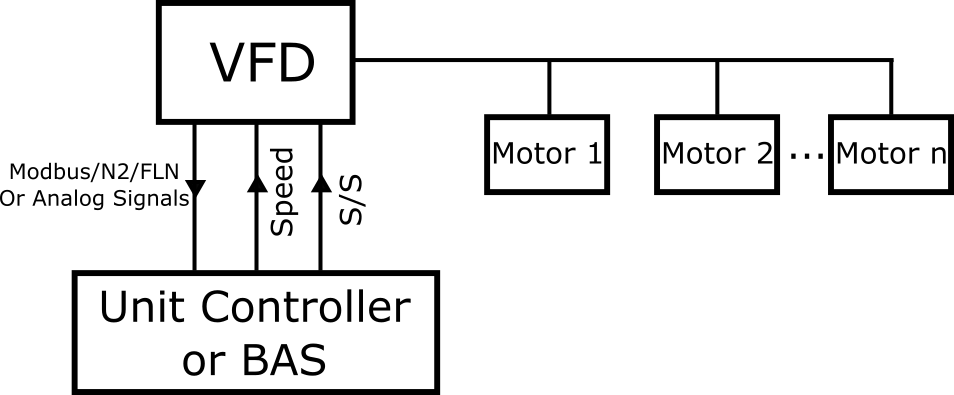
But for the aforementioned parameters to be useful in identifying HVAC system faults, the VFD needs to send the measured output to an external controller or a Building Automation System (BAS) through digital communication signals (BACNet, N2, Modbus, FLN, etc.) or analog output signals. There are two common configurations of connections between VFDs and the HVAC unit controller/ Building Automation System (BAS). In one configuration, a single VFD controls multiple HVAC motors, such as a pump motor, fan motor, or compressor motor, as shown to the right:
Through digital communications, the unit controller/BAS is able to monitor the operation of the HVAC motors and receive information about their operation (such as power consumption, speed, and torque). The controller then utilizes the received motor information and other system operations measurement readings (like real-time temperature, pressure, humidity, water flow rate, and airflow) to perform a Fault Detection and Diagnosis (FDD) analysis of the entire HVAC system.
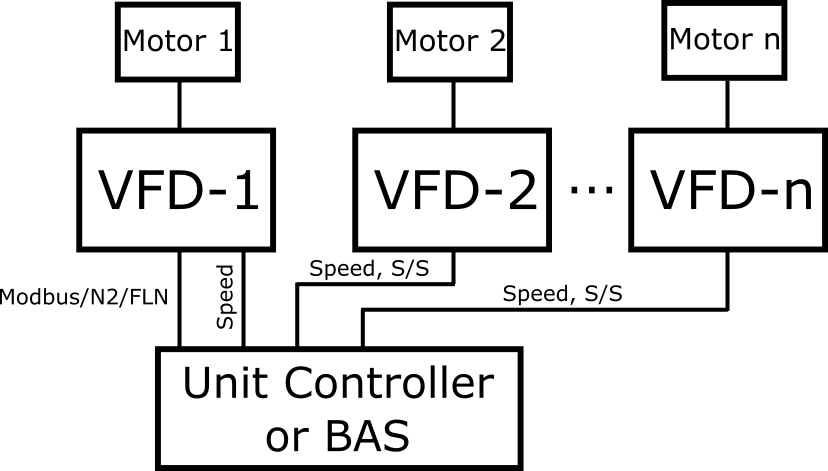
In the second configuration, each Variable Frequency Drive controls only one HVAC motor. In this case, the unit controller/BAS communicates with each VFD to perform a Fault Detection and Diagnosis (FDD) analysis of the HVAC system depending on the operating conditions of all connected HVAC motors. The second configuration is as shown below:
DO Supply Inc. makes no representations as to the completeness, validity, correctness, suitability, or accuracy of any information on this website and will not be liable for any delays, omissions, or errors in this information or any losses, injuries, or damages arising from its display or use. All the information on this website is provided on an "as-is" basis. It is the reader's responsibility to verify their own facts.