The Importance of Fieldbus in Industrial Automation
According to the study “Fieldbus Technology in Industrial Automation,” published by CiteSeerX, Fieldbus is “a type of communication protocol used in industrial control and automation systems. It provides a standardized method for transmitting data between control devices and control systems, enabling real-time control and monitoring of industrial processes.” (CiteSeerX, “Fieldbus Technology in Industrial Control and Automation Systems”).
Fieldbus technology is a widely used communication protocol in industrial settings that facilitates real-time control of manufacturing processes. It differs from traditional RS-232 serial connections as it operates within a network structure that accommodates multiple topologies, including star, bus, ring, mesh, and tree. The Fieldbus protocol enables multiple devices to connect simultaneously, thereby reducing the need for excessive cables and enhancing the overall connectivity efficiency. Another advantage of Fieldbus devices is the presence of a microprocessor that enables the execution of control algorithms, such as PID control, directly on the device side.
How Fieldbus Works
Fieldbus enables several field devices to communicate to a single point of connection, as opposed to just enabling communication via direct serial communications. To enable the distribution of information across the system, the single point of communication then links to the controller. In a Fieldbus, information is often sent via tiny packets that are sequentially broadcast and multiplexed over time.
In contrast to parallel transfers, this particular communication model essentially removes point-to-point linkages among all field devices and controllers, necessitating fewer connection lines. The creation of a single connection via which all information is transferred enables multiple devices to connect to one controller as opposed to just enabling two devices to communicate through each connection.
Common Fieldbus Types for Automation
Several communication protocols are commonly used in industrial control and automation systems. These protocols include INTERBUS, Foundation Fieldbus, Profibus, DeviceNet, and CAN.
A) Foundation Fieldbus
A controller may identify a wide range of setup and criterion information from plugged-in devices using the complex, object-oriented Foundation Fieldbus protocol, which employs numerous communications formats. A device may communicate Foundation Fieldbus characteristics that describe the estimated dependability of a certain piece of data. The delivery of messages is ensured by a scheduler in Foundation Fieldbus, thereby addressing the determinism and repeatability difficulties. The network consists of one scheduler for each section.
B) INTERBUS
The INTERBUS technology was created to enhance the productivity of machines and plants by transmitting process data while reducing costs. Now it has become a valid and reliable technology due to consistency in the IEC 61158 and IEC 61784. It features a unique transmission procedure and ring topology, offering fast and precise data, control of samples, and comprehensive diagnostic functions to decrease downtime through the use of fiber optics. These advantages, along with the cost-effective connections of devices like sensors and actuators, in contributing to the widespread adoption of the Fieldbus systems.
C) Profibus
It is a network that is designed to allow reliable communication between PLCs and computers. Given that it is prevalent in North America and South America and practically ubiquitous in Europe, it is the most frequently used international networking standard. It can meet the demands of massive installations while handling vast volumes of data quickly. Profibus supports master-slave and multi-master communication links, with cyclic or acyclic access, enabling transfer speeds of up to 500 kbps, based on the real-time capability asynchronous token bus idea. Although Profibus allows for numerous masters, there can only be one master per device output.
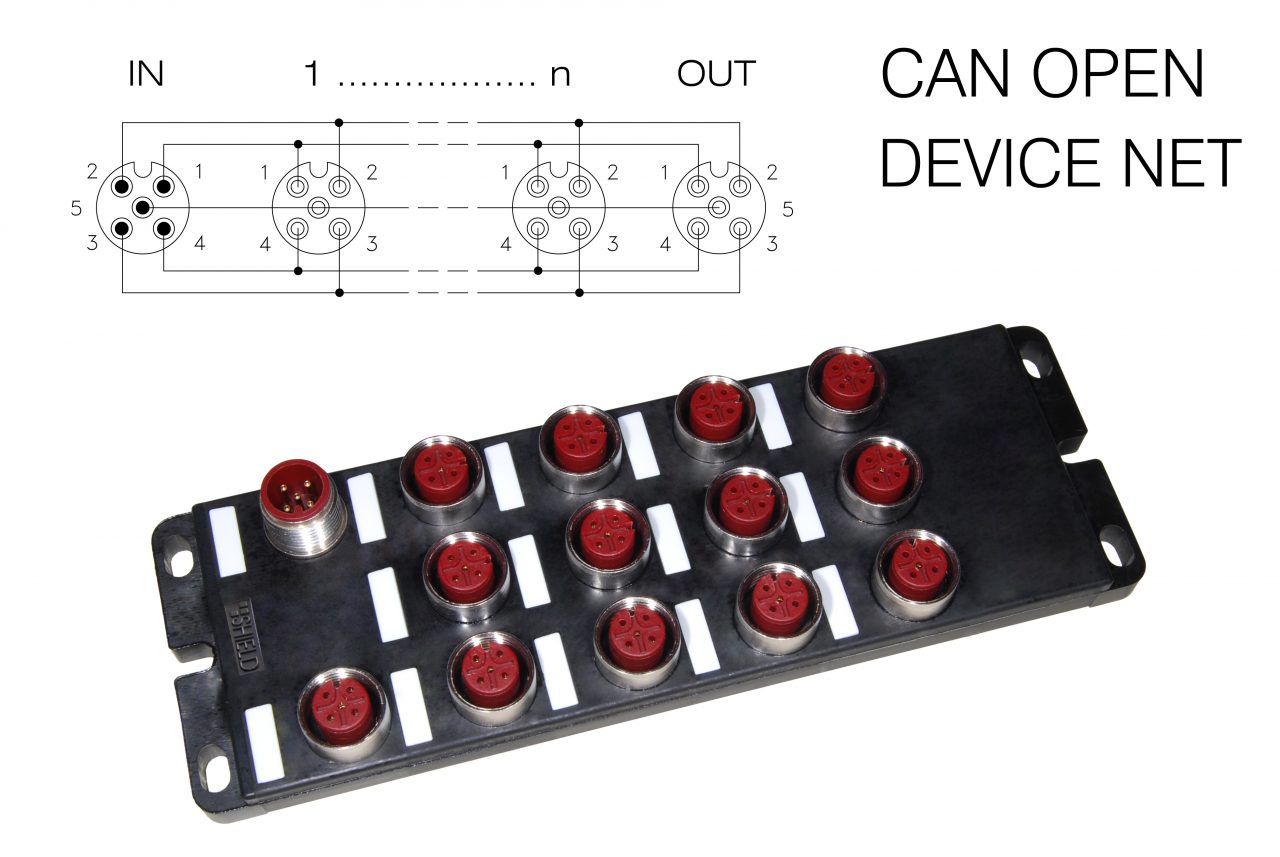
D) CAN (Controller Area Network)
CAN is a quick serial bus that’s intended to connect sensors and actuators in an effective, trustworthy, and affordable way. It can communicate with up to forty devices at 1 Mbps via a twisted pair wire. It was first created to simplify wiring in cars, but it is currently utilized in goods for machine and industrial automation. For synchronization, process data, network management, service data, time-stamping, and emergency signals, CAN offers standardized communication objects. The robust mechanical and electrical environment that an automobile present may be easily handled by the powerful fault detection and correction mechanisms of the Controller Area Network.
E) DeviceNet
DeviceNet is a variation of CAN that has been modified for vital manufacturing networking requirements. The “control” networks, such as ControlNet, are placed at the subsequent level. As the highest Fieldbus network, ControlNet was created with many high-performance automation and process control requirements in mind. The ability of devices to interact with one another with 100% determinism, while attaining quicker reaction times than conventional master/slave poll/strobe networks, is of utmost significance.
Fieldbus Network Topologies and Their Importance
Network topology is a concept that describes the arrangement of various nodes, devices, and connections within a network. It can be thought of as a map of the network, similar to how a city map shows the physical arrangement of streets and buildings. There are different techniques for arranging a network, each with its pros and cons, subject to the needs of the industry.
The two types of network topology are logical and physical. Logical network topology is a more theoretical and planned approach that focuses on understanding how the network is prepared and how will data travel through it. Physical network topology, on the other hand, states the actual physical links among nodes, in the network, such as different cables or wires.
Designing a local area network (LAN) topology is crucial for the success of your business. To ensure optimal performance, it is important to create a resilient, secure, and manageable network structure. There are various types of network topologies available, each suited for specific needs based on the size of the network and business goals. Keep in mind that there is no universally perfect solution. To assist you in determining the best fit, I will outline the most frequently used network topology definitions, highlighting the pros and cons of each.
Star Topologies
It is a most common type of network, where all nodes in the network are linked directly to a main hub through a twisted pair, coaxial, or optical fiber cable. This central hub serves to control the data communication, where information from a node on the network must go through the main hub to arrive at its destination. The main hub also acts as a repeater, preventing data loss.
Due to the ease of administering the whole network from one place, star topologies are favored. Since each node is individually connected to the main hub, the network can still operate even if one node fails. Additionally, it is possible to add, remove, or alter devices without putting the entire network offline.
The star topology employs less cabling in terms of physical structure, which makes it easy to configure as the network grows or shrinks. Administrators can see defects or performance problems more easily because of the straightforward network architecture.
Bus Topology
In the Bus topology, the devices on the network are aligned along a solo wire running in one direction from one point to the other. This is the reason that it is also known as a “backbone topology” or “line topology”. The direction of data flow on the network is the same as the cable’s travel.
Bus topologies are an economical solution for small networks as the layout is simple and the devices can connect through a solo coaxial or RJ45 cable. Adding nodes to the network is also easy by connecting more cables.
Ring Topology
In ring topology, many nodes are arranged in a circular pattern and data can flow in both directions. Each device in the network is connected to only two neighboring devices. The data travels through the ring network by moving across each midway node until it arrives at its destination. To prevent data loss in large networks, repeaters can be used. Since only one point on the network may send data at once, ring topologies are effective in sending data without mistakes. They are inexpensive, simple to configure, and have point-to-point communication, which makes it simple to spot problems.
Tree Topology
It is the tree topology which is structured like a tree with a central node acting as the trunk and other nodes connected linearly in a branch-like fashion. Unlike the star topology, the nodes in a tree topology have a mother-child relationship. Because of its adaptability and scalability, this topology is appropriate for helpfully with numerous dispersed devices. It combines aspects of the star and bus topologies and enables simple network growth. The ability to separately evaluate each branch for performance concerns makes mistake troubleshooting easier.
Mesh Topology
Mesh topology is much complex network structure in which nodes are joined to one another through point-to-point connections. Mesh topologies come in two forms: full mesh and partial mesh. In a full mesh, every single node is linked, but in a partial mesh, a few nodes have fewer connections than others. Two kinds of data transfer are made possible by the mesh topology’s web-like structure: routing and flooding. In flooding, data is transmitted to every node without using routing logic, whereas in routing, nodes employ logic to find the quickest route from the origin to the destination. Due to the intricate interconnectedness of nodes, mesh topologies are extremely dependable and stable, making the network immune to errors.
Hybrid Topology
In a hybrid topology, two or more distinct network architectures are combined, such as the bus topology and star topology in a tree topology. These are frequently observed in large organizations where departments each have their unique network topologies that are tailored to their requirements and usage. Hybrid topologies’ key benefit is flexibility since it allows for a wide range of network structures to be supported without any restrictions.
Fieldbus System Levels vs Complexity of Automation
To properly understand the fundamentals of a Fieldbus network and comprehend Fieldbus, one must first acknowledge the various levels of a Fieldbus system. A Fieldbus system may primarily be divided into four levels. These levels are” sensor bus network, device bus network, control bus network, and an enterprise bus network.” These are written according to their complexity. The lowest level is the first and the highest is the last.
1) Sensor Bus Networks
A sensor bus network is the most fundamental level. It is designed for industrial applications of a Fieldbus system. This level comprises numerous basic industrial devices connected to a single network connection, such as optical sensors or level limit switches. This level can provide output signals from the controller to alerts, indication lamps, or many other actuator devices through a single wire.
2) Device Bus Networks
It is the second level commonly called the “device bus network” which works similarly to the sensor bus network but on a wider scale. This level connects a variety of sensors and actuators as well as devices to speed drives and motor centers, allowing individual network pieces to be controlled.
3) Control Bus Networks
Control bus networks are much more complicated networks utilized on the production floor. Data transmission takes place at a high standard on this level. Among these networks, PLCs (programmable logic controllers) and digital instruments are coupled to (HIPs) human interface panels to provide comprehensive configuration and control of any instrument on the network.
4) Enterprise Bus Networks
The enterprise bus network is also called the information level network. It can connect all computers and divisions in the industry. This is the most complicated and extensive network level of a Fieldbus system. It is mostly computer-driven and entails mass data collecting, computer monitoring, and file transfers.
Benefits of Fieldbus
The Fieldbus technology has revolutionized the world of industrial communication by offering numerous benefits to industrial networks. Fieldbus technology refers to an industrial communication system that utilizes a digital signal to transmit data between control devices and sensors in an industrial environment. It offers several advantages over traditional parallel wiring configurations and has helped to simplify and optimize industrial networks.
Reduced Requirements for Cabling
One of the significant benefits of Fieldbus systems is reduced cabling requirements. In traditional parallel wiring configurations, a separate cable is required for each device connected to the network. This can result in many cables and can make the network quite complex and difficult to manage. Fieldbus systems, on the other hand, allow hundreds of devices to be connected to a single connection point and controller, which greatly reduces the number of cables required in the network. This not only simplifies the network but also makes it easier to manage, reducing the likelihood of cable-related issues and maintenance costs.
The length of the cables required in a Fieldbus system is also reduced, making the cabling process much easier. In traditional parallel wiring configurations, the cables can be quite long, which can result in signal degradation and interference. Fieldbus systems, on the other hand, use shorter cables, which reduces the risk of signal degradation and ensures the reliability of the network.
Lower Costs
Fieldbus technology offers several benefits to industrial control and monitoring systems, one of which is lower costs. By using a different topology and integrating control and input/output (I/O) functions, Fieldbus systems can significantly reduce the amount of cabling required in a network. This, in turn, leads to a reduction in the cost of setting up and running a network.
Instead of connecting each device in a network to a controller, Fieldbus technology allows devices to be connected in series which reduces the ongoing maintenance costs associated with repairing or replacing damaged cabling. Fieldbus devices often integrate both control and I/O functions, reducing the need for separate components and cables. Fieldbus systems can transmit data over long distances without the need for intermediate terminals, reducing the number of connections and cables required. This helps to reduce the complexity of the network, making it easier to set up and maintain. Fieldbus systems provide detailed diagnostics information, which can help to identify and correct wiring problems. This can reduce the need for additional wiring and cabling, further reducing the cost and complexity of the network.
Simplicity in Installation
Fieldbus systems are also appealing because they are much simple to install. Fieldbus systems contain much fewer wires than parallel wiring. As a result, developing, deploying, and coordinating a Fieldbus system often takes far less effort, resources, and time.
Better Reliability
Fieldbus systems in industrial automation are reliable when compared to parallel wiring. Because These systems have shorter signal paths, the system’s availability and dependability are enhanced. Furthermore, Fieldbus systems offer superior interference protection, which is notably noticeable with analog values.
DO Supply Inc. makes no representations as to the completeness, validity, correctness, suitability, or accuracy of any information on this website and will not be liable for any delays, omissions, or errors in this information or any losses, injuries, or damages arising from its display or use. All the information on this website is provided on an "as-is" basis. It is the reader's responsibility to verify their own facts.