The Role of Omron Robotics in Modern Manufacturing Environments
In recent years, industries have faced labor scarcity challenges; also, the globe has reached a tipping point in how the marketplace conducts business due to emerging health issues worldwide. Employees worldwide must maintain social distancing in production facilities, restrict business travel, and work remotely. Consequently, there is a rising need for more sophisticated automation using robots and a growing desire for digitalization. In the past, automated machinery for manufacturing facilities has been operated through various controllers, making it difficult to set up and regulate the timing and speed of numerous devices. Until recently, automating complex and complicated human functions was extremely hard. Furthermore, it wasn’t easy to validate a process architecture before it was implemented and with excellent accuracy before building equipment or a more extensive production line. Following the equipment’s commissioning, on-site adjustments become essential. These adjustments frequently entail revisiting specifications, resulting in a substantial increase in man-hours.
OMRON manufactures the motion robots, sensors, and safety equipment required to implement a fully robotic manufacturing line. The “Robotic Integrated Controller” is a system that tackles previously experienced industrial site issues. OMRON has overcome these concerns by incorporating control equipment effortlessly. The “two integrations” mentioned below will assist many clients in overcoming challenges at industrial sites.
OMRON Corporation, a significant automation corporation based on its unique Sensing & Control using Think technologies, is involved in various enterprises, comprising control devices, electronic parts, social systems, medical care, and environmental protection. OMRON, established in 1933, employs roughly 30,000 people globally, sells items, and serves over 120 nations and territories.
OMRON obtained Adept Technology Inc., a robotics company located in the United States, in October of 2015 as a subsection of OMRON’s advancement of its “Complete Automation Solution” approach for its Manufacturing Automation Business, which offers solutions for automation to the industrial markets. OMRON Automation and Safety Technologies was founded in 2019 to merge OMRON’s safety and robotics companies to deliver complete automation alongside safety solutions. The organization aims to contribute to creating a new industrial environment in which humans and robots may coexist peacefully.
This article aims to examine in depth the several contributions Omron Robotics makes to the development of contemporary industrial settings. Omron’s contributions have become crucial in improving manufacturing processes’ effectiveness, quality, and safety as we traverse the fourth industrial revolution. Through this investigation, we want to learn more about Omron Robotics’ transformational influence and how their technologies foster creativity, resolve problems, and accelerate industrial development. We will provide a thorough picture of Omron’s impact on contemporary manufacturing by looking at particular applications, technology, and success stories.
Robotics
Robots’ development, conception, construction, and usage are the concentration of the section of engineering referred to as robotics. Future robot technology is an autonomously controlled machine that finalizes duties ordinarily done by people by performing independent actions.
Although some do, robots generally don’t look like humans. Images of the production lines for vehicles might be used as proof. Machines with human-like characteristics are commonly referred to as “androids.” Even while robot designers strive to make their creations seem like humans so that society feels further at ease, it’s frequently not the situation. Robots may be unnerving to some individuals, especially ones that resemble humans.
Understanding Omron Robotics
Omron Corporation, founded in Kyoto, Japan, in 1933, is a globally renowned leader in automation and robotics. Their journey from medical equipment to automation giant is rooted in a dedication to innovative technology. Omron’s focus on automation is expansive, spanning manufacturing, healthcare, energy management, and more. Their goal is to improve society and streamline processes through automation.
Omron’s solutions include a wide variety of automation equipment, with a significant emphasis on tackling issues like mass customization, growing labor costs, and labor shortages. Their selection of robots includes Mobile, Collaborative, and Industrial models, each designed for a particular use. These robots, renowned for their dependability and accuracy, may be classified as SCARA, Parallel, Articulated, or Parallel Robots. They can easily adjust to challenging manufacturing demands and environmental factors.
Omron Robotics offers integrated vision systems for inspection, quality assurance, material handling, and robots. Omron’s software products, including ACE, Sysmac Studio, and Integrated Controller, make robot programming simple.
Their “cobots,” or collaborative robots, are designed to operate securely alongside human operators. These cobots are adaptable for applications because of characteristics like hand direction, sophisticated vision, and graphical programming.
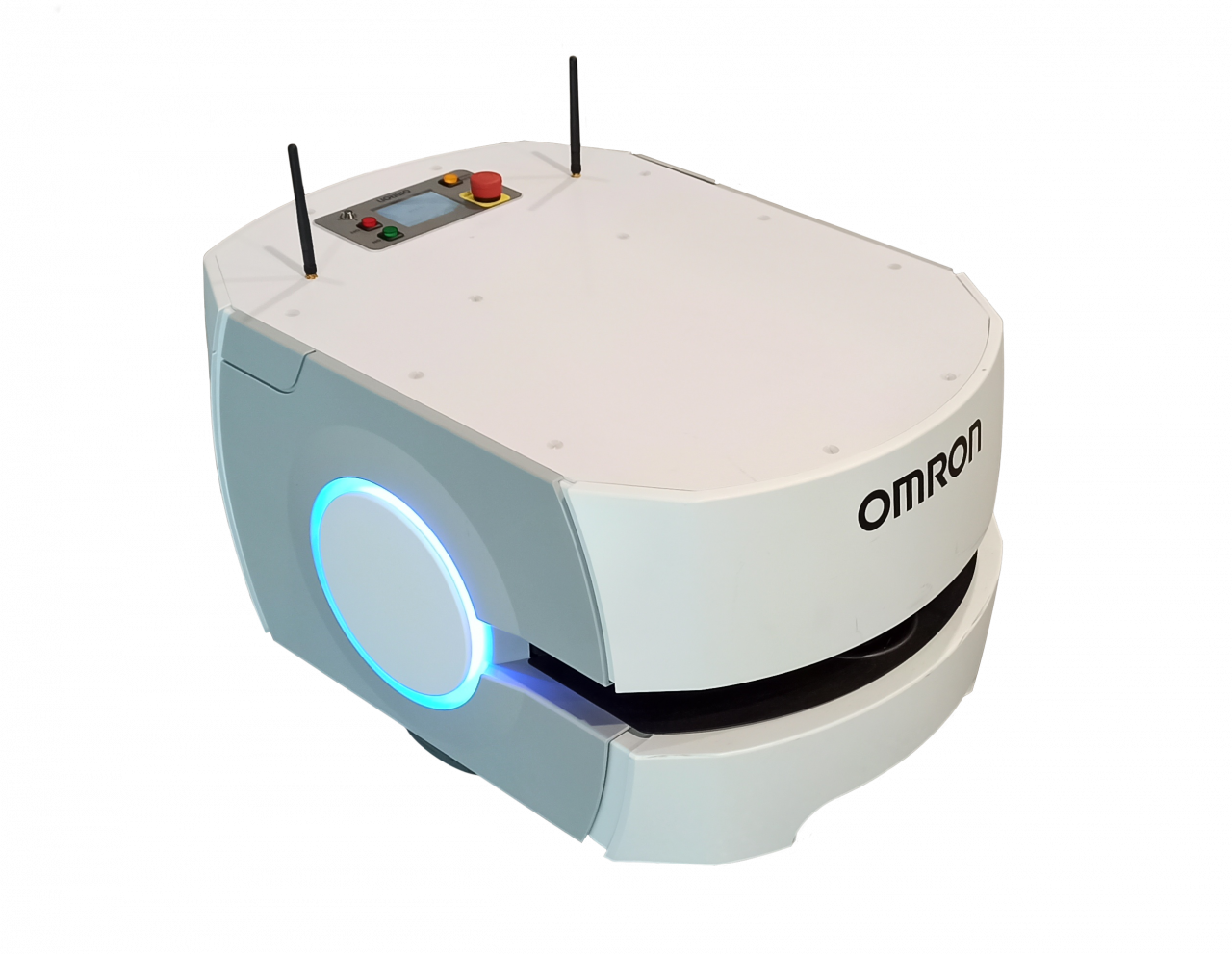
Mobile Robots from Omron are revolutionary because they provide an agile replacement for conventional conveyors and Automated Guided Vehicles (AGVs). Without the use of beacons, magnets, or predetermined pathways, they can travel on their own. These robots can securely interact with human workers and are simple to assemble. They also include cutting-edge sensors for obstacle identification and collision avoidance.
Omron provides the Fleet Manager driven by FLOW Core software for fleet management of up to 100 robots. This solution improves battery charging, job assignments, and traffic flow by boosting operational efficiency and flexibility while lowering programming complexity for robot tasks.
Omron Robotics in Manufacturing
Omron’s innovative integration of integrated control software, architecture, and robots addresses the challenges of modern factory automation. Omron’s current industrial, collaborative, and mobile robotics offerings help manufacturers meet production demands for today, tomorrow, and beyond, from applications that require a high volume and a broad range of products for those with shorter product lifespans that need quick production line alterations.
Today, Omron Robots find primary usage in manufacturing operations, with applications falling into these categories.
Handling and Transportation of Materials
Material handling and transportation applications include deployment and removal of machines and material transportation. Robotic assignments that include material shifting demand for the robots to transport goods or parts transfer from one location to another. Numerous of these duties need robotics to pick up components from a single conveyor and deposit them on the next. More difficult transfer tasks include, for example, putting components on pallets in a determined configuration. An automated system, robotics, is used when loading and unloading parts from production machinery. The following necessitates that the computerized device be tailored with a holding gripper. Usually, the gripper has to be distinctively designed for the shape of the individual component.
Processing Operations
Robots play a significant role in industrial production. The robot uses an instrument to process the work portion in robotic manufacturing activities. These applications include continuous welding using arcs, spray painting, and spot welding. Industrial robots are extensively used for spot welding in the US, particularly for vehicle bodies. The robot places a spot welder across the car frames and panels to finish assembling the bare vehicle body. Industrial robots move the welding rod alongside the edges to be joined in continuous arc welding. Spray painting entails moving a spray-painting nozzle across the entire surface of the target item. Other tasks in that group include polishing, grinding, and routing, where the robot’s tool is a revolving spindle.
Inspection and Assembling
Inspection and Assembly are the third deployment area for industrial robotics. Due to the high expense of physical labor, which is often used in these tasks, the usage of robotics in assembling will likely increase. Since robots can be automated, manufacturing various product designs in groups while reprogramming the robotic devices in between constitutes a specific assembly work practice. Manufacturing a variety of product patterns in an identical assembly cell provides an alternate method that requires every robotic device in that cell to recognize the product category as it reaches and then transmit the right tasks for a particular unit.
An essential component of robotic assembly is product design. Assembly approaches that are acceptable for humans are sometimes not appropriate for robotics. For instance, it is simple to use a nut and screw as a fastening mechanism during hand assembly, but a one-armed robot would have a very tough time doing the same task. Automation and robotic assembly are significantly more efficient in designs where components are added from a single direction with snap fits and quick fastening methods.
Inspection is another area of manufacturing activities where robotics is expanding. In an ordinary inspection task, a sensor is placed about the work component, and the robot assesses whenever the part complies with the quality requirements.
Almost all industrial robot applications use robots to replace human work. Industrial activities carried out by humans often have specific characteristics that make them suitable for robotic application:
- Repetitive operations consist of identical work motions during each cycle. This means that certain tasks in industrial production involve doing the same series of actions repeatedly and repeatedly.
- Operations are dangerous or uncomfortable for human labor, such as spray painting, arc welding, spot welding, and specific machine load and unloading work.
- The task necessitates using a cumbersome work component or tool. Robots are well-suited for such tasks because they can handle heavy loads with precision and without fatigue, reducing the risk of accidents or errors.
- The procedure enables the robotics to work two to three shifts. It’s more cost-effective and efficient to use robots. Robots can work around the clock in multiple shifts without needing breaks or rest, making them well-suited for processes that need 24/7 production.
What Effects Will Robotics Have on the World in the Future?
Robots will evolve from rote machines to collaborative partners with cognitive abilities due to superior sensor technology, machine learning, and AI advancements. These advancements are poised to enhance the competitiveness and potential for growth in robotics and related industries.
Robots are an integral part of our everyday lives, from the automation of car factories to the virtual assistants aiding us at home through conversational interfaces. Nevertheless, the question arises: will their influence extend to all aspects of our lives in the future?
Despite worries regarding an artificial intelligence (AI) takeover when technologies replace people as the dominant intellect on the globe, such a situation is implausible. By the middle of the 2030s, up to 30% of occupations might be substituted by robots, says the business network PwC.
According to predictions, 20 million robotic machinery could be in use globally by 2030, eliminating approximately 51 million employment opportunities. Their aim might not be world control, but we still foresee a rising influence of robotics in our everyday lives.
Future of Robotics Across Various Industries
The future of robotics across various industries is promising. In the technology sector, robots are advancing quickly, with automation becoming a key feature in electronics manufacturing. Customization is becoming standard. Manufacturing, an early adopter, is transitioning towards complete autonomy, from assembly to quality control, thanks to AI and IoT. The industrial sector is facing labor shortages, and automation in simple, repetitive tasks is the solution. Logistics benefits from robots in warehouses and autonomous vehicles for deliveries. In the military, robots are deployed in various roles. Travel sees robots speeding up processes, and entertainment utilizes robots for diverse purposes. Space exploration relies on robots for deep exploration. The hospitality industry benefits from robots for customer services, and the technology sector is rapidly adopting robots for manufacturing. The future of robotics promises transformative changes across various industries, enhancing efficiency, convenience, and innovation in our daily lives, from healthcare to space exploration.
Conclusion
In conclusion, Omron Robotics is at the forefront of shaping the modern manufacturing landscape. It offers innovative solutions that address the evolving challenges and demands of the industry. Omron Robotics has established itself as a key player in this transformation as we observe a paradigm shift in how businesses conduct their operations.
The industrial industry has transformed because of Omron’s dedication to providing complete automation solutions, supported by its integration of motion robots, sensors, and safety equipment. Their “Robotic Integrated Controller” technology effectively addresses enduring problems in industrial settings, making the integration of control equipment simple and providing a solid response to the difficulties encountered by producers.
Integrating Omron’s robotics and automation technology presents a powerful solution to enhance manufacturing efficiency, quality, and safety. This profoundly impacts various aspects of the industry, from material handling and processing to inspection and assembly, making it more efficient and cost-effective. Omron Robotics continues to drive innovation and progress in manufacturing.
The potential for robots in numerous sectors is quite promising in the future. Robotics is poised to tremendously impact our society, from the widespread use of robots in electronics production to the change of logistics, travel, and space exploration.
Omron’s dedication to excellence and innovation positions them as a key player in this evolving landscape, contributing to creating a new industrial environment where humans and robots coexist harmoniously. Omron Robotics is a leader in innovation as we traverse the fourth industrial revolution, providing solutions that boost productivity, spur creativity, and open the door to a future in contemporary manufacturing that is more automated and networked.
DO Supply Inc. makes no representations as to the completeness, validity, correctness, suitability, or accuracy of any information on this website and will not be liable for any delays, omissions, or errors in this information or any losses, injuries, or damages arising from its display or use. All the information on this website is provided on an "as-is" basis. It is the reader's responsibility to verify their own facts.