The Role of Fieldbus Technologies in Modern Industrial Automation
Fieldbus is a type of industrial network system used to connect field devices (e.g., sensors and actuators) and control devices on the factory floor, such as Programmable Logic Controllers (PLCs), drive controllers, industrial PCs, regulators, Human-Machine Interfaces (HMIs), etc.
It allows for real-time, two-way communications between the connected devices without connecting each field device back to a controller. This makes long-distance exchange of data and signals between different components of an automation system possible with Fieldbus networks even under high external loads.
How do Fieldbus Systems Function?
Fieldbus communication systems work on a network structure that generally allows star, daisy-chain, tree, ring, and bus/line network topologies. At the bottom-most level in the hierarchy of industrial networks, Fieldbus functions as a Local Area Network (LAN), connecting various field devices and field controllers used in process control and different industrial automation applications, like smart manufacturing, automated material handling, predictive maintenance, warehouse automation, and automated quality inspection(AQI).
Available Fieldbus Variants
There are so many IEC61158-approved Fieldbus standards used in modern-day industrial automation applications, including FOUNDATION Fieldbus, PROFIBUS, PROFINET, DeviceNet, ControlNet, MODBUS, EtherNet/IP, CC-Link Ethernet Powerlink, CANopen, Sercos Interface, EtherCAT, SmartWire-DT, VARAN, and CompoNet.
This is because manufacturers of industrial automation products develop proprietary Fieldbus technologies with varying features and functions to address the needs of their target customers best and gain a competitive edge on a technical level. Each Fieldbus variant has its own merits and drawbacks, making it suitable for specific applications.
Role of Fieldbus Technologies in Industrial Automation
In a classic industrial automation system, Fieldbus technologies are used to connect physical, process-controlling field-level devices like thermostats, proximity switches, relay coils, sensors, valves, actuators, & other Input/Output modules to control-level devices, such as process controllers (e.g., PLCs and PACs), RTUs (Remote Terminal Units), CNC machines, and HMIs. These technologies facilitate the timely and effective data exchange between the automation, as mentioned earlier, system components, enabling real-time monitoring and distributed control of automated industrial processes.
Inherently, real-time communications enhance the efficacy of the process being controlled by minimizing errors and downtime. As such, deterministic Fieldbus networks can enable efficient, error-free, and reliable control of industrial processes, resulting in increased productivity, reduced downtime, and improved quality control. It is worth noting that you can use Fieldbus technologies in diverse industrial automation systems to control a wide array of process variables, including speed, flow, temperature, level, and pressure.
Why Use Fieldbus Technologies in Industrial Automation?
Let’s look at the major motivations for using Fieldbus technologies in modern industrial automation.
Interoperability
Fieldbus technology was primarily developed to provide an industry-standard, allowing seamless connectivity and data exchange among field devices from different vendors for easier configurability and interoperability. This has been achieved, as the Fieldbus technologies available today support multiple communication protocols. Therefore, you can connect various industrial automation products to a compatible Fieldbus network, regardless of their manufacturer, i.e., you don’t have to use products from one manufacturer/vendor to establish a simple Fieldbus connection.
Reduced Wiring Costs
Fieldbus network systems normally require less electrical wiring than traditional discrete and analog communication systems, which require a separate communication cable to run between each field device and the controller. With Fieldbus, field devices and controllers can be daisy-chained or connected in series using a single cable, i.e., in a Fieldbus network, all sensors in the same location can be connected to the same node or cable. This means that a single Fieldbus communication channel can be configured to transmit multiple digital signals, thereby reducing the amount of communication cables required.
Before the introduction of Fieldbus, industrial controllers would connect to field devices using direct serial connections (like RS-232), allowing only two field devices to communicate per connection. However, Fieldbus allows numerous (hundreds) of digital and analog field-level I/O devices to be connected simultaneously to a single communication point at the controller level. This reduces the number and length of communication cables required to set up a typical Fieldbus network system.
Extensive Field Information
Fieldbus technologies allow high-bandwidth, two-way digital communications, with each connected field device providing the specific type of information required by a particular control system. For this reason, Fieldbus-connected devices can transmit more information than just process variables, including operational information, averages, processed data, maxima, minima, and diagnostic information (e.g., plausibility checks, operating hours, process & electronic temperature, and status bytes).
Advanced Diagnostic and Troubleshooting
Compared to conventional wired communication systems, Fieldbus networks provide cutting-edge diagnostic and troubleshooting capabilities. They also allow for data logging, remote configuration, and real-time monitoring of connected devices, making it easier to identify and resolve technical issues promptly and effectively.
Flexible Control Implementations
Present-day Fieldbus technologies allow multiple field-level I/O modules to be connected to a single industrial network, and they feature an inherent capability to distribute process control across the network. This facilitates real-time monitoring and automated control of various industrial processes.
For example, you can connect several valve stacks straight into your Industrial Ethernet network using a Fieldbus system and then onto your central controller. This means you don’t need to connect each of your valve stacks individually to a PAC (Programmable Automation Controller) or PLC. This enables more effective communication and better coordination between different field devices and industrial equipment, which can increase efficiency and productivity in your industrial company.
In addition, various Fieldbus technologies like FOUNDATION Fieldbus allow the control functionality to reside in connected field devices such as analyzers, logic solvers, and transmitters instead of centralized in a controller. They also support other process operations, diagnostics, and maintenance functions within the connected field devices. As a result, the majority of Fieldbus-connected devices can implement most of the control functions that a conventional distributed control system (DCS) would execute.
Moreover, almost all Fieldbus variants allow the installation of field devices in remote locations away from the main industrial facility, enabling more adaptable industrial automation system designs.
Popular Fieldbus Technologies in Industrial Automation
Below are some of the most broadly used Fieldbus variants in modern-day industrial automation applications.
Controller Area Network (CAN)
Controller Area Network is a highly integrated serial bus system that uses message-based communication protocols to network intelligent devices (like microcontrollers) for real-time control applications. It is known for its robustness and ability to provide high-speed communications, making it ideal for extreme industrial environments.
CAN was primarily designed to allow Electronic Control Units (ECUs) or microcontroller units found in today’s motor vehicle autonomous control systems, such as engine control, airbags, window motors, and anti-lock braking systems, to exchange essential control data with each other in a reliable, priority-driven manner. Nevertheless, it can also be used in other similar applications, but it’s not appropriate for automation systems with significant electrical noise levels or requiring long cable lengths.
Modbus
Modbus is a request/response Fieldbus protocol implemented using a master-slave communication model. It was originally developed in 1979 by Modicon Inc. for use with their Programmable Logic Controllers. Today, Modbus is a widely adopted protocol used to establish client-server communications between intelligent industrial devices for process automation.
In essence, Modbus is a simple, open, and dependable protocol that supports Ethernet and serial communications. It also enables the connection of several automation devices to a single industrial network, which makes it ideal for straightforward industrial automation applications. In addition, as an open communication protocol, Modbus can be easily integrated with other network systems, making it suitable for retrofitting existing automation systems.
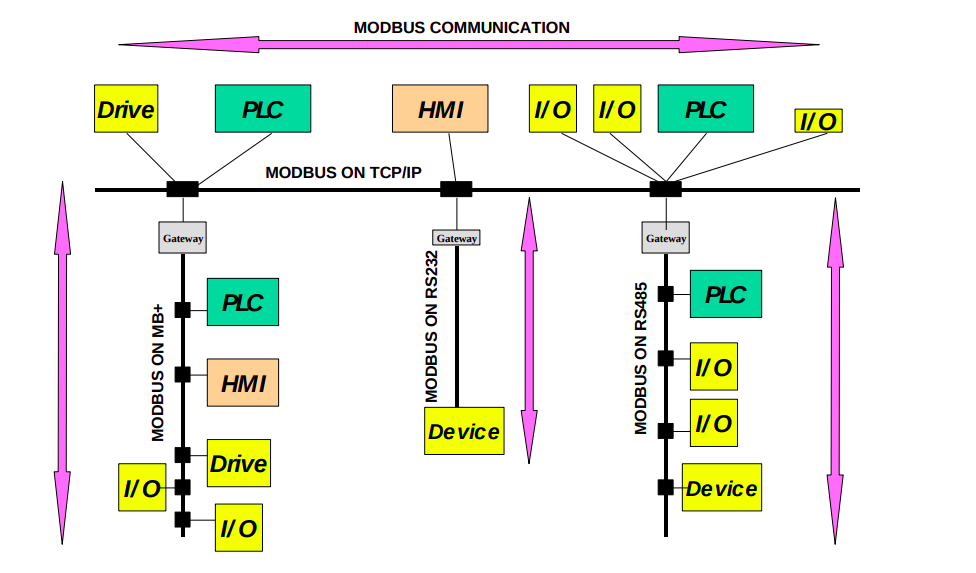
However, Modbus is not appropriate for large-sized automation systems or high-speed communication as it’s a relatively slow Fieldbus protocol that can only handle a maximum of 255 slave nodes on an industrial Ethernet network or up to 247 slave nodes on a serial network.
To configure a Modbus communication system, the user must specify the requisite data types, device addresses, and communication parameters like stop bits, parity, and baud rate. Meaning it’s easy to install and maintain.
ControlNet
ControlNet is an open industrial Fieldbus network that implements the Common Industrial Protocol (CIP™) at its upper layers of the Open Systems Interconnection (OSI) model, which are the Application, Presentation, and Session layers. This technology was originally developed in 1995 by Rockwell Automation, Inc., who later transferred its management to ControlNet International™, and it’s now managed by ODVA (Open DeviceNet Vendors Association).
ControlNet uses the producer/consumer communication model to provide reliable, high speed, high throughput communication between automation devices that exchange time-critical application-specific information in a predictable and deterministic manner. Some industrial devices that can communicate using ControlNet include PLCs, robots, HMIs, Variable Frequency Drives (VFDs), industrial PCs, and I/O chassis.
ControlNet is typically ideal for scheduled communications, high-speed control, and real-time I/O data transfer in complex industrial automation systems with large data requirements, such as machine vision systems, robotics, motion sensing and control, coordinated drive systems, weld control, process control, IIoT (Industrial Internet of Things) control, and complex batch control systems. It is also widely used in redundant automation systems to ensure the high availability of mission-critical I/O and messaging data.
DeviceNet
DeviceNet is a digital, application-level Fieldbus protocol used to connect simple I/O devices like level sensors, solenoid valves, flow meters, temperature sensors, motor starters, and relay coils used in industrial automation systems with higher-level industrial controllers such as PLCs and PACs.
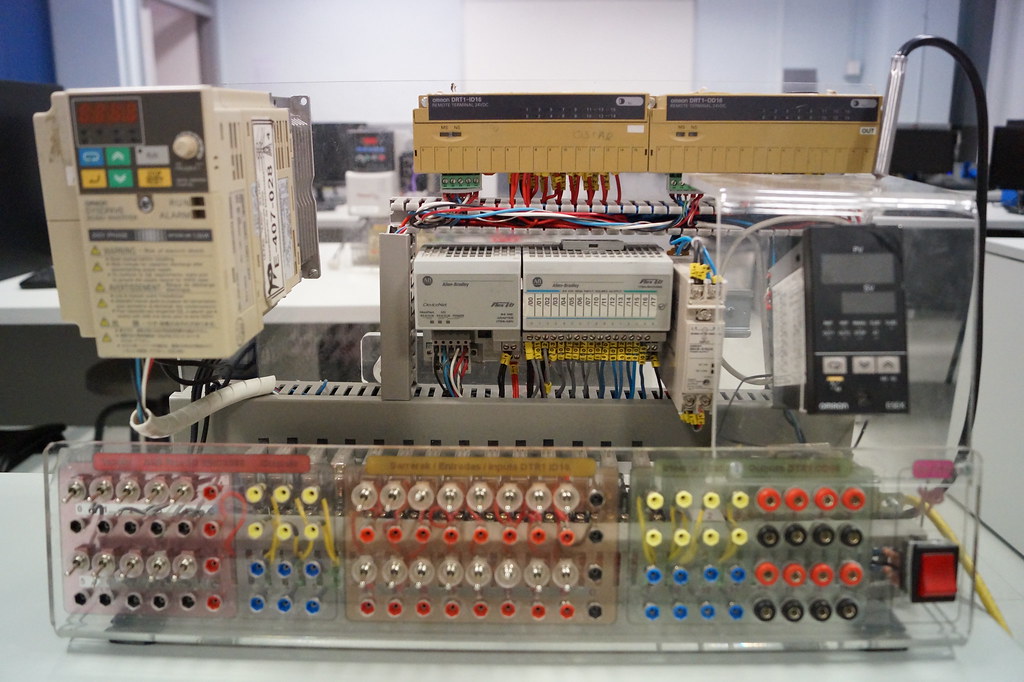
It employs a master-slave configuration to enable industrial controllers to communicate with the connected I/O devices in real time, providing users with a cost-effective Fieldbus network for real-time distributed control of industrial processes. DeviceNet is well suited for industrial automation applications requiring high reliability and where compatibility is of prime importance as it offers multi-vendor support.
EtherNet/IP
Ethernet/IP is a Fieldbus protocol that adapts the Common Industrial Protocol (CIP™) to traditional Ethernet technology. It’s a flexible, high-speed Ethernet-based industrial network protocol that enables communication with compatible automation devices. It uses a client-server communication model, where a higher-level device like a programmable controller functions as the client –sending data requests to servers– while other devices (like sensors, drives, and actuators) act as servers–sending the requested data back to the controller.
EtherNet/IP combines Common Industrial Protocol with prominent Ethernet standards like the IEEE 802.3 and Transmission Control Protocol/Internet Protocol (TCP/IP) suite forOSI’s physical, data link, and transport layers. It also leverages the User Data Protocol (UDP) networking standard for conveying I/O messages.
CIP is a consistent framework that defines how data is organized and shared in industrial devices for automation. It features an object-oriented design that ensures connected devices can interpret the exchanged data and understand each other’s messages. CIP also includes a comprehensive suite of network services such as file transfer and standard automation functions (e.g., position feedback, HMI, digital and analog I/O modules, and motion control) to support a wide variety of industrial automation applications.
Essentially, Ethernet/IP is specifically custom-built for industrial automation applications. It incorporates features such as high-speed data transfer, multicast support, high adaptability, and seamless integration with other Industrial Ethernet protocols, which make it ideal for complex industrial processes requiring reliable and efficient communication between deployed automation devices.
Nonetheless, EtherNet/IP is unsuitable for industrial automation applications requiring deterministic, hard real-time data communications. This is because Ethernet technology, as defined in the IEEE 802.3 protocol, is non-deterministic due to its MAC (Media Access Control) protocol based on CSMA/CD (Carrier Sense Multiple Access/ Collision Detection). The CSMA/CD backoff algorithm for handling collisions prevents the Ethernet network from supporting hard real-time data transmission as it introduces random delays and allows for the likelihood of transmission failures.
PROFIBUS
PROFIBUS (or Process Field Bus) is an open, digital Fieldbus standard designed to enable communication between field I/O devices (like sensors, encoders, and actuators) and system controllers (such as industrial PCs, PACs, and PLCs) in industrial facilities. It employs a master/slave communication model where the central controller is always the master– exercising unidirectional control over all its slave nodes–. In contrast, the field I/O devices are always the slaves.
PROFIBUS has a reputation for high adaptability and high-speed communication. Hence, it’s appropriate for complex communication tasks and time-critical industrial applications. It is the most popular Fieldbus technology for motion, factory automation, industrial processes, and safety control.
PROFIBUS technology is available in two different variants, namely:
- PROFIBUS DP(Decentralized Periphery): Rather than having every I/O device in the field or on the factory floor connected directly to the central controller via extensive electrical cabling, PROFIBUS DP decentralizes such I/O connections and brings them to the production floor. It’s particularly designed for high-speed data transmission (from 9.6 kbps to 12 Mbps) between system controllers and the distributed I/O at the field level. This makes it the most appropriate Fieldbus protocol for use in factory automation.
- PROFIBUS PA(Process Automation): This PROFIBUS variant offers only slower data transmission rates of 31.25 kbps, ideal for process automation. It’s also suitable for connecting devices in hazardous or explosive industrial environments because it can limit electric power flow to field I/O connections.
- PROFINET (or Profibus over Ethernet)
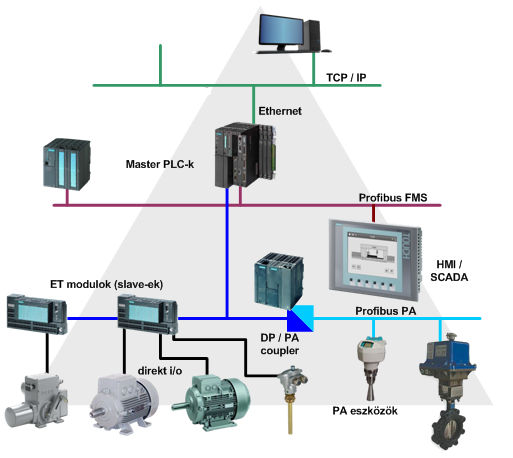
PROFINET is an Ethernet-based Fieldbus protocol that provides decentralized I/O connections and enables data exchange between system controllers and field I/O devices over Industrial Ethernet. It is most often implemented with standard automation system hardware and is typically faster than EtherNet/IP.
PROFINET communication cables (two-pair Cat5 or industrial Cat5) are a subset of Industrial Ethernet cables specially designed for heavy-duty industrial automation applications. These cables also allow for significantly higher data transmission speeds of 1 Gbps or even more, making PROFINET appropriate for:
- Process automation in oil and gas, pharmaceuticals, chemical processing, logistics, and mining industries.
- Factory automation in food and beverage processing, water treatment plants, automobile manufacturing, textile manufacturing, electronics manufacturing, etc.
- Motion control in robotics, automated material handling systems, wood and glass cutting machines, printing equipment, packaging machines, etc.
Selection Criteria
From the discussion in the above section, we can conclude that great functional differences and incompatibilities exist among the wide range of available Fieldbus variants. This can restrict the interoperability of Fieldbus-connected devices in an automation system. It is, therefore, important to select a Fieldbus technology that will best meet the needs of your industrial automation application.
Some of the key factors that should be considered when selecting a Fieldbus variant for a particular application include the following:
- Allowable Length of Transmission: The selected Fieldbus technology should provide a communication cable that can reach all the field devices and controllers in your industrial automation system without compromising the integrity of the transmitted data signals.
- Communication Speed: Select a Fieldbus variant whose specified data transfer rate can support the communication speed required by your application.
- Electrical Noise Immunity: For automation applications inside industrial facilities, be sure to select a Fieldbus network system with robust electrical noise immunity specifications, like good EMC (Electromagnetic Compatibility) performance and high CMRR (Common-Mode Rejection Ratio). Such a system can significantly suppress electromagnetic interference and function properly even in electrically noisy industrial environments.
- Ease of Integration: Select a Fieldbus protocol that seamlessly integrates with other industrial network systems for process automation.
- Reliability: For mission-critical automation systems that require high availability, select a highly reliable Fieldbus technology with an in-built capability to recover quickly in the event of network issues, such as latency, bandwidth saturation, and packet loss.
- Scalability: A good Fieldbus technology should have the capacity to support additional nodes to meet future needs for system expansion without compromising its functionality, performance, or reliability.
DO Supply Inc. makes no representations as to the completeness, validity, correctness, suitability, or accuracy of any information on this website and will not be liable for any delays, omissions, or errors in this information or any losses, injuries, or damages arising from its display or use. All the information on this website is provided on an "as-is" basis. It is the reader's responsibility to verify their own facts.