PowerFlex 4 vs PowerFlex 40: Choosing the Right VFD for Your Needs

In today’s fast-paced industrial environment, optimizing motor control can make all the difference in efficiency and performance. Whether upgrading existing equipment or designing a new system, adding an appropriate variable frequency drive (VFD) is crucial for performance optimization and efficiency enhancements.
Rockwell Automation’s PowerFlex 4 and PowerFlex 40 are excellent choices for powerful motor speed control in a compact design. This article dives into the nitty-gritty of these two models, comparing their strengths and differences to help you make an informed decision.
Let’s discover which VFD will give your operations the edge they need.
Comparing Input Specifications
Both drives share similar input specifications for single-phase voltage inputs of 100…120V and 200…240V and three-phase voltage inputs of 200…240V and 380…480V. However, the PowerFlex 40 has an additional class of three-phase voltage input of 480…600V.
Aside from this difference, the input frequency range for both drives is between 47 Hz and 63 Hz. Both drives also offer logic control ride-through greater than 0.5 (typically 2 seconds). The voltage is adjustable from 0V to the rated motor voltage, and both drives can handle intermittent current of 150% for 60 seconds.
This presents that for similar inputs, the PowerFlex 40 can cater to applications requiring input within the 480…600V range.
Enclosure Types and Operating Temperature Range
Both PowerFlex 4 and PowerFlex 40 offer enclosures rated as Open Type/IP20 (suitable for operating temperatures ranging from -10 to 50 °C with specified distance between drives or -10 to 40 °C when zero-stacked) and NEMA/UL Type 1/IP30 enclosures with optional conduit box kits (suitable for temperatures between -10 and 40 °C).
However, the PowerFlex 40 also provides NEMA/UL Type 4X/12/IP66 enclosures. Except for this, both drives feature the flange mount option (the front is rated at IP20, and the back/heatsink is rated at IP40/54/65).
PowerFlex 40’s better applicability to higher frequency application
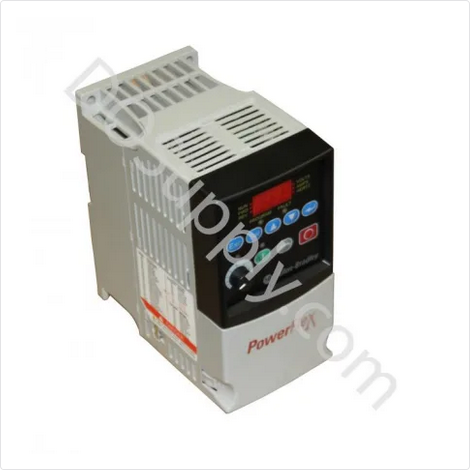
One of the significant differences between the PowerFlex 4 and PowerFlex40 is their frequency range. The PowerFlex 4 operates within a range of 0 to 240Hz, while the PowerFlex 40 can operate at frequencies up to 400Hz. This makes the PowerFlex 40 more versatile for applications requiring higher frequencies.
Expanded Control I/Os in PowerFlex 40
The PowerFlex 4 comes equipped with a 24V sink or source control, three inputs dedicated to start, stop, and reverse functions, and two inputs programmable for functions such as preset speed and jog. It also offers a 0…10V and 4…20 mA analog input with a programmable form C relay output.
In comparison, the PowerFlex 40 has four programmable inputs instead of two (for functions like speed and preset). The drive also has ±10V input and one analog output (0…10V or 4…20 mA). It comes with two programmable opto outputs and a programmable form C relay output, giving it more control I/O options than the PowerFlex 4.
Motor Control: PowerFlex 4 vs. PowerFlex 40
The PowerFlex 4 employs Volts/Hertz control, which is suitable for basic control applications. On the other hand, the PowerFlex 40 offers both Voltz/Hertz and sensorless vector control. Sensorless vector control is better suited to applications demanding precise control as it provides better speed regulation and torque production at low speeds. This makes PowerFlex 40 a better choice for more diverse applications than PowerFlex 4.
Differences in Power Ratings
PowerFlex 4 AC Drives:
- Input Voltage Class: 100…120V (1Ø)
- Output Voltage Class: 0…230V (3Ø)
- A Frame Rating: 0.2…0.37 kW (0.25…0.5 Hp)
- B Frame Rating: 0.75…1.1 kW (1…1.5 Hp)
- Input Voltage Class: 200…240V (1Ø)
- Output Voltage Class: 0…230V (3Ø)
- A Frame Rating: 0.2…0.75 kW (0.25…1 Hp)
- 1.5…2.2 kW (2…3 Hp)
- Input Voltage Class: 200…240V (3Ø)
- Output Voltage Class: 0…230V (3Ø)
- A Frame Rating: 0.2…1.5 kW (0.25…2 Hp)
- B Frame Rating: 2.2…3.7 kW (3…5 Hp)
- Input Voltage Class: 380…480V (3Ø)
- Output Voltage Class: 0…460V (3Ø)
- A Frame Rating: 0.37…1.5 kW (0.5…2 Hp)
- B Frame Rating: 2.2…3.7 kW (3…5 Hp)
PowerFlex 40 AC Drives:
- Input Voltage Class: 100…120V (1Ø)
- Output Voltage Class: 0…230V (3Ø)
- B Frame Rating: 0.4…1.1 kW (0.5…1.5 Hp)
- Input Voltage Class: 200…240V (1Ø)
- Output Voltage Class: 0…230V (3Ø)
- B Frame Rating: 0.4…1.5 kW (0.5…2 Hp)
- C Frame Rating: 2.2 kW (3 Hp)
- Input Voltage Class: 200…240V (3Ø)
- Output Voltage Class: 0…230V (3Ø)
- B Frame Rating: 0.4…3.7 kW (0.5…5 Hp)
- C Frame Rating: 5.5…7.5 kW (7.5…10 Hp)
- Input Voltage Class: 380…480V (3Ø)
- Output Voltage Class: 0…460V (3Ø)
- B Frame Rating: 0.4…4.0 kW (0.5…5 Hp)
- C Frame Rating: 5.5…11 kW (7.5…15 Hp)
- Input Voltage Class: 480…600V (3Ø)
- Output Voltage Class: 0…575V (3Ø)
- B Frame Rating: 0.75…4.0 kW (1…5 Hp)
- C Frame Rating: 5.5…11 kW (7.5…15 Hp)
The PowerFlex 4 covers input voltage classes from 1Ø 100…120V to 3Ø 380…480V, with output voltage classes from 0…230V to 0…460V. Its power ratings range from 0.2 kW to 3.7 kW, depending on the voltage class and frame size.
The PowerFlex 40 offers a wider range of input voltage classes, including 3Ø 480…600V, and output voltage classes from 0…230V to 0…575V. Its power ratings range from 0.4 kW to 11 kW, making it a better choice for applications requiring higher horsepower.
Communication Support and Integration
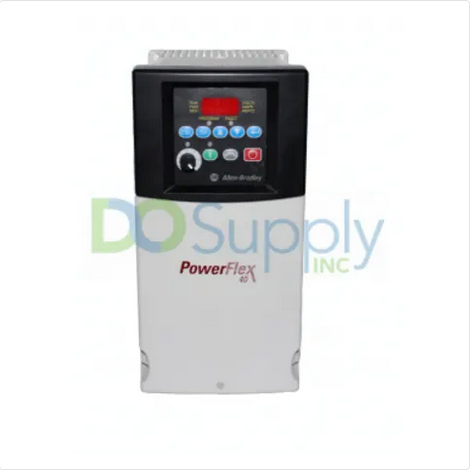
Integral RS485 communication with Modbus RTU/DSI is featured in the PowerFlex 4 and PowerFlex 40. However, the PowerFlex 40 integrates more seamlessly with optional networks, including DeviceNet, LonWorks, EtherNet/IP, BACnet, PROFIBUS DP, Bluetooth, and ControlNet.
While the PowerFlex 4 can also support similar optional networks, it requires an external DSI communications kit for integration. This makes the PowerFlex 40 more straightforward to integrate into modern communication networks.
Additional Features: What Sets Them Apart
The PowerFlex 4 includes a flying start feature, which allows the drive to start into a spinning motor. In contrast, the PowerFlex 40 has more advanced features, such as sensorless vector control, process PID, StepLogic functions (relay and timer), and compatibility with PTC inputs. These additional features make the PowerFlex 40 more versatile and suitable for complex control applications.
Shared Features of PowerFlex 4 and PowerFlex 40
The PowerFlex 4 and PowerFlex 40 share several common features, ensuring they meet industry standards and provide reliable performance:
- Standards Compliance: UL, C-Tick, CE, EMC EN61800-3, low voltage EN60204-1/EN50178
- Electrical Protection: Maximum short circuit rating of 100,000 Amps symmetrical
- Electronic Motor Overload Protection: I2 t protection – 150% for 60 seconds, 200% for 3 seconds (Class 10 protection)
- Carrier Frequency: 2-16 kHz, with drive rating based on 4 kHz
- Frequency Accuracy: Digital input within ±0.05% of set frequency, analog input within ±0.5% of maximum output frequency
- Application: Open-loop speed regulation
- Interface: An integral keypad with 4 digits, 10 LED indicators with a local potentiometer, and optional remote human interface modules (HIM). However, the IP66 version of the PowerFlex 40 does not include a local potentiometer.
- Dynamic Braking: 7th IGBT for dynamic braking on all ratings (except for the PowerFlex 40 drives without brakes)
Conclusion
The choice between PowerFlex 4 and PowerFlex is subjective to the requirements of your applications. However, it can be summarized that PowerFlex 4 is a more cost-effective solution for basic applications in terms of I/O, control, and power ratings. In contrast, the PowerFlex 40 offers a broader frequency range, high power ratings, and more advanced control features and environmental protection options. This makes the PowerFlex 40 drives a superior choice for applications of higher precision requirements, and greater flexibility.
DO Supply Inc. makes no representations as to the completeness, validity, correctness, suitability, or accuracy of any information on this website and will not be liable for any delays, omissions, or errors in this information or any losses, injuries, or damages arising from its display or use. All the information on this website is provided on an "as-is" basis. It is the reader's responsibility to verify their own facts.