SMC Plus vs. SMC 2: Which Soft Starter is Right for Your Needs?
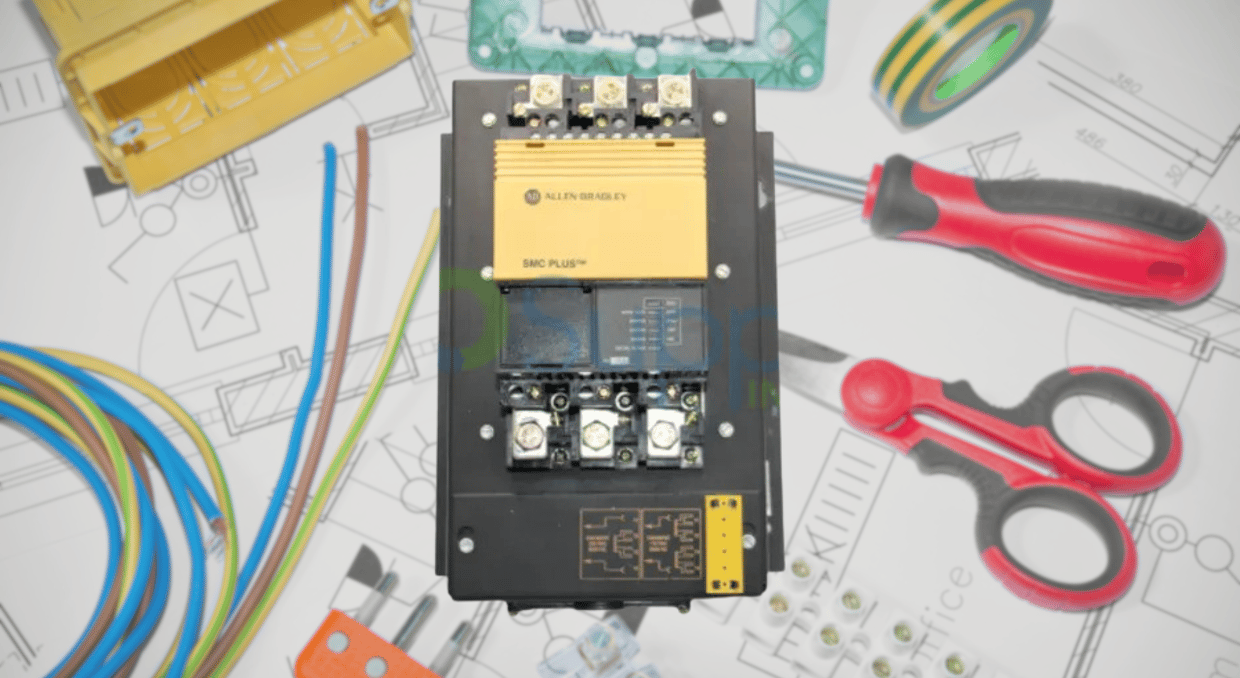
Allen-Bradley Smart Motor Controllers (SMCs) are designed to streamline the acceleration and deceleration of three-phase AC induction motors. By managing motor starts and stops with precision, they minimize mechanical stress and optimize efficiency. These solid-state, microprocessor-controlled soft starters excel in industrial environments, handling demanding applications like pumps, mills, compressors, and conveyors. This article provides a detailed comparison of two major Allen-Bradley SMC controller offerings, the SMC-2 and SMC PLUS controller series.
SMC-2 Controllers
The Allen-BradleySMC-2 controller line offers a range of compact, versatile, and multi-functional solid-state controllers designed to provide high-performance control for standard 3-phase squirrel cage AC induction motors and resistive loads such as electric furnaces, ovens, and heaters. These controllers are also easy to install and configure.
SMC-2 motor controllers are available in eight ampere ratings: 97, 68, 54, 35, 24, 16, 9, and 5 Amps, and in three operating voltage ranges: 200 to 240V AC, 380 to 480V AC, and 500 to 600V AC, at 60/50 Hz input frequency. This makes them suitable for motor control applications rated up to 55 kW (75 Hp). The controllers are also CSA Certified, CE Marked, and UL Listed.
Modes of Operation
Each SMC-2 motor controller is available with three starting modes as standard. The modes are:
- Soft Starting: In this mode of operation, a variable initial torque setting is applied to the connected induction motor. The setting can be varied from 0 to 70% of the motor’s locked-rotor torque. The SMC-2 controller then gradually increases the motor voltage to full voltage during the acceleration ramp period of 2.0 to 30.0 seconds.
- Full Voltage Starting: This starting mode allows users to set the acceleration ramp time to below 1/10 second. It’s suitable for motor control applications that demand across-the-line starting.
- Current Limit Starting: It is used to control the maximum amount of required starting current. When enabled, users can vary the level of the starting/inrush current limit from 25 to 550% of rated full-load motor current, and the starting time for the specified current limit to a definite value. If the motor hasn’t reached full speed by the end of the programmed current limit start time, the SMC-2 controller will switch the motor voltage to full voltage.
Interface Options
Standard SMC-2 motor controllers are operated through an external device. As a result, they come with an optional interface module to facilitate the external connection. The interface option provides the following features:
- Soft Stop Option: This feature extends the motor’s stopping period to prevent the connected load from spilling or shifting during stopping. It’s ideal for applications that need a stretched-out coast-to-rest. When the Soft Stop function is enabled, the voltage ramp-down timing can be adjusted from 5.0 to 110.0 seconds, as the motor stopping and starting times are independently adjustable. The connected load stops when the motor voltage decreases to an extent that the load torque is higher than the motor’s output torque.
- A Configurable Auxiliary Contact: This auxiliary contact functions as either an up-to-speed or instantaneous contact, thereby providing a wide selection of motor control schemes.
- Local ON/OFF Control: The interface option provides the connected SMC-2 motor controller with direct ON/OFF control via an external pilot device, eliminating the need for an extra contactor. This helps reduce control panel space requirements.
Controller Configurations
An Allen-Bradley SMC-2 motor controller can be set up in two different configurations:
- As a Series Controller: SMC-2 motor controllers are designed to operate in a series connection with conventional electromechanical motor starters. The series configuration offers the following benefits:
- Easy controller set-up with available digital adjustments, eliminating the assumptious and complicated use of analog potentiometers.
- Easy retrofits due to compatibility with existent electromechanical motor starters
- Simplified initial installation as no additional control wiring is required
- As a Controller with an Interface Option: As previously stated, SMC-2 motor controllers designed to be operated by a peripheral device include an interface option, which greatly enhances their capabilities. For SMC-2 motor controllers rated 5 to 16 A, the interface option is provided as a plug-in module while for those rated 24 to 97 A, the interface is a printed circuit board that is integrated into the controller’s logic design.
Application-Specific Features
- Energy Saver: This is an inherent feature of the SMC-2 motor controllers and is used to conserve energy in industrial applications where the induction motors in use are unloaded or slightly loaded for extensive periods of time.
- Protective Module: An optional protective module is available forSMC-2 motor controllers intended for use in applications where exposure to abnormal or high line transients is highly likely. The module incorporates Metal Oxide Varistors that protect the controller’s power components from high voltage transients and snubber networks that reduce stress on the SCRs by shunting electrical noise away. It can be mounted on both the load and line side of the SMC-2 controller unit.
SMC Plus Controllers
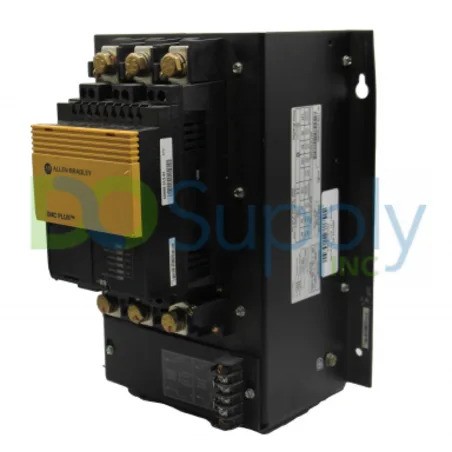
The Allen-Bradley SMC PLUS product line offers solid-state motor controllers that deliver microprocessor-controlled starting and stopping of 3-phase, squirrel cage, AC induction motors rated from 1/3 to 1000 HP (Horsepower). These controllers are available in 1 to 1000 Amps current ratings and in two voltage ranges: 200 to 480V AC, and 200 to 600V AC, at 60/50 Hz input frequency. Like the SMC-2, they also are UL Listed, CE Marked for low voltage applications, and CSA Approved.
Other features of the SMC PLUS motor controllers include advisory and diagnostic LEDs, digital adjustments using rotary digital switches and DIP switches, and two configurable auxiliary contacts provided as standard. The two auxiliary contacts are: One normally open contact, and one normally closed contact; they are provided for either instantaneous or up-to-speed motor operation.
Modes of Operation
All SMC PLUS controller configurations provide four starting modes/modes of operation as standard and self calibration. The four starting modes are:
- Soft Starting: Similar to the SMC-2, but with adjustable torque from 5% to 90% of locked-rotor torque, providing smoother acceleration for heavier loads.
- Soft Starting with Kickstart: The Kickstart or boost function is intended to provide an additional current pulse of 550% of the rated full-load amperes. The Kickstart time can be varied from 0.4 to 2.0 seconds.Activating the Kickstart function allows the connected induction motor to develop supplemental torque at startup for loads which may require a current boost to get into motion.
- Full Voltage Starting: In this mode, theSMC PLUS motor controller operates like a solid-state contactor, realizing maximum locked-rotor torque and starting current in less than a fourth of a second during the acceleration period. It’s ideal for across-the-line starting of induction motors.
- Current Limit Starting: Limits inrush current to safeguard equipment, with settings from 50% to 500% of full-load amps..
Control Options
SMC PLUS motor controllers offer a variety of mutually exclusive control options for rapid braking, soft stopping, pump control, and slow-speed operation, providing superior motor control solutions and exceptional application flexibility. The options include:
- Pump Control: Designed to prevent fluid surges in centrifugal pumping systems, this feature allows the motor to accelerate and decelerate smoothly. Users can program starting times between 2 and 30 seconds and stopping times up to 120 seconds, ensuring stable operation and protecting system components from abrupt pressure changes.
- Soft Stop: For frictional loads that would otherwise stop abruptly when power is cut, this feature provides a gradual reduction in motor voltage. Ramp-down times can be adjusted from 2 to 60 seconds, allowing the load to come to rest gently once the motor’s output torque falls below the load’s resistance.
- Smart Motor Braking (SMB): This braking option delivers rapid stops without requiring additional hardware like resistors or contactors. The SMB feature leverages a microprocessor to apply braking currents adjustable from 150% to 400% of the motor’s full-load current, bringing the motor to zero speed automatically and efficiently.
- Slow Speed with Motor Braking: This control option is particularly useful in motor control applications that require braking control for motor stopping and slow speed for motor positioning and alignment. It allows for the following adjustments:
- Slow Speed Adjustments: 15% (HIGH) or 7% (LOW) of rated motor speed
- Acceleration Current: It’s available for only 2 seconds and can be calibrated from 50 to 400% of the motor’s full load amps.
- Running Current: 50 to 450% of the rated full-load amps.
- Braking Current: 150 to 400% of the motor’s full load current
- Preset Slow Speed: This option is used in applications that feature slow-speed operations, like moving products into position. Using a selectable DIP switch the preset slow speed option can be adjusted to the following settings:
- Forward Direction Slow Speed: 15% (HIGH) or 7% (LOW) of the motor’s base speed
- Reverse Direction Slow Speed: 20% (HIGH) or 10% (LOW) of the motor’s base speed, without the need of a reversing contactor
- Slow-Speed Current Limit: 50 to 450% of the rated full-load motor current.
- Accu-Stop Option: Designed for precise motor stopping, Accu-Stop maintains the motor at a pre-set slow speed (15% or 7% of rated speed) until a stop command is issued. It then applies braking torque, decelerating the motor to zero. Both slow-speed current (50%–450%) and braking current (150%–400%) are user-adjustable for optimal control during stopping.
- Accu-Stop with Slow Speed during Starting: This variation extends the Accu-Stop functionality by allowing the motor to begin operation at a predefined slow speed before ramping to full speed. This reduces the need for frequent jogging to position loads and ensures smoother operation during startup.
Application-Specific Features
- Energy Saver: This is a standard built-in feature with theSMC PLUS motor controllers. It helps reduce energy consumption in industrial applications where the squirrel cage induction motors in use are unloaded or slightly loaded for extensive periods of time.
- A Protective Module: This is an optional module that can be installed to protect the power components of the SMC PLUS motor controller from line transients and/or electrical noise. It contains Metal Oxide Varistors that suppress voltage transients generated on the power supply lines, preventing the controller’s SCRs from getting damaged by such power surges. It also includes capacitors that shunt electrical noise away from the electronic components of the SMC PLUS controller.
Summary
In a nutshell, SMC PLUSmotor controllers are more of an upgrade of the SMC-2 controllers, offering more starting modes, current ratings, and control options, and thus, covering a wider range of motor control applications. Though that doesn’t mean that the SMC-2 is obsolete. We carry an extensive supply of both here at DO Supply and offer expert advice to help you pick the best SMC for your workplace. Or if you would like to read more on the benefits of soft starters in factories, you can find that article here.
DO Supply Inc. makes no representations as to the completeness, validity, correctness, suitability, or accuracy of any information on this website and will not be liable for any delays, omissions, or errors in this information or any losses, injuries, or damages arising from its display or use. All the information on this website is provided on an "as-is" basis. It is the reader's responsibility to verify their own facts.