The Evolution of Modicon Controllers: From 084 to M580
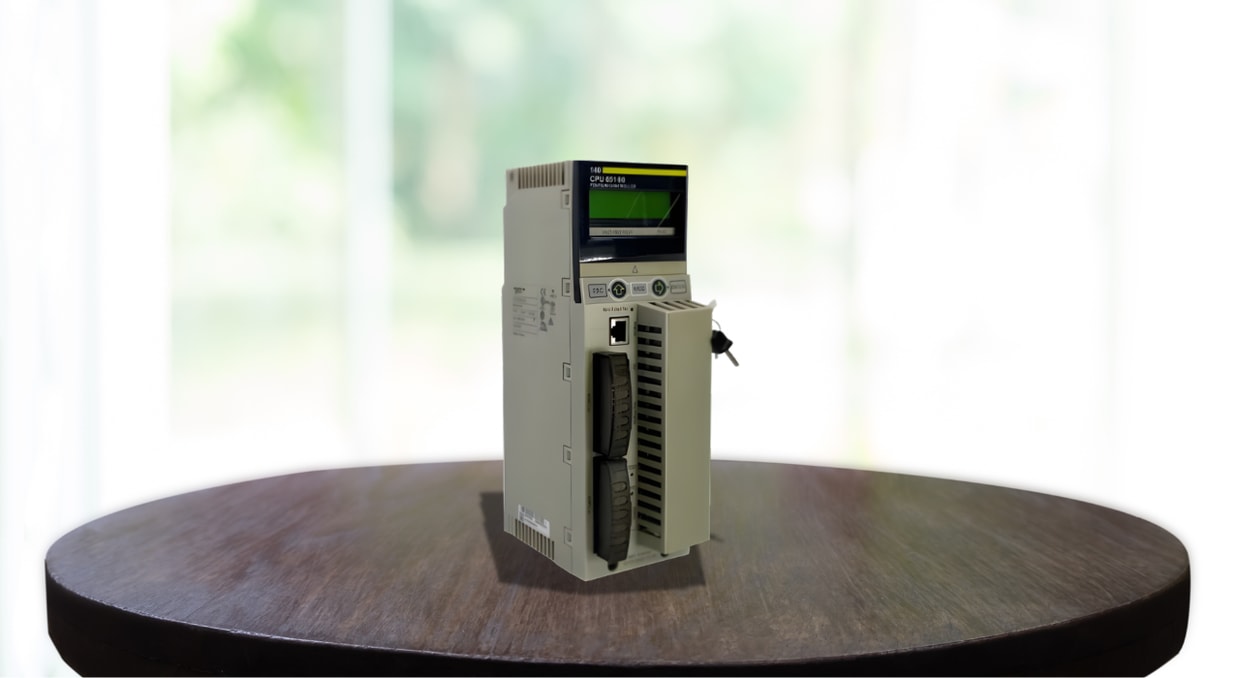
The Modicon by Schneider Electric brand carries a significant legacy in the automation world. From inventing the first PLC in 1968 that revolutionized industrial automation to creating the legendary Modbus protocol in 1979, Modicon has left a permanent mark and remains a significant pioneer in industrial automation. While today the Modicon band might not be as popular as Allen-Bradley’s offerings, there is still a significant amount of history and development that went into this line of PLCs. Join us today as we uncover not only the generational improvements from Modicon controllers but also the passion and dedication that went into shaping automation as we know it today.
The Modicon 084
Invented by a gentleman by the name Dick Morley in 1968, the Modicon 084 was the first PLC to become commercially available. Morley wanted an intuitive, programmable unit that could reduce the amount of programming and debugging time required to launch mini-computer systems. With the help of his engineering firm, Bedford Associates, he then went on to make the first operational prototype, affectionately named “Stupid.”, to show off at Landis Machine. This landed a gig with General Motors to help streamline their automotive manufacturing plants.
This PLC was a modular, solid-state controller that could be programmed using an easy representation of relay logic, which later became known as ladder logic. It included a CPU, I/O modules, and memory, which are the core components of today’s PLCs. To program it, the user had to use a dedicated terminal, as PCs didn’t exist yet. The name 084 also comes from it being the eighth attempt to get the design right.
Modicon 184 / 384 / 584
While the Modicon 084 was groundbreaking, it truly was a proof of concept more than anything. The 184, 384, and 584 took that concept, making it a commercially viable, structured product family. The 184 was the low-end card for smaller control systems, while the 384 was the mid-range model with more I/O and memory, and the 584 took it further to be able to handle more complex automation tasks. These PLCs also further took the original ladder logic to include timers, counters, mathematical operations, and more robust conditional logic. The 184 was known for its speed and outperformed competitors, like the PLC-2 from Allen-Bradley, in time benchmarks.
Rack-based modularity allowed users to expand I/O slots easily, mix and match analog/digital I/O, install communication modules, and upgrade memory or CPU without replacing the entire system. This was also the birth of the Modbus protocol in 1979.
Modicon 984 Series
By this point, industrial automation was no longer experimental. Plants were demanding more I/O, memory, connectivity, and diagnostics. The 984 gave them that in a rugged package. The line included several models, including the 984-A, 984B, 984x, and micro 984, each with different sizes and capabilities. These PLCs were everywhere, from water and wastewater plants to power generation.
Improvements and Innovations
The 984 series introduced true standardization for a unified programming and memory model across the family. It allows you to transfer ladder logic cleanly between the different models of the line. Modbus was now a native feature in both serial (RTU) and eventually TCP/IP forms, which made it integrate easily with SCADA systems, HMI panels, Remote I/O, and even early industrial PCs. Memory was also dramatically improved to allow for hundreds of rungs of logic, dozens of timers, and better support for structured programming. Then there was the addition of fault codes, LED status indicators, and optional programming panels for in-field troubleshooting.
Modicon Micro / Compact
The Micro and Compact were developed after the 984 for applications that didn’t require full racks of I/O or redundancy, such as conveyor systems, packaging machines, pump stations, and more. It preserves many of the 984’s benefits but removes the bulk.
What’s New?
The Compact and Micro lines feature an integrated power supply, CPU, and I/O in one housing, aimed at OEM designers. The Micro line is even smaller than the Compact line, often with digital-only I/O and limited expansion options. This allowed for lower costs, simplicity, unified programming, and Modbus compatibility. These became the spiritual ancestors of today’s M238, M221, M241, and M251 units.
Modicon Quantum
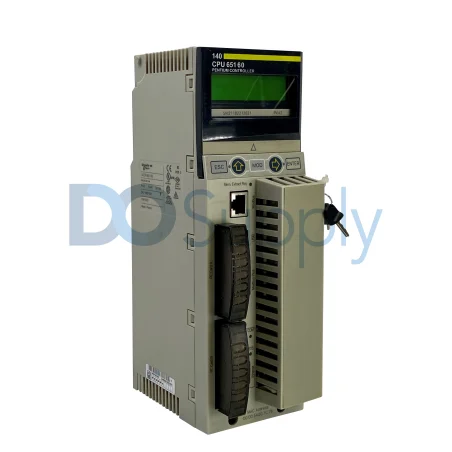
Where the 984 focused on modularity and reliability, Quantum focused on scalability, redundancy, and networked control. The idea was to create a platform built to handle large I/O counts, long cable runs, and complex control strategies, often across multiple physical locations.
Setting the Standard
The Quantum is built to support a tremendous amount of I/O points, especially when combined with remote I/O drops. The Quantum series could also handle mixed analog/digital I/O, RTDs, thermocouples, counters, and specialty modules like HART communication. Moving onto networking and protocol support, the Quantum is the first platform to natively support Modbus Plus with support for Modbus TCP/IP, Ethernet/IP, Profibus, and a few other fieldbus protocols. Finally, the Quantum featured hot-swappable I/O modules to help reduce downtime.
Modicon Momentum
First launched in the mid-1990s, the Modicon Momentum PLCs were designed around three core ideas: To mount directly where the control is happening, snap together only the parts you need, and integrate I/O, logic, and communication into one compact package. It’s a modular system where the I/O base, processor, and communication modules click together like building blocks. It can even be DIN-rail or panel-mounted without a traditional rack. A standard Momentum system consists of:
- I/O Base (the terminal block for wiring)
- Processor Adapter (PC-E984) or Communication Adapter
- Optional Function Module for local processing or special logic
- Optionally networked to a higher-level PLC or SCADA system
It allowed for them to be used as a standalone controller when using a processor adapter, a remote I/O station with a communication adapter, or as a gateway between field devices as a master PLC.
Key Features
The Momentum line used an E984 processor that allowed for 984-style ladder logic programming with the help of a PC-E984-258 and related modules. This meant that it was compatible with existing Modicon tools and could handle timers, counters, math, and Modbus registers like its larger siblings. However, the real star of the show was the ability to swappable communication adapters, allowing you to use Modbus TCP/IP, Modbus Plus, EtherNet/IP, Profibus DP, and DeviceNet.
Another advantage of the Momentum line was that it was small enough to mount directly in junction boxes or machinery, making it ideal for distributed I/O applications. It also had options for a weatherproof enclosure or remote mounting, which made it a favorite for SCADA and utility automation.
Modicon Premium
The Modicon Premium emerged in the late 1990s and early 2000s, filling the performance gap between the Compact/Micro series and the full-blown Quantum. With better I/O options, faster execution times, and modern communication capabilities, Premium quickly became a favorite for high-speed automation that needed reliability without large process control infrastructure overhead. The Premium PLC line (often carrying the TSX prefix, like TSX P57 or TSX DMZ) was built around the concept of:
- Modular design
- Wide I/O support
- Fast instruction processing
- Built-in networking
- Compatibility with IEC 61131-3 programming
It supported everything from motion control and complex logic to PID regulation and integrated communication, making it ideal for manufacturing, material handling, batching, and machine control systems.
What Makes it Stand Out
The Premium CPUs, like the TSX P57 series, were optimized for high-speed tasks with 37 ns per instruction and up to 7 Mb of program. Execution times were greatly improved over the Compact and Quantum line CPUs for many instructions, making them great for systems that needed tight timings, such as packaging lines or sorting machines. Another distinct feature of the Premium line is that they have increased memory and modularity, meaning up to 7 or 8 slots per base and thousands of I/O points when fully built out. Then there are the advanced I/O and specialty modules that allow for:
- Counter modules
- Temperature inputs (RTD, thermocouple)
- Motion control cards
- Weighing systems
- HART communication
- Digital and analog I/O
Modicon M238 / M241 / M251 / M262
The M238, M241, M251, and M262 represent Schneider Electric’s shift toward compact, high-performance PLCs specifically tailored for OEMs and machine builders. Collectively, they form the foundation of what Schneider branded as “Modicon Logic Controllers” under the EcoStruxure Machine architecture (formerly known as SoMachine). The goal: give machine designers an edge in cost, speed, and modularity without sacrificing communication or control power. They each have their own uses, but all share these common traits:
- DIN rail mountable
- Built-in real-time clock, retentive memory, and diagnostics
- Broad support for Modbus TCP, CANopen, and, in some models, EtherNet/IP
- Can serve as master or slave in many topologies
- Easy integration with Schneider HMI, Altivar drives, and Tesys motor starters
M238: The Entry-Level Classic
These were targeted at basic machines with simple sequencing, smaller I/O counts, and no advanced motion. They remained compact and cost-effective, supported ladder logic, used up to 7 TM2 I/O modules, and came with USB and RS232/485 ports. You can typically find these in small conveyor setups, basic packaging, and light material handling, though they have been largely phased out in favor of the more powerful M241/M251.
M241: Advanced Standalone Control with Motion
This series is designed for more advanced motion and complex machines. It comes built in with CANopen, Modbus TCP, and serial and supports up to 4 axes of motion control via pulse train output. This module also supports wb server capabilities for HMI pages. You can find these in multi-axis pick-and-place, automated bottling machines, textile, and more.
M251: Decentralized Architect with Dual Ethernet
These modules were aimed at distributed control and headless architectures. While there is no built-in digital I/O, it was meant to be used with remote I/O blocks over Modbus TCP or CANopen. This allows you to connect to SCADA, MES, and ERP systems using one of the dual Ethernet ports or even Wi-Fi.
M262: Edge-Ready and Cybersecure
The M262 is the most modern and feature-rich of the group, built for IoT, cloud, and edge computing use. It supports OPC UA, MQTT, HTTPS, and REST APIs out of the box. You can expect dual Ethernet ports again, but this time, you will have a firewall and cybersecurity built in (Achilles Level 2 Cert). Motion over Sercos, tag-based programming, and event logging are other features users can expect. You can find these in smart packaging systems, remote condition monitoring, edge-level logic for cloud-enabled factories, and more.
Modicon M340
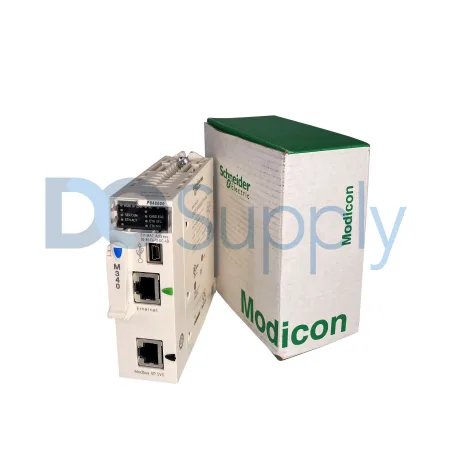
Released in the mid-2000s, the M340 was designed as a mid-range controller that bridged the gap between the Premium and Quantum lines. In a way, it was a response to the market’s demand for something powerful but compact, modular but affordable, and capable of networked control without needing a full-blown process system.
Notable Features
With this series, you can expect a compact rack-mounted design, built-in USB and Ethernet ports on most CPUs, native support for Modbus TCP, CANopen, and other fieldbuses, and expansion via local and remote racks with a full range of I/O modules. The M340 is basically used to support the M580. It’s a small package that doesn’t sacrifice connectivity or programmability.
Modicon M580 (ePAC)
The Modicon M580, launched in the 2010s, is Schneider’s current flagship controller. This isn’t just a new generation, it’s a full evolution of the control system into an Ethernet-based programmable automation controller (PAC). Where older PLCs treat Ethernet as a communication option, the M580 makes it the core of its architecture, and even the backplane is Ethernet.
What sets the M580 apart is not only the native Ethernet backplane (which makes all rack communication ethernet) or the Achilles Level 2 cyber security but also its redundancy for CPUs, power supplies, and network links and its support for cloud integration, remote access, and edge computing.
Communication-wise, you can expect the following:
- OPC UA, Modbus TCP, Ethernet/IP, SNMP
- MQTT and HTTPS support through add-on modules
- Can push data to cloud platforms like AWS and Azure
- Integrates with EcoStruxure architecture for enterprise-wide visibility
Final Thoughts
While this was a lot to cover, the Modicon series is quite expensive, as you could see. From the clack of physical relays in Detroit smart factories, the Modicon name has quietly followed the trajectory of industrial control itself. What began with the model 084 became a lineage of controllers that adapted with each era’s needs: modularity, speed, networking, and now, cloud connectivity. Modicon’s story isn’t just about progression. It’s about building with purpose. And whether you’re maintaining a decades-old Quantum rack or configuring an M580 for cloud reporting, you’re part of a system that’s been evolving for over 50 years, not because it had to, but because the job demanded it.
We at DO Supply are proud to be able to supply these controllers and support those who use them. We offer many different lines of Modicon PLCs and others, such as Allen-Bradley and Mitsubishi. On top of that, we offer in-house repairs and replacements that are backed by our unbeatable 2-year warranty. Visit our website today or give us a call! If you’re interested in how Modicon is contributing to Industry 4.0, we have an article here for you!
DO Supply Inc. makes no representations as to the completeness, validity, correctness, suitability, or accuracy of any information on this website and will not be liable for any delays, omissions, or errors in this information or any losses, injuries, or damages arising from its display or use. All the information on this website is provided on an "as-is" basis. It is the reader's responsibility to verify their own facts.