Allen Bradley PLC Families Explained: MicroLogix, ControlLogix, and CompactLogix
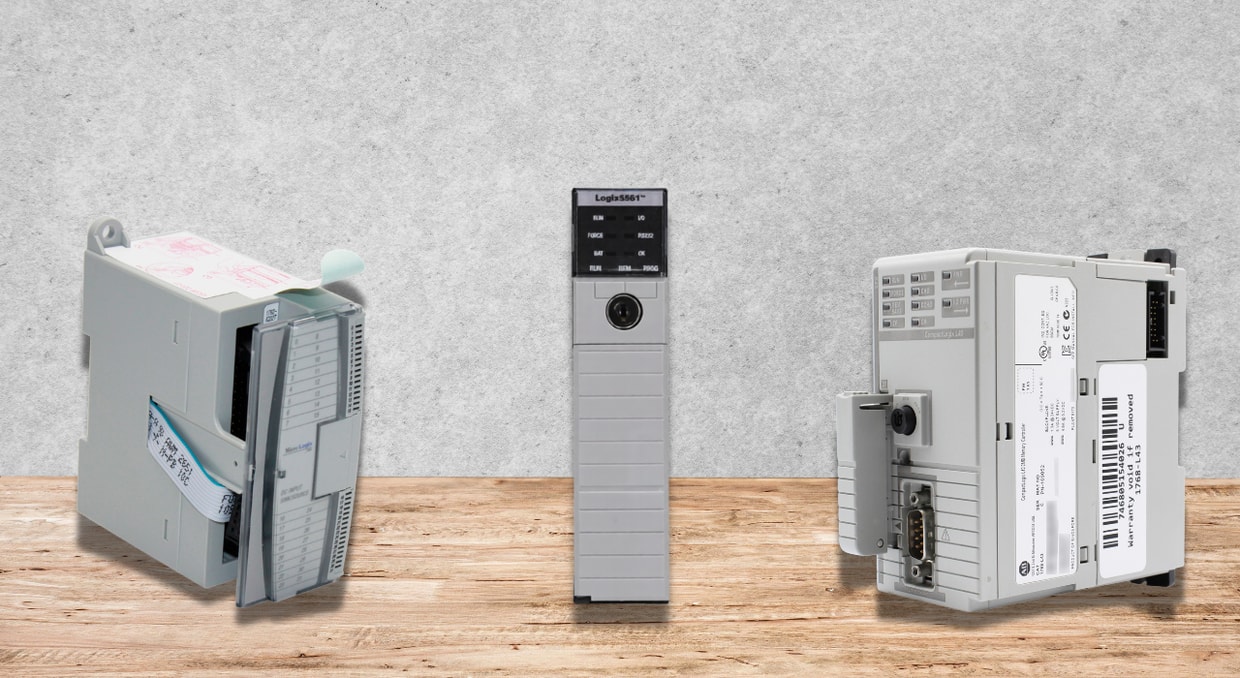
Allen-Bradley and its Logix controllers have been around since the dawn of PLCs. Today, they are found running the very factories that produce objects you use in your daily life. Each Logix family of controllers was designed to fill a role that emerged as automation adoption increased, from small-form-factor controllers to fit OEM designs to powerhouses that control hundreds of I/O points. Though going through each of them to understand what they can do or where they fit may be a daunting task, we’re here to make it as easy as possible, starting with the MicroLogix.
The MicroLogix: Compact and Cost-Effective
The Allen-Bradley Micrologix PLC family occupies a very specific place in the Allen-Bradley PLC lineup. These PLCs were designed for machines and processes that demanded reliable, deterministic control, without the extra overhead and costs associated with larger platforms.
The main idea is self-contained, compact control without complexity. Because of this, these controllers integrate the processor, power supply, and I/O into their packages, though some controllers can expand with optional modules to meet I/O count needs.
From a capability standpoint, MicroLogix controllers offer the familiar Allen-Bradley ladder logic experience, deterministic scan cycles, and solid real-time performance, just scaled to smaller problems. They excel at tasks like basic motion sequencing, interlocking, discrete control, timing operations, and light analog processing. If the control problem fits neatly inside a single panel and doesn’t need to coordinate tightly with dozens of other controllers, MicroLogix often fits naturally.
MicroLogix Controller Variants
The MicroLogix family comprises five distinct models that scale in I/O count, memory, and communication options while maintaining a consistent philosophy. For a full technical breakdown of the MicroLogix family, visit our blog here.
MicroLogix 1000
While the MicroLogix 1000 is the most basic of the family, it still has its place. It’s designed for fixed, repeatable machines that run on simple logic and are unlikely to be changed over time. These units are common in applications with tight workspaces that require up to 32 I/O points, such as high-volume OEM equipment or packaging machines.
MicroLogix 1100
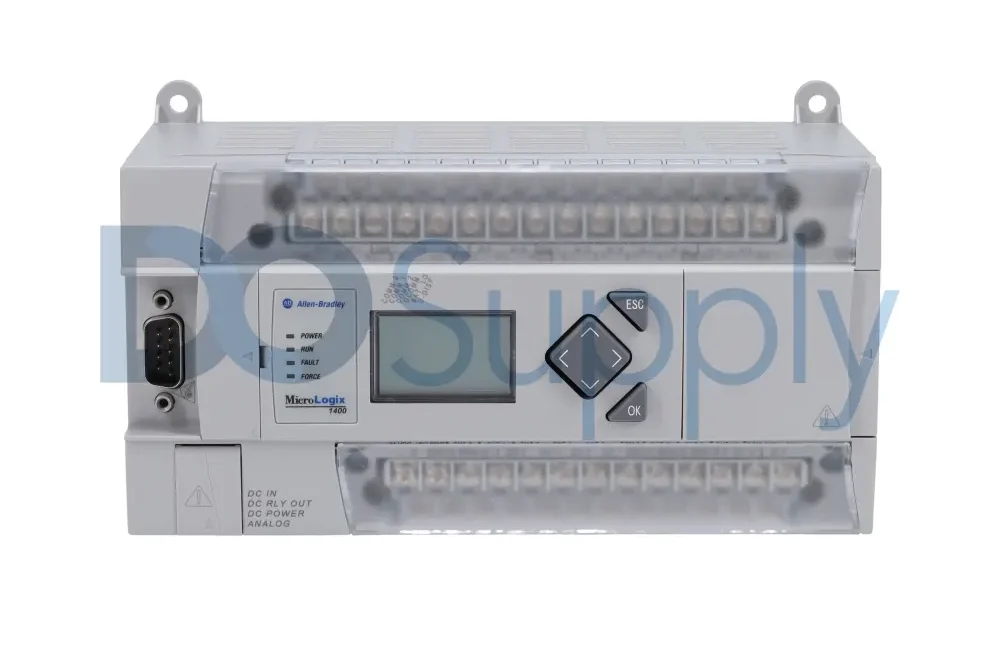
The MicroLogix 1100 offers more flexibility than its younger brother. It introduces built-in Ethernet, greater memory, and improved diagnostics, which make it more comfortable in networked environments or applications that require basic data exchange with HMIs or supervisory systems. These controllers also have a built-in LCD to display controller and I/O status, as well as simple operator messages. They can also be expanded via 1762 I/O modules.
MicroLogix 1200
This line of Allen-Bradley PLCs expands I/O capacity and performance while still retaining the all-in-one form factor. It’s a common choice for machines that grew beyond their original scope, where additional sensors, actuators, or analog signals were added after the initial design. It’s available in 24- and 40-point versions with the options for expandable, rackless I/O modules like the MicroLogix 1100.
MicroLogix 1400
We aren’t sure why Allen-Bradley decided to skip “1300” in its naming scheme. Still, the 1400 series of Allen-Bradley MicroLogix PLCs builds on the MicroLogix 1100 by introducing an LCD, Ethernet/IP, increased I/O, and faster counter/PTO and communication capabilities.
MicroLogix 1500
Finally, we have the MicroLogix 1500, introducing a new design language that supports a swappable processor, an embedded power supply, and I/O, with 1769 Compact I/O expansion support. These controllers are designed to accommodate I/O-hungry processes while maintaining the low-cost, small-footprint philosophy.
The ControlLogix: Scalable Plant-Wide Control
The Allen-Bradley MicroLogix PLC family moves away from the MicroLogix’s compact and self-contained I/O to expand across the plant floor. This family is designed for systems in which control is no longer isolated to a single machine but distributed across entire production lines, process units, or facilities. ControlLogix is built for environments where performance, coordination, and long-term scalability matter just as much as raw reliability.
At a structural level, ControlLogix is a modular, chassis-based platform. Instead of an all-in-one controller, users assemble a system from individual components:
- The controller
- Power supply
- Communication modules
- I/O modules
The ControlLogix family of Allen-Bradley PLCs is designed to handle large programs, high I/O counts, time-critical coordination, and safety. Just as importantly, they are built to act as a central authority, synchronizing data and control decisions across multiple subsystems without losing determinism.
The ControlLogix Controller Family
Rather than being divided into multiple product tiers, the ControlLogix family is primarily defined through controller performance classes and system architecture choices. This leaves users with two options.
ControlLogix 5570
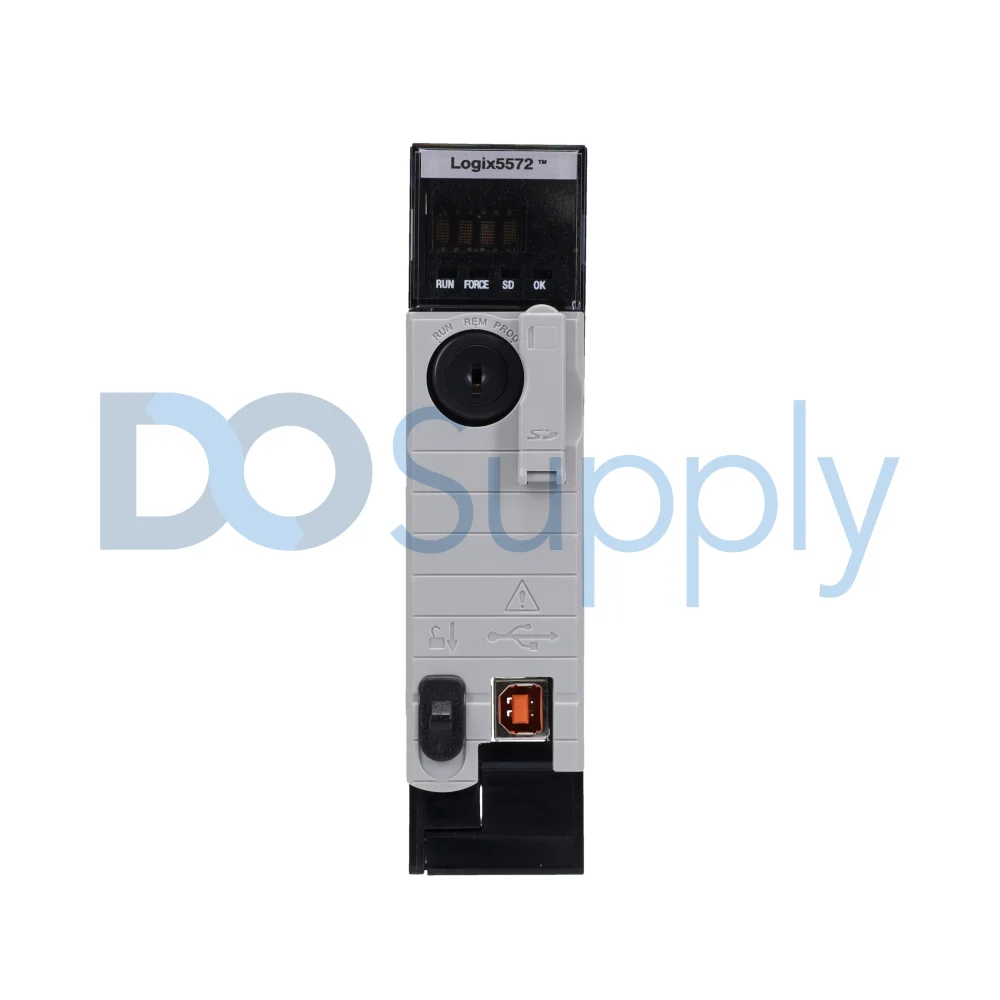
The ControlLogix 5570 family is a widely deployed generation of ControlLogix controllers that established the platform as a standard for large-scale automation. These controllers offer a range of memory sizes and performance levels, allowing them to scale from complex machines to full production lines.
Some of the features you can find on the ControlLogix 5570 are:
- Multiple memory options supporting large control programs and data sets
- Up to 32 tasks with support for periodic and event-triggered execution
- Chassis-based communication using dedicated EtherNet/IP, ControlNet, or DeviceNet modules
- Support for coordinated control across multiple controllers and distributed I/O
The 5570 platform also supports integrated motion and multiple programming languages, provided redundancy is not enabled. Safety-rated variants, known as GuardLogix 5570 controllers, extend the same architecture to safety applications while keeping standard and safety logic within a single project. Despite being an earlier generation, ControlLogix 5570 controllers remain common in active production environments due to their long service life and architectural stability.
ControlLogix 5580
Newer Allen-Bradley PLCs feature a design facelift to accentuate a more modern look, and the ControlLogix 5580 is no different. The ControlLogix 5580 controller family represents the modern generation of ControlLogix controllers, designed to expand performance, memory capacity, and network scalability while preserving the same modular, chassis-based architecture that defines the platform. While the overall system structure remains familiar, the 5580 controllers introduce meaningful architectural improvements aimed at large, network-intensive automation systems.
Like earlier ControlLogix controllers, the 5580 can be installed in any slot of a 1756 chassis and can coexist with other controllers operating independently. They continue to control I/O locally over the backplane and remotely across industrial networks, but with substantially higher capacity for connecting devices and exchanging data.
Key capabilities of ControlLogix 5580 controllers include:
- Significantly expanded user memory options, scaling from smaller control applications to very large, data-heavy systems
- Support for up to 32 tasks with multiple programs per task, including full event-task support
- Built-in Ethernet/IP connectivity on standard models, reducing reliance on separate communication modules
- Higher supported Ethernet/IP node counts compared to earlier generations, depending on controller model
ControlLogix 5580 controllers also extend the platform’s reach into more demanding environments. Variants are available for harsh or corrosive conditions, extended temperature ranges, and specialized applications such as process control and no-stored-energy (NSE) requirements.
The CompactLogix: For Those Who Need Something In-between
The CompactLogix family of Allen-Bradley PLCs is designed to bridge the gap between smaller, more self-contained PLCs, such as the MicroLogix, and large, plant-wide systems, such as the ControlLogix. It brings the Logix 5000 control model into a more compact, cost-conscious form factor, while still supporting modern networking, distributed I/O, and coordinated control.
Unlike ControlLogix, CompactLogix controllers do not use a shared backplane chassis. Instead, the controller and local I/O modules are mounted side-by-side on a DIN rail or panel, forming a single controller domain. This simplifies panel design while still allowing the system to grow through remote I/O and networked devices.
CompactLogix controllers are primarily designed to:
- Handle medium-scale machines and production cells
- Support distributed I/O and device-level networking over Ethernet/IP
- Execute multiple tasks with deterministic performance
- Integrate motion, drives, and safety within a single controller platform
CompactLogix PLC Controller Family
The CompactLogix ecosystem of Allen-Bradley PLCs offers an extensive family tree to choose from, depending on the user’s needs. The CompactLogix platform does bring some quality-of-life benefits, such as a common programming environment, common networks, and a common control engine in a smaller package. When paired with 1769 Compact I/O or Compact 5000 I/O modules, the CompactLogix can support simple to complex motion. While this does sound similar to the MicroLogix, we have a blog post here that compares the advantages and disadvantages of both.
From here, the differences between CompactLogix controllers come down to performance, memory, networking capacity, and long-term scalability.
CompactLogix 5370
The CompactLogix 5370 controller family forms the foundation of the CompactLogix platform. These controllers were built for small- to mid-sized machines that require the Logix 5000 control model but lack the performance, memory, or network scale of larger systems.
The 5370 is broken up into three variants:
- The L1 controllers that use 1734 POINT I/O modules. These are ideal for small to mid-sized machines at a lower cost.
- The L2 controllers which utilize 1769 Compact I/O modules. These are for small standalone equipment to higher-performance applications, such as indexing tables and packing.
- The L3 controllers that also use 1769 Compact I/O modules, but in a smaller and more affordable package.
CompactLogix 5380
The CompactLogix 5380 series of Allen-Bradley PLCs is the youngest of the group and comes with that refreshed look that the ControlLogix 5580 has. CompactLogix 5380 controllers use the Compact 5000 I/O platform and feature built-in dual EtherNet/IP ports, supporting modern network topologies such as linear and device-level ring configurations. Depending on the operating mode, the embedded ports can be configured for a single network or separated into distinct device-level and enterprise-level networks. This allows tighter integration with HMIs, drives, motion systems, and distributed I/O without adding external communication modules.
The CompactLogix 5380 also has its own safety-specific SIL 2 controllers called the GuardLogix 5380, which can achieve up to SIL 2/PLd (Category 3) with the help of the safety task and safety I/O.
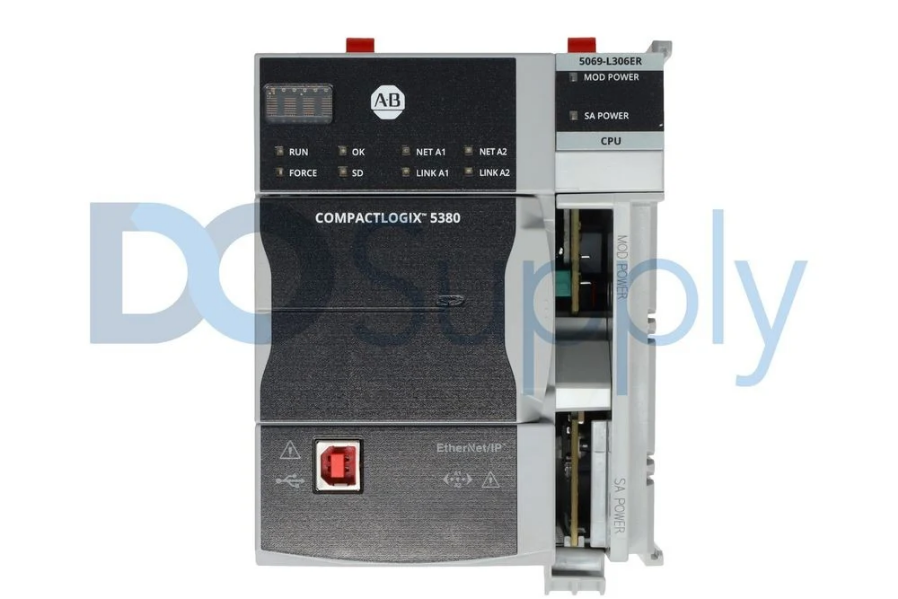
Compared to the 5370 family, CompactLogix 5380 controllers support larger programs, higher EtherNet/IP node counts, and significantly expanded integrated motion capability. As a result, the 5380 series is commonly used in complex packaging systems, coordinated motion applications, and connected production cells.
CompactLogix 5069
The CompactLogix 5380 platform also introduced a newer generation of local I/O modules known as 5069 Compact 5000 I/O. These modules replace the older 1769 Compact I/O used with earlier CompactLogix controllers and were designed to support higher performance systems.
The 5069 modules connect through a faster backplane architecture, allowing quicker data exchange between the controller and field devices. This improves responsiveness in applications where precise timing matters, such as coordinated motion systems, packaging equipment, and high-speed assembly machines.
Another advantage of the 5069 platform is its improved scalability. Modules are physically smaller and designed to be installed side-by-side on a DIN rail, making it easier to build compact control panels while still supporting large I/O counts. A wide selection of digital, analog, safety, and specialty modules is available, allowing the CompactLogix 5380 to handle everything from simple machine control to more complex automation cells.
CompactLogix 5480
The CompactLogix family of Allen-Bradley PLCs sits at the top of the lineup and is intended for applications that go beyond traditional machine-level control. While it still belongs to the CompactLogix ecosystem, the 5480 introduces a hybrid architecture that combines Logix control with industrial computing.
Unlike other CompactLogix controllers, the 5480 includes a dedicated Logix control engine running alongside an embedded industrial PC environment, such as Microsoft Windows IoT Enterprise. The two operate independently but share data, allowing the controller to handle real-time control tasks while also supporting higher-level data processing, visualization, or analytics functions. This makes the 5480 well-suited for systems that need both deterministic control and on-controller computing.
In practice, the 5480 is used in mid- to large-scale machines, advanced production cells, and data-heavy automation systems where a standard CompactLogix controller would be limiting. Still, a full ControlLogix platform would be unnecessary.
Final Thoughts
Allen-Bradley PLCs come in many different shapes and sizes, and it’s almost guaranteed that one will fit your industrial needs. Each lineup is catered to a smaller, more OEM-focused crowd, medium-scale automation tasks, or fully modular plant-wide control.
While keeping up with the different models may be challenging, sourcing them doesn’t have to be! Stop by our site at DO Supply and browse our hundreds of Allen-Bradley PLCs ready to fit your automation solution. We also offer repair services for PLCs and other automation equipment that need refreshing or replacing. For that, call or email our customer support team. As always, thank you for reading!
DO Supply Inc. makes no representations as to the completeness, validity, correctness, suitability, or accuracy of any information on this website and will not be liable for any delays, omissions, or errors in this information or any losses, injuries, or damages arising from its display or use. All the information on this website is provided on an "as-is" basis. It is the reader's responsibility to verify their own facts.