What ‘Real-Time’ Actually Means in Industrial Control
If you have spent any time reading about automation equipment and how they work, you would come across phrases such as: “Real-time control”, “real-time monitoring”, “operates in real-time”, or “real-time deterministic behavior”. It becomes one of those things that you might be afraid to ask about because it’s thrown around so much that it seems like it’s common knowledge. Alas, we at DO Supply don’t judge and encourage learning opportunities, so let’s get you up to speed on what ‘real-time’ actually means.
What is Real-Time?
In the world of industrial control, “real-time” is a more precise engineering term. It means predictable, rather than “fast”. A real-time system isn’t defined by how quickly it responds, but by whether it responds within a guaranteed, bounded window of time, every single time. That guarantee is what engineers call determinism, and it’s the whole reason the phrase gets used so often around PLCs, drives, and industrial networks.
To put it in perspective, say a video game you’re playing is running at 120 FPS. It might feel real-time to you, but if the occasional frame drops to 60 FPS, it might be annoying, but it won’t cause you to lose the match. On the other hand, a servo drive controlling a robotic welder is a different story. If the drive’s response time jitters by even a millisecond at the wrong moment, you can end up with a bad weld, a scrapped part, or a crashed tool. The speed matters less than the promise that the timing won’t slip.
Three Flavors of Real-Time
In automation, not all systems will have the same consequences for missing a deadline. Because of this, real-time can be broken down into three categories:
Hard Real-Time
Hard real-time systems will treat missed deadlines as a total failure. Safety shutdowns, emergency stops, motion control, and protective relays all fall under this umbrella. If a safety-rated controller doesn’t de-energize an output within its specified response time, the guarantee is broken, and the system has failed.
Firm Real-Time
Firm real-time systems can tolerate an occasional missed deadline without failing, but any result produced after the deadline is discarded as worthless. A high-speed packaging line is a classic example: a vision system inspects each product and sends a reject signal to a downstream air blast that kicks defective items off the conveyor. If that signal arrives even a few milliseconds late, the bad product has already passed the reject station, and the signal is useless, since there’s no point in firing the air blast now. Though the line keeps running and nobody gets hurt, that particular piece of work is a wasted effort.
Soft Real-Time
These systems will degrade gracefully when deadlines slip. An HMI updating a trend graph is a good example. If the screen refreshes 200ms late, the operator likely won’t notice, and the system will keep doing its job.
In reality, most industrial equipment is a mix of all three. A PLC running a conveyor might handle the actual conveyor logic in hard real-time while its data logging and HMI updates run in soft real-time on the same chassis.
How Industrial Systems Actually Achieve Real-Time
Getting a system to behave deterministically isn’t something that comes for free, but rather is the product of a carefully curated selection of hardware and software choices at every layer of the stack.
Controller Level
This is where your PLCs run on a scan cycle. The CPU reads the inputs, executes the program, and updates outputs in a repeating loop with a predictable scan time. Because the loop is bounded and interrupt behavior is tightly managed, the controller can guarantee that any given rung of logic will execute within a known window. General-purpose operating systems like Windows or stock Linux can’t make that promise, which is why industrial controllers run either bare-metal firmware or a real-time operating system.
Network Level
At the network level, you wouldn’t choose standard Ethernet as latency isn’t bounded, and traffic contention introduces jitter. Ethernet is non-deterministic by design. This is where you look to industrial protocols, since they solve these issues in different ways. EtherCAT uses a “processing on the fly” approach where the master sends a single frame that each slave reads and writes as it passes, yielding cycle times under 100 µs. PROFINET IRT (Isochronous Real-Time) reserves dedicated time slots within each network cycle for time-critical traffic. EtherNet/IP layers CIP Sync and CIP Motion on top of standard Ethernet with time-aware scheduling.
Device Level
At the device level, servo drives, safety relays, and remote I/O blocks are built around deterministic firmware, with response times bounded and published in their datasheets/manuals.
Why Determinism and Real-Time Matter in Automation
The short answer is that determinism is what makes coordinated motion possible. For example, if you’re running a printing press with twelve servo axes that need to stay synchronized to within a few microseconds, none of it works without real-time behavior at the controller, network, and drive levels. The same applies to robotic cells, CNC machining, high-speed bottling lines, and any process control loop where timing variability directly translates into product defects or safety risks.
It’s also the reason you can’t just swap in consumer-grade hardware “because the specs look similar.” A PC-based controller running a standard OS might post impressive average response times in a benchmark, but “average” isn’t what keeps a stamping press from crushing a tool. The industrial gear commands a premium because the guarantee is the product.
How the Major PLC Brands Deliver Determinism
Every major automation manufacturer has its own approach to real-time performance, shaped by its controller architecture, preferred industrial network, and the markets it serves. It often creates an ecosystem built around their products to all work as you would expect.
Allen-Bradley (Rockwell Automation)
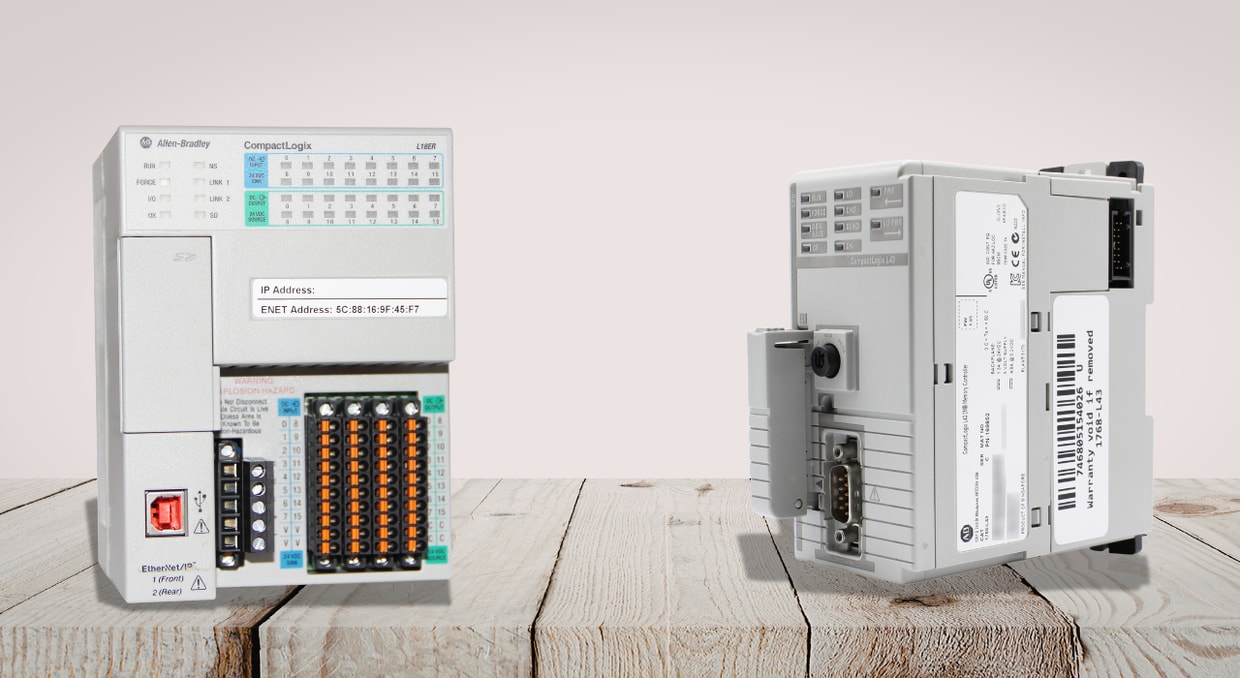
Rockwell handles real-time control over EtherNet/IP, with CIP Motion and CIP Sync layered on top of standard Ethernet to keep motion and I/O coordinated across a network. On the controller side, the workhorses for deterministic applications are the ControlLogix 5580 for high-end process and motion, and the CompactLogix 5380 for mid-range machine control. When coordinated motion is added to the picture, the Kinetix 5700 servo drives integrate with CIP Motion for multi-axis synchronization down to the microsecond level.
Omron
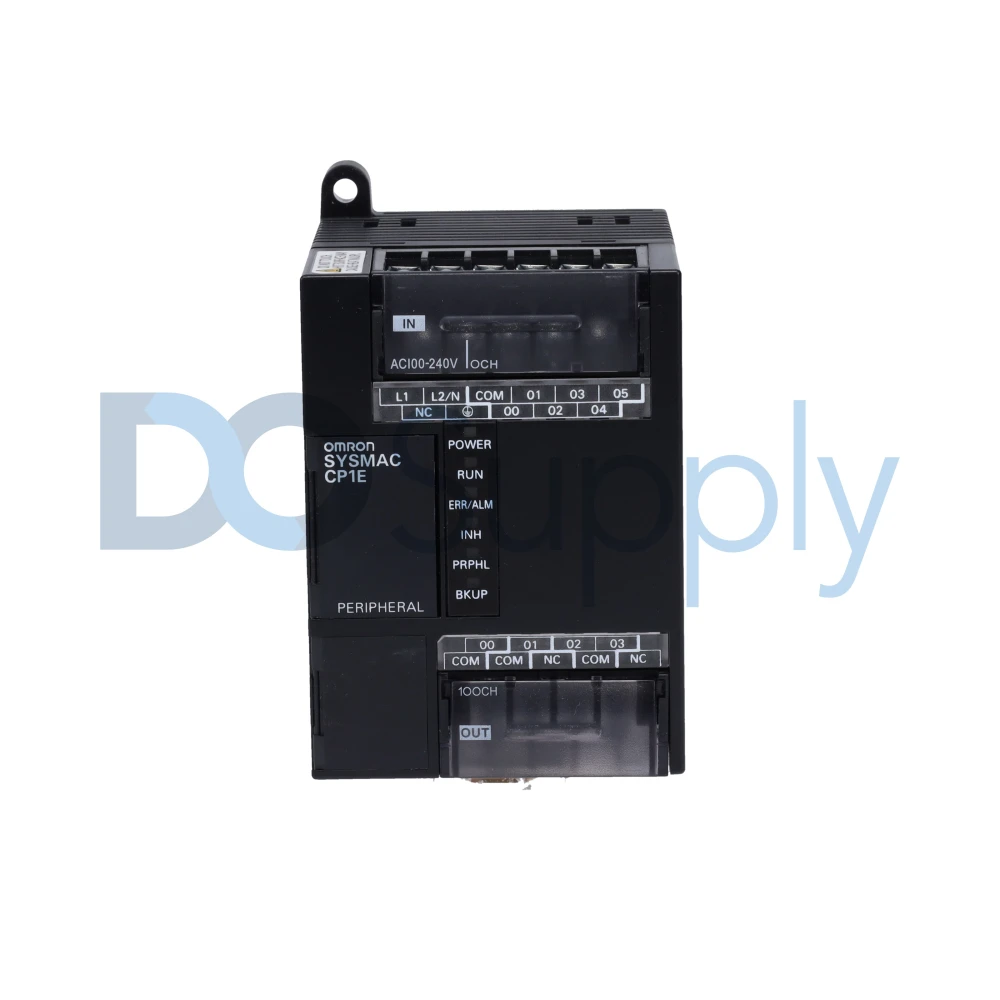
Omron’s flagship real-time controllers are the NJ/NX series, which run a dedicated real-time OS, and are tightly integrated with EtherCAT as the machine-level fieldbus. EtherCAT gives Omron’s controllers some of the fastest published cycle times in the industry, at well under a millisecond for most motion applications. The CS1 series anchors the medium-sized building-block lineup and supports Controller Link for deterministic peer-to-peer communication between PLCs. The CJ1 and CJ2 compact CPU modules carried that same architecture into a smaller footprint, with the CJ2 adding built-in Ethernet/IP for higher-speed I/O and information traffic. For smaller standalone machines, the CP1 offers a compact CPU lineup with integrated I/O.
Modicon (Schneider Electric)
Modicon has been a foundational name in PLCs since the original 084 defined the category, and the modern lineup keeps that legacy going with the M580 ePAC at the top. The M580 uses a backplane architecture where Ethernet is built directly into the rack, with deterministic backplane traffic and scheduled communication handling I/O updates. For process-heavy applications, the M580 Safety and Hot Standby variants bring redundancy into the real-time picture. Below the M580, the M340 covers mid-range machine control, and the older Quantum series is still in heavy use across process industries and remains a common repair platform.
Mitsubishi Electric
Mitsubishi’s real-time approach is built around CC-Link IE, their own gigabit industrial Ethernet protocol, which handles both control and motion traffic with guaranteed cycle times. The MELSEC iQ-R series sits at the top of the lineup and is built for high-speed, high-axis-count applications, with multi-CPU architectures that let motion, sequence, and process CPUs share a backplane without stepping on each other’s timing. The iQ-F (FX5U) handles the compact end for smaller machines, while the older Q series remains extremely common in the installed base, particularly in automotive and electronics manufacturing.
Final Thoughts
“Real-time” often gets used loosely enough in marketing that it’s easy to tune out, but on a plant floor, the term carries real weight. It’s the difference between a system that usually responds quickly and one that guarantees a response within a known window. As we mentioned earlier, a good deterministic system relies on the components and communication protocols interacting optimally. If you don’t know where to start when building a deterministic, real-time system, why not give us a call? We at DO Supply carry automation controllers, accessories, drives, and networking equipment to help curate a proper deterministic system for your needs. We also test all of our products and back them with our two-year warranty.
DO Supply Inc. makes no representations as to the completeness, validity, correctness, suitability, or accuracy of any information on this website and will not be liable for any delays, omissions, or errors in this information or any losses, injuries, or damages arising from its display or use. All the information on this website is provided on an "as-is" basis. It is the reader's responsibility to verify their own facts.