ControlLogix 5580 vs CompactLogix 5380: Where the Performance Gap Actually Matters
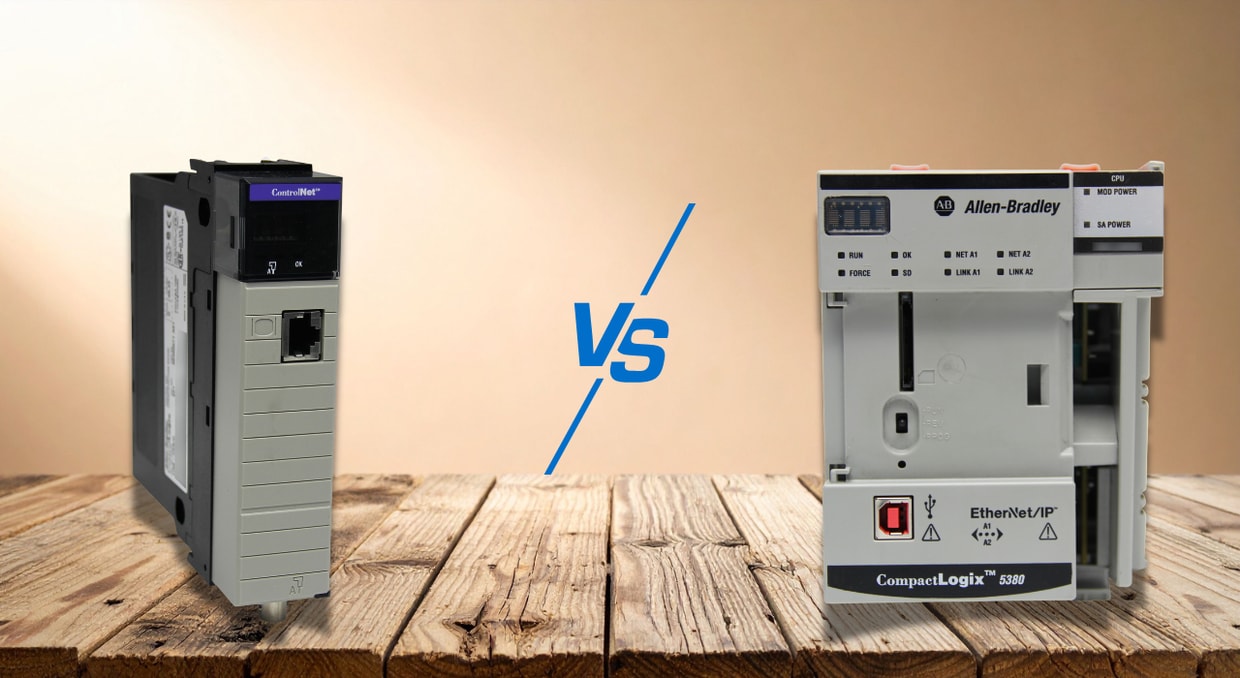
Industrial automation engineers selecting between the Allen-Bradley ControlLogix 5580 and CompactLogix 5380 rarely face a straightforward decision. Both support EtherNet/IP-based motion and safety and carry the Logix that makes them interoperable within Rockwell’s Integrated Architecture. Beneath that shared surface, however, the two platforms diverge in capacity, scalability, environmental tolerance, and application scope. Understanding where that gap actually matters determines whether a system is appropriately specified or quietly undersized.
The Fundamental Design Behind Each Platform
The CompactLogix 5380 was designed for compactness and self-contained machine control. Its architecture assumes a bounded application, a defined axis count, manageable I/O, and a system that runs on a single machine or in a production cell. The ControlLogix 5580 was designed for a different problem: applications that grow, where multiple disciplines coexist in one program, and where the controller serves as the backbone of a plant-wide architecture. This distinction in design intent is the lens through which every specification difference should be evaluated.
Memory Capacity and Program Complexity
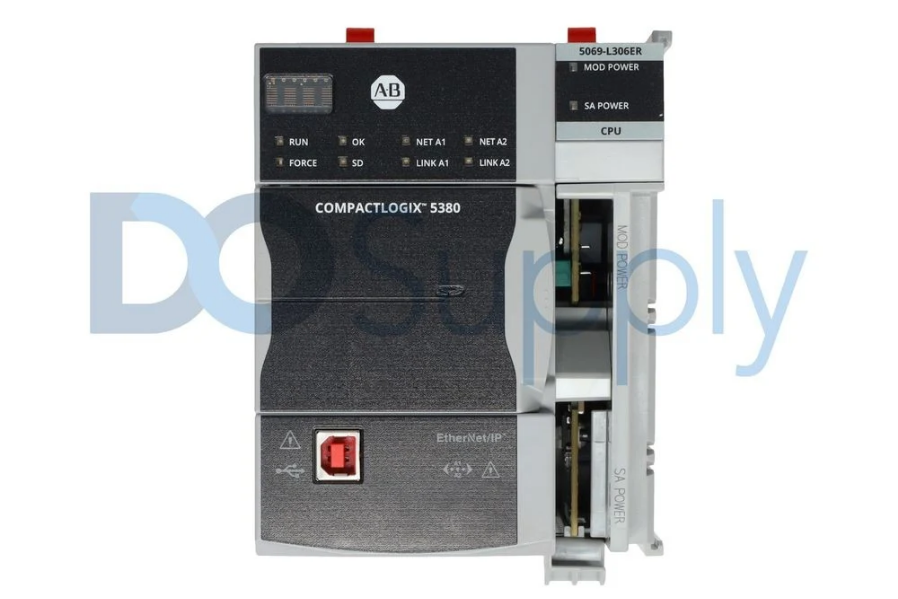
The CompactLogix 5380 offers standard memory from 0.6 to 10 MB, with safety memory from 0.3 to 5 MB on Compact GuardLogix variants. For a machine-level application with 200 I/O points, 8 motion axes, and several hundred rungs of logic, 10 MB is sufficient. The ControlLogix 5580 offers 3 to 40 MB standard, with safety memory from 1.5 to 6 MB.
For example, a water treatment facility running 150 PID loops with PlantPAx 5.0 AOIs, each consuming 15–25 KB, exhausts 3.75 MB on AOI instances alone before custom logic, alarm routines, or historian tags are added. The 5580 handles this with headroom; the 5380 does not.
Axis Count and Motion Architecture
The CompactLogix 5380 supports up to 32 axes of integrated motion over EtherNet/IP, sufficient for delta robot cells, multi-axis labelers, and synchronized packaging lines. The ControlLogix 5580 supports up to 100 axes, powered by a dual-core CPU that significantly improves the execution of axis trajectory planners. Automotive assembly lines, semiconductor wafer handling systems, and high-speed web printing presses routinely require coordinated motion across 60–100 axes. This is not a tuning problem or a programming challenge for the 5380; it is a hard platform limit that categorically excludes the CompactLogix from these applications.
EtherNet/IP Node Capacity and Network Scalability
The Compact GuardLogix 5380 supports up to 180 EtherNet/IP nodes. For a machine-level application, this is generous; most machines connect fewer than 60 EtherNet/IP devices. The GuardLogix 5580 supports up to 250 nodes. In a plant-wide architecture anchoring distributed remote I/O panels, VFDs across multiple conveyor sections, safety devices across multiple work cells, and process instruments, node counts exceeding 180 are routine. The 5580’s higher ceiling, combined with improved communication rates from its dual-core processor, prevents message-queue saturation and RPI jitter that arise when a controller approaches its connection limit.
Safety Architecture: SIL Levels and Integration Depth
Both platforms support functional safety. The Compact GuardLogix 5380 achieves SIL 2/PLd with a 1oo1 architecture and SIL 3/PLe with a 1oo2 architecture, requiring a safety partner. For machine safety, guarding, emergency stops, and safety-rated speed monitoring, this is cost-effective and appropriate. The GuardLogix 5580 achieves SIL CL 3/PLe with a primary controller and a safety partner. Still, it is specifically optimized for faster safety reaction time, providing the timing margin critical in high-speed processes where a safety function must respond within 10–20 ms. The 5580 also supports networked safety, integrated with Kinetix 5700 and PowerFlex 755 Advanced Safety drives, enabling safe torque off and safe limited speed at the drive level, which is essential for large multi-axis systems where hardwired safety I/O per axis is impractical.
Redundancy: A Capability That Only Exists on One Platform
Controller redundancy is an absolute differentiator. The ControlLogix 5580 supports redundant configurations, with primary and secondary controllers maintaining synchronized program state for bumpless failover in the event of a hardware fault. This is essential where an unplanned controller outage costs tens of thousands of dollars per hour, or where process safety requires continuous control without manual intervention. Oil and gas separation trains, pharmaceutical batch reactors under FDA validation, and continuous casting lines require redundancy as a baseline. The CompactLogix 5380 has no redundancy capability. If a 5380 fault occurs, the machine stops. For a standalone packaging machine, this is acceptable; for a critical process unit, it is not. This single gap categorically excludes the 5380 from high-availability applications, and the 5580’s implementation carries no memory penalty for enabling redundancy.
Environmental and Hazardous Location Variants
Both platforms offer conformal coating for corrosive atmospheres. The ControlLogix 5580 further extends environmental capabilities with two specialized variants that the 5380 cannot match. The Extreme Temperature controller operates from -25 to +70°C with convection cooling, is tested to ANSI/ISA-S71.04-1985 Class G3, and is targeted for outdoor installations, unheated enclosures, and high-ambient environments such as foundry floors. The No Stored Energy controller is intended for applications where the installed controller must deplete residual stored energy before being transported into or out of the application. Rockwell specifies that the residual stored energy depletes to 400 µJ or less in 40 seconds. It carries TÜV Rheinland IEC 62443-4-2 certification, the most rigorous cybersecurity standard for industrial controllers. For Ex Zone 2 (Division 2) areas, the 5380 requires a purge-and-pressurization enclosure; the 5580 No Stored Energy controller eliminates that requirement by design.
Security Architecture and CIP Security Implementation
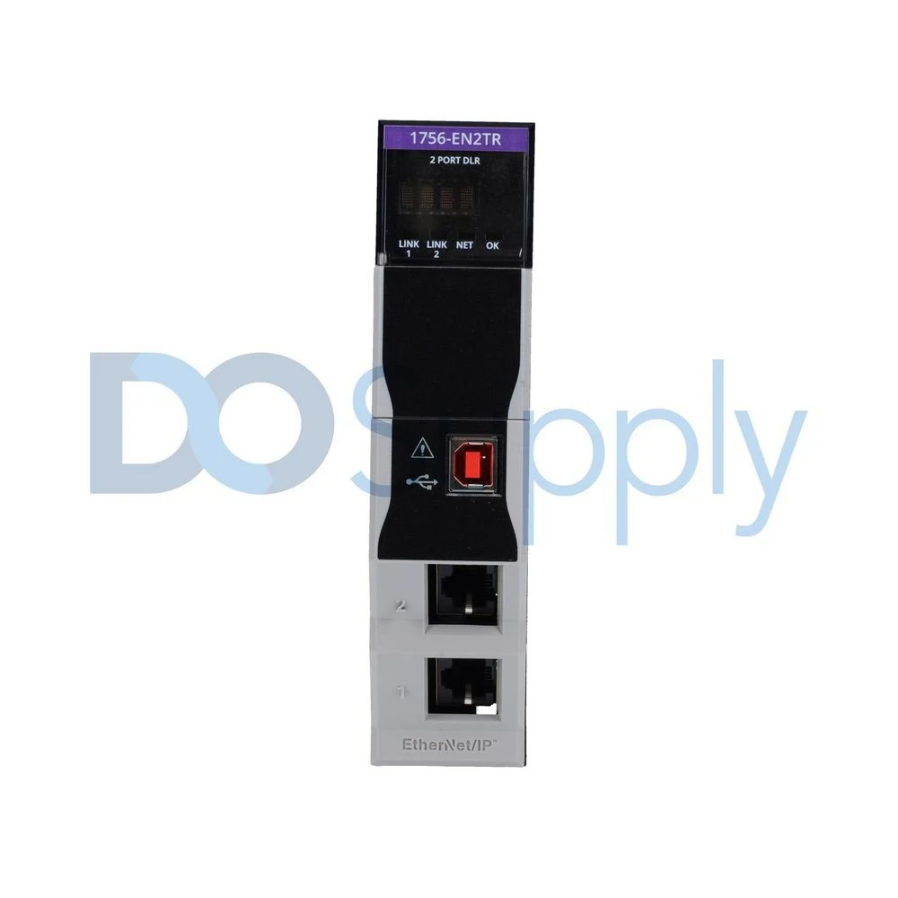
The CompactLogix 5380 incorporates CIP, providing device authentication, data integrity, and data confidentiality over EtherNet/IP. It includes controller-based change detection and logging, encrypted firmware, and role-based access control to routines and AOIs, a comprehensive security posture for machine-level applications. The ControlLogix 5580 extends this to the enterprise level with centralized authentication, ISO 27001 certification covering its development and maintenance processes, and a vulnerability management process aligned to IEC 29147 and IEC 30111. For OT/IT-converged architectures in pharmaceutical, oil and gas, or water utility environments, where security audits examine the full supply chain and vulnerability disclosure process, the 5580’s documented security posture addresses requirements that the 5380 does not formally cover.
Physical Footprint, Chassis Architecture, and Installation Constraints
The CompactLogix 5380 mounts on DIN rail, connects directly to up to 31 Compact 5000 I/O modules, and includes dual configurable Ethernet ports supporting dual-IP addressing. Its small footprint is purpose-built for machine control panels where space is measured in centimeters. The ControlLogix 5580 uses the 1756 chassis with up to 17 slots in standard and conformal-coated variants. The 1756 Slim Power Supply for Series B and C chassis reduces width by 29%, which is meaningful when a fully populated redundant chassis occupies significant panel real estate. The chassis architecture co-locates the controller with communication, motion, and bridge modules on the 1756 backplane, enabling inter-module communication at backplane speeds without additional network hops, an advantage in systems where latency between the controller and a ControlNet bridge or HSL motion module affects scan time.
Where the Decision Actually Lands
The performance gap manifests at specific, non-negotiable decision points. If the application requires more than 32 axes, the 5380 is eliminated. If controller redundancy is required, the 5380 is eliminated. If it requires hazardous location operation without an enclosure, the 5380 is eliminated. If a complex process program exceeds 10 MB, the 5380 is at risk. If it requires operation at extreme temperatures above 60°C, the 5380 has no suitable variant. Outside these boundaries, the CompactLogix 5380 is not a compromise; it is the appropriate tool, delivering genuine performance for machine control, safety-integrated packaging lines, and self-contained process skids without the cost and footprint of the 5580.
In conclusion, the ControlLogix 5580 and CompactLogix 5380 are complementary platforms with defined, non-overlapping roles at the upper boundary of their capabilities. The 5380 excels within its scope. The ControlLogix 5580 is the correct specification when the application is large, uptime is non-negotiable, the environment is extreme, or the system must scale over a decade without a platform change. Matching the platform to quantified application requirements, rather than to brand familiarity or budget pressure alone, determines whether the system performs reliably throughout its full operational life. If you’re interested in learning more, we do have a MicroLogix vs CompactLogix blog here!
We at DO Supply carry a wide range of Allen-Bradley ControlLogix, CompactLogix, GuardLogix, I/O, communication modules, and related automation components to help keep those systems running. Whether you are replacing a failed controller, expanding existing architecture, or sourcing legacy and current Allen-Bradley hardware, our team can help you find the right part for the job. Browse our inventory today or contact us for help locating the components your system depends on.
DO Supply Inc. makes no representations as to the completeness, validity, correctness, suitability, or accuracy of any information on this website and will not be liable for any delays, omissions, or errors in this information or any losses, injuries, or damages arising from its display or use. All the information on this website is provided on an "as-is" basis. It is the reader's responsibility to verify their own facts.