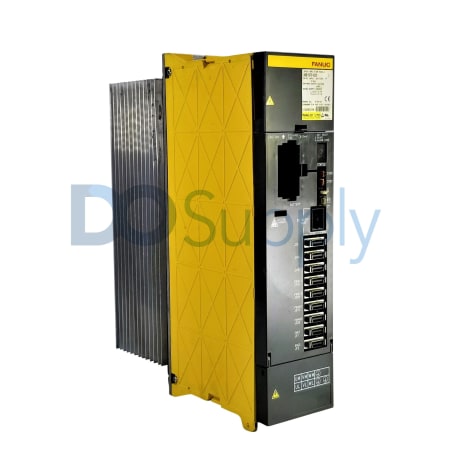
Product image is representative; revision or series may vary. Contact us to request a specific version.
A06B-6079-H208
The FANUC A06B-6079-H208 is a precise servo amplifier designed for CNC systems. This dual-axis drive operates at an input voltage of 230 V and has a rated current capacity of 2-80/80 A, allowing efficient control of your CNC machinery.
-
We sell industrial automation parts backed by our free 2-Year DO Supply Warranty.
-
Same-day domestic and fast international shipping with UPS, FedEx, DHL, and more.
-
AMEX, Visa, MasterCard, Discover, wire transfer, net terms, and more.
-
Repairs and exchanges are available for all automation products.
- Reseller Options
Drop shipping, blind shipping, and account shipping with no extra fees.
Technical specifications for A06B-6079-H208
| Manufacturer | FANUC |
|---|---|
| Product Type | Servo Amplifier (Servo Drive) |
| Product Line | A06B |
| Part Number | A06B-6079-H208 |
| Weight | 14.56 lbs (6.61 kg) |
| Application | CNC Systems |
| Cooling Method | Air Cooled |
| Mounting | Vertical/Wall-mounted |
| Rated Current | 2-80/80 A |
| Frequency | 50/60 Hz |
| Control Type | PWM Interface |
| Operating Temperature | 0°C to 55°C |
| Input Voltage | 230 V |
| Protection Features | Overload, Overcurrent, Overvoltage Protection |
| Axis | Dual axis drive |
The A06B-6079-H208 from FANUC is a robust servo drive engineered for CNC system applications. Engineered for reliability, it operates effectively at a 230 V input voltage. This servo amplifier supports a rated current range between 2 and 80 A for each axis, capable of managing dual axes simultaneously.
This component is compact, weighing 6.60 kg, and designed for vertical or wall mounting. Its air-cooled design facilitates heat dissipation, ensuring the unit remains operational under varying conditions. It functions within a frequency spectrum of 50 or 60 Hz, making it versatile for different setups.
Thermal performance is further enhanced with an operating temperature range from 0°C to 55°C. The A06B-6079-H208 also incorporates essential protection systems that guard against overload, overcurrent, and overvoltage, thus securing the integrity of connected systems. Control is achieved via a PWM interface, allowing for precise operation adjustments, making it a reliable choice for users looking to optimize their CNC capabilities.
- A068-6079-H208
- A0686079H208
- A06B-6079-H20B
- A06B-6079-H2O8
- A06B-6O79-H208
- A06B6079H208
- A06B6079H20B
- A06B6079H2O8
- A06B6O79H208
- AO68-6O79-H2OB
- AO686O79H2OB
- AO6B-6079-H208
- AO6B-6O79-H2O8
- AO6B6079H208
- AO6B6O79H2O8