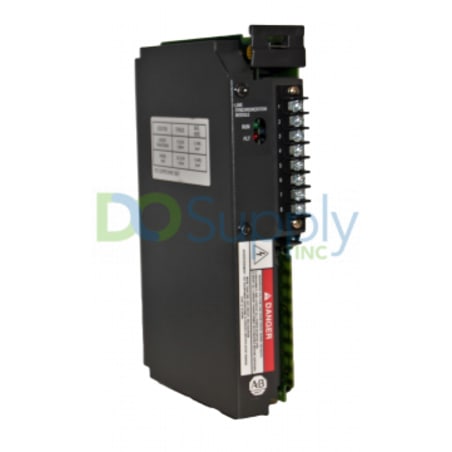
Product image is representative; revision or series may vary. Contact us to request a specific version.
1402-LS51
The 1402-LS51 is a Line Synchronization Module that is designed in incompatibility with Allen Bradley’s 1771 PLC series. This module is a Two (2) slot module with the same form factor as the 1771 series. This module is capable of measuring 5 A, full-scale current, and 100/120 VAC voltage. It is mainly utilized to synchronize different 3-phase systems, capable of performing engine governor control and acting as a multi-function power metering device.
-
We sell industrial automation parts backed by our free 2-Year DO Supply Warranty.
-
Same-day domestic and fast international shipping with UPS, FedEx, DHL, and more.
-
AMEX, Visa, MasterCard, Discover, wire transfer, net terms, and more.
-
Repairs and exchanges are available for all automation products.
- Reseller Options
Drop shipping, blind shipping, and account shipping with no extra fees.
Technical specifications for 1402-LS51
| Manufacturer | Allen Bradley |
|---|---|
| Product type | Line synchronization module |
| Product Line | NEMA Controller Operator Kit |
| Part Number | 1402-LS51 |
| Weight | 7.44 lbs (3.37 kg) |
| Compatible systems | 3-phase systems |
| Series | Power Monitoring Protection and Management Products |
| Mounting chassis | Standard 1771 I/O chassis |
| Module Type | Line Synchronization Module |
| Slots | 2 |
| Current | 0 to 5A RMS Cont., 200A RMS 1 Second |
| Equipment type | Solid-state |
| Frequency | 40 to 100 Hz (steady-state) |
| Open or closed equipment | Open |
| Dielectric Withstand Voltage | 2500V RMS |
| Operating temperature | 0 to 60 degrees Celsius |
| Current Input Burden | 0.05 VA |
| Voltage | 0.05% steps |
| Voltage Input Impedance/Burden | 728K /0.02 V |
| Phase | 1 degree step |
| Backplane current draw | 1.1A at 5V DC (2.2A, 5 ms Inrush) |
| Update rate | Synchronizing Bus Error Parameters — 100 milli-seconds; Load Share and Monitor Parameters — 200 milliseconds (Synchronization Inactive); 1 second (Synchronization Active) |
The Allen Bradley 1402-LS51 is a Line Synchronization Module. This module is mainly utilized to synchronize Two (2) different 3-phase systems. This module is a dual-slot module that directly mounts to a 1771 chassis of Allen Bradley. The 1402-LS51 provides automatic synchronization, load sharing, and high-speed power system monitoring. The 1402-LS51 can perform voltage match error in steps of 0.05 percent; frequency match error, or slip in 0.01 Hz resolution; synchronizing bus to reference bus phase match error in a resolution of 1 degree; load sharing error that is measured in scalar quantity between 0.000 and +/- 1.000). The module’s synchronization feature provides a variety of status feedbacks such as frequency within limits; voltage within limits; phase within limits; synchronization mode conflict failure; phase rotation mismatch failure (3 phase synchronization mode only) no reference bus voltage present failure; no synchronizing bus voltage present failure; reference bus over-voltage failure and synchronizing bus over-voltage failure. The power meter capabilities of this module include an extensive range of measurable and calculated parameters specifically, current in Amps (per phase & neutral); average current in amps; positive sequence current in amps; negative sequence current in Amps; percent current unbalance voltage in Volts (per phase L–L, also L–N on 4–wire systems); average voltage in volts (L–L, also L–N on 4–wire systems); positive sequence voltage in volts negative sequence voltage in volts; percent voltage unbalance; frequency in Hz; phase rotation (ABC, ACB); power factor in percent (total, also per phase on 4–wire systems) watts (total & per phase on 4–wire systems; VA (total & per phase on 4–wire systems); VAR (total & per phase on 4–wire systems); power consumption in kW hours reactive power consumption in kVAR hours and demand (Amps, VA, & Watts).
The 1402-LS51 module is a line synchronization module that is manufactured by Allen Bradley/Rockwell Automation. The Allen Bradley 1402-LS51 line synchronization module is a solid-state module, not a hardwired electromechanical module, which means that it is suitable for use in a variety of industrial applications, but it should not be used for safety functions that require sudden surges in power such as emergency stopping. Attempting to use this solid-state module for emergency functions may damage it, cause it to malfunction, fail to avert the emergency situation or error that it was used to respond to, or cause injury to the users. The purpose of the Allen Bradley 1402-LS51 line synchronization module is to synchronize 2 different 3-phase systems through functions like load sharing, automatic synchronization, and high-speed power system monitoring. The Allen Bradley 1402-LS51 line synchronization module has 2 slots and it can be mounted in standard 1771 I/O chassis that are also manufactured by Allen Bradley. It can be used as a multi-function digital power monitor for the 2 systems that it is being used to synchronize. It measures all the appropriate parameters from the 2 connected 3-phase systems so that it can provide the appropriate error and control signals for the synchronization process. Always install the Allen Bradley 1402-LS51 line synchronization module in a dry and clean industrial environment that contains no strong magnetic fields, strong electrical fields, or sources of constant high heat. This synchronization module should only be used in an operating temperature range of 0 to 60 degrees Celsius. It can be installed in a local rack to make its data transfer rate as efficient as possible.
- 1402-LS5I
- 1402LS51
- 1402LS5I
- 14O2-LS51
- 14O2LS51
- 1A02-LS51
- 1A02LS51
- I402-LS51
- I402-LS5I
- I402LS51
- I402LS5I
- IAO2-LS5I
- IAO2LS5I
Does the 1402-LS51 come with a warranty?
Yes, the 1402-LS51 includes a free 2-year DO Supply warranty. You can upgrade to a 3-year warranty at checkout for even more protection.
What is the measured current of the 1402-LS51?
The 1402-LS51 measured current is 5 Amperes, full-scale.
What is the measured phase voltage of the 1402-LS51?
The 1402-LS51 measured phase voltage is 100/120 VAC.
What is the form factor of the 1402-LS51?
The 1402-LS51 is a dual-slot module that directly install to the 1771 chassis.
The 1402-LS51 module is a line synchronization module that is manufactured by Allen Bradley/Rockwell Automation. The purpose of the Allen Bradley 1402-LS51 line synchronization module is to synchronize 2 different 3-phase systems through functions like load sharing, automatic synchronization, and high-speed power system monitoring.