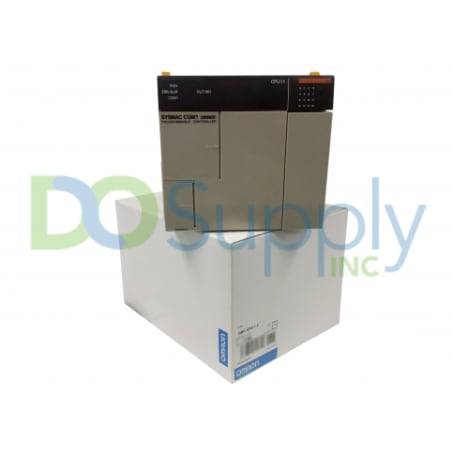
Product image is representative; revision or series may vary. Contact us to request a specific version.
CQM1-CPU11-E
Part number CQM1-CPU11-E from Omron Automation & Safety is a CPU unit with robust capabilities for automation control. It supports a maximum of 128 I/O points and can connect up to 7 units simultaneously. With a program capacity of 3.2K words and a DM capacity of 1k words, it offers efficient processing and storage capabilities. The CPU unit operates on a low current consumption of 800 mA, making it energy-efficient. It employs the Ladder diagram programming language and executes instructions at impressive speeds. The unit includes 24 VDC inputs with 16 points for various input applications. The approximate weight of this device is 0.52 kilograms.
-
We sell industrial automation parts backed by our free 2-Year DO Supply Warranty.
-
Same-day domestic and fast international shipping with UPS, FedEx, DHL, and more.
-
AMEX, Visa, MasterCard, Discover, wire transfer, net terms, and more.
-
Repairs and exchanges are available for all automation products.
- Reseller Options
Drop shipping, blind shipping, and account shipping with no extra fees.
Technical specifications for CQM1-CPU11-E
| Manufacturer | Omron |
|---|---|
| Product Line | CQM1 |
| Part Number | CQM1-CPU11-E |
| Weight | 0.06 lbs (0.03 kg) |
| Model Type | CPU Unit |
| Maximum I/O points | 128 pts |
| Max. units connected | 7 units max |
| Program capacity | 3.2K words |
| DM capacity | 1k words |
| Current consumption | 800mA |
| Control method | Stored program method |
| Data memory | 1,024 words (DM 0000 to DM 1023) plus DM 6144 to DM 6655 (read-only) |
| Interrupt processing | External interrupts: 4 Scheduled interrupts: 3 |
| Communication port | RS-232C port |
| Input Voltage built-into CPU unit | 24 VDC +10%/--15% |
| Input Impedance IN4 and IN5 | 2.2 kΩ; other inputs: 3.9 kΩ |
| Input Current IN4 and IN5 | 10 mA typical; other inputs: 6 mA typical (at 24 VDC) |
| ON/OFF Delay Default | 8 ms max. (can be set between 1 and 128 ms in PC Setup) |
Manufactured by Omron Automation & Safety, catalog number CQM1-CPU11-E is a powerful CPU unit designed to cater to a wide range of control applications. With a maximum of 128 I/O points, it offers versatility and flexibility in handling various input and output devices. The CPU unit allows a maximum of 7 units to be connected, enabling the creation of complex control systems. This CPU unit boasts a program capacity of 3.2K words, ensuring sufficient memory for storing extensive control logic. The data memory (DM) capacity is 1k words, providing ample space for storing data and intermediate values during program execution. Operating with a current consumption of 800mA, it maintains an optimal balance between performance and energy efficiency. The control method used by the Omron CQM1-CPU11-E is the stored program method, where the control logic is written in the ladder diagram programming language. The instruction length varies from 1 step per instruction to 1 to 4 words per instruction, enabling efficient and compact programming. The CPU unit executes various instructions with execution times ranging from 0.50 to 1.50 μs for basic instructions and 24 μs for special instructions such as the MOV instruction. With 117 instructions available, including 14 basic types, it can handle various control tasks with precision and speed. The data memory offers 1,024 words in the DM 0000 to DM 1023 range and an additional read-only section from DM 6144 to DM 6655, further expanding its data storage capabilities. The CPU unit supports four external and three scheduled interrupts for interrupt processing, facilitating responsive and event-driven control. The Omron CQM1-CPU11-E features an RS-232C port for seamless communication with external devices, enhancing connectivity and data exchange capabilities. Weighing only 0.52 kg, it is lightweight and easy to handle during installation and maintenance. Additionally, the CPU unit has built-in 24-VDC inputs, offering 16 points for various input devices. It can accommodate different input requirements for enhanced control precision with configurable ON/OFF delays and specific voltage ranges.
- CQM1-CPU1I-E
- CQM1-CPUI1-E
- CQM1CPU11E
- CQM1CPU1IE
- CQM1CPUI1E
- CQMI-CPU11-E
- CQMI-CPUII-E
- CQMICPU11E
- CQMICPUIIE