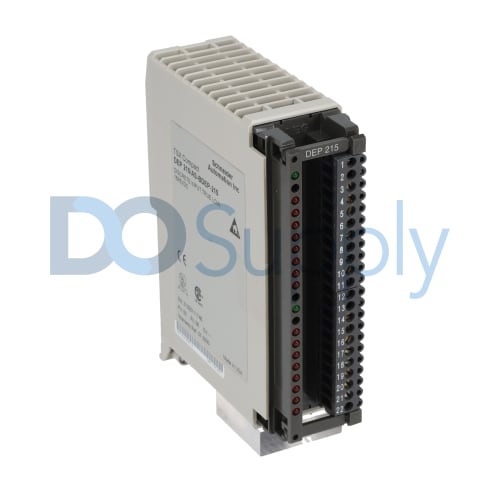
Product image is representative; revision or series may vary. Contact us to request a specific version.
AS-BDEP-215
The Schneider Electric AS-BDEP-215 is a discrete input module designed for versatile applications. It accommodates up to 16 inputs, organized into two distinct groups of eight, and utilizes optocouplers for input isolation, ensuring reliability and signal integrity.
-
We sell industrial automation parts backed by our free 2-Year DO Supply Warranty.
-
Same-day domestic and fast international shipping with UPS, FedEx, DHL, and more.
-
AMEX, Visa, MasterCard, Discover, wire transfer, net terms, and more.
-
Repairs and exchanges are available for all automation products.
- Reseller Options
Drop shipping, blind shipping, and account shipping with no extra fees.
Technical specifications for AS-BDEP-215
| Manufacturer | Schneider Electric |
|---|---|
| Product Type | Discrete Input Module |
| Product Line | TSX COMPACT |
| Part Number | AS-BDEP-215 |
| Weight | 0.81 lbs (0.37 kg) |
| Number of Inputs | 16 |
| Input Grouping | 2 groups of 8 inputs each |
| Input Isolation | Optocoupler per input |
| External Power Requirement | 5 V DC for eight inputs |
| Input Signal Type | Sinking device |
| Internal Power Source | 5 V, 25 mA maximum (from I/O bus) |
| Power Dissipation | 2 W (typical) |
| False Condition Signal Range | 4 to 5 V DC |
| True Condition Signal Range | -1 to +2 V DC |
| True Condition Input Current | 3.5 mA at 0 V DC |
| Response Time | 1 ms (typical) |
| Operating Logic | Active low (True Low) |
| Wiring Specifications | 14 AWG (single wire), 20 AWG (two wires) |
The AS-BDEP-215 model from Schneider Electric's TSX COMPACT series functions as a discrete input module featuring a total of 16 inputs. These inputs are intelligently divided into two separate groups, each containing eight inputs. For enhanced isolation, an optocoupler is present for each input, thereby ensuring that signals remain unaffected by external noise.
To function properly, the module mandates an external power supply of 5 V DC for the first eight inputs provided. It operates utilizing a sinking device signal type to transfer information back to the control system. Internally, the module derives power from the I/O bus, which provides a maximum of 25 mA at 5 V.
The power dissipation during standard operation is approximately 2 watts, which is typical for this type of application. The input voltage ranges for determining signal conditions are strictly defined: false conditions are recognized within a voltage range of 4 to 5 V DC, while true conditions are detected between -1 to +2 V DC. When there is a 0 V DC signal, the true condition input current is measured at 3.5 mA.
In terms of responsiveness, the input module provides a reaction time of around 1 ms, ensuring quick adaptation to changes in input signals. The operating logic for this module is classified as active low (True Low), which means the inputs are considered to be active when the voltage is in the low range. Wiring for the device adheres to specific specifications, with recommended sizes of 14 AWG for single wires and 20 AWG for wiring configurations that use two wires.
- AS-8DEP-215
- AS-8DEP-2I5
- AS-BDEP-2I5
- AS8DEP215
- AS8DEP2I5
- ASBDEP215
- ASBDEP2I5