The terms artificial intelligence (AI) and machining learning are used interchangeably by many, and sometimes even tech professionals and enthusiasts find it hard to draw a line between the two. There is a good reason for this; Machine Learning is a subset of AI, specifically a derivative branch of study that deals with large sets of data. Machine learning is a specialized branch of AI. If you have read about AI and machine learning in the news you may have come across the phrase, “all machine learning is AI but not all AI s machine learning.” AI is defined as a broad aspect of computer science and engineering that aims at ultimately enabling computers to do things in a similar way as a human and even surpass them. AI is, therefore, acquisition of knowledge and using it intelligently. The main component of AI is artificial neural networks which are modeled to work similarly to a human brain. On the other hand, machine learning is a more specific field about teaching machines how to...
Thirty years ago, smart technology and home automation were relegated to the realms of science fiction, or the homes of the extremely wealthy. Yet, with the advent of smart home products and systems that are also smart on the wallet, a rise of consumers buying into smart gadgets is at the forefront of the home market. Smart home technology has increasingly been adopted by Millennials and baby boomers. Starter homes, to senior communities, to apartment complexes must have home automation at an affordable price. The smart home market is set to reach $114 billion by 2025, according to Fortune Business Insights Home Automation Market Report. The market for Home Automation has been increasing steadily and is projected to continue The National Association of Realtors trend report states that among the smart home automation makeup, 43 percent are Millennials, 33 percent between the ages of 33-54, and 24 percent are baby boomers (55+). In the National Association of Home Builders (NAHB)...
This may be your first time reading about CIP safety. Welcome, we will talk about how this protocol works as well as its similarities and differences with standard communication protocols. While this will be a technical overview, we will not discuss safety programming specific topics, but instead an overall picture of how CIP safety fits into the evolving industrial automation industry. Over the past decade, with the advancements from hard-wired safety relays to programmable network-monitored safety devices, it is necessary to understand how this technology works and how you can benefit. It is important that everyone from business managers to engineers understand how this technology can be used to save cost as well as increase safety. What is CIP Safety? Is there special hardware for CIP Safety? Does CIP Safety communicate differently to a PLC (Programmable Logic Controller)? How is CIP Safety used in Industrial Automation? Are there programming differences when using CIP Safety? So...
Having the correct I/O module for your application is crucial to keep the communication and information flowing effectively and safely. Point and Flex I/O modules are both distributed I/O systems designed for use with modular Allen-Bradley automation systems but there are many models that are particularly suited for specific applications. Here you can compare and contrast the two, so you can make the best purchase decision. Allen-Bradley provides a large selection of models that will fit any type of system to meet the needs of anyone using I/O systems. Here are a few key features of the Point I/O modules: Easy to Install, and have a small footprint Comes in digital, analog, specialty, and safety-rated models Choice of Termination in Input and Output Modular Network Interface Independent I/O Selection The installation of the Point I/O modules are super easy. They are designed to be put together and have an outer shell that provides many places and ways to attach it to wherever it needs...
Today, we’re going to take a look at Allen-Bradley’s popular CompactLogix and ControlLogix processor lines. The ControlLogix and CompactLogix are Allen-Bradley’s most popular lines of Automation controllers. The ControlLogix is designed for larger, more demanding systems, requiring higher I/O counts. The CompactLogix, with its smaller, more affordable frame, is better suited to smaller applications. Here, we will examine the differences in detail. The CompactLogix line sports two variants – modular chassis-free system and all-in-one controller with a chassis. The most popular all-in-one controllers are CompactLogix L23, L1XER, and L2XER. If you’ve used CompactLogix processors, you might have heard of these, as they were best-selling processors in the line. For the modular systems, the L30ER, L33ER, L32X, and L35X are the best-selling components. The packaged CompactLogix processors are ready for work out-of-the-box, which is their main advantage. Conversely, the modular L3 models...
The electric motor represents a crucial part of any electrical drive system. Without the electrical motor, the whole system wouldn’t function. However, in order to work properly, even the most advanced motor needs some kind of controller. Usually, system designers and engineers take advantage of a VFD (Variable Frequency Drive). Choosing and purchasing the right VFD for your system can be a daunting task. You need to take into an account all the different variables and features of your chosen VFD to make it work properly. Luckily, over the last 30 years, VFDs have become cheaper and more reliable than ever, to the point that upwards of 40% of all newly-installed motors now include the technology. To make your decision easier, we prepared a special buyer’s guide for the right variable frequency drive. We’re going to give you some general tips on what to look for when buying, in order to make the buying process a bit less time-consuming. Allen-Bradley 1336-Series Adjustable Frequency...
When it comes to the process automation and advanced system design, PLCs, SCADA, and HMIs play crucial roles. A PLC is a hardware-based device, SCADA is a system that works in conjunction with the PLC. But, an HMI is also a system that works in conjunction with a PLC. Since the SCADA system and an HMI can complete more or less the same functions, it’s crucial that you know the difference between these two. In this article, we’ll talk about each of them and explain their functions. Furthermore, we’ll discuss how they work together in a seamless system that controls different functions. We suggest that you grab a cup of coffee– it’s going to be a long read! SCADA didn’t get its name by luck, it is actually an abbreviation that stands for Supervisory Control and Data Acquisition. As we said earlier, it’s a system that has both software and hardware elements and is usually used for a couple of things: Control of various processes from a remote location or locally Interaction with sensors...
We use both AC and DC current on a daily basis for digital electronics and various power outlets. However, people still don’t know the basic differences between these two, and why we need both. With that in mind, we’re going to examine some of the key differences between AC and DC, as well as talk about their use in our everyday lives. allaboutcircuits.com Alternating Current is nothing more than a periodical change in direction of the flow of charge. Simply put, alternating current is here to describe the flow of the electricity through the conductor. As its name suggests, the flow of the current is periodically changed, reserving the voltage level along with it. Alternating Current is supplied to households and office buildings and can be converted to direct current if needed. Can you generate an Alternating Current? Of course, you can. The most popular device for generating AC is called an alternator. Inside the alternator is a magnetic field as well as a loop of wire which is spun...
2018 was an exciting year in the realm of technological advancements, surpassing even the most expertly stated expectations. In October 2017, international business consulting firm Gartner published their predictions for the top strategic technology trends in 2018. A year later, in October 2018, Forbes Technology Council convened a panel of experts to offer their take on the most disruptive technology breakthroughs of 2018. A comparison of Gartner’s forecast to the Council’s retrospective provides clues for what may be in store in 2019. If trends hold, it could be an even more explosive year. Gartner is a research and advisory company that operates in 100 countries and serves 15,000 client organizations across the globe. Based on their interactions with these clients, Gartner generated the insights which informed their Top 10 Strategic Technology Trends for 2018 , a report they released in October of 2017. Making sense of a surging technological landscape that continues to bloom so...
While the topic of climate change is controversial in this day and age, it is generally accepted that mass production efforts can do more to clean and maintain the lands and oceans of our planet. As catastrophes like wildfire, famine, and powerful storms drive discussion and incite passion in the world’s population, great minds are finding ways to utilize the latest technologies in hopes of creating positive outcomes for the environment. One such technology making the leap from idea to action is blockchain. A concept first applied to the cryptocurrency Bitcoin, blockchain is a “distributed ledger technology” that is designed to make transactional data transparent, decentralized, and verifiable. Applied to projects focused on helping to sustain the environment, blockchain could allow for the creation of currency systems based upon trackable data, like carbon emissions from mass production. Trading in these currency systems, producers and consumers would be incentivized to make wiser...
Mass production – the manufacturing of products on a vast scale, based on principles such as interchangeable parts, high-volume assembly lines, and the resulting large-scale production – has been developing since the 1800s. Just as today’s mass production looks very different from the times when steam power was a brand new invention, the technology powering tomorrow’s mass production, and the idea of mass production itself, is also set to be very different. Some of the core concepts of mass production are likely to remain relatively unchanged. The division of labor into specialized tasks to enable minimal handling or positioning, the simplification and standardization of component parts, the development of machines, materials, and processes and finally, planning the entire process from obtaining raw materials through to delivery of the final product will all still need to work in unison to reduce the cost of production while increasing the quality of the products being made. Below we...
Manufacturers have traditionally been at the forefront of technological developments, adopting new practices and technologies to cut down production times, costs, and waste since the early 1900’s. Recent developments in AI, machine learning, connection to the IoT, and blockchain, are already being incorporated into manufacturing businesses. Smart manufacturing is becoming more and more common as it grows through the adoption of sensors throughout production lines and the increased connectivity of machines and systems; it could be said that manufacturing is entering a new golden era of automation. Below is an examination of some of the technology that is changing manufacturing and an examination of how linking these improvements in technology together can further advance the automation of business practices. Many larger manufacturers have been developing AI (Artificial Intelligence) systems that aid robot learning, monitor all parts of the manufacturing process to detect inefficiencies...
We’ve all seen the movies; the year is 2050 and sophisticated robots have gained a mind of their own, taking over the world in a blaze of fire and panic. Whilst the prospect of artificial intelligence is a scary thought in the minds of those who aren’t well versed in current technological trends, the reality is a little less dramatic. However, this is not to say that it’s dull. In fact, AI is perhaps one of the most exciting movements of the 21st century and we’re only just getting started. Artificial Intelligence Well, in simple terms, AI is the ability of a machine or computer program to learn, specifically machines that are able to “think” and act like humans in an intelligent and measured way. With this definition in mind, it is understandable that AI is often still placed in the 21st-century bracket of futurism. However, upon closer inspection, the technology has already been established and is embedded into computerized systems of all kinds. AI is beginning to manifest itself in...
Artificial intelligence (AI) is generating exciting headlines lately. With stories covering seemingly infinite capabilities, from creating expensive art, to keeping the United States of America ahead in the international race to develop cutting-edge weaponry, to helping our homes take care of us, AI can be perceived as having suddenly embedded itself in virtually every aspect of our modern lives. While it is true that AI is a powerful technology with a broad range of business applications, AI is also a young technology still in the earliest stages of development. Due to its potential to achieve intelligence beyond that of humans, it warrants a thoughtful approach to remain beneficial and safe. Image: Digital Wellbeing AI can seem like a nebulous concept to the average person, and separating fact from fiction can be a challenge. The Future of Life Institute (FLI) , a multidisciplinary group of individuals whose mission is “to catalyze and support research and initiatives for...
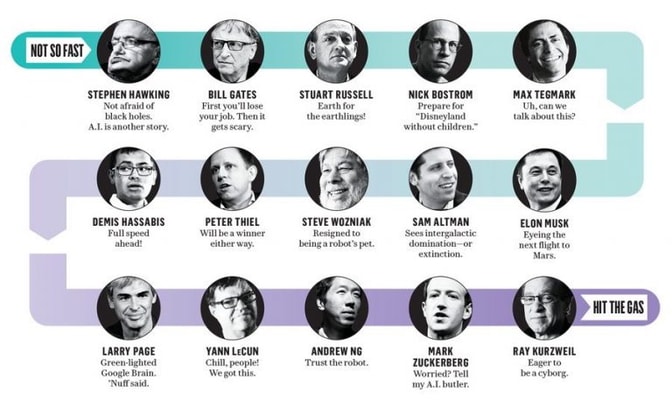
There is a much-hyped debate between two of the world’s most notable tech entrepreneurs, centered on the risks inherent in the rapid development of Artificial Intelligence (AI). This highly publicized row involves the dueling perspectives of Mark Zuckerberg, Founder and Chief Executive Officer of Facebook, and Elon Musk, most notably co-founder and Chief Executive Officer at Tesla and Space Exploration Technologies (also known as SpaceX). Mr. Zuckerberg is optimistic and eager to advance AI as Facebook chases its goal of building a global community, while Mr. Musk is concerned and cautionary about AI’s potential threats to humanity if its growth is unchecked, its power too centralized. Their arguments are compelling and important to understand, as is the nature of AI technology itself. Though the term “AI” is universally known, it is not widely understood by the general public. This could be because AI technology is in its infancy, and much of what the average person knows about AI...