
Allen Bradley
1788-EN2FFR
This linking device features two isolated FOUNDATION Fieldbus H1 Ports and operates with a data rate of 31.25 kbps. It provides a power supply output ranging from 9 to 32 V DC. The device demands 260
Available
Call
Allen Bradley 1788 linking devices are designed to connect different networks. The 1788 series includes Ethernet-to-DeviceNet linking modules and ControlNet-to-DeviceNet linking modules. The 1788 linking devices can be mounted on DIN Rails, panels, or other mounting fixtures. These linking devices provide centralized data storage options for data that is shared by the 2 linked networks. The 1788 linking devices do not require extended or special protocol features to operate.
Browse available units in our catalog of 1788 Linking Devices.
This linking device features two isolated FOUNDATION Fieldbus H1 Ports and operates with a data rate of 31.25 kbps. It provides a power supply output ranging from 9 to 32 V DC. The device demands 260
This linking device supports a maximum ambient humidity of 80% RH without condensation and is constructed for vertical mounting. It dissipates 12.24 Watts of power and has an isolation voltage rating
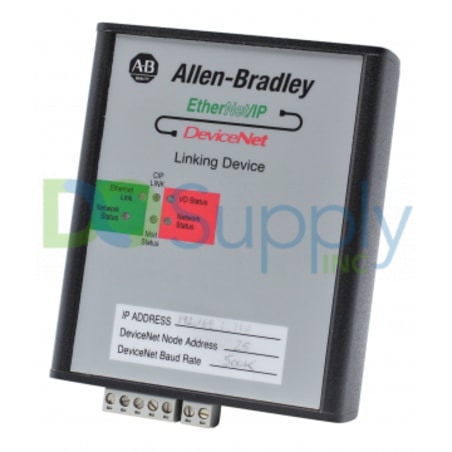
Capable of supporting up to 63 DeviceNet nodes, this linking device operates at Ethernet speeds of 10/100 Mbps. It features two M12 D-Code connectors for Ethernet and two 7/8 inch circular connectors
This linking device supports dual BNC coax ports for ControlNet communication and utilizes an input voltage range of 24–32 VDC. Its power consumption reaches 260 mA under these conditions, with a powe

This device features a central RJ-style interface for network access and includes two node address switches for configuration. The module has LED indicators for both status and diagnostics, ensuring e
This module works within a specified input voltage range of 24 to 32 volts DC. Its power consumption is rated at 260 mA with a power dissipation of 12.24 watts at 24 VDC. The device can handle relativ
Designed as part of the 1788 Linking Devices series, this module accommodates both single and dual ControlNet media options. It supports DLR Ethernet topologies and includes multiple status indicators
Designed for Category 3 wiring, this daughtercard is suitable for environments where temperatures range from 0°C to 60°C during operation. It offers reliable shock resistance rated at 30 g and can wit
This device has four field device drop-line ports and features redundant input and output pairs for trunk ports, enhancing reliability. Rated IP20, it offers an open-type enclosure and is mountable on
This component is designed for linking ControlNet with DeviceNet, supporting an input voltage range from 18V to 32V DC. The device operates at an input current of 500 mA when powered at 24V DC. It inc
The 1788 Linking Devices are manufactured by Allen-Bradley/Rockwell Automation. These devices are used to seamlessly connect information or control-level networks with device-level networks. Consequently, the 1788 Linking Devices help to reduce costs by using existing network structures to access data from other networks on the factory floor. Examples of the 1788 Linking Devices include 4-way Fieldbus junction boxes which provide a fault-tolerant method for connecting field devices to a Profibus-PA or Foundation Fieldbus network, ControlNet-to-Foundation Fieldbus H1 devices which provides an integrated and fast solution for adding Foundation Fieldbus devices to any Logix platform, and EtherNet/IP-to-DeviceNet linking devices which provide a fast and integrated way to add a DeviceNet network to an existing or new system. These devices also require RJ45 connectors for Ethernet connection purposes, DeviceNet connectors that are 0.55 millimeters square, and power connectors that are 0.25 to 2.55 millimeters square. For ControlNet connections, an RG6 connector is necessary.
The Allen-Bradley/Rockwell Automation 1788 Linking Devices have an operating shock of 30 G, a non-operating shock of 50 G, and an insulation voltage of 30 Volts. Additionally, the devices support an open enclosure type and an operating temperature of between a minimum of 0 degrees Celsius and a maximum of 60 degrees Celsius. When being transported or when being stored, these devices should be kept in environments with a surrounding temperature of between a minimum of -40 degrees Celsius and a maximum of 85 degrees Celsius. The 1788 Linking Devices accommodate an operating and non-operating relative humidity of between 5 and 95% without condensation. The Allen-Bradley 1788 Linking Devices can comfortably accommodate an operating vibration of 2 G at a frequency of between 10 Hertz and 500 Hertz. Additionally, the ESD immunity for the devices is 6 kiloVolts for the contact discharge and 8 kiloVolts for the air discharge.