We found 260 posts about Automation Technologies from DO Supply, a global automation parts
reseller focused on hard-to-find and obsolete industrial automation products.
This may be your first time reading about CIP safety. Welcome, we will talk about how this protocol works as well as its similarities and differences with standard communication protocols. While this will be a technical overview, we will not discuss safety programming specific topics, but instead an overall picture of how CIP safety fits into the evolving industrial automation industry. Over the past decade, with the advancements from hard-wired safety relays to programmable network-monitored safety devices, it is necessary to understand how this technology works and how you can benefit. It is important that everyone from business managers to engineers understand how this technology can be used to save cost as well as increase safety. What is CIP Safety? Is there special hardware for CIP Safety? Does CIP Safety communicate differently to a PLC (Programmable Logic Controller)? How is CIP Safety used in Industrial Automation? Are there programming differences when using CIP Safety? So...
When it comes to the process automation and advanced system design, PLCs, SCADA, and HMIs play crucial roles. A PLC is a hardware-based device, SCADA is a system that works in conjunction with the PLC. But, an HMI is also a system that works in conjunction with a PLC. Since the SCADA system and an HMI can complete more or less the same functions, it’s crucial that you know the difference between these two. In this article, we’ll talk about each of them and explain their functions. Furthermore, we’ll discuss how they work together in a seamless system that controls different functions. We suggest that you grab a cup of coffee– it’s going to be a long read! SCADA didn’t get its name by luck, it is actually an abbreviation that stands for Supervisory Control and Data Acquisition. As we said earlier, it’s a system that has both software and hardware elements and is usually used for a couple of things: Control of various processes from a remote location or locally Interaction with sensors...
We use both AC and DC current on a daily basis for digital electronics and various power outlets. However, people still don’t know the basic differences between these two, and why we need both. With that in mind, we’re going to examine some of the key differences between AC and DC, as well as talk about their use in our everyday lives. allaboutcircuits.com Alternating Current is nothing more than a periodical change in direction of the flow of charge. Simply put, alternating current is here to describe the flow of the electricity through the conductor. As its name suggests, the flow of the current is periodically changed, reserving the voltage level along with it. Alternating Current is supplied to households and office buildings and can be converted to direct current if needed. Can you generate an Alternating Current? Of course, you can. The most popular device for generating AC is called an alternator. Inside the alternator is a magnetic field as well as a loop of wire which is spun...
2018 was an exciting year in the realm of technological advancements, surpassing even the most expertly stated expectations. In October 2017, international business consulting firm Gartner published their predictions for the top strategic technology trends in 2018. A year later, in October 2018, Forbes Technology Council convened a panel of experts to offer their take on the most disruptive technology breakthroughs of 2018. A comparison of Gartner’s forecast to the Council’s retrospective provides clues for what may be in store in 2019. If trends hold, it could be an even more explosive year. Gartner is a research and advisory company that operates in 100 countries and serves 15,000 client organizations across the globe. Based on their interactions with these clients, Gartner generated the insights which informed their Top 10 Strategic Technology Trends for 2018 , a report they released in October of 2017. Making sense of a surging technological landscape that continues to bloom so...
Mass production – the manufacturing of products on a vast scale, based on principles such as interchangeable parts, high-volume assembly lines, and the resulting large-scale production – has been developing since the 1800s. Just as today’s mass production looks very different from the times when steam power was a brand new invention, the technology powering tomorrow’s mass production, and the idea of mass production itself, is also set to be very different. Some of the core concepts of mass production are likely to remain relatively unchanged. The division of labor into specialized tasks to enable minimal handling or positioning, the simplification and standardization of component parts, the development of machines, materials, and processes and finally, planning the entire process from obtaining raw materials through to delivery of the final product will all still need to work in unison to reduce the cost of production while increasing the quality of the products being made. Below we...
Manufacturers have traditionally been at the forefront of technological developments, adopting new practices and technologies to cut down production times, costs, and waste since the early 1900’s. Recent developments in AI, machine learning, connection to the IoT, and blockchain, are already being incorporated into manufacturing businesses. Smart manufacturing is becoming more and more common as it grows through the adoption of sensors throughout production lines and the increased connectivity of machines and systems; it could be said that manufacturing is entering a new golden era of automation. Below is an examination of some of the technology that is changing manufacturing and an examination of how linking these improvements in technology together can further advance the automation of business practices. Many larger manufacturers have been developing AI (Artificial Intelligence) systems that aid robot learning, monitor all parts of the manufacturing process to detect inefficiencies...
We’ve all seen the movies; the year is 2050 and sophisticated robots have gained a mind of their own, taking over the world in a blaze of fire and panic. Whilst the prospect of artificial intelligence is a scary thought in the minds of those who aren’t well versed in current technological trends, the reality is a little less dramatic. However, this is not to say that it’s dull. In fact, AI is perhaps one of the most exciting movements of the 21st century and we’re only just getting started. Artificial Intelligence Well, in simple terms, AI is the ability of a machine or computer program to learn, specifically machines that are able to “think” and act like humans in an intelligent and measured way. With this definition in mind, it is understandable that AI is often still placed in the 21st-century bracket of futurism. However, upon closer inspection, the technology has already been established and is embedded into computerized systems of all kinds. AI is beginning to manifest itself in...
Artificial intelligence (AI) is generating exciting headlines lately. With stories covering seemingly infinite capabilities, from creating expensive art, to keeping the United States of America ahead in the international race to develop cutting-edge weaponry, to helping our homes take care of us, AI can be perceived as having suddenly embedded itself in virtually every aspect of our modern lives. While it is true that AI is a powerful technology with a broad range of business applications, AI is also a young technology still in the earliest stages of development. Due to its potential to achieve intelligence beyond that of humans, it warrants a thoughtful approach to remain beneficial and safe. Image: Digital Wellbeing AI can seem like a nebulous concept to the average person, and separating fact from fiction can be a challenge. The Future of Life Institute (FLI) , a multidisciplinary group of individuals whose mission is “to catalyze and support research and initiatives for...
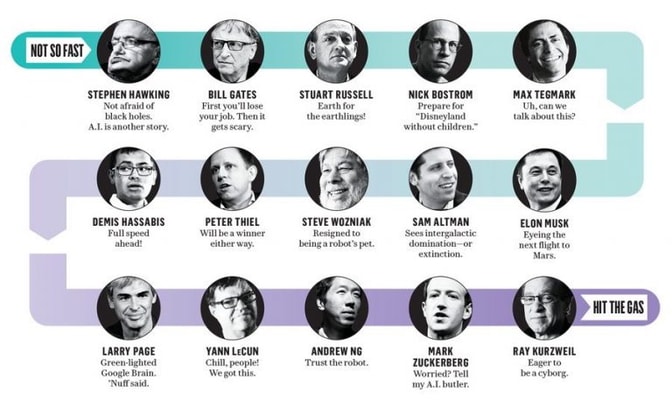
There is a much-hyped debate between two of the world’s most notable tech entrepreneurs, centered on the risks inherent in the rapid development of Artificial Intelligence (AI). This highly publicized row involves the dueling perspectives of Mark Zuckerberg, Founder and Chief Executive Officer of Facebook, and Elon Musk, most notably co-founder and Chief Executive Officer at Tesla and Space Exploration Technologies (also known as SpaceX). Mr. Zuckerberg is optimistic and eager to advance AI as Facebook chases its goal of building a global community, while Mr. Musk is concerned and cautionary about AI’s potential threats to humanity if its growth is unchecked, its power too centralized. Their arguments are compelling and important to understand, as is the nature of AI technology itself. Though the term “AI” is universally known, it is not widely understood by the general public. This could be because AI technology is in its infancy, and much of what the average person knows about AI...
A new paradigm in manufacturing is steadily growing thanks to partnerships among academics, industry leaders, and government entities. In laboratories across the globe, breakthroughs in the engineering of biomaterials are giving glimpses into the future of regenerative medicine, which is a means of treating disease and saving lives that harnesses the power of the body’s ability to heal itself and marries it to cutting-edge technology. As the healthcare and manufacturing industries combine their powers to address a mounting global health crisis, the line between science fiction and science fact is blurred for the benefit of everyone. It wasn’t long ago that tissue and organ transplantations were considered medical breakthroughs. According to the U.S. Department of Health and Human Services, the first transplant of skin occurred in 1869 and the first transplant of a solid organ – a kidney – took place in 1954. In the ensuing decades, the demand for replacement body parts increased...
This article will go over the important points about choosing a SCADA system and evaluate one of the more cost effective solutions out there, Inductive Automation’s Ignition. The customer usually doesn’t mind paying a little more for a system that delivers more performance, has more features, or is more flexible than the competition. Also, the system has a whole has to be taken into account. For example, a SCADA software package could be relatively low in cost but the operating system that the server has to run on may be expensive. Additionally, the database software license may tip the scale too far. Sometimes the SCADA system requires multiple servers that run in tandem multiplying the other “auxiliary” costs across the install, and a lot of times this cost is not discussed or disclosed up-front. The user needs to be a little tech savvy to think of the right questions to ask: how many physical servers, operating system licenses, or how much are client licenses? A lot of times the...
In the midst of the Fourth Industrial Revolution, known colloquially as Industry 4.0, the World Economic Forum (WEF) has released a report titled The Future of Jobs Report 2018 , which forecasts how global employment will be impacted by emerging technologies. Optimistic in its findings, the WEF expects a net positive for job growth as long as businesses, employees, and governments are proactive and agile in their efforts to align human talent with an evolving job market. Rather than being wholly replaced by robots, humans have an opportunity to merge their talents with available technologies for the purpose of enhancing bottom lines, but it is up to businesses and governments to create an environment conducive to sustainable growth. Based in Switzerland, the World Economic Forum (WEF) was founded in 1971 and is a non-political membership organization comprised of the world’s top public and private companies. The WEF focuses its activities on understanding the strategic challenges of:...
Over recent years, there has been an awful lot of hype over the Internet of Things (IoT). We’re told it will transform our lives, bring about the fourth industrial revolution and possibly even improve our work lives and living standards. Less is said about how this will be achieved, or even what the IoT actually is, and why it will benefit our lives. In an age when technology is moving in leaps and bounds, it is important to stay informed about the changes happening to our world. Here we sift the fact from the fiction in order to understand how business can expect to change as the IoT ushers in a new era for us all. In the most basic terms, the IoT is a network of products, both for commercial and consumer use, which are connected to each other and various services or businesses through the internet. These items have chips with sensors inserted into them which are programmed to record and monitor various functions and use. This information is then communicated within a closed network...
Add-on instructions are generally a small, tested, pocket of code that the user wants to reuse multiple times in program(s). This tutorial will go into best practices of add-on instructions, how the add-on instructions work, and it will go through creating a custom add-on instruction. There are some best practices for add-on instructions, which are listed below. Testing: Add-on instructions cannot be changed online so make sure whatever instruction the program is using is tested and will work in a production environment. Again, add-on instructions cannot be changed online. Single Level: It is good practice to write only a single level of add-on instructions, meaning that you should not have add-on instructions within add-on instructions, even though it is possible. Naming: It is good practice to name add-on instructions with a consistent prefix. For example, “ao\_IO\_DigitalOutput” would be an add-on instruction for a digital output. When add-on instructions have a consistent prefix...
There are a few different methods of programming for a Control Logix processor, listed here in the order of most common to least common: Ladder Logic (Most common, Preferred) Function Block Diagram Sequential Function Charts Structured Text In this tutorial, I will go over the different methods and describe how they work. Hopefully, the differences between programming methods will be clear. Each method has its own instruction set. Some are very similar between methods but some instructions are only available in one method versus the other. For example, the PIDE instruction, which is called “Enhanced PID” is only available inside the function block diagram method. In a Control Logix PLC, combinations CAN be used in conjunction with each other. The different routines can access the same tags regardless of method, meaning that a function block diagram can access the same tags as a ladder routine. It is good practice to use one method of programming, but if a different instruction is only...