We found 92 posts about Maintenance from DO Supply, a global automation parts
reseller focused on hard-to-find and obsolete industrial automation products.
Calculate No Load RPM RPM Slip Full load RPM Stator Frequency Frequency (Hz) Number of Poles Slip (RPM) Actual Rated RPM Desired Synchronous RPM Results No-load RPM RPM RPM Slip RPM Full-load RPM RPM Full-load RPM Hz Allen Bradley MPM Servo Motors An electric motor is a device that transforms electrical energy into mechanical energy. Electric motors are used in a variety of industrial applications, to provide mechanical energy to run power tools, fans, electric vehicles, etc. These motors operate on the basis of the electromagnetism principle, which states that: if a current-carrying conductor is placed in a magnetic field, it experiences a mechanical force caused by the attractive and repulsive forces created by the magnetic field. The magnitude of the mechanical force may be obtained as a product of the magnetic field, the current in the conductor, and the length of the coil in the motor. While the direction of motion of the conductor can be determined by Flemings left-hand rule...
Programmable Logic Controllers (PLCs) are rugged and lightweight computers used to automate industrial processes such as wastewater treatment plants, ore processing plants, and manufacturing plants assembly lines. They are designed to perform logical decisions for different electro-mechanical control applications and to operate reliably in harsh industrial environments like in extreme low or high temperatures, and dusty conditions. Also, PLCs are capable of automating an entire production line or a specific machine function, or a given process. All Programmable Logic Controllers consist of four basic components. These components include the Processor section, an Input/Output(I/O) section, a programming section, and the power supply. The power supply provides the appropriate voltages levels required to power on the PLC and its internal components. It accomplishes this by converting a line voltage, mainly 120V or 240V AC (Alternating Current), into the required DC (Direct Current)...
The printed circuit board (PCB) invention ushered in a radical change in electrical and electronic technology. This success has led to the continued improvement of many devices and smaller and even miniature profiles for others. It has also resulted in entirely new classes of products across almost every industry. And it isn’t easy to imagine a powered device or appliance without a PCB. As the technology has matured, two distinct methods for producing PCBs emerged. The first is surface mount technology (SMT). Because PCB components became smaller over time, SMT became the dominant technology by volume. In SMT, components are mounted directly onto the bare board surface. Instead of wires, tabs and connectors are used with solder to complete the board circuitry. Through-hole technology (THT), holes are drilled in the bare board, and wires are run through the holes to connect the components. One side of the board will have “trace holes” to mark the path of the wiring. Wires are soldered...
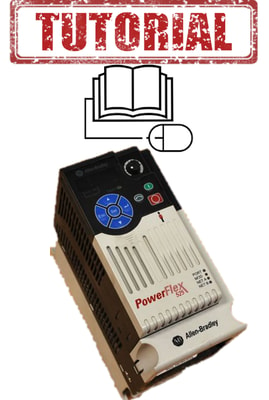
The PowerFlex family of variable frequency drives gives system builders many options to fit both architecture and budget needs. The PowerFlex 525 is part of Allen Bradley’s compact class of AC drives. These drives are modular and are used for stand-alone control applications or for simple control systems. Of the entrants in the 500 series of compact drives, the 525 offers embedded EtherNet/IP and a modular design that helps in tight spaces and easier installs. The 525 also carries standard safety features and can be programmed via USB. Because it is rated to run in temperatures as high as 158 degrees, the PowerFlex 525 can handle harsh environments. The 525 also has the Safe Torque-Off feature for added safety. Setting the IP Address Parameters for the 525 There are two ways to set the IP address in the 525. The first is through using the keypad on the unit itself. The second is using the USB connection and programming from a PC or laptop. Setting the IP Address with the Keypad Step...
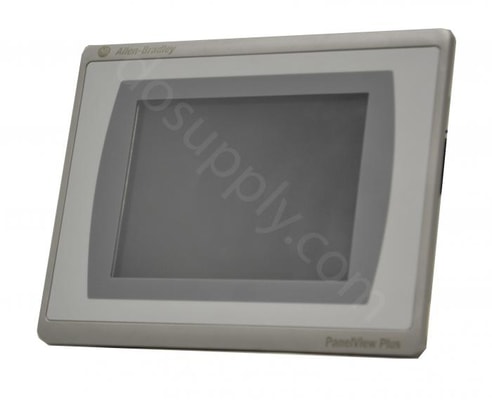
Automation and control systems run the gamut from both simple to complex as well as small to large. Allen Bradley’s PanelView Plus 7 was introduced to better visualization for larger and more complex applications. In addition to best-in-class functionality, the PanelView Plus 7 offers a larger screen and much more processing power. In today’s complex manufacturing environments, visualization is critical to manage production or process flow. To do this, companies rely on multiple terminals as well as many PCs for both remote monitoring as well as programming. The PanelView Plus 7’s embedded Ethernet capability and two Ethernet ports allow it to function in a number of complex control solutions such as device level ring topology. The Ethernet connectivity is key to the PanelView Plus 7’s success in allowing managers and technicians direct as well as remote access to configure devices, troubleshoot process issues and review and address alarms. Because of its importance to the PanelView...
A high-speed counter (HSC) is a functional capability within particular PLCs. HSCs count the frequency of the pulse of processes from systems with elements such as high-speed encoders. In these cases, special input modules ensure the count’s accuracy and deliver the output to the system element within the latency criteria that optimizes machine or system uptime to meet throughput requirements. Normal counters are adequate unless the pulses you are counting will arrive faster than 2 times the scan time. HSC Overview and Application An HSC is a select type of counter. Counters used in systems with lower pulse frequencies (CTU/Ds) can be implemented as a software-defined PLC element. Thus, it only exists virtually. The HSC requires a hardware input module that can operate reliably in the harsh environmental conditions experienced on a factory floor. The engineering design is a simple input/output device that uses ladder logic to develop the output signal from the inputs provided. After...
In part 1, we discussed general safety terms and categories and covered the concept of risk. By understanding risk, we can determine a structure for the architecture needed to manage that risk. That structure will result in a controller that accomplishes all the tasks involved with the lowest acceptable risk to equipment and staff. In part 2, we will dig deeper into terms and categories to understand their impact on machine safety. The concept of building this structure is called Functional Safety Engineering. Here, functional safety means that the automation protection protocols correctly operate in response to inputs. According to the International Electrotechnical Commission 61508 (IEC): “Functional safety is the detection of a potentially dangerous condition resulting in the activation of a protective or corrective device or mechanism to prevent hazardous events arising or providing mitigation to reduce the consequence of the hazardous event ”. Functional safety is achieved by...
You want to improve machine safety at your facility, but you don’t even know where to start. Not only do you not know where to start, but you don’t even know what words to use to describe the things you want to do. Hopefully, by the time you get done reading this, you’ll feel more comfortable talking about machine safety and confident in starting your safety journey. What is machine safety? You’ll hear a lot of terms thrown about – categories, performance levels, safety integrity levels, diversity, redundancy, diagnostics – and those are just some. What it boils down to is machine safety (or functional safety) is using technologies to prevent harm to people and equipment. This can come in many forms, and doesn’t just have to utilize one philosophy. It could mean fences around machines, or sensors and “safe” controls. It could mean PPE like gloves, or it could mean signs that say “DANGER!” Machine safety is an overarching concept, but in the end it’s all about making the machine as...
The first entry in our new Safety First! series of articles, is a guide to the sometimes-confusing realm of NEMA Ratings for electrical enclosures. NEMA stands for the National Electrical Manufacturers Association. This nationwide group represents electrical equipment and medical imaging manufacturers. One of its main purposes is to set and publish agreed-upon standards for industrial manufacturers. Markets NEMA supports include building systems and infrastructure, lighting systems, transportation, utility products, industrial products and medical imaging. Electrical enclosures used in industrial applications service particular purposes depending on whether they are installed inside or outside, what elements or conditions it is exposed to. These enclosures are assigned a rating by NEMA. These ratings ensure continuity across the industry, and ensure that the correct level of protection is enabled for safety and security purposes. This chart defines the ratings, the environment where...
In the world of machine safety, most people think about the things that are out in the open – guards, emergency stops, light curtains, etc. The most important components are usually out of sight, however. Safety relays (really small safety controllers today) are the brains of the safety system. Whether they’re yellow, red, or gray, the safety relay is the component that controls how the safety system works, and is part of what makes the system certified to protect people and equipment. In the past few years, advances in technology have allowed for great improvements in these components, and new lines of safety relays are being rolled out by all manufacturers. If you’re looking at installing or replacing an existing safety relay, these new components are definitely worth a look. One important note to start this conversation, we’re talking about safety. If you’re not talking to an expert about what you’re doing, then you’re doing it wrong already. Even if you’re just going to verify...
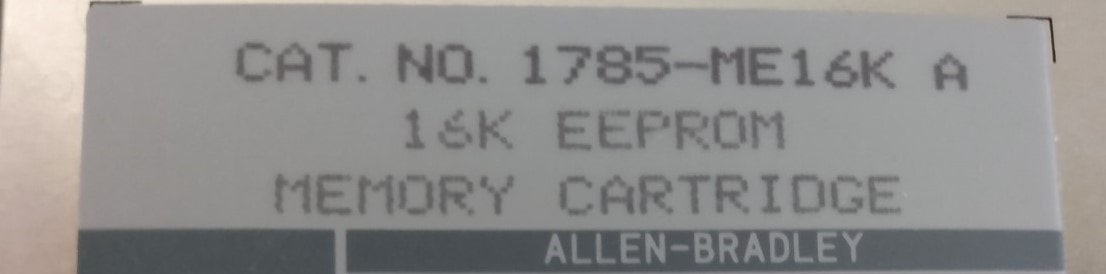
Some Allen Bradley parts are manufactured with an extra safety precaution known as a Conformal Coating. This is a thin film of polymerizing plastic which is applied to delicate components such as circuit boards, and conforms to their contours (thus the name of “conformal” coating). This film provides a water resistant barrier to protect the coated part from moisture, dust, and other environmental hazards, making the finished product much more durable in harsh conditions. Allen Bradley products indicate the presence of a conformal coating on a product with an extra “K” at the end of the product’s Catalog Number. Note: Some Allen Bradley products naturally end in a “K”. In such cases, the “K” is not an indicator of the presence of a conformal coating. You should check the manufacturer’s literature to determine whether or not the catalog number usually ends in a...
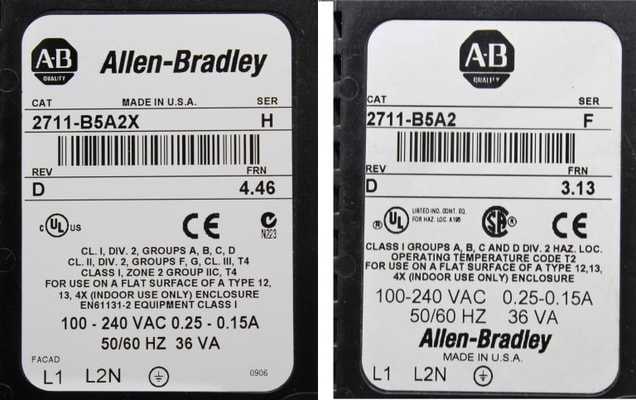
When working with Allen Bradley products, you may occasionally run across a catalog number that matches one with which you are familiar, except for one seemingly out-of-place letter: an extra ‘X’ at the end. Seeing an unexpected letter in your part’s catalog number may come as a shock, but in this case it is nothing to worry about. The extra ‘X’ simply indicates that the part was remanufactured by the factory to fix some defect. Parts with an extra ‘X’ ending their catalog number can be used in exactly the same way, and have all the same features and functionality you would expect from a refurbished unit without the extra letter. Note: Some Allen Bradley products have catalog numbers which naturally end in an “X”. These catalog numbers are usually found on servo drives, where the “X” stands for “Indexing” and is a normal part of the catalog number. In such cases, the “X” does not indicate a remanufactured...
Add-on instructions are generally a small, tested, pocket of code that the user wants to reuse multiple times in program(s). This tutorial will go into best practices of add-on instructions, how the add-on instructions work, and it will go through creating a custom add-on instruction. There are some best practices for add-on instructions, which are listed below. Testing: Add-on instructions cannot be changed online so make sure whatever instruction the program is using is tested and will work in a production environment. Again, add-on instructions cannot be changed online. Single Level: It is good practice to write only a single level of add-on instructions, meaning that you should not have add-on instructions within add-on instructions, even though it is possible. Naming: It is good practice to name add-on instructions with a consistent prefix. For example, “ao\_IO\_DigitalOutput” would be an add-on instruction for a digital output. When add-on instructions have a consistent prefix...
The most important thing about learning to program PLCs is understanding ladder logic. Unlike other computer languages, ladder logic is graphical, meaning that the program is literally drawn out rather than typed. This can be confusing to programmers who come from a background in traditional languages, such as C or C++. You don’t get anything too fancy with ladder logic; rather, the graphical program is meant to represent a facsimile of a wiring diagram for traditional relay logic. Relays were used, and still are, to control various systems and these control systems are often very complicated. Engineers needed a way to represent the complicated arrangements and relationships in a relay control system, so the ladder logic representation was developed to make things clear. You will find schematic diagrams for relay racks written out using ladder logic notation to this day. The popularity and longevity of ladder logic notation can be traced to its ease of use. Ladder logic is easy for...
In an electrical circuit, we always encounter either a circuit breaker or a fuse. Many people, even with all available info on the internet, mistake a fuse for a circuit breaker or vice versa. The common thing about these two is that they both protect electrical circuits from overloads . These overloads are usually mitigated by disrupting the continuity of the current. So, since both the circuit breaker and fuse essentially do the same thing, do we really need both of them? If so, which one is better, and why? We’ve done our best to answer these questions in this article. Fuse – en.wikipedia.org A fuse is something we all have in our houses and buildings, whether it is a commercial or residential building. While there are several types of fuses, the most common one is made of metal and is plugged into a central fuse box. The metal wire inside the fuse is enclosed in ceramic or metal casing, which is then mounted into a central fuse box, located at the place where the wiring passes...