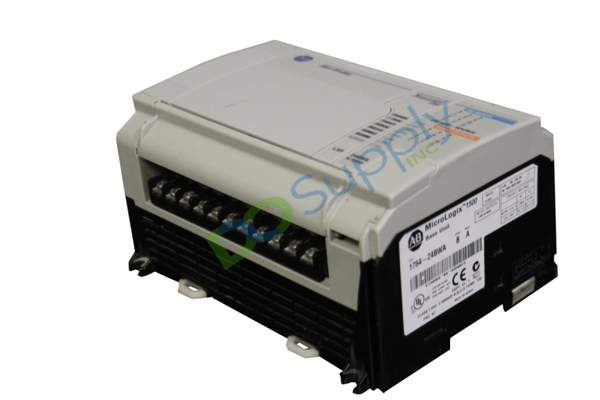
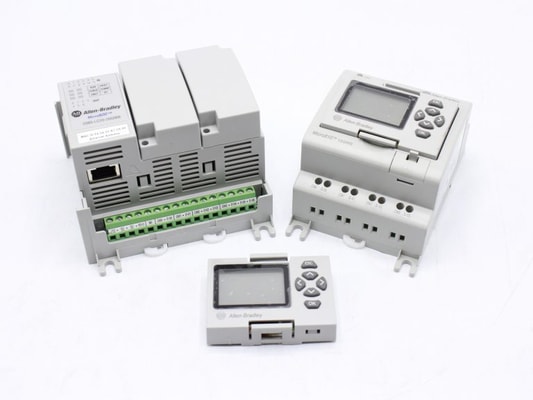
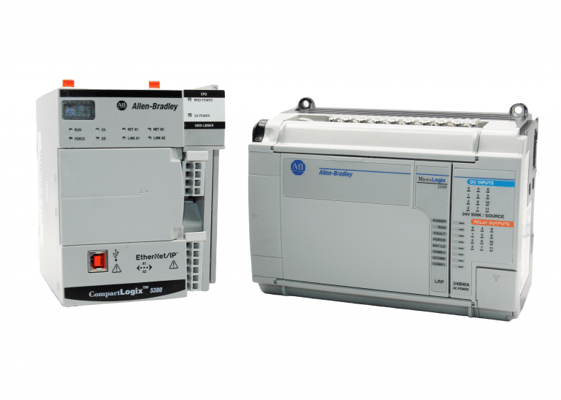
Like the other entrants in the MicroLogix series, the MicroLogix 1500 is small and can be expanded to fit a wide range of control and communication requirements. The 1500 is also expandable to 512 I/O points and is the most powerful in the MicroLogix family in terms of capabilities. As an addition to the MicroLogix 1100 and 1200 series family members, The MicroLogix 1500 has three base options with a removable processor and an updateable flash OS. With its numerous embedded as well as expandable I/O, the 1500 is a workhorse within the MicroLogix family. Main differences between the 1500 and other MicroLogix family members include: Central Processing Unit – Perhaps the biggest distinction between the MicroLogix 1500 and the other members of the MicroLogix Family is that the 1500 is a two-part system. One component consists of the controller, of which there are three base models, the 1764-24BWA, the 1764-24AWA and the 1764-28BXB. The second component is the central processing unit...
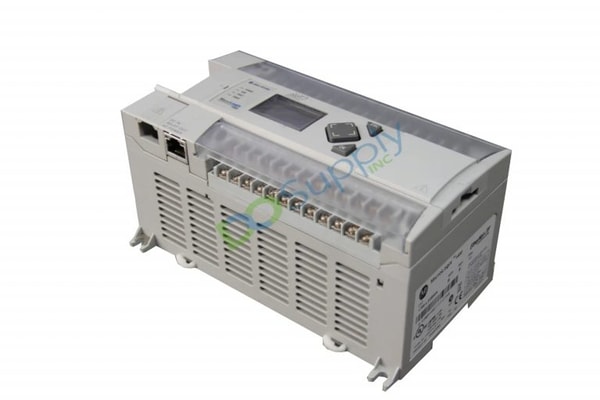
The MicroLogix 1400 series was designed to be small, versatile and expandable to suit a variety of control and communication needs. These controllers offer EtherNet/IP, as well as online editing of programming. They also feature a larger number of I/O compared to other MicroLogix family members. And the MicroLogix 1400 series can enhance network functionality and offer a range of features to help build a customized control solution for a wide range of applications. As part of a family of small programmable logic controllers, the MicroLogix 1400 offers a step up with an expansion of capabilities over other members in this family. Built upon the successful capabilities of the MicroLogix 1100, the 1400 series offers many of the same features but with a more robust feature set on some functionalities including: Increased I/O – The 1400 increases the embedded digital I/O count from 16 in the 1100 to 32. It also doubles the embedded analog I/O on some versions from the 2 offered by the 1000...
We are living in an ever-connected world. It is expected that by 2025, there will be over 75 billion connected devices worldwide. And while personal gadgets, smart homes and smart cities account a large part of those devices, there is an equally fervent push to digitize and automate factories as well. One estimate states that by the end of 2020, 80% of manufacturing companies will adopt some type of IoT technology. And the same urgency of adoption is taking place in utilities, transportation and logistics. In the industrial, warehousing and utilities sectors, much of this control is aimed at empowering the automation of equipment to perform tasks at a faster, more accurate and more productive rate. And this equipment needs control systems and ever improving control technology to adapt to these new requirements. It is easy to assume that these requirements involve large and complex buildouts connecting an entire factory or enterprise. And while that is certainly the case for larger...
In today’s manufacturing environments, few companies can remain competitive without extensive industrial automation. Automation speeds processes, reduces errors, allows for precision manufacturing and ensures factory level control and maintenance over the system of production. It also reduces operator fatigue by eliminating manual tasks thus improving quality. Just as important as the automation functions are the safety features built into the controllers that drive this automation. These safety features are created by use of safety circuits within the automation control panels themselves and are first and foremost designed to provide safe operation for equipment operators and technicians. Aside from reducing risk of injury to those performing tasks on the equipment, safety circuits within control panels also reduce risk by allowing for safe operation to protect damage to expensive capital equipment and to reduce waste through loss of material caused by equipment malfunction. As a...
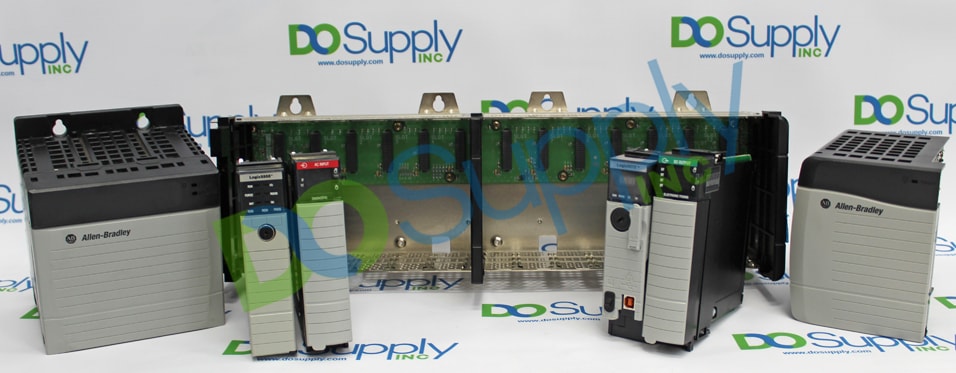
The Allen-Bradley Programmable Logic Controllers (PLC) are classified as for large, small, and micro-control system. The ControlLogix PLC series uses powerful processors to provide high performance for large control system. In the late 90s, the ControlLogix PLC was first introduced to the market. This ControlLogix series was a rack based platform, kept the major advantage of the fastest PLC. Rockwell began to use meaningful tag addressing instead of direct addressing on the platform. The 5550 with L1 processers are included in the First ControlLogix platform. Due to technological improvements in memory capacity and processing speed, the First ControlLogix favored the 5560 and L60 processor. The ControlLogix 5570 with improved speed and more memory to replace the 5560. Also the Armor ControlLogix controller is introduced in 5570 production line to extend the standard ControlLogix platform for dust and wash-down protection. For new project design, Rockwell Automation recommends first...
In part 1, we discussed general safety terms and categories and covered the concept of risk. By understanding risk, we can determine a structure for the architecture needed to manage that risk. That structure will result in a controller that accomplishes all the tasks involved with the lowest acceptable risk to equipment and staff. In part 2, we will dig deeper into terms and categories to understand their impact on machine safety. The concept of building this structure is called Functional Safety Engineering. Here, functional safety means that the automation protection protocols correctly operate in response to inputs. According to the International Electrotechnical Commission 61508 (IEC): “Functional safety is the detection of a potentially dangerous condition resulting in the activation of a protective or corrective device or mechanism to prevent hazardous events arising or providing mitigation to reduce the consequence of the hazardous event ”. Functional safety is achieved by...
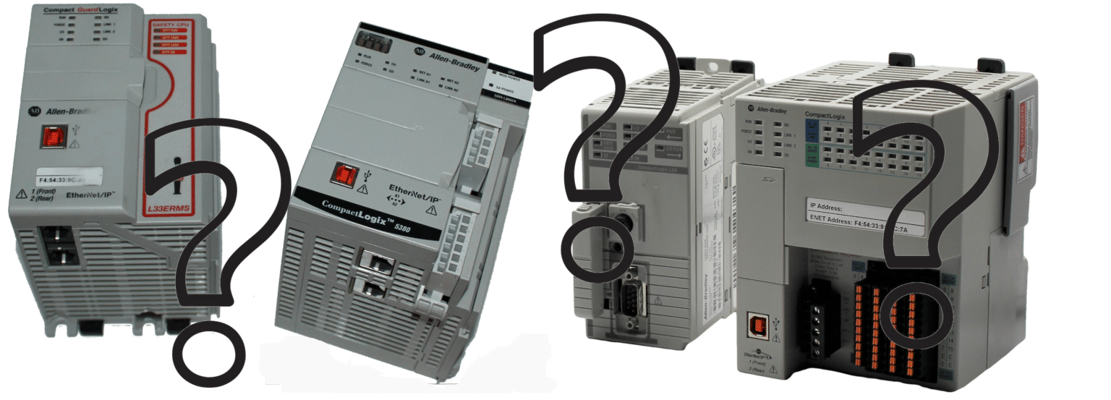
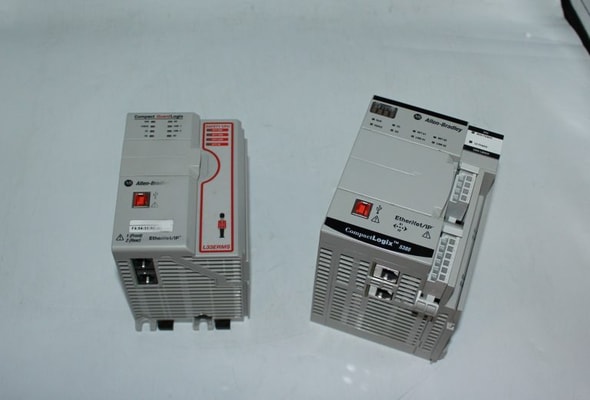
Recently we discussed selecting a new ControlLogix platform and the questions you need to ask yourself, and the expert you discuss them with, before you choose the right controller. For some, the answer will not be a ControlLogix, but a CompactLogix platform, based on system size and complexity. This article will delve into how to separate out the various versions of this controller line and give you a foundation for the conversation about which CompactLogix controller is best for your application. The CompactLogix line currently comes in a much larger range of options than the ControlLogix. Because of its popularity and the wide range of applications it can serve, there are several legacy versions of the CompactLogix that are still (and will continue to be) supported by the manufacturer. Currently, Allen Bradley offers three families of CompactLogix controllers, the 1768, 1769, and 5069 families. Inside this, the 1769 family is broken down into the L3x controllers and the 5370...
Before we dive into the specifics of this processor selection guide, it is important to bring up a few points about picking a controller. While the controller is the main piece to a control system, the best controller will fail if the remainder of the control system isn’t paired properly with it. The biggest, baddest controllers will cover for a lot of mistakes throughout the rest of your system, but they’ll expose just as many weaknesses as they make up for. This blog post will help you select the highest end family of Allen-Bradley’s controllers, the ControlLogix line. But, just as the article says, please sit down and converse with an expert. Plan the system, design it according to the plan, execute according to the design. With the knowledge you’ll gain from this article and the collaboration with those people who research these things on a daily basis, you’ll have more than a successful implementation, you’ll have a control system that will bestow great benefits upon you for...
1968 – The concept of the PLC was born as the Standard Machine Controller. 1969 – Richard Morely of Bedford Associates launches the Modicon 084 Model, kickstarting the race to refine this new technology. 1970 – Parallel to MODICON was Allen-Bradley, releasing the Bulletin 1774 PLC. This was the first time the tern PLC was used. 1971 – General Electric unveils the first design of their general-purpose programmable controller, Logitrol. 1973 – Bedford Associates upgrades the 084 to the Modicon 184, the first commercial success and the first PLC designed to meet the market’s needs. 1975 – Modicon introduces the Modicon 284, the first controller with a microprocessor and distributed control. 1975 – In the same year, the Modicon 384 is released as the first PLC with digitized process algorithms for continuous control. 1977 – The Modicon brand is sold to Gould Electronics 1977 – Allen-Bradley launches the PLC2- based on the Intel 8080 microprocessor 1979 – Allen-Bradley introduces Data...
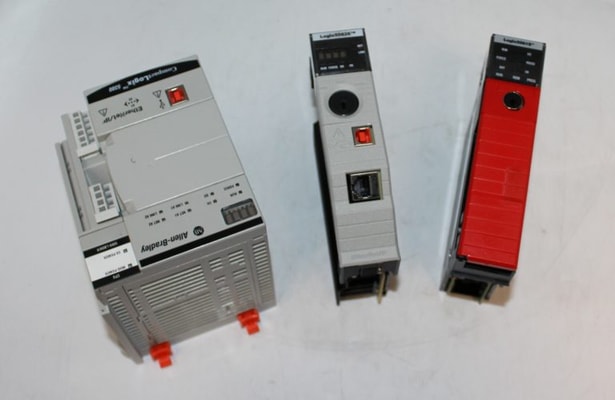
With the current trend in machine safety being moving towards integrated control and safety functions, Allen Bradley (like most other major suppliers) offers two versions of its main control platforms, the Logix line of controllers. Based on application size and complexity, facilities will use either the CompactLogix or ControlLogix controller platforms for control. Adding safety features onto these controllers, Allen Bradley offers the Compact GuardLogix and GuardLogix (ControlLogix) functional safety rated controllers. As these controllers are updated and improved, there have been several generations of safety rated controllers. With a future trend towards integrating data, safety, and control into one unit for increased productivity, we will continue to see improvements, both evolutionary and revolutionary. The ControlLogix (1756 family) and CompactLogix (1768, 1769, and 5069 families) Programmable Automation Controllers are the primary controllers in Allen Bradley’s offering. The...
Allen Bradley introduced the Micro 800 family of controllers several years ago, and they are slowly taking over the low-end controller segment for the manufacturer. These controllers are meant for small stand-alone projects, and for OEM’s and machine builders who need a low cost but effective controller. Five series of controllers comprise this family, from the Micro 810 “Smart Relay” to the Micro 870 controller. Each series builds on the previous, with the Micro 820 and 830 series being the smallest of the two (and specialized siblings of each other) and the Micro 850 and 870 including higher functionality and capabilities. All five series in the Micro 800 family have some common benefits. One of the biggest benefits is being able to program and configure the controllers. From the Micro 820 up to the 870, onboard add-on modules allow for additional IO, memory backups, and numerous other higher feature capabilities. Except for the Micro 810, all are capable of some expansion from...
In 2016, Rockwell Automation announced an update to their small controller package in the Logix line of controllers, the 5069 CompactLogix controller family. Previously, the CompactLogix processors had been classified under the 1769 (and previously the 1768) family numbers. With the update came several changes, most notably in form factor and performance. The 1769 family of controllers started with the L1x, L2x and L3x, then continued with the 5370 series controllers. These controllers are part of the Logix line of Process Automation Controllers (PAC) from Allen Bradley and are designed to accommodate small to medium sized automation projects. Some common features of the 1769 series are dual RJ45 ports for Ethernet/IP (only a single IP address allowed), LED status indicators on the front of the processor, a USB and SD card port for programming and storage, and a program/run/remote mode switch. Options in the series allow for up to 48 Ethernet/IP nodes, 16 axes of motion, and...
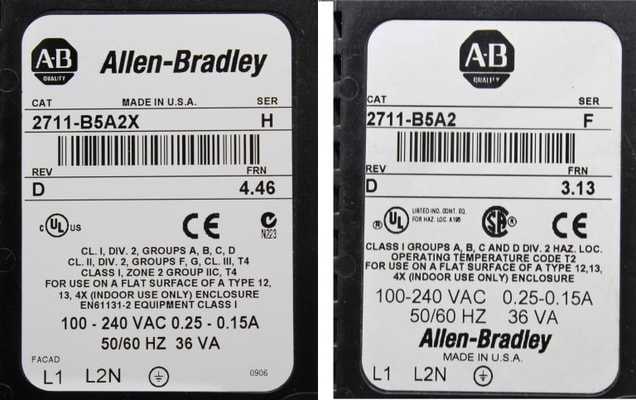
When working with Allen Bradley products, you may occasionally run across a catalog number that matches one with which you are familiar, except for one seemingly out-of-place letter: an extra ‘X’ at the end. Seeing an unexpected letter in your part’s catalog number may come as a shock, but in this case it is nothing to worry about. The extra ‘X’ simply indicates that the part was remanufactured by the factory to fix some defect. Parts with an extra ‘X’ ending their catalog number can be used in exactly the same way, and have all the same features and functionality you would expect from a refurbished unit without the extra letter. Note: Some Allen Bradley products have catalog numbers which naturally end in an “X”. These catalog numbers are usually found on servo drives, where the “X” stands for “Indexing” and is a normal part of the catalog number. In such cases, the “X” does not indicate a remanufactured...
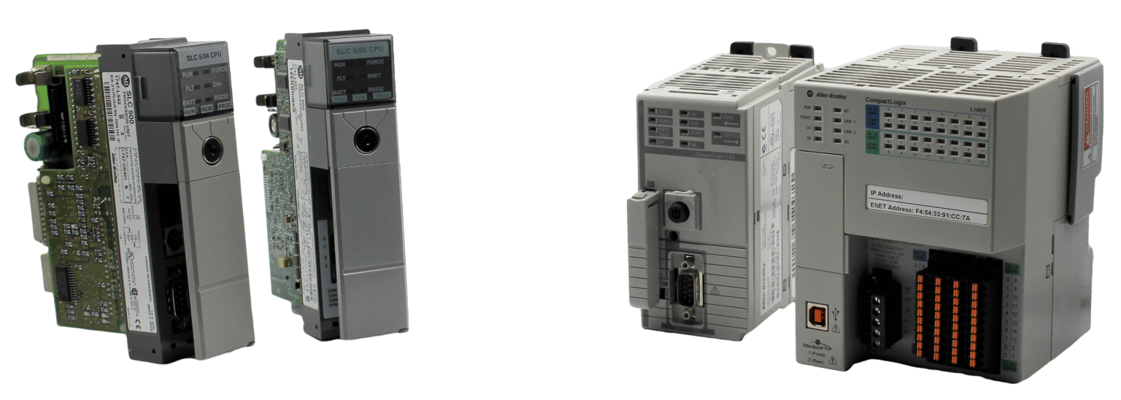
The Allen-Bradley SLC-500 product line was introduced nearly thirty years ago. The product line has reached Active Mature status, with many modules at End of life or discontinued. Active Mature products are still fully supported; however, you can gain value by migrating to a new product of family of products. In this post, we compare the SLC-500 family to the preferred migration product family, the CompactLogix processor. When Allen-Bradley released the CompactLogix 5380 controller it boasted significant performance improvements (+20% capacity and 5-20x faster scan times) over previous CompactLogix models. This performance is orders of magnitudes faster and more capable than the SLC-500 platform. For an in-depth comparison, we will compare system architecture, memory, scan time, I/O capability and power connections. Feature SLC-500 CompactLogix CPU 16-Bit operations 32-bit operations Programming Languages Relay ladder Relay ladder, Structured Text, Function block, SFC Operating System...
The MicroLogix 1500 controller family from Allen Bradley is a PLC platform equipped with high level features and performance. This controller and compatible modules are DIN Rail mounted and of a modular type that takes up minimal space during installation. Generally designed for small and medium applications, the controller supports remote I/O function by combining with 1769 compact I/O modules. The controller comes with a RS232 Serial communication interface that supports the AB proprietary DF1 protocol (Full and Half Duplex) which can be used to communicate with HMI, SCADA and programming units. The CompactLogix 5380 controllers are part of the Logix5000 family of controllers. Similar to MicroLogix 1500 family, controllers under this platform supports DIN rail mounting and component modularity contributes to minimum panel space installation requirement. Small to Mid-size smart machines and equipment for manufacturing are the specialty of this controller family. The CompactLogix 5380...