Selecting the Right PLC for a Job
Anytime automation is required in any system or process, a Programmable Logic Controller (PLC) is often the most ideal solution. There are many things to consider when selecting a PLC for a given task or tasks. PLCs are best suited to rugged environments where there may be excessive dust, metal swarf, or moisture that could cause other types of control equipment to fail.
The most common task for PLC is taking input from sensors and activating or deactivating the outputs according to the inputs. They are also well suited for timing control, for systems like lights or motors. Allen-Bradley offers PLCs in all shapes and sizes from the MicroLogix series for small applications to systems like the ControlLogix for high-performance applications.
Enclosures
PLCs are generally housed in an enclosure to further protect the devices. When designing the control system you should pay attention to the dimensions of the PLC and how it is properly mounted. All Allen-Bradley PLCs offer convenient rack or rail mounting so they can be easily incorporated into a panel with other devices. It’s important to check the mounting style to ensure that the PLC will fit into your existing system. If you’re designing the panel around the PLC(s) then this is less of an issue, but it is more likely that you will need to integrate the PLC into an existing system, so it is worthwhile to ensure that it will fit.
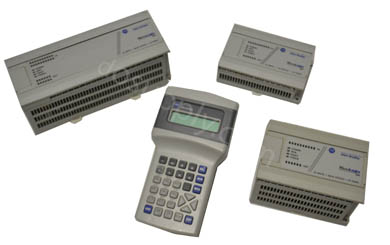
MicroLogix 1000
I/O
One of the most important things to consider is how many inputs and outputs you will require to implement the control system. In general, the more I/O (Inputs/Outputs) a PLC offers, the more costly it can be. You don’t want to go out and get the largest PLC on the shelf and try to make it do all the work. PLCs are made to exist within a larger system and cooperate to achieve the goal of the larger system.
Having multiple PLCs is also important for reliability, as you don’t want multiple processes to be stalled because of a single point of failure. That said, you should still maximize the capabilities of each device and avoid leaving unused I/O.
The discrete inputs for a PLC are rated for a specific voltage range for either AC or DC voltages. Be certain which type of voltage you will need to register and that they are in the rated range of the inputs. PLCs can also offer analog inputs for things like thermocouples, RTDs, scales, and any other sensor device that provides an analog signal.
The PLC outputs are either relays or transistors that actuate or energize when instructed by the program. The relay type outputs can handle greater loads then the transistor type outputs however they have slower switching speeds. Systems like the CompactLogix or ControlLogix series offer many different input and output modules for your specific needs.
Size
Allen-Bradley offers three different sizes of PLC; large, small, and micro. The ControlLogix series offers the most I/O and expandability for big jobs, while the CompactLogix series offers many of the same capabilities in for the medium sized jobs; finally, the MicroLogix series is sufficient for small jobs that only require simple I/O.
Features
There is definitely a balance between reliability, redundancy, capability, and cost. As you design your system or process, think about how many PLCs you will require and where you feel comfortable dividing things into subsystems, each with their own PLC. Bear in mind that the largest PLCs typically offer up to a dozen or so inputs and outputs.
There are also modular PLC systems, such as the CompactLogix and ControlLogix series, that offer modules to add additional I/O or features. Most Allen-Bradley PLCs also include support for Ethernet and other forms of wireless communication. This can dramatically increase the versatility of the system and allow for remote control.
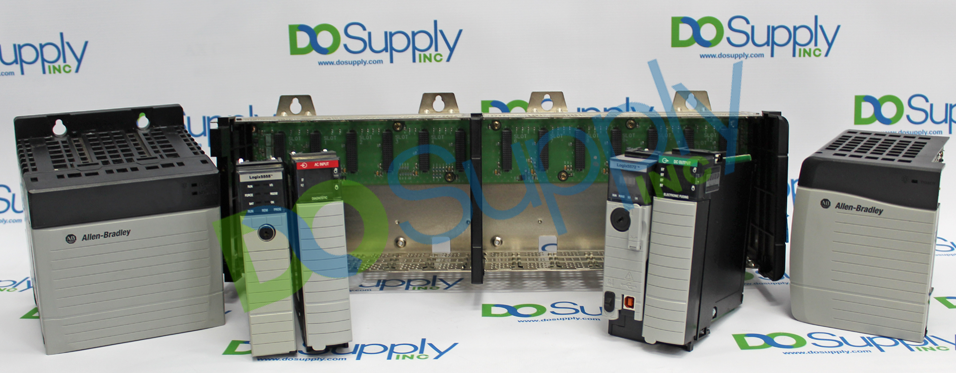
ControlLogix Series
Performance and capability are also very important factors when selecting a PLC. You want to be certain that it has enough memory and speed to perform the given task. This can be tough to assess without a very good idea of what the program will be required to do. Here are some good questions to ask when assessing performance and capability requirements.
- Does your application require a lot of floating point math?
- Is PID control a requirement of the system?
- Will the PLC be taking data inputs such as ASCII from things like bar codes or other alphanumeric sources?
- Does the PLC need high-speed counters for things like encoders?
- Will the PLC be controlling motor positioning or servo stepping?
Some PLC systems include modules that can increase the performance, memory and other capabilities. If you are not certain just how much performance and what capabilities you will require, it is a good idea to select a modular PLC system, such as the CompactLogix system or the ControlLogix system, as they can expand to meet your needs.
Environmental Factors
Environmental concerns are very important when selecting the right PLC for the job. If the PLC is expected to perform in environments with lots of dust, water, or metallic shavings, you may require a PLC rated for such conditions. If the PLC is operating in volatile environments, such as Class I, Division II, the PLC enclosure will need to be rated for explosion proof conditions.
Temperature is another major concern when selecting a PLC. Each PLC will include a specified temperature rating that the PLC is capable of operating over. If the environment temperature exceeds this range the PLC will not function properly and may be damaged. When the temperatures are expected to be very extreme a heater or cooling system may be required for the enclosure.
Most Allen-Bradley PLCs are rugged enough to endure temperatures from freezing conditions to those found on the hottest job sites. Finally, when designing your system, be certain that it complies with local and national electrical codes. Make sure to contact your local authorities to find out what codes you must comply with. Many PLCs are geared specifically to meet the needs of harsh environments and extreme temperatures.
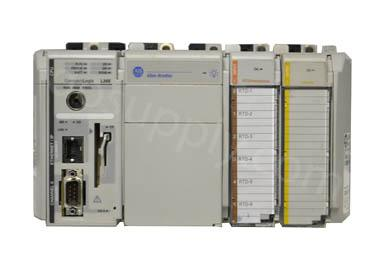
CompactLogix Series
Programming
There are several methods for programming a PLC. A PC computer is the most common method, however, most PLC systems offer handheld programmers that can be used on site without a computer. If you expect to be making modifications to the program in the field, make sure that your PLC supports handheld programmers. A computer is recommended for complex programs, and many technicians prefer to use a PC when implementing the program since it is often much more convenient. Allen-Bradley PLCs offer both options when it comes to programming your devices.
Picking a Module
There’s an Allen-Bradley PLC system out there for almost every application, environment, and budget. Modular systems like the ControlLogix series are a good way to ensure that you can dynamically add performance and capability to your system as new requirements arise.
For simpler applications, there are many small and micro control systems that offer minimal I/O. These can be a very cost-effective solution for automating small to medium tasks. Take care when selecting your system and make sure that you have made a thorough assessment of the requirements, to ensure you get the right PLC.
For more information or to purchase a PLC module, click here.
DO Supply Inc. makes no representations as to the completeness, validity, correctness, suitability, or accuracy of any information on this website and will not be liable for any delays, omissions, or errors in this information or any losses, injuries, or damages arising from its display or use. All the information on this website is provided on an "as-is" basis. It is the reader's responsibility to verify their own facts.