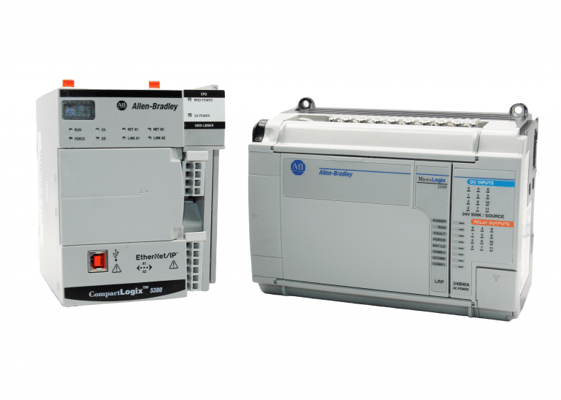
The MicroLogix 1500 controller family from Allen Bradley is a PLC platform equipped with high level features and performance. This controller and compatible modules are of a modular type, mounted on a DIN Rail so as to take up minimum panel space during installation. Generally designed for small- and medium-sized applications, the MicroLogix 1500 controller supports remote I/O function by combining with 1769- series compact I/O modules. The controller comes with an RS232 Serial communication interface that supports the AB proprietary DF1 protocol (Full and Half Duplex) which can be used to communicate with HMI, SCADA and programming units. The CompactLogix 5380 controllers are part of the Logix5000 family of controllers. Similar to MicroLogix 1500 family, controllers under this platform supports DIN rail mounting and component modularity contributing to minimum panel space installation requirement. Small to Mid-size smart machines and equipment for manufacturing are the specialty of...
This may be your first time reading about CIP safety. Welcome, we will talk about how this protocol works as well as its similarities and differences with standard communication protocols. While this will be a technical overview, we will not discuss safety programming specific topics, but instead an overall picture of how CIP safety fits into the evolving industrial automation industry. Over the past decade, with the advancements from hard-wired safety relays to programmable network-monitored safety devices, it is necessary to understand how this technology works and how you can benefit. It is important that everyone from business managers to engineers understand how this technology can be used to save cost as well as increase safety. What is CIP Safety? Is there special hardware for CIP Safety? Does CIP Safety communicate differently to a PLC (Programmable Logic Controller)? How is CIP Safety used in Industrial Automation? Are there programming differences when using CIP Safety? So...
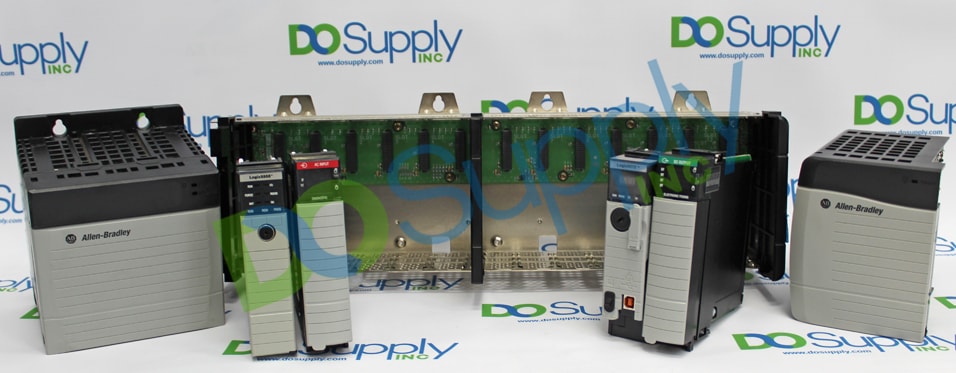
Today, we’re going to take a look at Allen-Bradley’s popular CompactLogix and ControlLogix processor lines. The ControlLogix and CompactLogix are Allen-Bradley’s most popular lines of Automation controllers. The ControlLogix is designed for larger, more demanding systems, requiring higher I/O counts. The CompactLogix, with its smaller, more affordable frame, is better suited to smaller applications. Here, we will examine the differences in detail. The CompactLogix line sports two variants – modular chassis-free system and all-in-one controller with a chassis. The most popular all-in-one controllers are CompactLogix L23, L1XER, and L2XER. If you’ve used CompactLogix processors, you might have heard of these, as they were best-selling processors in the line. For the modular systems, the L30ER, L33ER, L32X, and L35X are the best-selling components. The packaged CompactLogix processors are ready for work out-of-the-box, which is their main advantage. Conversely, the modular L3 models...
When it comes to the process automation and advanced system design, PLCs, SCADA, and HMIs play crucial roles. A PLC is a hardware-based device, SCADA is a system that works in conjunction with the PLC. But, an HMI is also a system that works in conjunction with a PLC. Since the SCADA system and an HMI can complete more or less the same functions, it’s crucial that you know the difference between these two. In this article, we’ll talk about each of them and explain their functions. Furthermore, we’ll discuss how they work together in a seamless system that controls different functions. We suggest that you grab a cup of coffee– it’s going to be a long read! SCADA didn’t get its name by luck, it is actually an abbreviation that stands for Supervisory Control and Data Acquisition. As we said earlier, it’s a system that has both software and hardware elements and is usually used for a couple of things: Control of various processes from a remote location or locally Interaction with sensors...
Add-on instructions are generally a small, tested, pocket of code that the user wants to reuse multiple times in program(s). This tutorial will go into best practices of add-on instructions, how the add-on instructions work, and it will go through creating a custom add-on instruction. There are some best practices for add-on instructions, which are listed below. Testing: Add-on instructions cannot be changed online so make sure whatever instruction the program is using is tested and will work in a production environment. Again, add-on instructions cannot be changed online. Single Level: It is good practice to write only a single level of add-on instructions, meaning that you should not have add-on instructions within add-on instructions, even though it is possible. Naming: It is good practice to name add-on instructions with a consistent prefix. For example, “ao\_IO\_DigitalOutput” would be an add-on instruction for a digital output. When add-on instructions have a consistent prefix...
There are a few different methods of programming for a Control Logix processor, listed here in the order of most common to least common: Ladder Logic (Most common, Preferred) Function Block Diagram Sequential Function Charts Structured Text In this tutorial, I will go over the different methods and describe how they work. Hopefully, the differences between programming methods will be clear. Each method has its own instruction set. Some are very similar between methods but some instructions are only available in one method versus the other. For example, the PIDE instruction, which is called “Enhanced PID” is only available inside the function block diagram method. In a Control Logix PLC, combinations CAN be used in conjunction with each other. The different routines can access the same tags regardless of method, meaning that a function block diagram can access the same tags as a ladder routine. It is good practice to use one method of programming, but if a different instruction is only...
The most important thing about learning to program PLCs is understanding ladder logic. Unlike other computer languages, ladder logic is graphical, meaning that the program is literally drawn out rather than typed. This can be confusing to programmers who come from a background in traditional languages, such as C or C++. You don’t get anything too fancy with ladder logic; rather, the graphical program is meant to represent a facsimile of a wiring diagram for traditional relay logic. Relays were used, and still are, to control various systems and these control systems are often very complicated. Engineers needed a way to represent the complicated arrangements and relationships in a relay control system, so the ladder logic representation was developed to make things clear. You will find schematic diagrams for relay racks written out using ladder logic notation to this day. The popularity and longevity of ladder logic notation can be traced to its ease of use. Ladder logic is easy for...
Anytime automation is required in any system or process, a Programmable Logic Controller (PLC) is often the most ideal solution. There are many things to consider when selecting a PLC for a given task or tasks. PLCs are best suited to rugged environments where there may be excessive dust, metal swarf, or moisture that could cause other types of control equipment to fail. The most common task for PLC is taking input from sensors and activating or deactivating the outputs according to the inputs. They are also well suited for timing control, for systems like lights or motors. Allen-Bradley offers PLCs in all shapes and sizes from the MicroLogix series for small applications to systems like the ControlLogix for high-performance applications. PLCs are generally housed in an enclosure to further protect the devices. When designing the control system you should pay attention to the dimensions of the PLC and how it is properly mounted. All Allen-Bradley PLCs offer convenient rack or rail...
A PLC or Programmable Logic Controller is an electronic or computer device used for industrial control systems. PLCs run a program that manages inputs and logically turns outputs on/off to obtain the desired control. This article will cover the general structure of a PLC program. PLC programming An instruction or job order is formed by two main parts: operation and function. The function is the complement of the operation and is divided into symbol and parameter. The operation determines the CPU’s job or the kind of instruction that it must execute, and the function determines the address. The address, in turn, indicates where the CPU should execute the instruction of elements such as counters, timers, I/O, and internal marks. Basic examples of instructions are: LD: (4C) Loads the line LDN: (42) Negation of the operation LD AND: (41) AND logic ANDN: (44) Negation of the operation AND OR: (4F) OR logic To write a program, other kinds of instructions called service instructions are...