Introduction to Force Torque Sensors in Industrial Automation
Imagine this scenario: You’re lying on your garage floor under your vehicle, tightening the last bolt on the shiny new part you’ve just replaced. As you apply pressure, striving for that perfect snug fit, the unexpected happens—the head of the bolt snaps off right past the snug point. This moment of frustration highlights the delicate balance of force and precision. It echoes a concept that has intrigued minds since the days of Archimedes, who famously claimed he could move the world with a lever if given a fulcrum to place it on. This ancient idea of leveraging force to manipulate the physical world lays the groundwork for understanding the complexities and nuances of torque in modern engineering and, by extension, the sophisticated realm of industrial automation.
In today’s industrial landscape, the principles of force and torque have transcended the simple mechanics of levers and bolts to become fundamental elements of sophisticated automation systems. Force torque sensors, integral components of these systems, are revolutionizing how machines interact with the physical world. By imbuing robots and automated devices with the ability to detect and measure forces and torques, these sensors empower them to perform tasks with a level of precision and care once thought impossible for anything but the human hand.
From the detailed assembly of delicate electronics to the meticulous testing of material strength, force-torque sensors are the unsung heroes of industrial automation. They enable machines to ‘see’ and ‘hear’ and, most crucially, to ‘feel’—transforming them from mere tools to intelligent partners capable of navigating the complexities of the modern manufacturing landscape.
This introduction to force torque sensors in industrial automation will explore their evolution, functionality, and impact. It aims to illuminate how these advanced technologies are not just enhancing automated systems’ capabilities but fundamentally reshaping the dynamics of industries worldwide.
Technological Foundations and Tools
At the heart of force torque sensors lies a world where precision engineering meets cutting-edge technology. These devices are marvels of modern science, built upon principles that Archimedes himself would marvel at, yet integrated into systems as familiar to us as the vehicles we drive. To appreciate the ingenuity behind force torque sensors, one must first understand the basic yet sophisticated technologies that enable their functionality.
Key Components and Technologies
Force torque sensors are comprised of several key components, each playing a critical role in their ability to measure force and torque accurately:
- Strain Gauges: The fundamental component of many force torque sensors is the strain gauge, a type of sensor that measures an object’s deformation (strain) when a force is applied. Strain gauges adhere to the surface of the object, and as the object deforms, the strain gauge deforms as well, changing its electrical resistance. This change in resistance is measured and converted into a force or torque value. For example, in precision machining, strain gauges are applied to the tool holder to measure the cutting force of a tool. This data helps in optimizing the machining parameters for improved surface finish and tool life.
- Signal Processing: Advanced signal processing algorithms are employed to interpret the data from the strain gauges, filtering out noise and ensuring the readings are accurate and reliable. This processing is crucial in environments where precision is paramount.
- Robotic Integration: The true magic happens when these sensors are integrated into robotic systems. Robots can process sensor data in real-time through sophisticated software and hardware interfaces, allowing them to adjust their actions on the fly.
- Grippers and Manipulators: Robotic end-effectors, such as grippers and manipulators, are often equipped with force torque sensors to handle materials with precision and care. In the electronics industry, robotic grippers equipped with force torque sensors are used to assemble delicate components like circuit boards. The sensors allow the gripper to apply just enough force to place the components without causing damage.
Enabling Precision and Control

Integrating force torque sensors into industrial automation systems has been nothing short of revolutionary. By providing robots with detailed feedback on the forces they exert and the resistance they encounter, these sensors have enabled a level of precision and adaptability that was previously unattainable. Whether it’s applying just the right amount of torque to a bolt or gently handling a fragile component, force-torque sensors allow robots to execute tasks with human-like dexterity.
Applications in Industrial Automation
The applications of force torque sensors in industrial automation are as varied as they are impactful. From the assembly line to the research lab, these sensors are enabling efficiencies and capabilities that redefine what machines can do.
Precision Assembly and Product Handling
Just as you would want to avoid snapping that bolt again, automakers have applied this technology to ensure that every bolt fixed to the vehicle chassis has been tightened as per its rated torque spec to avoid over and under-tightening. This practice is important as I’m sure the average driver would not want their oil pan falling off while they’re driving or have their wheels torqued on so tight that they won’t come off without the battle of the century.
Quality Control and Testing
Force Torque sensors are deployed in quality assurance tests where repeatable actions are needed for end-of-line or life-cycle testing. As ATI Industrial Automation has demonstrated, a robot arm with this sensor installed can measure the force that an electronic screen would need to actuate the buttons feature, as well as test it over and over in order to determine how the screen may degrade with use.
Another way these sensors can be helpful is by testing the flexibility of materials under various conditions. This includes tensile, compression, and bending tests to evaluate the materials’ elasticity, plasticity, and tensile strength properties. Stress testing can be seen in aerospace applications when the integrity of aircraft components is in question. Performing these tests can give engineers extremely valuable information to ensure that these aircraft can endure the rigorous flight conditions ahead of them.
Collaborative Robots and Human-Robot Interaction
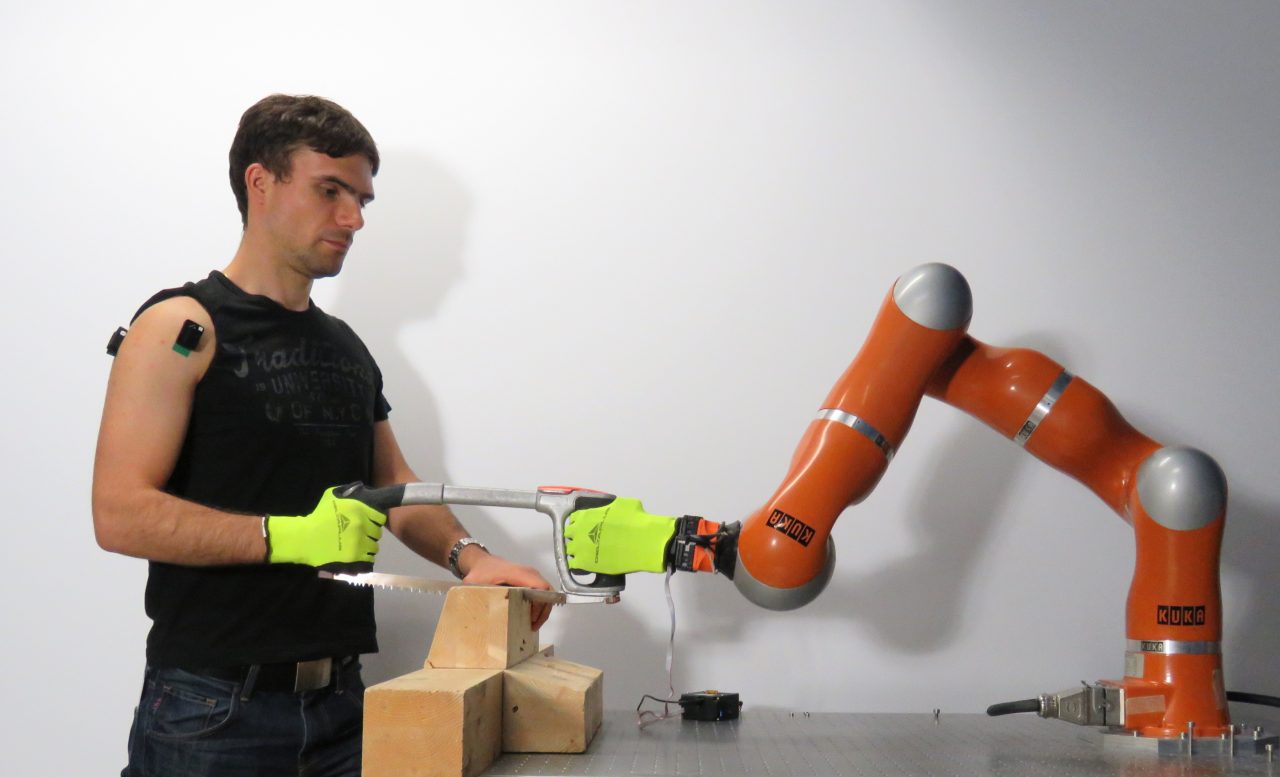
If you think that working beside an industrial-grade robot is a very fast way to get injured, you won’t be alone. Normally enclosed in a cage and painted hazardous yellow, industrial robots have taken a leap in innovation to be able to live the iron curtains so that collaboration between man and machine can be achieved. By turning down the speed and force and introducing real-time mapping and torque force sensors, collaborative robots have single-handedly changed public perception of helpful robot arms. Highly sensitive sensors built into these robots can detect if they have bumped into something or someone so that they may pause to avoid injury or damage to equipment.
Advantages of Force Torque Sensors
The deployment of force torque sensors in industrial settings heralds a new era of efficiency, safety, and innovation. Their impact is profound, reshaping traditional processes and introducing a new level of performance and data collection.
Enhanced Precision and Efficiency
The meticulous precision that force torque sensors offer cannot be overstated. They enable machines to perform tasks with an accuracy that rivals and often surpasses human capabilities. This precision translates directly into efficiency gains, reducing waste and increasing throughput in manufacturing and assembly processes. This is especially crucial for applications such as grinding, polishing, deburring, cutting, welding, and so on. The sensor can adjust how the robot moves and even its impedance parameters to provide a profile for its specific task. Six-axis sensors can measure the force in X, Y, and Z directions for more precise data collection.
Safety in the Workplace
One of the most significant contributions of force torque sensors is the enhancement of safety. In environments where heavy machinery and delicate human operations coexist, these sensors provide the necessary feedback mechanisms to prevent accidents. Robots equipped with force torque sensors can detect the presence of human workers and adjust their operations accordingly, minimizing the risk of injury.
Adaptive Learning and Improvement
The integration of force torque sensors paves the way for adaptive learning systems in industrial automation. By continuously analyzing the data collected during operations, these systems can learn and improve over time, optimizing their performance for efficiency, speed, and precision. This type of technology is seen in the cobots discussed earlier, enabling them to be safe to work alongside workers and other equipment.
Facilitating Complex Operations
With force torque sensors, robots can now perform complex tasks previously thought to be beyond their reach. From assembling intricate electronic devices to handling fragile materials, these sensors empower robots to execute operations that require a gentle touch and nuanced control. For example, certain assemblies will require someone to make sure the mating objects don’t bind or become misaligned upon installation. This can be replicated with the sensor as the tool head of the robot conducting the installation will send live data to the computer that then interoperates what the robot feels as resistance, binding, pressure, or if the part is going in as intended. This allows the robot and its tool to function just as a normal worker would.
Limitations and Challenges
Despite their numerous advantages, force-torque sensors are not without their challenges and limitations. Understanding these constraints is essential for leveraging their full potential and anticipating future developments.
Technical and Integration Challenges
While force torque sensors are highly sophisticated, they also bring complexities in terms of integration and operation. Ensuring compatibility with existing systems and achieving the desired level of sensitivity and accuracy can be challenging, requiring specialized knowledge and expertise.
Cost Considerations
The initial cost of implementing force torque sensors can be a barrier for some organizations, especially small and medium-sized enterprises. The investment in these technologies must be weighed against the potential gains in efficiency and safety, making cost a significant consideration. The price for sensors really depends on the level of sensitivity and features that a customer may want. Some sensors can be as inexpensive as $300 for simple systems or as expensive as $10,000 for 6-axis torque sensors. Of course, this cost doesn’t cover the initial investment of the equipment it will be installed on, the software, or the installation.
Future Trends and Developments
The development of new materials and advancements in sensor technology are poised to dramatically enhance the capabilities of force torque sensors. Innovations in nanotechnology and micro-electro-mechanical systems (MEMS) are making sensors smaller, more sensitive, and more resilient to environmental conditions.
Nanomaterials
Utilizing nanomaterials in the construction of force torque sensors can significantly improve their sensitivity and response time. For instance, with its exceptional electrical and mechanical properties, graphene offers the potential for creating ultra-sensitive sensors that can detect minute changes in force and torque.
Flexible and Wearable Sensors
The future may see the rise of flexible and wearable force torque sensors that can easily be integrated into soft robotics or wearable technologies. These sensors could provide valuable feedback in applications requiring gentle handling or intricate movements, like rehabilitation robotics or advanced prosthetics.
AI and Machine Learning
Artificial intelligence and machine learning are poised to take the capabilities of force torque sensors to the next level. These systems can optimize operations in real-time by analyzing vast amounts of data, predicting maintenance needs, and adapting to changing conditions without human intervention.
Integration with Smart Manufacturing
As the industrial world moves towards smart manufacturing and the Internet of Things (IoT), force-torque sensors will play a pivotal role. Their integration into interconnected systems will enable unprecedented levels of automation, efficiency, and flexibility in manufacturing processes.
Final Thoughts
Force torque sensors represent a quantum leap in the capabilities of industrial automation. Their impact is transformative, from enhancing precision and safety to enabling complex operations and adaptive learning. While challenges remain, ongoing technological advancements and a shift towards smart manufacturing promise to overcome these obstacles and unlock new potential.
As we look to the future, the role of force torque sensors in industrial automation is set to grow, driven by the relentless pursuit of efficiency, safety, and innovation. Their journey from the simple principles of Archimedes to the complex systems of today is a testament to human ingenuity and a harbinger of the technological marvels yet to come.
DO Supply Inc. makes no representations as to the completeness, validity, correctness, suitability, or accuracy of any information on this website and will not be liable for any delays, omissions, or errors in this information or any losses, injuries, or damages arising from its display or use. All the information on this website is provided on an "as-is" basis. It is the reader's responsibility to verify their own facts.