Getting Started with the SMC Plus: A Practical Guide for Automation Applications
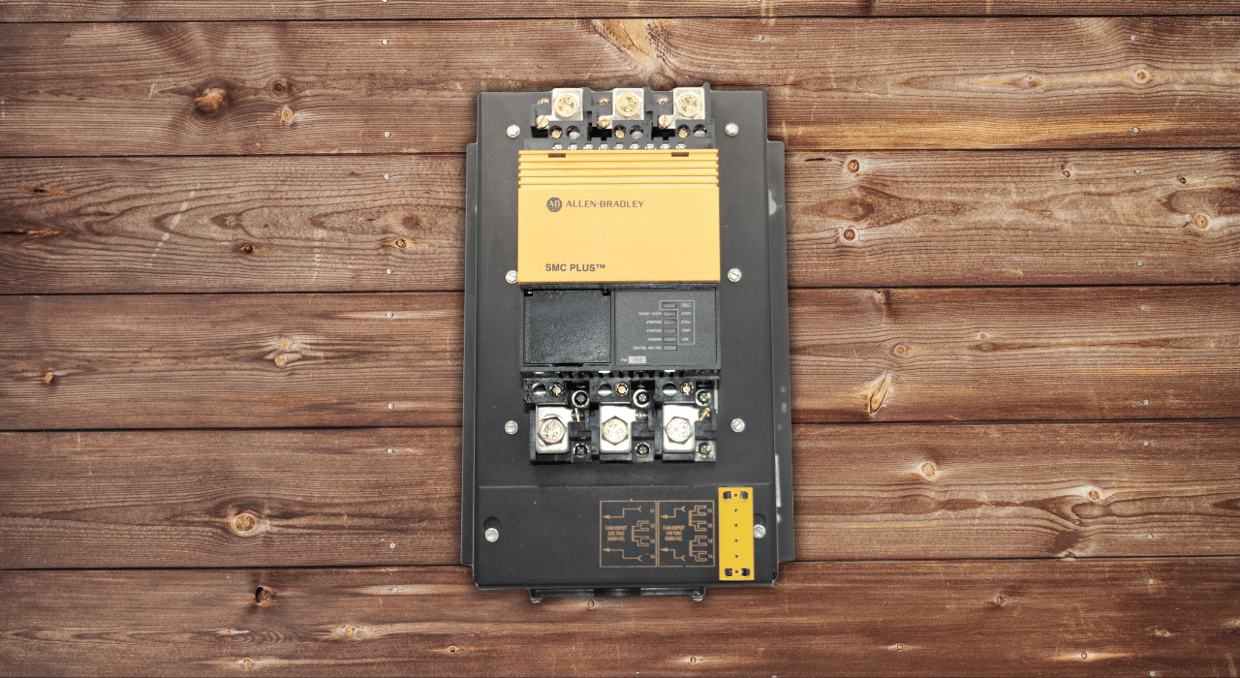
Overview: SMC Plus Controllers
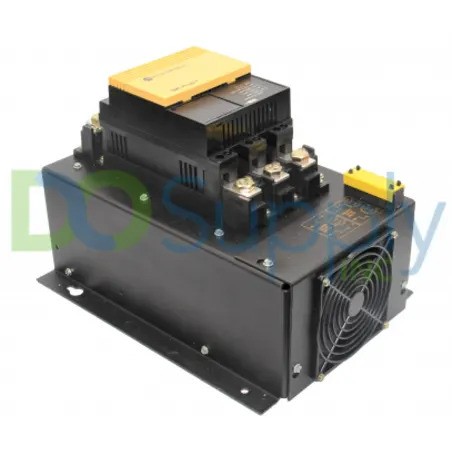
Allen-Bradley SMC Plus (Bulletin 150) controllers are compact, solid-state motor controllers designed to provide microprocessor-controlled starting or stopping of low-voltage, squirrel-cage AC induction motors with 3-phase power supply in the range of 200 to 600V AC. They are primarily intended to control induction motors rated from 0.33 to 1000 HP (Horsepower), but they can also operate resistive loads like space heaters and incandescent lights.
Technical Specifications
Here are the main technical specifications for the SMC Plus motor controllers:
Power Module Input Voltage:
- 3-phase, 200 to 480V AC, +10% or –15%
- 3-phase, 200 to 600V AC, +10% or –15%
Control Module Input Voltage:
- Single-phase, 100 to 240V AC, +10% or –15%
- Single-phase, 110 to 120V AC
- Single-phase, 220 to 240V AC
Repetitive Peak Inverse Voltage (PIV) Rating:
- 1400V AC (Line voltage 200 to 480V AC)
- 1600V AC (Line voltage 200 to 600V AC)
Input AC Frequency – for power and control module: 50 or 60 Hertz (Hz)
Nominal Current Ratings: 24 to 1000 A(Amperes)
Operating Temperature: 32°F to 122°F (0°C to +50°C)
Relative Humidity: 5 to 95% (non-condensing)
Storage Temperature: –40°F to 185°F (–40°C to +85°C)
Resistance to Shock: 30 G for 11 milliseconds (ms), shock peak acceleration
Resistance to Vibration: 2.5 G for 60 minutes
Altitude: 6560 feet (2000 meters) without derating
Electrical Noise and Radio Frequency (RF) Immunity: Up to 1.5kV peak showering arc transients and up to 3.0kV peak surge transients
Functional Design Specifications
SMC Plus motor controllers come with the following design specifications:
- Pre-start Protection: They have inbuilt pre-start & run protection from shorted SCRs and phase loss.
- Stall Protection: Stall protection provides additional motor protection and is available during motor starting and run conditions.
- Energy Saver: This is a built-in feature of the SMC Plusmotor controllers, specifically designed for low-load conditions. It helps minimize energy usage in automation applications where the three-phase induction motors in use are unloaded or moderately loaded for long periods of time.
When the Energy Saver is activated, the SMC Plus controller constantly monitors the applied motor load with its inherent feedback circuitry, and using its SCRs it can reduce the output voltage to the connected squirrel cage motor as necessary to minimize motor power losses.
Note: The Energy Saver feature cannot be enabled when an IEC/NEMA bypass contactor is in use.
- Control Wiring: SMC Plus motor controllers are available with 3-wire and 2-wire control circuits, which enables them to cover a broader variety of automation applications.
- Wiring Adjustments: Standard SMC Pluscontrollers are configured using rotary digital switches and DIP switches. Also, they can be wired without or with conventional motor starters.
- Auxiliary Contacts: Each SMC Pluscontroller is available with two auxiliary hard contacts, which are configurable for either instantaneous or up-to-speed motor operation. The two contacts are:
- 1 Normally Open (N.O.) Contact, rated as: 240V AC Maximum, 24V Minimum, Make 4700 VA(Volt-Amperes) inrush, Break 470 VA sealed
- 1 Normally Closed (N.C.) Contact, rated as: 40V AC Maximum, 24V Minimum, Make 2750 VA(Volt-Amperes) inrush, Break 275 VA sealed
- Diagnostic and Status Indicators: SMC Plus motor controllers are provided with dual-purpose LEDs which indicate the following conditions:
- Control Voltage Available
- Starting Mode
- Start Fault
- Running Mode
- Energy Saver Enabled
- Temperature Fault
- Stalled Motor
- Stopping Mode
- Line Fault
- Protective Modules: Optional SMC Plus protective modules are available for use in automation applications where the SMC Plus motor controllers are likely to be exposed to high or unusual line transients and/or high levels of electrical noise. The modules can be installed on both the supply line and load side of the SMC Pluscontroller unit.
The protective modules contain two elements:
- Metal Oxide Varistors, 220 Joules: They protect the controllers’ Silicon-Controlled Rectifiers from getting damaged by transient voltages generated on the supply lines.
- RC (Resistor-Capacitor) Snubber Networks: They provide DV/DT protection to the SCRs by shunting electrical noise away.
Working Principle
SMC Plus motor controllers feature a solid-state design that incorporates six Silicon-Controlled Rectifiers (SCRs) in the power section, two SCRs per phase. The controllers use the SCRs to regulate the current conduction period and voltage output (and hence, the motor torque) to the connected induction motor during starting, stopping, and running.
A Silicon-Controlled Rectifier (shown below) is a 3-terminal thyristor, a 4-layer semiconductor device, that allows electric current to flow in only one direction. The conducting capacity of an SCR is determined by the current pulses that are received at its control gate.
The six SCRs in the controller’s power section are connected back-to-back, two SCRs per phase, as illustrated below. This allows full-cycle control of the AC voltage to the connected squirrel-cage motor by adjusting the line-voltage firing angle during each half cycle. In essence, the AC voltage and current to the motor can be steplessly and gradually increased or reduced by adjusting the firing angle. SMC Plus motor controllers also include a built-in microprocessor that controls the firing of the six SCRs.
Once the connected squirrel-cage induction motor is started, the SMC Plus SCRs gradually increase the voltage output to the motor during the acceleration period up until full voltage is attained, enabling the motor to get up to speed. At this point, SMC Plus controllers with internal IEC/NEMA bypass or isolating contactors (rated for AC3 duty) bridge the SCRs in the current switching circuit. Bridging these SCRs reduces the possibility of the motor overheating and allows advanced motor control in a smaller footprint.
Modes of Operation
All Allen-Bradley SMC Plus motor controllers provide the following modes of operation, also referred to as starting methods, as standard:
- Full Voltage Starting: This starting method is intended for automation applications that require across-the-line starting of squirrel cage induction motors. When it is enabled, the SMC Plus controller functions in a comparable manner as a solid-state contactor, attaining maximum starting current and locked-rotor (starting) torque. The voltage ramp period is programmed to be less than 0.25 seconds.
- Current Limit Starting: This mode of operation is intended for automation systems that require the motor’s starting current to be limited in the acceleration period. With this mode, the starting current limit can be adjusted from 25% to 550% of the rated full-load amps. If the squirrel cage motor being controlled does not get up to speed by the time the programmed current limit period elapses, the SMC Plus motor controller will transition the motor’s input voltage to full voltage.
- Soft Start: Soft starting is ideal for most general automation applications. When enabled, the connected induction motor is amplified to a precise initial torque value. This value can be varied from 5% to 90% of the motor’s starting (locked-rotor) torque.
The voltage applied to the squirrel cage motor is then steadily ramped up throughout the acceleration period of 2.0 to 30.0 seconds. This helps minimize starting torque surges, providing smooth and gradual motor acceleration while preventing damage to motor belts, couplings, and gears.
- Soft Starting with Selectable Kickstart: Activating the Kickstart or boost function in Soft Start mode provides an additional current pulse of 550% of the rated full-load amps to start motor loads that need a torque boost to start off. SMC Plus users can adjust the Kickstart time from 0.4 to 2.0 seconds.
Control Options
The SMC PLUS product line features a wide variety of motor control options that provide enhanced braking, slow-speed operation, pump control, and soft stopping, allowing greater application versatility. These control options are mutually exclusive, with each SMC PLUS controller unit supporting only one option. They include:
- Preset Slow Speed: This option provides a fixed slow speed for alignment or material positioning applications. A DIP switch is used to set the preset slow speed at either:
- 15% or 7% of the motor’s base speed, forward direction
- 20% or 10% of the motor’s base speed, reverse direction
The direction of the connected induction motor is selected with the DIP switch. In addition, when this control option is enabled, the slow-speed current can be varied from 50% to 450% of rated full-load amperes.
- Soft Stop: The option provides an extended coast-to-rest period to minimize load spillage/shifting during motor stops. It also provides a user-adjustable voltage ramp-down time of 2.0 to 60.0 seconds. It is designed for automation applications with frictional-type loads.
- Smart Motor Braking (SMB): This control option provides microprocessor-controlled motor braking for automation systems that require the induction motors in use to stop more rapidly than the coast-to-rest stopping. The strength of the applied braking current can be adjusted from 150% to 400% of full-load motor current.
With this option, motor braking is realized without any additional hardware like braking contactors, resistors, or other power devices. Also, automatic zero-speed stopping is provided without a speed sensor, tachometer, or timer.
- Slow Speed with Braking: This option avails a combination of Preset Slow Speed, and Smart Motor Braking functions for automation systems that require forward slow speeds for motor set-up, alignment, & positioning, and also controlled braking-to-stop.
When enabled, the following parameters are available for user adjustment:
- Acceleration Current: 50% to 400% of full-load motor current. This current is provided for 2 seconds only.
- Running Current: 50% to 450% of full-load motor current
- Forward Direction Slow Speed: 15% or 7% of rated motor speed
- Braking Current: 150% to 400% of full-load motor current
- Pump Control: The option is used in automated pumping systems to reduce fluid surges resulting from the starting & stopping of motor-powered centrifugal pumps. When enabled, the microprocessor incorporated in the SMC PLUS controller evaluates the operating variables of the connected motor and generates commands that control the motor acceleration and deceleration so as to reduce the possibility of surges arising in the pumping system.
With Pump Control, the starting time of the connected squirrel cage motor can be varied from 2.0 to 30.0 seconds, and the stopping time from 2.0 to 120.0 seconds.
- Accu-Stop Option: This is a position control option that provides precise motor stopping control to minimize jogging-to-stop in high-precision positioning applications.
When enabled, a 3-phase braking current (variable from 150% to 400% of full-load amps) is supplied to the connected squirrel cage motor for rapid braking to a specific slow speed (set at either 15% or 7% of the rated RPM speed). At this point, a slow-speed current (user-adjustable from 50% to 450% of full-load amps) is applied to hold the motor at the pre-specified slow speed up until the SMC PLUS controller gives a stop command. Once the command is provided, a braking torque is then applied to the motor till it gets to zero speed, braking it to a stop.
- Accu-Stop Option with Slow Speed at Startup: The Accu-Stop control option can also permit the connected squirrel cage motor to operate at a pre-specified slow speed when the Slow Speed Start feature is enabled. This helps minimize the jogging operations required to move motor loads into a desired position. Afterwards, a start command is required to ramp up the motor voltage from the pre-specified slow speed to the rated RPM speed.
Applications
Allen-Bradley SMC Plus motor controllers provide advanced motor management solutions that meet the automation needs of an extensive variety of applications. Common applications include:
Mining and Metals
- Roller and Hammer Mills
- Roller and Belt Conveyors
- Centrifugal Pumps
- Tumbling Machines
- Dust Collectors
- Wire Drawing Machines
- Chillers, Fans, and Compressors
- Rock Crushers and Grinders
- Shredders and Slicers
Machine Tools and Transport Systems
- Material Handling Conveyors
- Ball and Roller Mills
- Palletizers and Presses
- Grinders
- Centrifugal Pumps
- Fans and Compressors
- Die Changers
- Rotary Tables
- Trolleys
Food Processing
- Centrifugal Pumps
- Agitators and Mixers
- Centrifuges and Dryers
- Compressors and Fans
- Separators
- Bottle Washers
- Palletizers and Slicers
- Hammer Mills
Wood and Lumber
- Circular and Band Saws
- Planers and Edgers
- Power Sanders
- Fans and Centrifugal Pumps
- Conveyors
- Compressors
- Wood Debarkers and Chippers
Petrochemical
- Centrifuges
- Mixers and Agitators
- Centrifugal Pumps
- Ball Mills
- Fans
- Screw Conveyors
- Compressors
- Extruders
All this to say that even today the SMC Plus is still a viable option for automation solutions. We carry many options in our inventory and our dedicated team is always on standby to help you pick the best examples that fit your needs. Feel free to give us a call today or even take a look at our inventory ready to be shipped to your door. If you would also like to see how the SMC Plus stacks up to the SMC 2, you can read that article here.
DO Supply Inc. makes no representations as to the completeness, validity, correctness, suitability, or accuracy of any information on this website and will not be liable for any delays, omissions, or errors in this information or any losses, injuries, or damages arising from its display or use. All the information on this website is provided on an "as-is" basis. It is the reader's responsibility to verify their own facts.