PowerFlex 750 Series Comparison – 753 vs 755
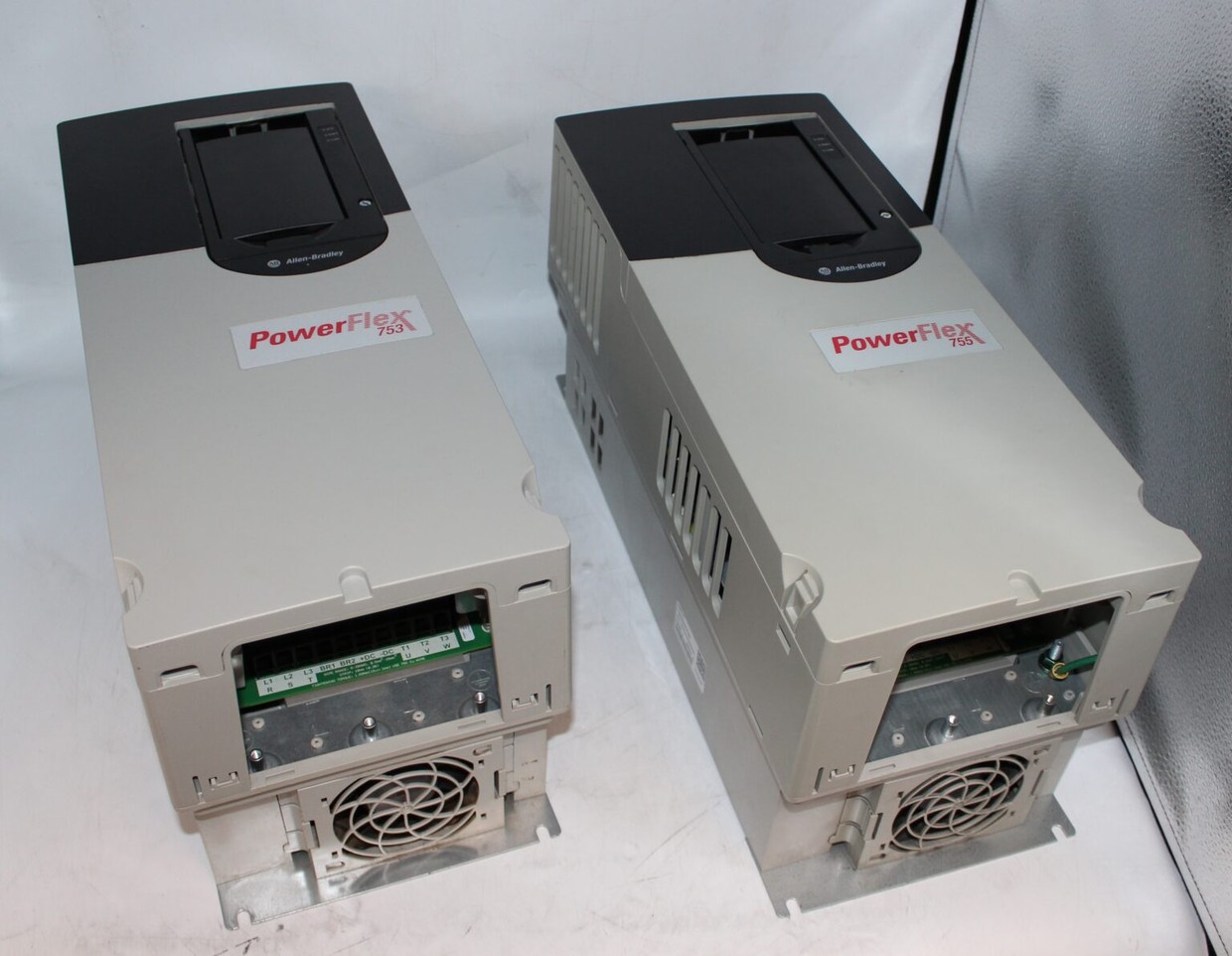
The Allen Bradley PowerFlex 750 series is part of their Architecture Class of drives, higher feature drives for automation projects. They complement the Compact Class drives (PF4x, PF52x) through additional capabilities, although at a higher cost. When looking for a drive solution, these are the Allen Bradley drives to look at when you’re saying terms such as “torque control”, “coordinated drives”, or “almost a servo application”. Both the PowerFlex 753 and PowerFlex 755 drives are capable of torque control, speed control, permanent magnet motor control, and integrated safety (through option modules.) Capability-wise, these drives can compete with any other drives on the market, and their engineering aspects can provide some excellent benefits to the people installing and using them.
There are some common features worth noting in the 750 family of drives. Integration into the Studio 5000 programming environment is made easier and more straightforward through use of Add-On Profiles. Programming for the drive can also be moved to the drive itself through use of DeviceLogix control, reducing the load on the processor and the network. Flexibility through option modules allow the drives to be tailored to the specific needs of the application. Impressive control and diagnostics are available through the local LCD display HIM. Common frame sizes allow for minimal engineering changes if upgrading to a 755 from a 753 (you must replace the whole drive, however.) Of all these features, the AOP’s and DeviceLogix are the most intriguing. AOP’s allow for engineers and programmers to quickly integrate a drive into a system, significantly reducing engineering and programming time (probably the most precious resource in a project.) DeviceLogix moves programming for the drives from the processor to the drive itself, freeing up processor space for more important functions like sequencing or coordination by moving logic such as speed regulation and motor control to the drive’s processor. DeviceLogix also helps with the limiting factor most engineers don’t think about, network bandwidth. By moving the logic to the drive instead of having high speed control running across networks, the high-speed control can be contained to the drive itself while slower command and status signals can be relayed over the network.
The 753 is the baseline series of the family, with standard hardwire control, speed and torque control, and available option modules to add higher feature capabilities such as Ethernet/IP or DeviceNet communications, integrated safety functions such as hardwired Safe Torque Off or Safe Speed Limiting, or sensors such as encoders. The 753 comes with 3 digital inputs, 1 relay output, 1 solid state output, 1 analog input, 1 analog output, and 1 PTC input. 3 option slots allow for the addition of more IO, communications, or other higher features. These drives are available in voltage ranges of 200-690VAC, and horsepower ranges of 0.5-400HP. Control modes consist of V/Hz (volts per hertz), sensorless vector control, and vector control with FORCE technology (proprietary AB control that improves flux and torque control.) Indexing functions are available in the 753 series, and incremental encoders can be used to close the feedback loop when more precise control is needed.
The 755 series takes a significant step up in some areas from the baseline 753. The most notable is the move to networked control, resulting in a “1 Wire” control setup. The 755 series has 1 digital input standard, used for a hardwired enable bit, otherwise all other controls are expected to be through network communications. The 755 has 5 option slots in all but Frame 1 sizes (only 3) versus the 3 option slots in the 753. Those option slots can be used for numerous functions, including network communications, integrated safety, integrated safety over the network, additional IO, and feedback such as encoders. The 755 ranges from 200-690VAC and 0.5-2000HP, with the larger horsepower units being enclosed in floor mount cabinets. The 755 comes with a built in RJ45 port for Ethernet/IP in addition to the option slots, allowing for network communications without adding modules. Control modes include V/Hz, Sensorless Vector Control, Vector Control with FORCE Technology, and Permanent Magnet Motor Control. One addition over the 753 is the inclusion of TorqProve, allowing the 755 to be used in lifting applications such as cranes or elevators. Another addition is the use of motion instructions to control the 755, allowing for more simplified engineering when designing a program that includes servos or other motion components. The addition of integrated network safety is a huge plus as well, allowing for safety functions to be utilized without requiring additional wiring for them, although a safety rated controller is required to use networked safety. Motion features include indexing, PCamming, electronic gearing, and position or speed profiling, allowing for more precise control without the use of servos.
The 753 and 755 series drives are part of the 750 family of Architecture Class drives from Allen Bradley. They each boast significant improvements over the Compact Class of drives, and each series has its advantages and disadvantages. For applications requiring more precise control than a Compact drive can achieve but does not require the networking or the higher features, the 753 is an excellent choice. For applications that could benefit from the networking and safety aspects of the 755, the additional cost can be justified through reduced installation and engineering time. Whether the application calls for torque control, indexing, or light motion control, the 750 class drives will have a solution that optimally fits the requirements.
| SPECIFICATION COMPARISON | ||
| Rating | PowerFlex 753 | PowerFlex 755 |
| Voltage | 200-690VAC | 200-690VAC |
| Power | .5-400HP | .5-2000HP |
| Option Slots | 3 | 5 (3 for Frame Size 1) |
| Communications | Optional | Embedded Ethernet/IP |
| Embedded IO | 3DI, 1RO, 1DO, 1AI, 1AO, 1 PTC | 1DI |
| Motor Types | Induction, Interior Permanent Magnet | Induction, Surface or Interior Permanent Magnet |
| Motion Features | Indexing | Indexing, PCamming, Electronic Gearing, Position/Speed Profiling |
| Application Sets | Pump Jack, Pump Off, PJump & Traverse | Torqprove, Pump Jack, Pump Off, PJump & Traverse |
| DeviceLogix | Yes | Yes |
| Hardwire Safety | Yes with Option Card | Yes with Option Card |
| Network Safety | No | Yes with Option Card |
| Predictive Diagnostics | Yes | Yes |
| Conformal Coating | Yes | Yes |
DO Supply Inc. makes no representations as to the completeness, validity, correctness, suitability, or accuracy of any information on this website and will not be liable for any delays, omissions, or errors in this information or any losses, injuries, or damages arising from its display or use. All the information on this website is provided on an "as-is" basis. It is the reader's responsibility to verify their own facts.