The Use of Automation within the Mars Rover
Mars Rovers Overview
A Mars Rover is a robotic vehicle specially designed to explore the surface of Mars. Mars being the planet that most closely resembles Earth (if Earth was to have an average temperature of -81 degrees Fahrenheit and was apparently lifeless) has captivated human explorers for decades. With the naked eye, this Red Planet is seen as a stellar object in the night sky while telescopes reveal a surface full of intriguing landforms and geological patterns similar to those of various places on Earth.
As early as the 1960s, humans have been sending uncrewed spacecrafts and robotic vehicles on Mars to discover whether this planet hosted alien life previously and what it can teach us about evolution of other planets. Early missions to Mars involved spacecrafts snapping pictures as they flew past the planet. Later on, probes orbiting around Mars were sent, and more recently, stationary landers and robotic rovers have touched down on Mars surface.
Mars Rovers serve a different purpose than stationary landers and orbital spacecrafts, i.e., they can examine more of Mars territory, they can weather winter seasons by placing themselves in sunny positions, and they can be remotely directed to interesting geological features, thereby advancing automation technologies for robotic vehicle control. Each rover that has landed on Mars has been on a mission to study the physical and chemical composition of the planet’s surface at different locations, with the aim of assisting space researchers determine if water has ever existed on Mars and to look for other signs suggesting that this toxic planet (as seen today) might have formerly been as habitable as Earth.
Successful Mars Rovers
Here’s a look at the various Mars Rovers that have successfully landed on Mars:
Sojourner Rover
Sojourner was the first ever successful rover to land on Mars. It was launched on December 4, 1996 by NASA engineers for a seven-day mission of exploring the Martian terrain and it landed on July 4, 1997, on-top-of its landing vehicle, the Mars Pathfinder. It was a small wheeled, solar-powered robotic explorer designed to study the surface of Mars.
One of the mission’s greatest innovations was Sojourner’s landing system, a spacecraft called Pathfinder lander. Instead of using conventional rockets to land on Mars surface, Pathfinder’s landing system was pyramid shaped and it included airbags for a bouncy landing. Just eight minutes before landing, the airbags inflated while the rocket engines on the Pathfinder’s back shell fired to smooth out the thrust when the lander hit the ground.
During landing, the Pathfinder’s landing system lowered the rover from its back shell, via a tether. Then the lander delivered the Sojourner Rover to Mars surface a distance of 30 meters (100 ft.) from the ground, bouncing across the plain using the inflated airbags for several minutes before rolling safely to a halt. The pyramid shape of the landing system ensured that the Sojourner Rover and its Pathfinder lander could be flipped up on the right side, regardless of how they landed. Once Sojourner touched down on Mars surface, a panel opened, and it started exploring the Martian terrain.
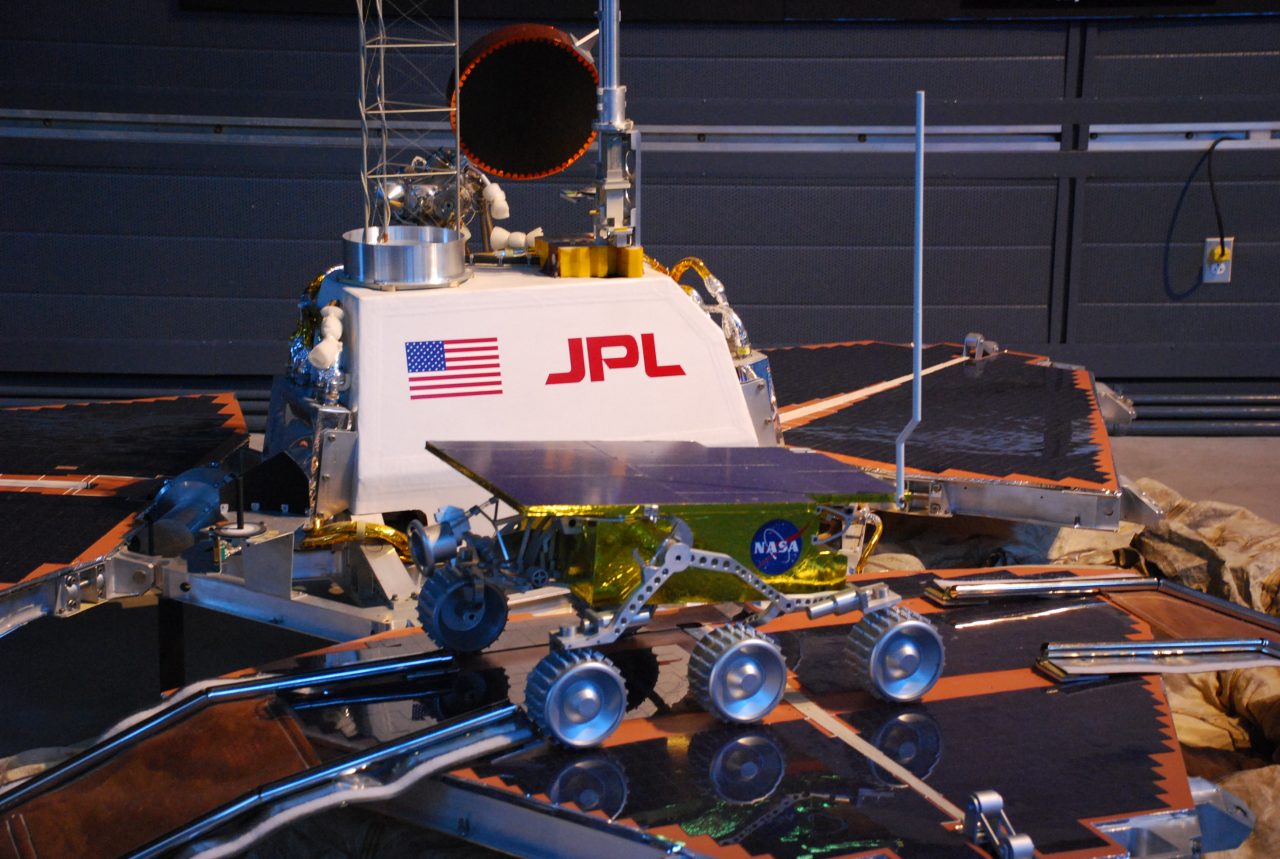
Sojourner explored a surface of Mars called Ares Vallis, near its landing site. NASA scientists had taken interest in this area because it seemed like a site of a primeval flood—flat with lots of dirt and rocks pushed in one place. It navigated short distances while using its cameras to take over 550 pictures of the Martian landscape. It also had onboard scientific instruments to study the composition of the nearby Martian dirt and rocks.
All through, this rover was broadcasting the collected data and photos in real-time on early long-range Internet networks. Its Pathfinder lander also collected information about Mars weather factors such as winds. The results of Sojourner exploration suggested that Mars was once warm and wet, with a thicker atmosphere and water existing in liquid state.
Spirit Rover
Spirit Rover was the first of the twin robotic explorers launched in 2003 by NASA, as part of the agency’s MER (Mars Exploration Rover) mission. It was launched on June 10, 2003, and it touched down on the Red Planet, at a landing site called Gusev crater, on January 3, 2004. It was a six-wheeled, 380-pound (174-kg) robotic vehicle equipped with high-resolution cameras and a suite of measuring instruments including a rock-grinding tool, a microscopic imager, and alpha-particle, infrared, and gamma-ray spectrometers which analyzed the Martian soil, dust, and rocks around the Gusev crater. Also, unlike the Sojourner Rover, which consisted of a separate Pathfinder lander, all the features of a landing system were packed into the Spirit Rover for greater autonomy.
The Spirit Rover was tasked with searching for signs of past life on Mars, characterizing the Red Planet’s geology, and studying current and past Martian climate. It outlasted its 90-day (90 sols, Martian days) mission by far, lasting more than 2,200 Martian days (over six years Earth days). In May of 2009, Spirit Rover got stuck in an unexpected sand trap at a site called “Troy”, with its wheels unable to gain traction. NASA engineers spent several months sending it commands to try and get it to safer ground, but without success.
On March 22, 2010, Spirit Rover eventually stopped transmitting data back to Earth. Among its many discoveries, it found strong evidence that the Red Planet was previously much wetter than its current condition and it also helped NASA scientists to better understand the wind on Mars.
Opportunity Rover
Opportunity was the second of the twin Mars rovers launched by NASA in 2003. It was launched on July 7, 2003, and it began traversing the Red Planet on January 24, 2004 at the Meridiani Planum crater (its landing site), in search of evidence for ancient water. It was a 380-pound(178-kgs), six-wheeled robotic vehicle equipped with high-end cameras and a collection of scientific instruments. The scientific instruments onboard Opportunity Rover consisted of a microscopic imager, panoramic camera, engineering cameras, magnetic array, three spectrometers, and an abrasion tool for rocks. It also had a small robotic arm for obtaining close-up data and pictures about interesting Martian targets.
Initially intended to last for 90 sols, Opportunity Rover explored the Martian terrain from January 24, 2004, all through to June 2018—almost 15 years after it landed on the Red Planet. It made several scientific discoveries about Mars including confirming the presence of perpetual water for an extended period time on one area of Mars and that the environmental conditions of this area were appropriate for sustaining microbial life. It also uncovered the presence of gypsum, hematite and other types of Martian rocks that are known to form in water on Earth. The rover also found substantial evidence of past hydrothermal systems.
Opportunity Rover crawled a distance of 45.16 km (28.06 miles) on Mars until June 2018, when it was incapable of charging its batteries due to a monster dust storm. NASA declared it dead on February 13, 2019. So far, Opportunity Rover still holds the longest and most accomplished lifetime of Mars exploration, leaving behind a collection of scientific data about Mars history. Also, it opened the way for a more rugged and robust Mars rover—the Curiosity Rover.
Curiosity Rover
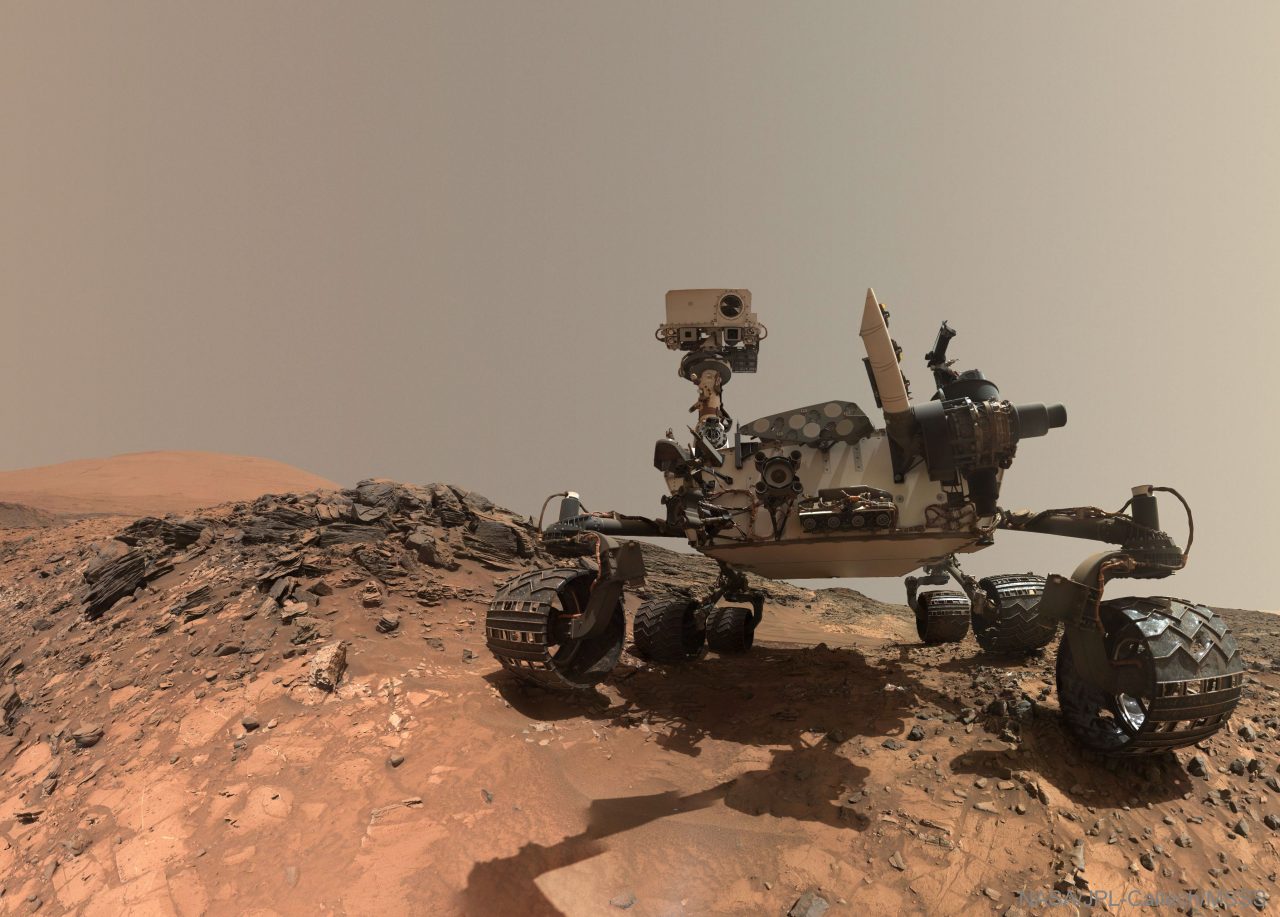
NASA launched Curiosity Rover to Mars on November 26, 2011, as part of the agency’s Mars Science Laboratory (MSL) mission. After traveling for eight months and 10 days it arrived at its Martian landing site, Mount Sharp region, on August 5, 2012. Curiosity stands out as the largest and most capable robotic explorer ever launched to Mars, weighing 2,000 pounds (900 kgs) with a wheel diameter of 50.8 cm (20 inches) and a length of 9ft. 10 inches (approx. 3 meters).
This nuclear-powered rover also included a novel landing method, where the accompanying lander-style spacecraft descended on a parachute prior to its landing system firing up the rocket engines and it hovered as the Curiosity Rover was lowered down onto the Martian surface.
Curiosity Rover set out to look for habitable environments on Mars and any signs of ancient life. Its main focus has been to determine whether the Red Planet has ever had the right environmental conditions to sustain microbial life. During its decade of Mars exploration, Curiosity has traversed from Gale Crater to Mount Sharp (Aeolis Mons). In the course of its travels, the rover has discovered extensive evidence of ancient water and changes in Martian climate as well as a couple of geological shifts. In fact, its onboard scientific tools have found mineral and chemical indications of past habitable Martian environments. Currently, Curiosity is still exploring the Martian landscape looking for rocks that indicate signs of ancient microbial life and learning more about the unique environment of the Red Planet.
Perseverance Rover
Perseverance Rover is a large, six-wheeled, nuclear-powered robotic explorer launched by NASA to Mars on July 30, 2020. After a seven-month journey it arrived at Jezero Crater on February 18, 2021. Jezero Crater was chosen to be Perseverance’s landing site due to speculations that a river delta and lake might have existed in the region in Mar’s ancient past. Thus, landing Perseverance at this crater gives the rover the best chance to find biological clues of ancient life-forms.
The key scientific goals for the Perseverance mission included determining whether microbial life ever existed on Mars, characterizing Martian climate, describing the Martian geology, and preparing for human missions to the Red Planet in future. To achieve the aforementioned objectives, Perseverance Rover is fitted with a suite of sophisticated scientific instruments each designed to carry out different experiments or test various technologies on Mars.
For example, it includes a microscopic camera and a high-end ultraviolet scanner called SHERLOC—Scanning Habitable Environments with Raman & Luminescence for Organics and Chemicals. SHERLOC is designed to look for the minutest clues to assist in solving the mystery of past life-forms on Mars. The rover also has sample materials of astronaut spacesuits, to test if the materials can withstand the extreme Martian environment.
In addition, Perseverance Rover includes an experimental technology known as MOXIE (Mars Oxygen In-Situ Resource Utilization Experiment) that’s attempting to process oxygen using carbon dioxide within Martian atmosphere.
This rover is also equipped with a sophisticated landing gear that includes a Terrain-Relative Navigation (TRN) control system to avoid hazards and a sensor suite known as MEDLI2(Mars Science Laboratory Entry, Descent and Landing Instrumentation 2) for gathering data about Mars atmosphere. It also includes a small-sized autonomous helicopter referred to as Ingenuity, launched to test if powered flights are possible across the Martian thin atmosphere. Perseverance is still exploring Mars on a planned mission of one Martian year (approximately 687 Earth days).
Automation Technologies Applied in Mars Rovers
In general, automation details an extensive range of technologies that minimize human input/intervention in processes or physical tasks. Automation has been achieved through various means including combination of electronic devices, computers, mechanical, electrical, pneumatic, and hydraulic systems. It plays a vital role in the control and operation of robotic vehicles such as Mars rovers.
As discussed in the section above, all the rovers that have successfully landed on Mars have been uncrewed; they relied heavily on automation to perform their designated tasks from safe landing on Mars, navigating the Martian terrain, collecting necessary scientific data and transmitting it back to earth. The design of Mars rovers that are more autonomous in how they explore and study the Red Planet has a lot to do with the application of highly efficient automation technologies. Let’s have a look at some of these technologies:
Autonomous Entry, Descent, and Landing (EDL)
Landing a rover on Mars is extremely hard because of the light time delay between Earth and Mars. In fact, only 40% of all the rover missions ever launched to Mars– by different space agencies– have been successful. Also, Mars rovers are required to find their way to the surface of Mars since human operators cannot “joystick” the rover’s Entry, Descent, and Landing phase. EDL begins with the rover entering the apex of the Martian atmosphere, moving at nearly 20,000 km/hr (12, 500 miles/hour). And it ends after about 7 minutes, with the rover landed safely on the Martian surface. This makes EDL the most intense phase of any rover mission on Mars.
For this reason, Mars rovers are equipped with sophisticated automation technologies to enable them to safely go from such high speeds down to zero, and in the shortest time possible. Actually, by the time the mission team on Earth receives a radio signal that the rover has landed successfully on Mars, it is usually already on the ground for about 10 or 12 minutes. Essentially, these rovers are designed to complete the entire EDL process autonomously. Here’s a breakdown of the key automation technologies used by Mars rovers during Entry, Descent, and Landing phase:
Range Trigger
The most recent Mars rover, Perseverance Rover, uses a new automation technology for parachute deployment known as “Range Trigger”. This is a precision landing technique that calculates the rover’s distance to the intended landing site and opens the supersonic parachute at the ideal time to hit the desired target. The key to this technology is determining the right moment to activate the “trigger” that releases the parachutes.
Earlier rovers landing on Mars, such as Opportunity and Curiosity, deployed their spacecraft’s parachutes as soon as possible, once the lander attained the required velocity. But the Range Trigger technology on Perseverance Rover was designed to deploy the parachute depending on the position of the rover’s spacecraft relative to the targeted landing site. As such, the lander’s parachute could be deployed earlier or later, based on how close the rover was to its desired landing target.
Terrain-Relative Navigation
Twenty seconds after the spacecraft’s parachute is deployed, the rover’s heat shield drops away. Consequently, the rover gets exposed to the harsh Martian atmosphere for the first time, and the onboard critical cameras and scientific instruments begin locking onto the fast-approaching Mars surface below. At this point, the rover’s landing radar bounces multiple signals of the Martian surface to determine its altitude. Concurrently, another EDL automation technology known as Terrain-Relative Navigation (TRN) takes effect.
Terrain-Relative Navigation technology was first tested on Perseverance Rover with the aim of enabling future Mars rovers to land on more challenging Martian terrains, which seem much more interesting to explore. Because 99% of the landing sites for the past Mars rover missions, had to be clear of hazardous Martian rocks and slopes for a safe landing. But with Terrain-Relative Navigation technology, the Martian landing sites that have been off-limits can now be considered.
Terrain-Relative Navigation technology improves EDL by enabling the Mars rover to make a far more accurate estimation of its actual position relative to the Mars surface during descent. It also enables the rover to divert to a safer landing site in case it’s headed towards a hazardous Martian terrain. To accomplish this, TRN involves use of a special high-resolution camera that rapidly identifies features of the fast-approaching Mars surface; then, the rover’s computer quickly compares the captured landmarks to an onboard map to determine exactly where the rover is headed.
The onboard map of the desired landing site is usually created in advance by the mission team using images captured by Mars orbiters. The rover then stores the map in its computer “brain”, to specifically support use of Terrain-Relative Navigation technique during its descent.
Autonomous Safety Controls
To ensure that a Mars rover does not accidentally crash into obstacles while crawling on Mars surface, NASA engineers have developed an ingenious Artificial Intelligence Software that equips the rover with human capabilities such as “thinking for itself”, and “making decisions on its own”. With this software, a Mars rover can control its own navigation safety by means of images taken by Hazard Avoidance Cameras (HazCam). The HazCam cameras are mounted directly onto the rover’s body, and they take images that enable the Mars rover to map out a rocky Martian terrain ahead of it, a distance of 3 meters.
Also, the AI-based hazard avoidance software within a Mars rover self-assesses the position of the rover, by stopping after every 10 seconds, re-evaluating the terrain ahead of it, and subsequently computing the next maneuver for about 45 seconds, before starting its expedition once again. Although this may seem like a tedious task, this software controls the Mars rover, enabling it to navigate safely at an average of 30 cm before re-evaluating its ever-changing terrain. The Mars rover can change its speed, velocity, position, and course if a threatening terrain is identified using multiple onboard control devices, such as system control reaction thrusters, which are key to changing the speed of the rover. They are designed to rapidly adapt to new orientations and make swift turns when necessary.
Automated Scientific Observations
Some Mars rovers, like the Curiosity Rover, have Artificial-Intelligence software referred to as Autonomous Exploration for Gathering Increased Science (AEGIS) installed on their main flight computer. This software allows the rover to select inspection-worthy features on Mars surface such as soil targets and specific types of Martian rocks. It also corrects the focus of the rover’s rock-zapping lasers with 93% accuracy.
With AEGIS software, Curiosity Rover can search and pick soil/rock targets in a much more sophisticated way, since the software is guided by a computer program based on specific images of the Martian surface. AEGIS works with a scientific instrument known as ChemCam (Chemistry and Camera) —a laser emitting brick-shaped, one-eyed device on top of the rover’s robotic neck—to recognize the type of soil and rock features that match the set parameters, ranking them by how closely they resemble the images specified by the mission scientists. In a nutshell, AEGIS software has turned the six-wheeled, Curiosity Rover into a field scientist without much human input.
DO Supply Inc. makes no representations as to the completeness, validity, correctness, suitability, or accuracy of any information on this website and will not be liable for any delays, omissions, or errors in this information or any losses, injuries, or damages arising from its display or use. All the information on this website is provided on an "as-is" basis. It is the reader's responsibility to verify their own facts.