Automated Warehousing: Efficiency and Fulfillment Solutions
In today’s rapidly evolving world of international trade and e-commerce, the demand for highly efficient, more streamlined, and error-free warehousing operations has made warehouse automation necessary and not just an option. As companies seek more accurate inventory management techniques and faster delivery times, automated warehousing systems have emerged as vital tools for attaining these goals. In this article, we’ll discuss several automation solutions implemented in modern warehouses to increase operational efficiency and improve order fulfillment processes.
Warehouse Automation
In its simplest form, warehouse automation uses state-of-the-art technologies, software, and robotic systems to optimize and streamline various operations within a distribution center or warehouse. It involves the automation of repetitive warehousing and order fulfillment tasks traditionally performed by human workers, such as data entry, storage, inventory retrieval, sorting, packing, palletizing, order picking, and transportation of goods, with the aim of improving operational accuracy, efficiency, and overall warehouse productivity.
There are two different types of warehouse automation, namely:
Physical Warehouse Automation
Physical automation in warehouses involves using robotic systems and automated material handling machinery & equipment, such as robotic arms, sorters, automated guided vehicles, conveyors, mobile robots, and pickers, to mechanize physical, time-consuming warehouse operations. This means that automated machines and robots are used to execute warehousing tasks previously performed by human workers, e.g., picking items for order processing, classifying orders by sorting individual items, scanning and labeling items, packaging products, loading and unloading goods, etc.
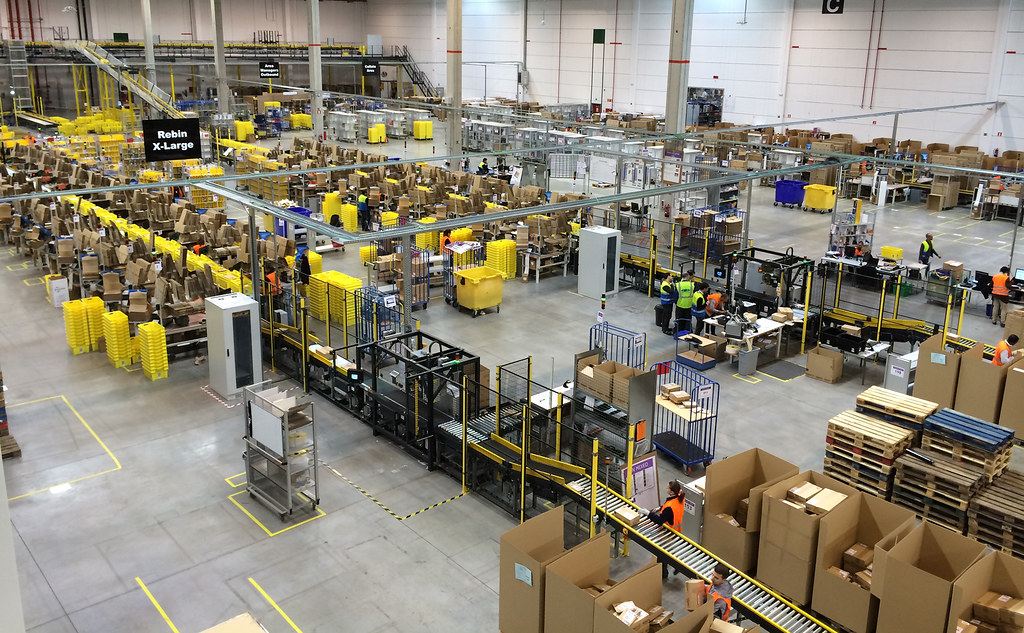
This type of warehouse automation aims to reduce the time taken to process orders and minimize/eliminate the need for manual labor to complete repetitive, labor-intensive warehouse operations through automated systems. For example, automatic sorting machines capable of handling various product sizes and types with minimal human input can sort and categorize thousands of items into smaller orders.
Digital Warehouse Automation
Digital warehouse automation goes beyond the physical automation tools and equipment we find in automated warehouses. It revolves around integrating computerized systems and software into warehousing operations to automate and optimize warehouse workflows. At the heart of this type of automation is software – specialized programs that can track shipments, accurately manage inventory, and even forecast future warehousing needs based on real-time and historical data.
This automation approach leverages a wide range of digital technologies and systems, including AI-driven algorithms, cloud computing, IoT (Internet of Things) sensors, advanced data analytics, warehouse management systems (WMS), robotic process automation (RPA), inventory management systems, storage and retrieval systems (AS/RS), and order management systems (OMS). These digital systems and software tools analyze real-time and historical data regarding warehouse operations, schedule deliveries, track inventory, and route orders to streamline warehouse processes with minimal human involvement.
Essentially, digital automation seeks to improve the overall functionality of a warehouse by reducing manual workflows and ensuring that the warehouse is operating at optimal efficiency.
Automated Warehousing Solutions
Let’s look at several automation technologies being implemented in modern warehouses to streamline order fulfillment processes and enhance warehouse efficiency.
Automated Guided Vehicles (AGVs)
Automated Guided Vehicles are a class of mechanized material handling systems that work autonomously, moving goods and materials throughout a manufacturing facility, distribution center, or warehouse without an onboard driver or operator. These vehicles navigate through a predetermined path across the manufacturing facility or warehouse using different digital sensors, such as floor stickers (markers), LiDAR, wire, magnetic tape, laser, and camera sensors.
AGVs are designed to handle heavy-duty and repetitive tasks that are normally handled by manual carts, conveyor systems, or forklifts, like putting away large volumes of inventory in a repetitive manner, point-to-point transfer of goods, handling empty pallets, or loading finished goods into over-the-road trailers. Their use is limited to large, simple warehouses with properly constructed navigation layouts. As such, they are not recommended for complex warehouse environments with limited space and human traffic.
Over the recent years, AGVs have become a popular option for warehouse automation in countless organizations due to their ability to ensure material flow visibility, automate repetitive and labor-intensive tasks, and minimize the risk of downtimes in warehouses.
Mobile Robots
Mobile robots are software-controlled machines that function through a combination of Artificial Intelligence (AI) algorithms and physical robotic elements, like end effectors, tracks, wheels, actuators, legs, manipulators, etc. They use machine vision and sensor technologies to identify their surroundings and navigate space, which enables them to perform various warehousing tasks without pre-established routes. They are often used in distribution centers and warehouses to automate a wide array of tasks, such as packing, picking, and stocking.
Currently, available mobile robots are either remotely controlled or autonomous. Remotely Controlled Mobile Robots (CMRs) require a human operator’s input to control their movements. Autonomous Mobile Robots (AMRs) are capable of locating items and moving them from point A to point B without human intervention.
Note: Autonomous Mobile Robots (AMRs) should not be confused with Automated Guided Vehicles (AGVs), even though they transport materials and inventory throughout a warehouse or distribution center autonomously. This is because, unlike AGVs, which move along predefined (fixed) routes guided by digital sensors like magnetic tape sensors and LiDAR systems and which sometimes require the supervision of a human operator, AMRs rely on machine vision and sensors to locate items and navigate through more flexible routes without the need for a human operator. AMRs are intelligent robots that are capable of interpreting their surroundings and continuously adjusting their routes as necessary, thanks to their integrated AI technology.
Collaborative Mobile Robots
Collaborative mobile robots are computer-controlled machines specifically built to operate alongside human workers. They are designed with advanced machine vision and radar sensors, multiple motion capabilities, and robust safety mechanisms such as power and force limiting (PFL) safety functions. All of these features enable them to easily navigate through their surroundings and work safely in tandem with humans. Also, due to their highly developed AI/machine learning functions and exceptionally attuned response capabilities, these robots can monitor their own spacing and speed, move freely in open environments, and learn and master how to perform specific tasks.
In automated warehouses, collaborative mobile robots are used to enhance accuracy and productivity by assisting human workers perform a wide range of warehousing tasks and order fulfillment processes. They leverage Artificial Intelligence and Machine Learning technologies to optimize routes in real-time and guide workers through each warehousing task, reducing unnecessary human movements while also increasing the accuracy and speed of executing different warehouse operations, such as order picking, moving heavy items, packing, and return processes.
They also help reduce the number of workplace injuries by minimizing or eliminating the need for human workers to carry out repetitive, cumbersome, or hazardous tasks. In a nutshell, deploying collaborative mobile robots in warehouses brings about numerous benefits, including increased flexibility, scalability, reduced walking time, better reliability, and higher productivity.
Note: By complementing the duties of human workers in warehouses and distribution centers, collaborative mobile robots help optimize the throughput efficiency of the workers while also allowing them to focus on high-level intellectual tasks that add value to warehouse or supply chain operations.
Unmanned Aerial Vehicles (UAVs)
Unmanned Aerial Vehicles, commonly known as drones, are flying robotic platforms that are either remotely controlled by human operators or guided autonomously using GPS-based navigation and positioning systems. They are one of the latest trends in warehouse automation aimed at improving operational efficiency and reducing costs in warehouses.
Warehouse drones are normally used to carry out remote sensing operations inside a warehouse or distribution center. They accomplish this using onboard infrared cameras and optical sensors that capture inventory data, as required. For instance, if the drones detect any inventory item in the wrong storage location or products that require replenishing, they automatically transmit alerts requiring appropriate action.
Internet of Things (IoT) Technology
As companies strive to enhance operational efficiency and provide better operational transparency, IoT technology has emerged as a vital tool for increasing warehouse efficiency and productivity. Currently, various IoT solutions are being used in warehouses to monitor and track goods, manage inventory, predict demand trends, and execute other warehouse functions in real time.
For example, IoT-connected sensors installed in a warehouse provide real-time visibility into the status, location, and condition of stored items, allowing warehouse managers to promptly and precisely assess the availability of those items. Also, the same sensors could be used to monitor the condition of warehouse machinery and equipment and send alerts whenever they detect anomalies or faults that may lead to equipment breakdown. This allows maintenance teams to schedule and perform maintenance tasks proactively, ensuring warehouse operations run smoothly and prevent costly downtimes.
Warehouse Management Systems
Warehouse Management Systems are software solutions that offer real-time visibility into the daily warehouse operations, from the moment materials and goods are received into the warehouse to the point where they are shipped out. They allow companies to manage and control inventories and streamline order fulfillment processes effectively.
With WMS solutions, users can monitor, control, and optimize essential warehouse tasks, including inventory receiving and stowing, picking and packing, inventory tracking, and shipping products, all from a single dashboard. These solutions may also be used to monitor and control automated material handling machinery in warehouses. In essence, the primary goal of deploying a Warehouse Management System (WMS) is to ensure that the movement of inventories inside a warehouse is as economical and efficient as possible.
Barcode Technologies
Automated barcode labeling and scanning systems are an integral part of many high-throughput warehouses and distribution centers. They are used in these facilities to track and manage inventories. When synced with a robust Warehouse Management System and other smart technologies, barcode scanning offers real-time visibility into the movement of materials and inventory all around a facility. Barcode scanners are also used in automated sortation systems to locate items on a conveyor system.
Amazon’s warehouse automation systems make use of barcode labels and scanners to optimize warehouse operations and attain greater levels of storage accuracy. Unique barcode labels are applied to incoming items and products for identification; the labels also specify the respective storage locations of each item/product. As a result, Amazon workers can utilize picking lists and automated routes to quickly locate the products when processing orders, leading to optimized product flow and timely order fulfillment.
Radio-Frequency Identification (RFID)
RFID is a wireless sensing technology that uses radio waves to transmit data from an electronic tag, known as an RFID label or tag, for the purpose of automatically identifying and tracking individual inventory items in real-time.
Inventory items are fitted with RFID tags – small digital devices with smart barcodes that hold more data than standard barcodes – that communicate with RFID reader devices, even when the items are not within line-of-site, e.g., when hidden behind pallets or boxes. The RFID tag readers then share the captured data with digital warehouse automation software, like a Warehouse Management System (WMS), to identify or locate the items.

RFID technology integration into warehouse management systems allows warehousing tasks to be executed with greater accuracy, speed, and efficiency. Also, syncing RFID with IoT technology and an Enterprise Resource Planning (ERP) system can better control an inventory’s location within a supply chain. This makes RFID the best warehouse automation technique for improving order picking/shipping accuracy, inventory visibility, and inventory count rates.
Automated Conveyor Systems
Automated conveyor systems make use of advanced technologies to automate material handling operations, thereby reducing or eliminating the need for human involvement in executing such operations. They employ features such as sensors, automatic loaders and unloaders, infeed and outfeed tables, motors, and conveying control systems (e.g., Programmable Logic Controllers) to streamline different warehousing tasks like palletizing, sorting, loading, unloading order fulfillment, and more.
These types of conveyor systems are primarily deployed in warehouses and manufacturing facilities to maximize efficiency, enhance productivity, minimize human error, improve product quality, ensure workplace safety, and reduce labor costs, among other benefits.
Warehouse Control Systems
A Warehouse Control System (WCS) is an application software used to automate and control different material handling equipment in warehouses, from simple belt conveyors to more complex systems like sorters, automated storage and retrieval systems (AS/RS), palletizing/depalletizing machines, automated guided vehicles (AGVs), print and apply (PANDA) equipment, and carousels, among others.
Common WCS solutions include equipment control, storage optimization, order routing, and inventory tracking. These solutions help ensure an efficient flow of products across different sub-systems and material handling equipment inside a warehouse until the products are ready to be shipped out. Essentially, with a warehouse control system, you can optimize your daily warehousing operations, improve your storage strategies, establish good inventory control, and retrieve stored goods more efficiently.
In addition, you can integrate a Warehouse Control System with a Warehouse Management System to enhance inventory visibility and ensure that essential warehouse operations are coordinated effectively to allow smooth inventory flow – from receiving and stowing to shipping.
Automated Storage & Retrieval Systems (AS/RS)
Automated Storage & Retrieval Systems are computer-controlled platforms that automatically retrieve and store inventory in warehouses. These systems leverage Machine Learning (ML), Artificial Intelligence, and other related technologies to accurately and quickly place and retrieve goods from predetermined storage locations in the warehouse. They are ideal for use in high-density warehouse applications with storage space constraints.
Typically, automated storage and retrieval systems integrate a wide selection of digital, robotic, and racking elements to deliver user-focused automated warehousing solutions capable of handling large volumes of different goods, all monitored and controlled via digital automation software. A custom-built AS/RS solution can be configured from an extensive range of technology options, including cranes, horizontal and vertical carousels, shuttle systems, Vertical Lift Modules (VLMs), Mini-load AS/RS, stockers, Micro-load AS/RS, fixed and moveable aisles, Vertical Sequencing Modules (VSMs), cube-based storage systems, and Unit-load AS/RS, among other systems.
Each of the aforementioned AS/RS hardware includes powerful software that can integrate into a Warehouse Management System (WMS), Warehouse Execution System (WES), Warehouse Control System (WCS), or other digital automation software for control purposes.
Concluding Thoughts
Today, Automated Storage & Retrieval Systems are widely used in manufacturing and distribution facilities to boost warehouse efficiency and productivity, optimize floor space, and enhance workplace safety. For example, IKEA’s– the world’s largest furniture retailer– distribution centers are equipped with different AS/AR inventory automation systems and equipment, like conveyor rack systems, 100-foot-tall trilateral pallet stacker cranes, and pallet conveyor systems that can handle up to 4,500 pallets per hour.
DO Supply Inc. makes no representations as to the completeness, validity, correctness, suitability, or accuracy of any information on this website and will not be liable for any delays, omissions, or errors in this information or any losses, injuries, or damages arising from its display or use. All the information on this website is provided on an "as-is" basis. It is the reader's responsibility to verify their own facts.