Beyond the Basics: Exploring the Features of PowerFlex 7 Drives
PowerFlex drives are a series of Variable Frequency Drives (VFDs) manufactured by Allan Bradley. They control the speed and torque of AC motors in various industrial applications, such as pumps, fans, conveyors, centrifuges, extruders, compressors, and chippers.
Features of PowerFlex 7 series
PowerFlex 7 drives are a line of advanced drives for high-performance applications. This guide provides the technical nuances of PowerFlex 7 drives, covering aspects such as input and output specifications, motor control, communication interfaces, safety features, and diagnostic capabilities, so industrial professionals can make informed decisions when integrating PowerFlex 7 drives into automation systems.
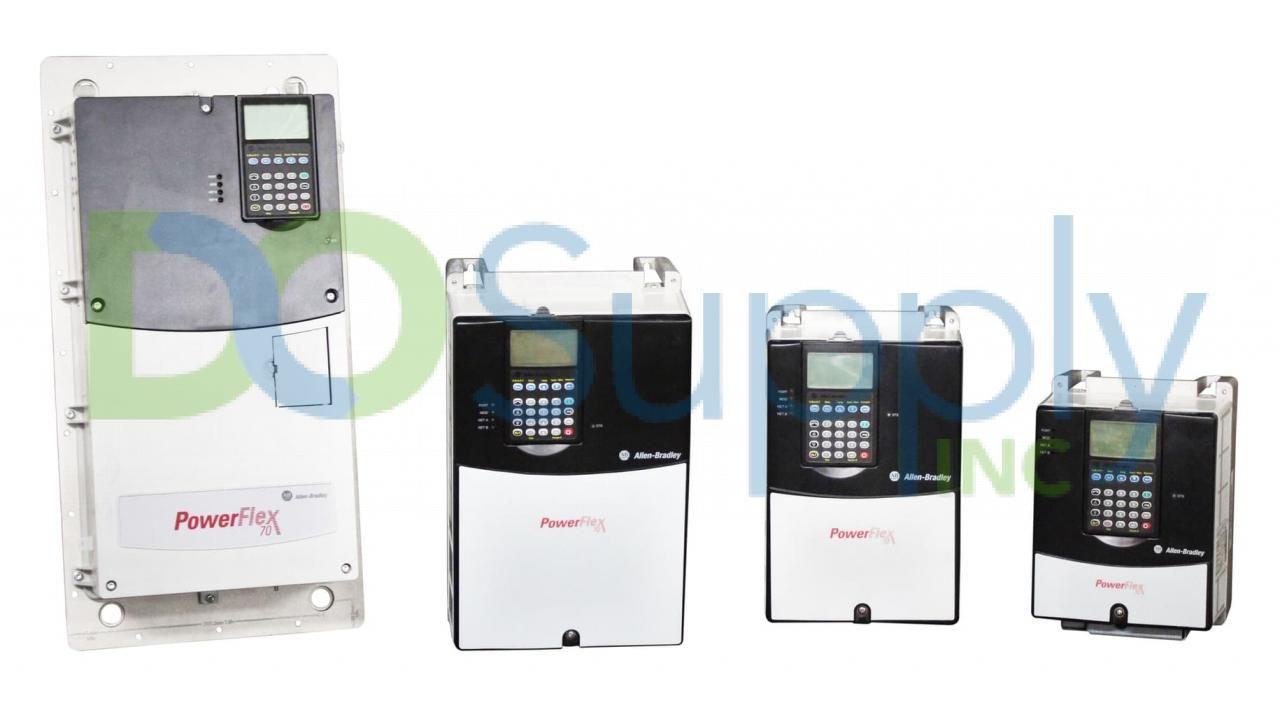
Here are some of the unique features that these drives offer.
Electrical specifications
Electrical specifications refer to a range of electrical parameters, including voltage range, power ratings, frequency tolerance, input phases, power factor displacement, and efficiency. Each factor provides important information about how the drive interacts with the electrical supply and operates under various conditions.
Voltage Range:
This series offers drives with wide voltage ranges from 200VAC to 690VAC. For example, PowerFlex 753 AC drives and PowerFlex 755 AC drives are available in 200 VAC to 690 VAC ratings. There may also be devices that only come with a limited voltage rating. One example of such drives is PowerFlex 755TS, which comes in ratings of 400 VAC to 480 VAC. It’s safe to say that the series has drives available for applications ranging from low voltage to high voltage.
Power Ratings:
With wide ranges of voltages, the drives in the Power Flex 7 series also come in different power ranges from 0.37 kilowatts to 24 megawatts. Series like PowerFlex 700S feature power ratings as low as 0.37 kW (0.5 Hp), which is ideal for small machinery. On the other hand, the PowerFlex 7000 in different configuration drives have power ratings between 150kW (200 Hp) and 24 MW (34,000 Hp), making them better suited for large-scale industrial applications with a high-power output.
Frequency Tolerance:
These drives can tolerate frequencies as low as 47 Hertz and as high as 63 Hertz. The wide frequency range may allow the systems to maintain operational flexibility in situations where fluctuations in electrical frequency are faced.
Input Phases:
Some of the drives in this series come with a configuration option designed to accept a single-phase supply as input. It is important to note that with this configuration, the device may not have the same output (output current may be reduced to 50%) as its rated three-phase input. However, they will still be useful in situations where only a single-phase supply is available. PowerFlex 70 AC Drive, PowerFlex 755 AC Drive (@ 1-7 frames), and PowerFlex 753 AC Drive come with this additional input configuration option.
Power Factor Displacement:
Power Factor displacement is a crucial parameter in determining the efficiency and reliability of an AC electrical system. The PowerFlex 7 series has a consistent power factor displacement of 0.98 across the entire speed range.
Efficiency:
At rated amps, most of these provide up to 97.5% efficiency. The higher the efficiency, the less energy is lost and the greater the environmental benefits.
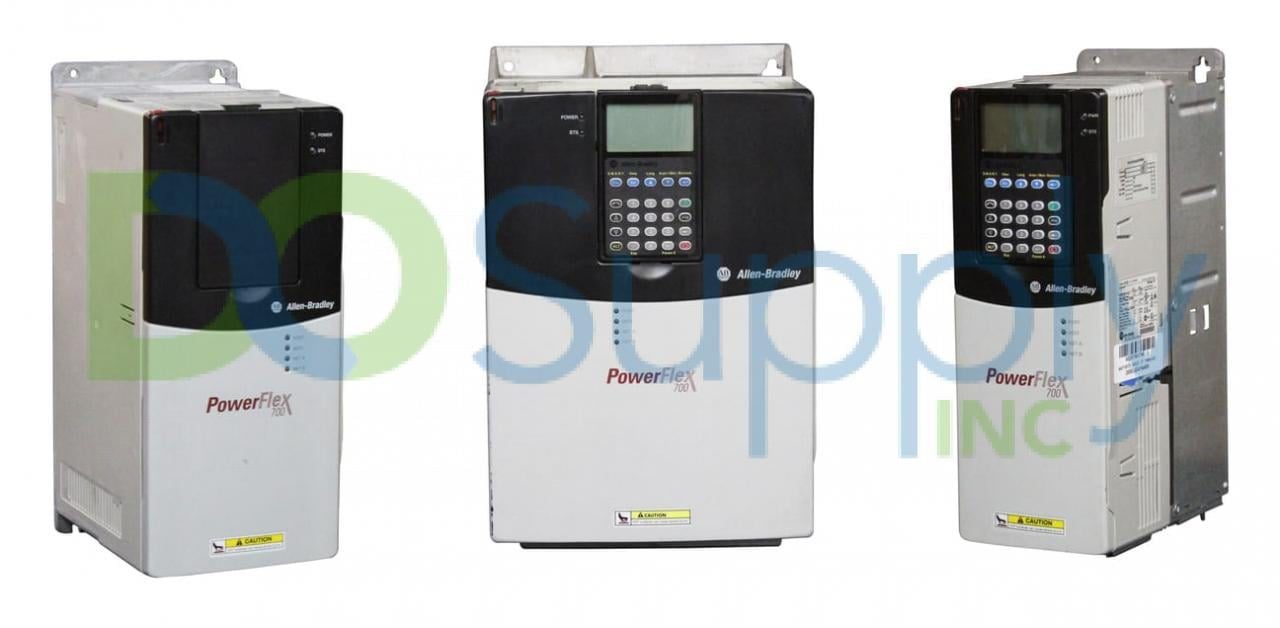
User Controllable Features
Frequency Control:
Various
methods of frequency control exist across different products in the PowerFlex 7
series. The wide range of control options offers flexibility and enhances
stability and accuracy throughout the speed range.
For instance, the PowerFlex 700H drive has a speed regulation of 0.5% of base
speed across a 40:1 speed range. The drive’s slip compensation feature
maximizes performance and accuracy.
Similarly, the PowerFlex 750 series drives exhibit consistent speed regulation of 0.5% of base speed across a 40:1 speed range, with digital input frequency accuracy within ±0.01% of set output frequency.
The PowerFlex 70 drive has a speed regulation as low as 0.001% of base speed across a 40:1 speed range in Sensorless Vector mode. This precision makes it an ideal drive for applications that require optimal motor performance, particularly in high-demand applications.
Speed Control:
The different models within the PowerFlex 7 series integrate a variety of speed control options, including vector control modes with and without feedback.
In vector control mode, the PowerFlex 700H drive can achieve a speed regulation of 0.1% of base speed across a wide 120:1 speed range. In comparison, the PowerFlex 750 series delivers similar precision with a speed regulation of 0.1% across a 100:1 speed range. The PowerFlex 70 drive can also reach 0.1% accuracy across a 120:1 speed range in vector control mode.
With feedback-enabled vector control, the PowerFlex drives become better in speed regulation precision. The PowerFlex 700H drive becomes ten times better with feedback at speed regulation of 0.001% of base speed across a 120:1 speed range and a remarkable 1000:1 operating range. Similarly, the PowerFlex 750 series achieves a speed regulation of 0.001% across a 100:1 speed range with feedback.
Important Note: Speed control focuses on regulating the actual rotational speed of the motor shaft. In contrast, frequency control regulates the frequency of the electrical supply to the motor, indirectly affecting the motor’s speed. They both are methods of speed regulation.
Torque Regulation:
Torque regulation governs the amount of rotational force exerted by the motor shaft. Like speed control, torque regulation also improves with additional feedback.
Torque regulation in the PowerFlex 700H drive without feedback stands at ±5% with a 600 rad/sec bandwidth. Feedback improves accuracy to ±2% with a wider bandwidth of 2500 rad/sec.
Similarly, the PowerFlex 70 drive also delivers ±5% torque regulation with feedback, in comparison to ±10% without feedback
Important Note: While speed regulation controls the consistency of motor shaft rotation speed for stable operation across different loads, torque regulation manages the amount of rotational force exerted by the motor shaft for more precise control over mechanical tasks
Control Methods
Catering to diverse industrial needs, the PowerFlex 7 series drives are equipped with a wide range of control methods for controlling the speed, torque, and position of electric motors.
Some of the commonly offered control methods in these drives are:
Flux Vector Control with an Encoder:
This method uses an encoder to control motor speed and torque, even in dynamic loads.
Sensorless Vector Control:
This is a cost-effective method that allows control without the need for additional feedback devices. This method uses internal signals such as voltage and current to provide real-time control.
Volts per Hertz:
This method established a proportional relationship between voltage and frequency to control wide speed ranges.
Permanent Magnet Motor Control:
The method is specifically designed for the Permanent Magnet Synchronous Motors (PMSMs). These motors are highly efficient, power-dense, and have a dynamic response. The method controls the speed and torque by regulating the magnetic field.
Economizer:
This method adjusts operation parameters based on load conditions. This reduces operation costs by minimizing energy consumption.
Safety Features
Power Flex 7 series drives offer both built-in/hardwired (directly wired with wire) and integrated/networked (via Ethernet/IP) safety features such as Hardwired and Networked Safe Torque Off, Hardwired Safe Speed Monitor, and Networked integrated safety functions, depending on drive series.
Hardwired and Networked Safe Torque Off:
Safe Torque Off (STO) ensures that the drive output is turned off to prevent any unexpected startup or movement of machinery. Hardwired STO provides a physical, direct means of disabling torque in the drive through a dedicated hardware connection. In contrast, Networked/Integrated STO disables torque via network communication and allows for centralized control and monitoring.
Hardwired Safe Speed Monitor:
This feature limits the motor’s speed within a safe range, minimizing the risk of overspeed accidents. It uses physical wiring connections that trigger safety actions when predefined speed thresholds are exceeded.
Networked Integrated Safety Functions:
These may incorporate various safety functions, such as safe Brake Control and safe direction, into the drives’ networked communication system.
The PowerFlex 753 AC drive offers Hardwired and Networked Safe Torque options and a Safe Speed Monitor. The PowerFlex 755 AC drive has additional Networked Safe Torque Off capabilities with SIL 3 and PL e certifications. Additionally, it provides options for Networked Integrated Safety Functions, pushing the safety certifications to SIL CL 3 and PL e Cat 4. The PowerFlex 70 AC drive offers Hardwired Safe Torque Off but it operates at a slightly lower safety integrity level of SIL 2 and PL d. The PowerFlex 755TS, 755TL, and 755TR drives maintain a high safety standard with Hardwired and Networked Safe Torque Off capabilities, Safe Speed Monitor, and Networked Integrated Safety Functions, all certified up to SIL 3 and PL e.
Other Features
Predictive Diagnostics:
Predictive diagnostics are a common feature in the PowerFlex 7 series drives, which offer advanced monitoring capabilities. These advanced monitoring systems are built on sophisticated algorithms for analyzing various parameters and performance indicators throughout the operation. Predictive diagnostics can forecast potential problems before they escalate into major failures by detecting the most subtle deviations from normal operation conditions.
Adjustable Voltage Control:
Adjustable voltage control allows the user to fine-tune voltage levels within the drive and make precise adjustments to match the requirements of different applications (or operating conditions). With optimized voltage levels, efficiency, performance, and stability may be improved. Power Flex 7 series drives come equipped with this feature.
Application-Specific Control:
The PowerFlex 7 series comes with application-specific control capabilities to meet the needs of various industrial settings. These are specialized control algorithms designed specifically for a specific application.
Option Slots:
Each drive in the PowerFlex 7 series has multiple option slots, which makes it flexible for system expansion and customization. These option slots accommodate additional modules, including I/O (Input/Output), feedback devices, safety components, auxiliary control power modules, and communication interfaces. The modular design allows room for the drive system to be requirement-specific both now and in the future. This scalability and future-proofing makes the system easily adapt to newer needs simply by upgrading modules.
TorqProve for Lifting Applications:
TorqProve technology is designed for lifting applications such as hoists and cranes. It helps verify precise control of load handling in a lifting application. TorqProve™ monitors real-time torque levels to ensure safety and accuracy in lifting, lowering, and positioning heavy loads. The PowerFlex 7 series drives featuring TorqProve™ pose a minimum risk of accidents or equipment damage.
Convenient Roll-In/Out Design:
Some drives in the PowerFlex 7 series, like PowerFlex 755, feature a convenient roll-in/out design for floor-mounted installations. The design simplifies installation, maintenance, and other servicing procedures as it allows the drive module to be easily rolled into and out of position as needed. Whether for routine maintenance tasks or troubleshooting activities, This accessibility feature minimizes downtime and disruptions in production processes regarding maintenance tasks or troubleshooting surveys.
Regenerative Capability:
This technology helps decrease energy consumption by delivering regenerative energy from motors back to the incoming supply. Line regeneration reduces the need for braking resistors and associated cooling equipment and hence avoids energy losses.
Overview of PowerFlex 7 Series Drives
This section of the article summarizes the overall features offered by the various drive series of the PowerFlex 7 series.
Architecture-class AC drives:
PowerFlex Architecture-class AC drives come with a broad set of application-specific parameters and features, which makes them the best choice for high-performance applications. They are designed for applications where the requirements for speed and torque control are up to 27 kW/ 400 Hp.
PowerFlex 755 AC Drives:
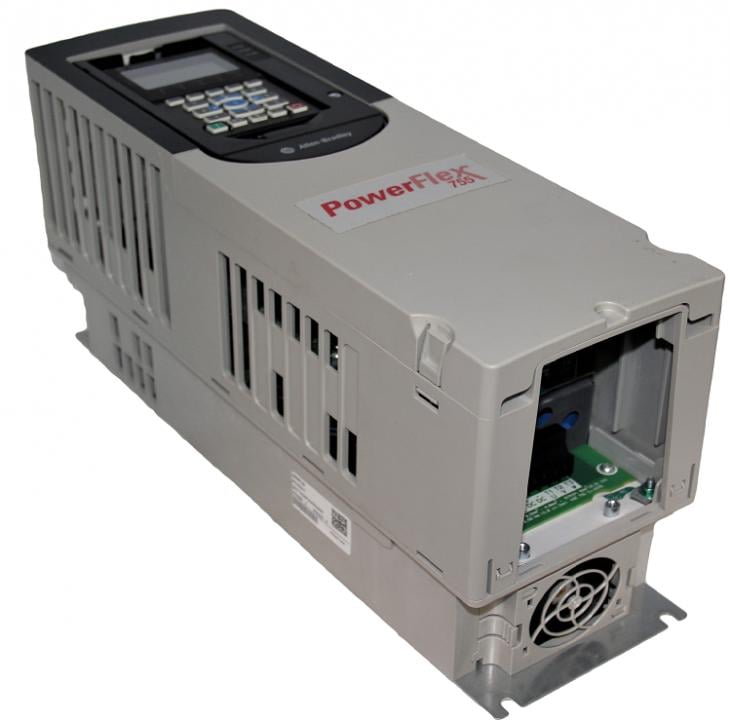
These drives include multiple options for safety, control, and hardware. With built-in EtherNet/IP, they deliver real-time operating data and can seamlessly integrate into the Logix control system. They are best suited for applications that need position, speed, or torque control up to 1500 kW / 2000 Hp. They also have DC input options included. Key features include:
- Predictive diagnostics
- Five option slots for I/O, feedback, safety, etc.
- TorqProve™ for lifting applications
- Application-specific control for indexing, oil well, and fiber applications
- Adjustable voltage control
- Convenient roll-in/out design for floor mount drives
PowerFlex 753 AC Drives:
This drive series is equipped with built-in I/O and offers three additional option slots for communication, safety, and additional I/O. Key features of this variant include:
- Embedded I/O standard
- Adjustable voltage control
- Three option slots for I/O, feedback, safety, etc.
- Application-specific control for indexing, oil well, and fiber applications
- Predictive diagnostics
PowerFlex 70 AC Drives:
PowerFlex 70 AC drives combine power, control, and operator interface in a single package to offer a compact yet powerful solution for various applications where there is a demand for size. They are available in machine-mounted and wall-mounted configurations. Key features are:
- Embedded I/O Standard
- Speed and Torque Control:
- P-Jump and Traverse Functions:
- Flexible Packaging and Mounting Options
PowerFlex 700 AC Drives
- Inertia Ride through
- Parameter Linking
- Motor overload protection
- Flying start
- Memory storage
- Fault memory
- Drool control
The PowerFlex 700 drives come with the Human Interface module, allowing the option to switch between auto and manual modes. These drives also incorporate an auto economizer for a safer and cost-effective operation. These drives provide three kinds of braking options: dynamic braking, flux braking, and fast braking. Key features include:
PowerFlex 7000 AC Drives
PowerFlex 7000 AC Drives are designed for medium voltage and high power applications. Their operation voltage ranges between 2.3 kV to 11 kV, and the power ratings can be up to several megawatts. The system design is modular, which allows flexible configuration and scalability. Modules can operate power cells; control modules can have various communication options. These drives come in various variants; some notable variants include:
PowerFlex 7000 Air-cooled Drives are better suited for motors operating from 150-6000 kW at 2.4 to 6.6 kV. The drive comes in different frame sizes. They offer a heat sink or pipe to provide adequate ventilation and ambient temperatures for different power ranges.
PowerFlex 7000 Extended Power Configurations operate at ranges up to 25,400 kW at 2.4 to 6.6 kV. There may be air-cooled or liquid-cooled modules. These high-power drives offer an effective solution for hot backup and redundancy, Load-Commutated Inverter retrofits, and power upgrades.
PowerFlex 7000L Liquid-Cooled Drives are best suited for ranges between 2240-6340 kW at 4.16 to 6.6 kV. The drives use a closed-loop liquid-cooling system with liquid-to-air or liquid-to-liquid heat exchangers that provide redundant pumps.
PowerFlex 7000L Marine Drives have power ratings from 600 kW to 24 MW. They use Direct-to-Drive technology to conserve space and weight.
Other features may include Voltage Source Inverter (VSI) Technology and Inherent Regenerative Braking Capability
PowerFlex 755T AC Drives with TotalFORCE Technology
PowerFlex 755T Drive:
PowerFlex 755T drive Products feature harmonic mitigation, regenerative capabilities, and non-regenerative and common bus solutions that reduce energy costs and improve flexibility and productivity. These drives are the first to offer TotalFORCE® technology, which helps with excellent motor control through precision in the control of torque, speed, and position for electric motors.
PowerFlex 755TS Drive :
The PowerFlex 755 TS Drive integrates TotalFORCE technology into a traditional six-pulse drive. This expands the application’s versatility. Their applications now extend from fans, pumps, and conveyor operations to advanced motor control processes that require high-performance features. The drive also provides real-time operational intelligence, automated commissioning, and optimization capabilities. Key features include:
- TotalFORCE technology for system optimization
- Simplified migration from PowerFlex 755
- High power density with a compact footprint
- Optional enhanced corrosive gas protection (XT)
PowerFlex 755TR Drive:
The PowerFlex 755 TR Drive is equipped with built-in regeneration capabilities and harmonic mitigation. The drive also offers power factor correction for an even more efficient energy solution. This makes up an energy-efficient drive. Other features include:
- TotalFORCE technology
- Predictive diagnostics
- Convenient roll-in/out design
- High power density with a compact footprint
- TorqProve for lifting applications
- Five option slots for I/O, feedback, safety, auxiliary control power, communication
PowerFlex 755TL Low Harmonic AC Drive:
The PowerFlec 755TL Drive uses active front-end technology to provide harmonic mitigation and power factor correction features. The drive offers an energy-efficient and cost-effective solution to power distribution issues by reducing harmonic distortion. Here are some of the other notable features:
- TotalFORCE technology
- Predictive diagnostics and maintenance
- Convenient roll-in/out design
- High power density with a compact footprint
- TorqProve for lifting applications
- Five option slots for I/O, feedback, safety, auxiliary control power, communications
Communication Options
The PowerFlex 753, 755, and 70 drives all boast a variety of common features, including an Internal Drive Peripheral Interface (DPI) and compatibility with an array of communication protocols, notably EtherNet/IP, ControlNet, DeviceNet, BACnet, CANopen, and Modbus/TCP. The PowerFlex 753 distinguishes itself with options for single or dual-port EtherNet/IP and supports additional communication protocols like PROFIBUS DP and RS-485 D. In contrast, the PowerFlex 755 comes with built-in EtherNet/IP ports and the ability to utilize RS-485 DF1 and PROFINET IO. For those requiring compatibility with external SCANport, the PowerFlex 70 series is an ideal choice, as it also supports the Siemens P1 HVAC protocol. Meanwhile, variants of the PowerFlex 755, including the 755TS, 755TL, and 755TR, are equipped with dual EtherNet/IP ports, making them particularly well-suited for applications that require high network availability. These models also provide support for an extensive range of communication options such as ControlNet, DeviceNet, PROFIBUS DP, and PROFINET.
Furthermore, the Internal DPI serves as a universal communication gateway for the PowerFlex 7 series drives, facilitating seamless interfacing with different control systems and devices. Certain drives within these series are also equipped with EtherNet/IP ports, enhancing real-time data exchange and control capabilities over Ethernet-based networks. The inclusion of dual-port configurations in some models ensures greater reliability of the network. Additionally, a variety of communication options are available across these drives, including well-known industrial networks and various HVAC protocols, catering to a wide range of application needs.
Conclusion:
In conclusion, PowerFlex 7 series drives provide VFD solutions for a wide range of industrial applications. One must know their specific needs to make an informed decision when selecting one of these drives. While this article provides a comprehensive overview of various features that come with PowerFlex 7 series drives, it is recommended to always read the official manuals to better understand the products.
DO Supply Inc. makes no representations as to the completeness, validity, correctness, suitability, or accuracy of any information on this website and will not be liable for any delays, omissions, or errors in this information or any losses, injuries, or damages arising from its display or use. All the information on this website is provided on an "as-is" basis. It is the reader's responsibility to verify their own facts.