The Hidden Cost of Running Oversized VFDs
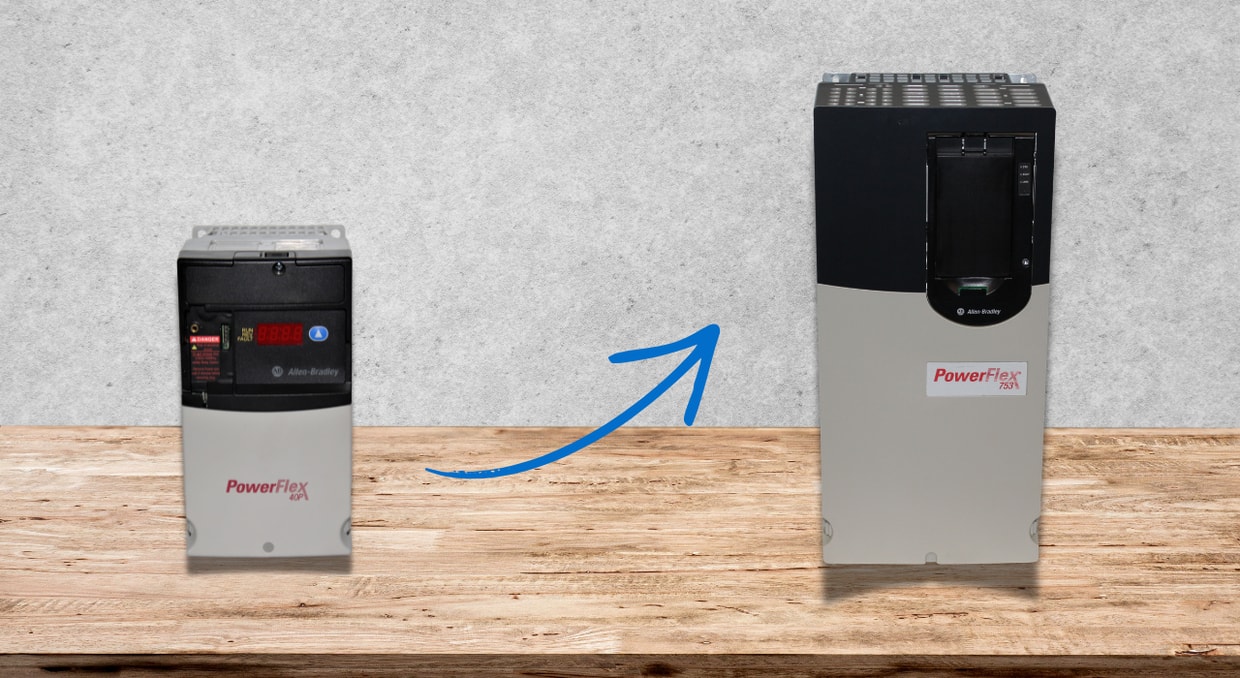
When designing or making electrical installations, the first thoughts often turn to how much safety margin to build into the electrical design so it will withstand a certain amount of overcurrent during an emergency or surge. But when we install a VFD, the idea of putting an oversized one to build in a safety margin actually backfires. An oversized drive does not provide any safety margin — it decreases energy efficiency and motor protection while increasing harmonic distortion and costs.
Why Extreme Oversizing Creates Problems
A good rule of thumb is that any drive should not be larger than twice the rating of the connected motor. Drive manufacturers go further and specify that the motor must carry a rating above 50% of the drive. Combining a 150 kW drive with an 11 kW motor gives only a 7.3% ratio. The issue comes from the large difference between the motor’s operating current and the VFD’s rated current range. A VFD measures the output current and uses it for motor control, torque estimation, and electronic overload protection.
When a small motor is paired with a much larger drive, its current will occupy only a small portion of the drive’s measurement and adjustment range, making it less precise. A motor rated under a manufacturer’s suggested range can lead to inaccurate tuning, vector control, or overload protection.
Compromised Control Performance
Drives provide two control modes: V/Hz and open- or closed-loop vector control. Vector control delivers accurate torque output even at low speeds, but suffers heavy degradation with an oversized drive. Some drives even have minimum motor current or motor power limits for auto-tuning and vector control. If the connected motor falls below those limits, the drive may reject the motor data, fail to tune correctly, or provide degraded torque control. At low speeds, an oversized inverter cannot apply the correct current to magnetize a small motor, and may cause speed regulation to become unstable
Inaccurate Protection Features
VFD oversizing reduces the protection the drive provides. The inverter’s algorithm uses Full Load Ampere (FLA) values for thermal protection. With severe oversizing, the motor FLA may represent only 7–8% of the drive’s measurement range, at which resolution the drive fails to detect currents that would overheat the motor. An external overload relay is an option, but it must be rated for non-sinusoidal VFD output currents, adding further cost to an already mismatched installation.
Compounded Harmonic Distortion
Harmonic currents are generated whenever AC-to-DC-to-AC conversion occurs inside a VFD. These currents cause transformer overheating, instrumentation interference, voltage distortion, and potential non-compliance with IEEE 519.
Oversizing makes this worse in two ways. The larger DC bus capacitor bank of an oversized drive draws greater peak charging currents, producing a harmonic profile richer in 5th and 7th harmonics. A VFD operating well below its rated capacity also produces a much higher Total Harmonic Distortion (THD) as a percentage of the fundamental current. Line filtering chosen for a correctly sized drive may therefore be completely ineffective when an oversized unit is substituted. Facilities containing sensitive instrumentation or tightly integrated control equipment may require additional power-quality analysis, particularly where source impedance is high or nonlinear loads make up a large share of facility demand.
Energy Efficiency Losses
A correctly-sized VFD, exploiting the affinity laws, can realize energy savings of approximately 49% from a 20% reduction in motor speed. An oversized drive continuously generates conversion losses that erode these benefits.
Independent of the output load, the AC-to-DC-to-AC conversion in every VFD dissipates a small percentage of the input power as heat. Because larger drives contain larger power semiconductors and filtering components, their conversion losses are greater than those of a correctly-rated drive performing identical work. A 150 kW VFD driving an 11 kW load generates considerably more heat than a matched 15 kW unit would. This excess heat leads to thermal derating in warm mechanical rooms where ambient temperatures approach 40°C, reducing output capability and prompting the installation of yet a larger drive — repeating the cost cycle with no performance gain.
Capital and Infrastructure Costs
Oversizing raises equipment costs because higher-voltage drives, better enclosures, more options, and higher horsepower demand a premium. The impact extends beyond the drive unit itself, since all surrounding infrastructure scales with the drive rating, not the motor rating.
Electrical codes require feeder conductors to be sized for the VFD’s rated current. An oversized drive may require larger input conductors, disconnects, reactors, filters, and protective devices. A VFD three or four frame sizes larger than necessary also consumes enclosure space that would otherwise be available for future expansion and restricts airflow within densely populated panels.
Long-Term Reliability and Maintenance Challenges
Power semiconductors and DC bus capacitors undergo abnormal thermal cycling stress beyond their designed operating range, potentially shortening service life, as these are the components most likely to cause drive failure.
Predictive maintenance routines such as thermal imaging, capacitor ESR testing, and fan inspections are calibrated for drives operating at their intended load. An oversized VFD produces irregular thermal signatures that complicate trend analysis and hide incipient faults. A cool-running oversized drive is not necessarily a healthy one; it may simply be one that can no longer accurately report its own condition.
Specifying the Right VFD from the Start
Proper load analysis must precede any VFD specification. The drive rating should correspond to the actual motor, with derating applied only under verified site conditions. Drive manufacturers may include derating factors for altitude, ambient temperature, carrier frequency, enclosure, and input phase.
Where a retrofit requires temporary use of an oversized VFD, V/Hz scalar mode offers the best tolerance for the mismatch, a VFD-rated external overload relay is mandatory, and feeder sizing must match the drive rating. These measures improve safety but cannot resolve the efficiency losses, harmonic penalties, and reliability problems outlined above. Only a properly sized VFD, achieved through disciplined load profiling, can fully deliver the performance, protection, and energy savings that drive technology promises.
Final Thoughts
Overall, oversizing a VFD is not automatically dangerous, and moving up one rating may be justified by overload duty, ambient temperature, and other verified derating requirements. The problem arises when a drive is several sizes larger than the motor for no clear engineering reason. At this point, the added capacity may provide no practical benefit, especially when it comes at a higher price, takes more space, and has higher cooling requirements. More importantly, the motor may fall outside the range in which the drive can accurately tune, control, and protect it.
A good recommendation is to size the drive based on the motor’s actual current, load profile, overload demand, and installation conditions, rather than using horsepower alone. A properly selected VFD gives the motor the control and protection it needs without paying for capacity the application will never use. If you would like to learn more about compact vs. full size drives, we have an article here for you!
If you need help finding the right-sized VFD for your installation, contact us at DO Supply. Our team can help compare compatible options and find the right equipment for your job. We also back our products with a two-year warranty for added peace of mind.
DO Supply Inc. makes no representations as to the completeness, validity, correctness, suitability, or accuracy of any information on this website and will not be liable for any delays, omissions, or errors in this information or any losses, injuries, or damages arising from its display or use. All the information on this website is provided on an "as-is" basis. It is the reader's responsibility to verify their own facts.