Compact Drives vs Full-Size Drives: Where PowerFlex Splits
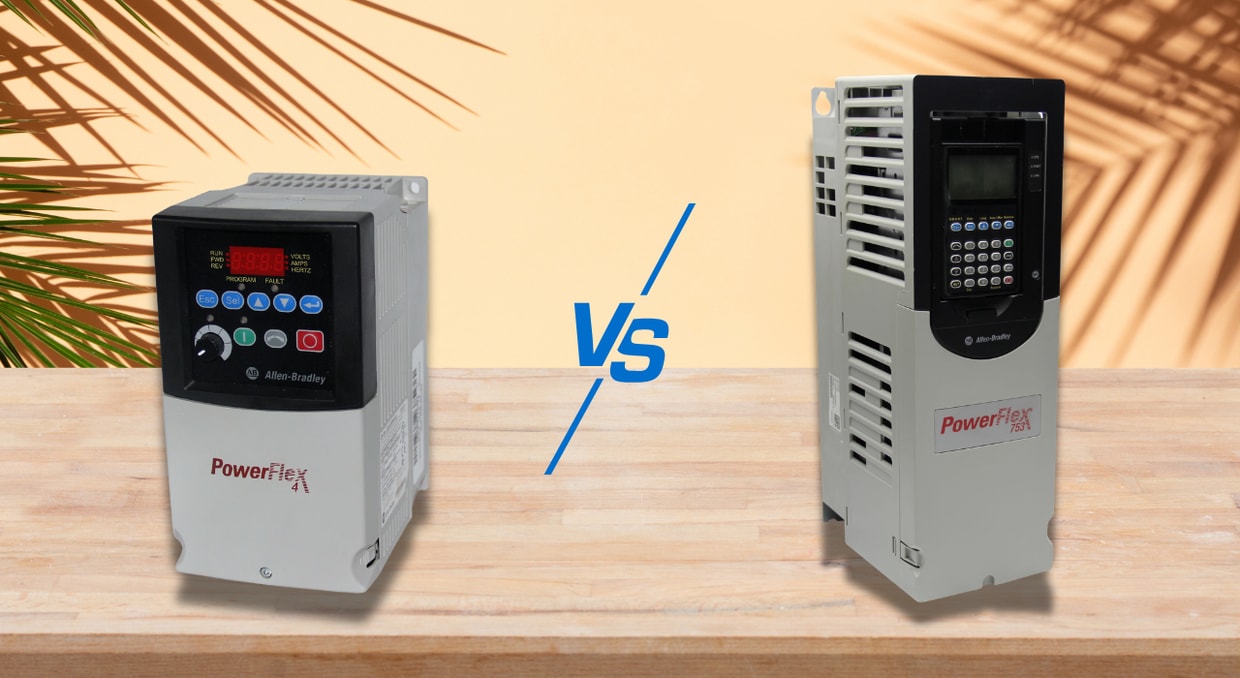
The PowerFlex product family from Rockwell Automation spans one of the broadest drive portfolios in industrial automation. Engineering the right selection from within that portfolio requires understanding precisely where Rockwell draws the line between its compact and full-size (architecture-class) drive categories, and what technical capabilities exist on each side of that line. PowerFlex drives are broadly categorized into compact-class and architecture-class: compact drives are smaller, cost-effective units for simpler applications, while architecture-class drives are high-performance, feature-rich units for demanding industrial requirements. Here, we will discuss some parameters for comparing the two types of drives.
The PowerFlex Portfolio: How the Tiers Are Defined
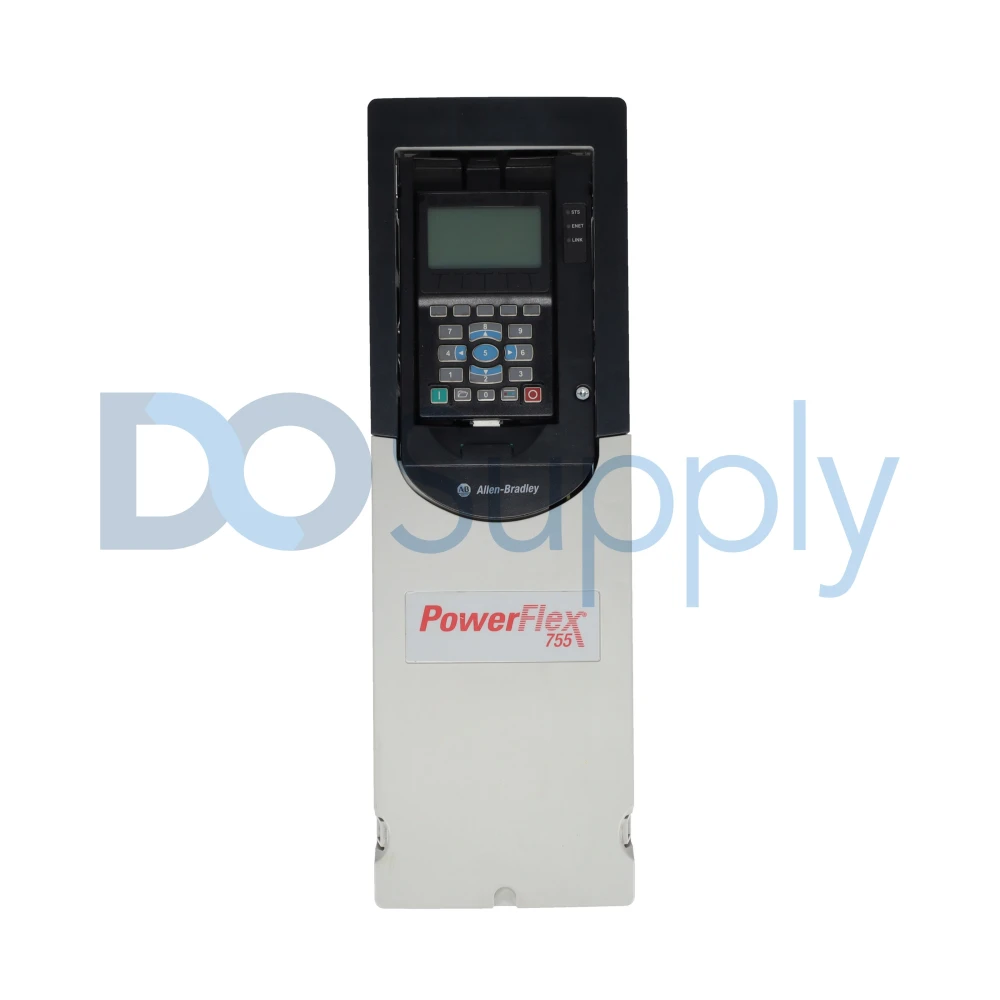
Rockwell Automation organizes the PowerFlex family into three tiers: compact (component-class), standard, and architecture-class. The compact tier encompasses the PowerFlex 4, 40, 523, 525, and 527 series. The architecture-class tier covers the PowerFlex 70, 700, 753, 755, and the current-generation 755T sub-family. The compact, low-voltage PowerFlex drives provide a low-cost, general-purpose solution for automation applications requiring simple system integration and speed control. In contrast, the high-power and standard low-voltage PowerFlex drives are ideal for applications requiring torque, speed, and position control with an application-specific variety of features. The split between these tiers is not an arbitrary catalog boundary; it reflects distinct design priorities, hardware architectures, and application scopes that map directly to distinct engineering requirements in the field.
Power Range and Physical Frame Architecture
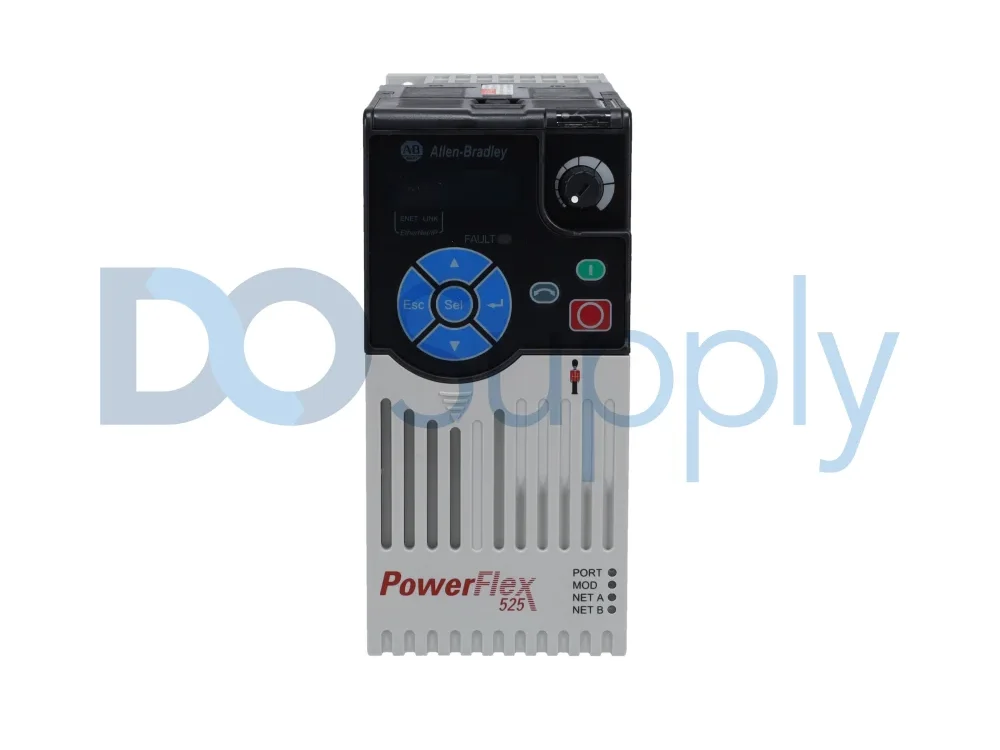
The most immediate physical differentiator between compact and full-size PowerFlex drives is power range and the frame architecture built around it. The PowerFlex 523 and 525 are compact 520-series drives, with the PowerFlex 525 rated from 0.4 to 22 kW / 0.5 to 30 HP across global voltage classes. The 523 also reaches up to 22 kW / 30 HP depending on voltage and catalog configuration. Zero stacking is allowed for ambient temperatures up to 45°C, saving valuable panel space. DIN rail mounting is available on Frame A, B, and C drives. The Frame A PowerFlex 523 at 0.25 HP measures approximately 55 mm wide, narrow enough to install multiples within a compact MCC section.
Architecture-class drives begin where compact frames end in both power and physical scale. The PowerFlex 753 and 755 have current ratings up to 720 A for high-power applications such as extruders and compressors. The PowerFlex 755T with TotalFORCE technology handles up to 2,400 A, and the PowerFlex 7000 delivers up to 7,200 A in medium-voltage installations for demanding settings such as oil refineries. Full-size drives from Frame 5 upward are floor-standing enclosures with front-access maintenance design, separate converter and inverter sections, and dedicated cooling airflow paths that reflect fundamentally different thermal management requirements compared to DIN-rail compact units.
Control Mode Depth: V/Hz, Vector, and TotalFORCE
Control mode capability is the most consequential technical distinction between compact and full-size PowerFlex drives. Compact drives support V/Hz scalar control and sensorless vector control (SVC). The PowerFlex 525 offers V/Hz control for simple applications as well as sensorless vector control for improved torque response and speed regulation. It also supports configurable closed-loop control with an optional encoder card for speed or position feedback and basic position control.
Architecture-class drives extend well beyond this baseline. The PowerFlex 755 supports multiple motor control modes, including V/Hz, sensorless vector, and closed-loop vector control with an encoder, accommodating demanding loads that require precise torque regulation. The 755T series introduces TotalFORCE technology as a further step. TotalFORCE delivers precise velocity, torque, and position control that automatically adapts to load and mechanical changes as they happen, without requiring drive-tuning experts or complex code. The practical implication is decisive: a fan, pump, or simple conveyor on a variable-torque load profile is fully served by SVC on a 525. A crane hoist, winder, or extruder, where torque must be regulated through transient load changes, where overshoot can create process or safety issues, requires the closed-loop flux vector capability of the 755 or 755T platform.
Option Slot Architecture and Hardware Expandability
One of the clearest dividing lines in the PowerFlex family is hardware expandability. Compact drives in the 520 series provide a fixed set of onboard I/O plus one or two option module slots. The 523 supports one option module; the 525 supports two. Installing a communication adapter in one slot occupies the slot that would otherwise hold an encoder card; these are mutually exclusive choices on the compact platform.
The PowerFlex 755 architecture-class drive features five option slots for I/O, feedback, safety, and communication modules. The 753 includes three option slots for I/O, feedback, and safety. This slot-based architecture means a single base 755 drive can be configured with a resolver feedback card for positioning, multiple analog I/O cards for local sensor monitoring, a safety option module for SIL 2 stop functions, and a network communication adapter, all simultaneously. The 755T slot-based hardware structure allows selection of option modules for safety, communication, I/O, and feedback, reducing spare parts inventory requirements, as the same hardware control options are supported across both the 753TS and 755TS platforms. By design, compact drives do not support this level of simultaneous hardware expansion.
Communication and Logix Integration
The PowerFlex family shows a sharp generational divide in communication within the compact tier and a consistent full-capability advantage in the architecture-class tier. The PowerFlex 525 includes an embedded EtherNet/IP port, enabling configuration, control, and data collection over the network. An optional dual-port EtherNet/IP card supports linear and ring network topologies. The PowerFlex 523 has no embedded EtherNet/IP; network connectivity requires an add-on communication adapter module, consuming its sole option slot.
The PowerFlex 527 takes compact Logix integration furthest. The PowerFlex 527 has two integrated Ethernet ports for flexible network topology applications. The 527 has no standalone keypad and is exclusively programmed through the Logix controller, making it suitable only for fully networked machine architectures. Architecture-class drives provide the deepest Logix integration. The PowerFlex 755 features built-in EtherNet/IP, delivering real-time operating data seamlessly integrated into the Logix control system. Automatic Device Configuration simplifies setup by collecting settings from Logix controllers, while EtherNet/IP connectivity enables smooth communication across ring, star, and linear topologies. ADC automatically downloads stored drive parameters to a replacement drive upon detecting a network, reducing post-failure recommissioning time from hours to minutes.
Safety Function Integration
Safety capability is a decisive selection criterion across both tiers, but the depth of available functions differs substantially between them. The PowerFlex 525 integrates built-in safety functions, including Safe Torque Off, rated to SIL 2/PLd, which are useful for safety interlocks in material-handling and conveyor applications. For most machine applications involving hazardous motion zones, STO on the compact drive is sufficient.
Architecture-class drives support a broader safety-function portfolio through dedicated safety-option modules. The PowerFlex 755 with a safety option card supports STO, Safe Stop 1, Safe Stop 2, Safe Operating Stop, Safe Limited Speed, and Safe Direction functions as defined in IEC 61800-5-2. These advanced functions are necessary for applications such as collaborative robot interfaces, operator-access conveyor zones requiring monitored speed rather than full de-energization, and crane applications where Safe Brake Control coordinates drive stopping with mechanical brake engagement. The PowerFlex 755TS uses TotalFORCE technology for torque regulation in special applications, including cranes with anti-sway algorithms and torque control while load sharing with another drive on the same mechanical system, scenarios where safety-integrated torque monitoring is a system-level requirement.
Harmonic Mitigation and Power Quality
Power quality at the supply bus is a consideration exclusive to the architecture-class tier at meaningful power levels. Standard six-pulse rectifier topologies in compact drives inject characteristic 5th-, 7th-, 11th-, and 13th-harmonic currents. For small, compact drives, the absolute contribution is modest relative to the supply transformer’s capacity. For large full-size drives, harmonic distortion can violate IEEE 519 limits at the point of common coupling.
The 755T sub-family addresses this through topology differentiation. The four 755T variants, TS, TL, TR, and TM, all share the same TotalFORCE foundation, with differences in power topology, harmonic performance, and system architecture. The 755TL is a low-harmonic drive with an active front end to mitigate line harmonics and improve power factor, useful where IEEE-519 harmonic compliance is required or in generator-supplied systems. The 755TR adds full regenerative capability, returning braking energy to the supply rather than dissipating it as heat. PowerFlex 755T drive products provide harmonic mitigation, regeneration, non-regenerative, and common-bus solutions that help reduce energy costs, increase flexibility, and boost productivity. None of these power topology options exists in the compact drive tier.
Final Thoughts
In conclusion, the PowerFlex family is split between compact and full-size at a boundary defined by five major selection factors: control-mode depth, hardware expandability, safety-function portfolio, predictive-maintenance capability, and power-quality topology. Compact drives deliver cost-effective speed control for standalone machines and variable-torque loads. Architecture-class drives deliver precise flux vector torque control, multi-slot expandability, TotalFORCE adaptive intelligence, advanced safety, and IEEE-519-compliant harmonic mitigation for process-critical applications. Getting that boundary right, application by application, is where good drive selection really matters. For a more robust drive comparison, check out our PowerFlex comparison guide for harsh environments here!
At the end of the day, selecting the right drive depends entirely on the application it will be installed in, rather than the catalog number. If you need simple speed control for a pump, fan, or conveyor, a compact drive may be the smarter, more cost-effective choice. If the job involves higher power, tighter torque control, advanced safety, regeneration, or harmonic mitigation, stepping up to an architecture-class drive may be worth it. We at DO Supply can help you compare PowerFlex options, source replacement drives, and help you find the right fit for your application! Contact us today to learn more about our available inventory, repair services, and 2-year warranty.
DO Supply Inc. makes no representations as to the completeness, validity, correctness, suitability, or accuracy of any information on this website and will not be liable for any delays, omissions, or errors in this information or any losses, injuries, or damages arising from its display or use. All the information on this website is provided on an "as-is" basis. It is the reader's responsibility to verify their own facts.