When Omron CP1 PLC Line Is Enough for OEM Machines
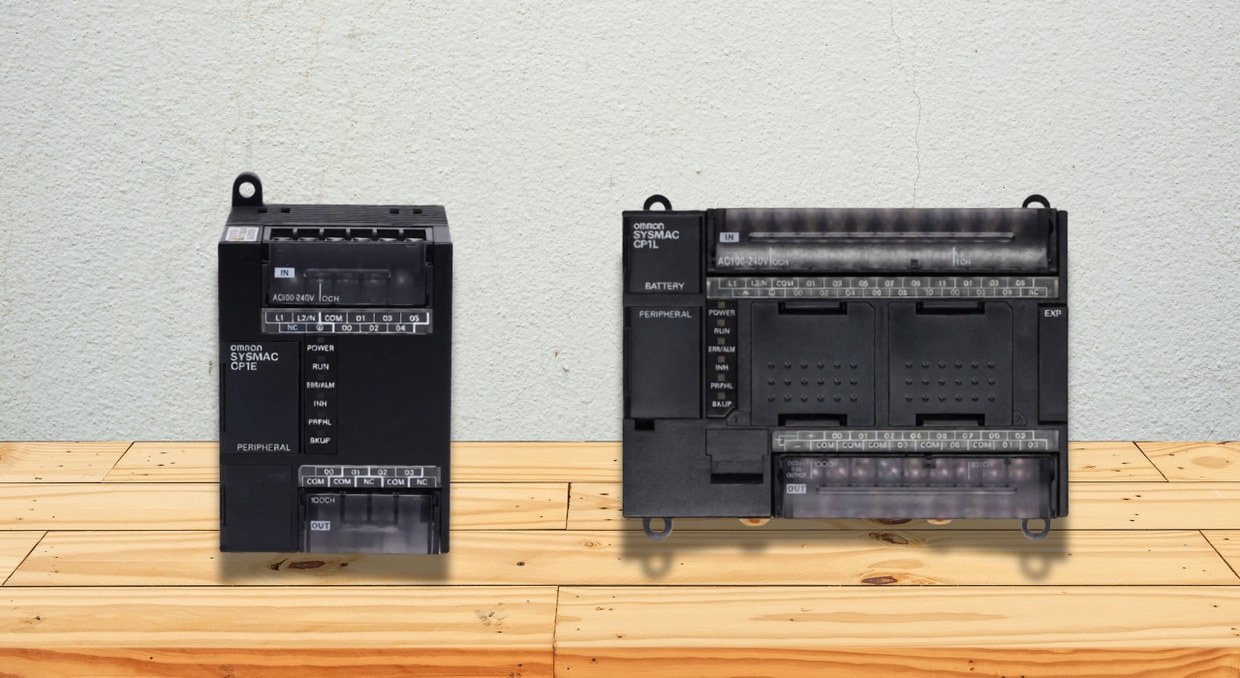
The problem that every OEM machine builder faces is what hardware to buy that will help power and control their system. For PLCs, they may face constraints with controller memory size, communication options, motion capabilities, and the size of the PLC.
For many compact to moderately complex OEM machines, an Omron CP1 controller may already provide everything the design requires. Designed for machine level automation, the CP1 families capabilities range from basic control tasks to more capable applications involving communications, analog signals, and positioning.
Understanding the Three CP1 Performance Levels
Omron has split the CP1 controller family into three different performance levels: The CP1E, CP1L, and CP1H. The CP1E is the most cost effective solution for simpler machines, the CP1L offers a middle ground between the three, and the CP1H is the high end model with additional speed and positioning capabilities.
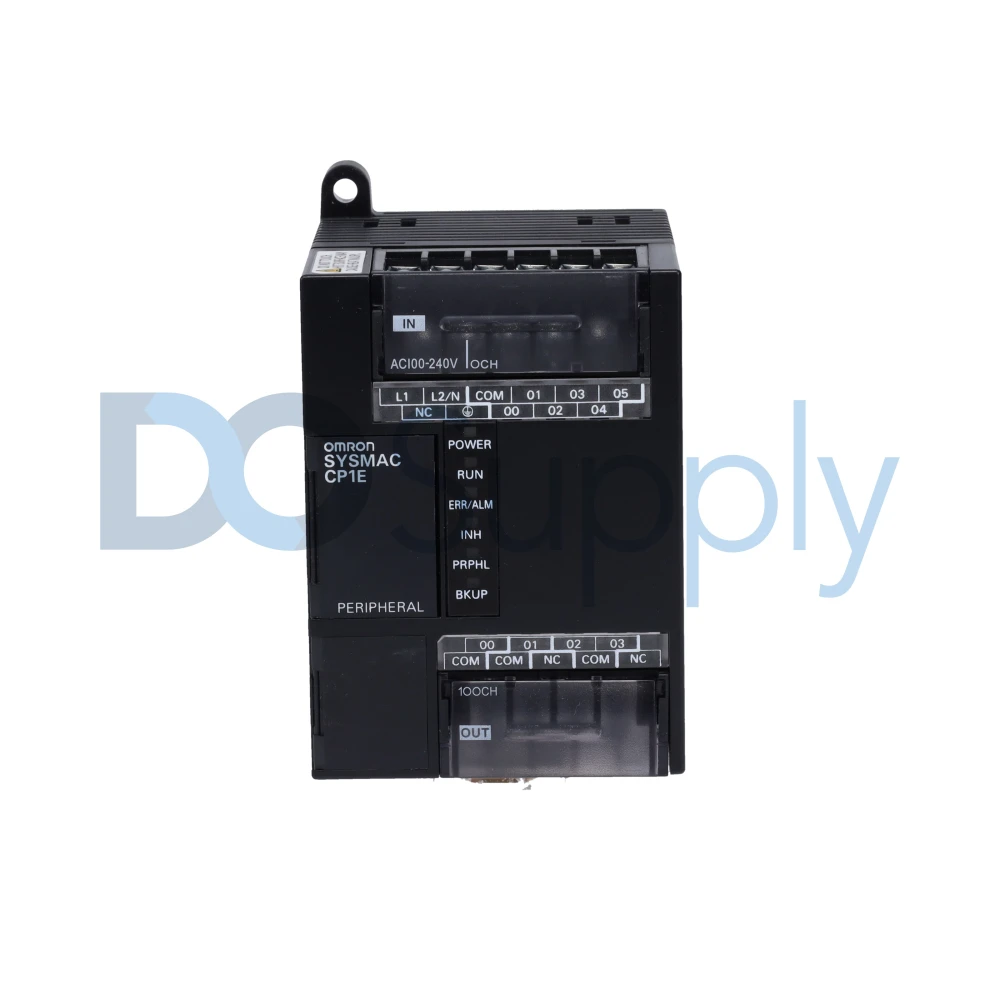
CP1E: The Economy Controller
The Omron CP1E is the entry level controller in the CP1 family. It is designed to be an economy focused option for OEM machines that have a modest program, a contained I/O count, and clearly defined communication or positioning needs that match the selected CPU model. The CP1E also supports basic expandability with their optional modules as well.
Omron separates the CP1E into three types:
- The E-type CP1E for standard control
- The N-type and NA-type CP1E with more memory and communication options
The E-type CP1E is the most basic version. Omron describes it as a controller for basic applications using standard logic, data movement, arithmetic, and comparison instructions. It fits machines built mainly around sequencing, timers, counters, interlocks, and ordinary discrete I/O. Their program capacity is 2k words and come with CPU units that have 10, 14, 20, 30, 40, or 60 I/O points
The N- and NA-type CP1E are intended for more application-oriented machines. These CPUs support connections to devices such as operator terminals, inverters, and servo drives, making them better suited to machines that require serial communication or basic positioning in addition to standard sequencing. They come with 8k words of memory, a RS 232C port, a RS-485 port (NXXS1-type only), and can have a battery installed.
Depending on the exact model, the CP1E family can also support quick-response inputs, interrupts, high-speed counters, pulse outputs, PWM outputs, serial communication, PID temperature control, and optional Ethernet or analog boards. So while these still remain the economical choice, they still pack a hefty punch.
CP1L: The Mid-Range Option
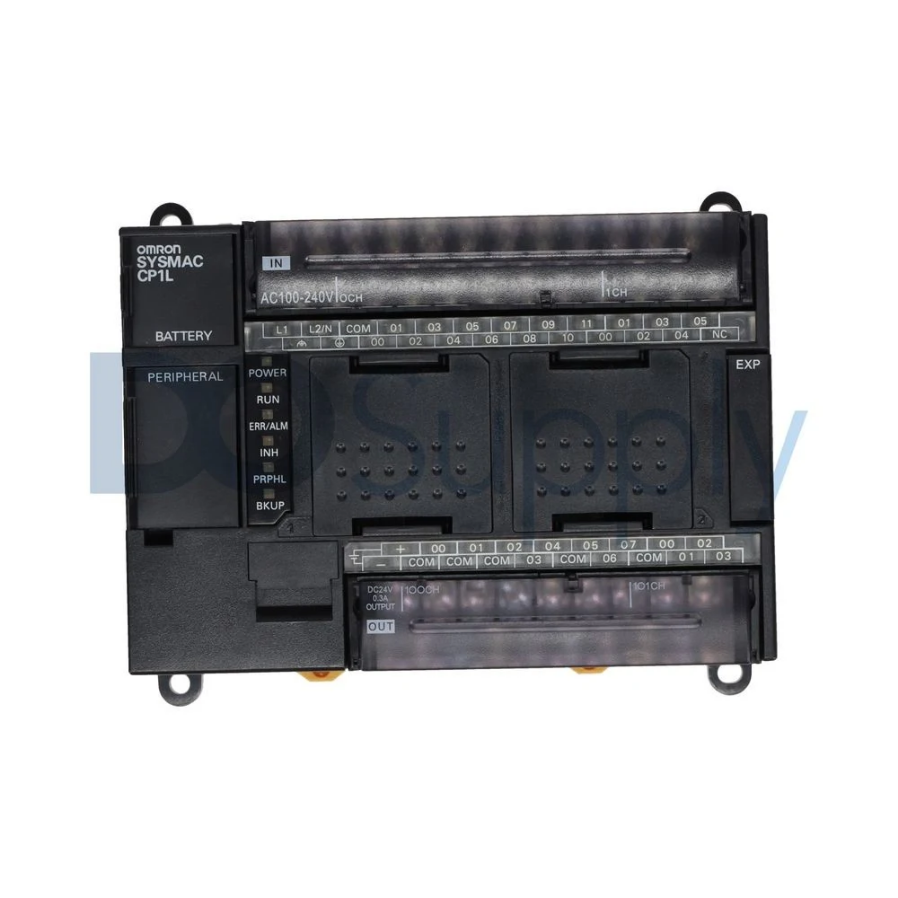
For machines that demand more from their controller, the CP1L is designed to outgrow basic control while staying within the constraints of a budget system. Depending on the model, CP1L CPUs provide between 10 and 60 built-in I/O points, along with either 5,000 or 10,000 steps of program capacity.
The CP1L also supports four 100 kHz high-speed counter inputs and two 100 kHz pulse outputs on transistor-output models.
Communication is another reason an OEM may move from the CP1E to the CP1L. CP1L-EM and CP1L-EL models include a built-in Ethernet port, while CP1L-M and CP1L-L controllers include a peripheral USB port. Serial, analog, temperature, and additional Ethernet connections can also be added through compatible option boards and expansion units.
CP1H: The High-Performance CP1
Stepping up to the flagship model, the CP1 retains the compact construction of a micro PLC but provides faster instruction processing, more memory, and greater positioning capability than the CP1E or CP1L.
The CP1H lineup includes three main CPU types:
- CP1H-X for general high-performance machine control
- CP1H-XA for high-performance control with built-in analog I/O
- CP1H-Y for higher-speed positioning applications
The CP1H-X and CP1H-XA support four 100 kHz pulse-output axes on applicable models. The CP1H-Y adds two dedicated pulse outputs capable of operating at up to 1 MHz. The CP1H-XA also includes built-in analog I/O, while the X and Y types focus more heavily on discrete control and positioning.
Expansion is another major difference. The CP1H can use CP-series expansion units as well as certain CJ-series Special I/O Units and CPU Bus Units. CJ-series Basic I/O Units are not supported, so ordinary I/O expansion still relies on CP-series hardware.
Where the CP1 Line Shines in OEM Machines
Now that we’ve seen what these controllers are capable of, its time to put them into practice and see how the three controller levels divide the workload.
The CP1E for Simple Standalone Machines
This lightweight class controller fits machines that rely mostly on discrete sequencing, timers, counters, interlocks, and a moderate number of inputs and outputs. Depending on the model, it can also support serial communication, high-speed counting, pulse outputs, expandable modules, temperature control, and built-in analog functions.
Examples include:
- Small conveyors
- Pump and fan skids
- Assembly fixtures
- Basic packaging equipment
- Filling or dispensing systems
- Simple indexing systems
- Standalone test stations
The E-type models fit the most basic control requirements, while N-type and NA-type CPUs add stronger device connectivity and analog capability.
CP1L for Mid-Range Machines
The CP1L fits machines that need more I/O, program capacity, communication, or positioning than the CP1E can comfortably provide.
Examples include:
- Labeling machines
- Cut-to-length systems
- Indexing conveyors
- Small process skids
- Multi-station assembly equipment
- Packaging machines with HMIs and drives
- Machines with several analog or temperature signals
The CP1L provides a great middle ground with its built-in I/O, Ethernet options, serial expansion, high-speed counters, and two 100 kHz pulse-output axes.
CP1H for Higher-Speed or More Expandable Machines
The flagship CP1H fits in machines that need a compact PLC footprint but with faster execution, additional positioning capability, or more extensive expansion.
These controllers fit in:
- High-speed feeders
- Forming machines
- More advanced packaging systems
- Multi-axis indexing equipment
- Spindle-control systems
- Machines using specialty communication or I/O modules
- Equipment combining positioning and analog process control
The CP1H-X and CP1H-XA support up to four 100 kHz pulse-output axes, while the CP1H-Y adds two dedicated 1 MHz pulse outputs for faster positioning. The CP1H can also use certain CJ-series Special I/O Units and CPU Bus Units in addition to CP-series expansion hardware. This gives both OEM suppliers and end users the capability to expand their system if needed.
Considerations Before Choosing the CP1 Line
With any product, there is much more to it than the advertised specifications. When picking an Omron CP1 controller for your OEM machine, it’s a good idea to take a good look at potential program growth, communication options, positioning, expansion, and long-term support to determine whether a CP1 remains a practical choice throughout the machine’s service life.
Verify the Exact Model’s Features
While we did go over the general specifications of each controller family, we didn’t go fully in depth with each controller. The capabilities of a CP1 controller can vary considerably in some families. A feature available on one CPU type may be unavailable on another, or it may require a specific output configuration or option board.
This is particularly important in the CP1E range. E-type, N-type, and NA-type CPUs differ in their support for device connections and built-in analog control. Pulse outputs also require compatible transistor-output models, and communication options differ among the CP1E, CP1L, and CP1H variants.
We recommend checking the full catalog number to compare against every required function of your systems requirements.
Account for Long-Term Availability and Support
While the CP1 PLC family is a reliable work horse, they are also quite old with the CP1E series having been phased out and the CP1L on its way next. This may pose a problem for OEMs looking to support their product for years after commission.
Before standardizing on the CP1 family, the OEM should also consider whether the customer already supports Omron CP-series hardware, and whether replacement CPUs and expansion units will be available throughout the expected service period.
Check Communication Requirements Early
A CP1 Controller may have enough I/O and processing capability for the machine, but it still may be unsuitable due to the lack of communication compatibility.
The design should account for:
- Required communication protocols
- Number and type of physical ports
- Simultaneous device connections
- Expected network traffic
- Required update rates
- Plant or customer network standards
- Remote-access and data-collection requirements
Ethernet is built into CP1L-EL and CP1L-EM CPUs, but other CP1 models may require an Ethernet option board. Serial ports and supported communication methods also vary according to the controller and installed option hardware.
Final Thoughts
The Omron CP1 remains a capable controller ready to be installed in machines for numerous applications without moving into larger module PLC systems. The CP1E covers simpler and more cost-sensitive designs, the CP1L adds more communication, positioning, and expansion flexibility, and the CP1H extends the platform into faster and more demanding machine control.
Need help selecting the right Omron PLC for your OEM machine? Give us a call! We at DO Supply carry a range of CP1E, CP1L, CP1H, and compatible expansion products to help match your control system to the application. If you find that the CP1 series isn’t quite enough for you, we also carry Allen-Bradley, GE, Schneider Electrics, and other PLC brand offerings.
DO Supply Inc. makes no representations as to the completeness, validity, correctness, suitability, or accuracy of any information on this website and will not be liable for any delays, omissions, or errors in this information or any losses, injuries, or damages arising from its display or use. All the information on this website is provided on an "as-is" basis. It is the reader's responsibility to verify their own facts.