Mitsubishi MELSERVO Selection Guide
In industry, servo motors provide precise position and speed control to assist various machine control operations. Industrial servos are mainly alternating current (AC) servos that control AC motors. The manufacturing and process industries are becoming fully automated, limiting human intervention in most tasks, thus increasing efficiency, safety, and quality. Mitsubishi’s AC Servo Systems (MELSERVO) has fulfilled industries’ demands for years by providing complete servo solutions. MELSERVO provides three types of control operations: position, speed, and torque corresponding to applications in warehouse management, spin coaters for the semiconductor industry, and industrial printers, respectively.
The AC servos configuration comprises three devices; the servo amplifier, the servo motor, and the controller (exceptions exist). The servo amplifier works as the control unit, the servo motor acts as the drive unit, and the controller functions as the command unit. The controller provides commands to the amplifier, which interprets that information to the motor. The motors have encoders that track precise motor rotations and feed that information back to the amplifier. The amplifier re-adjusts the input to the motor based on the feedback to achieve the desired output.
AC servo motors have three types: rotary, linear and direct drive. Rotary servo motors are the most common, and linear servo motors are configured with a rotary motor extended along a flat surface. Direct drive motors look like rotary servo motors in general. AC servo motors are provided with a brake mechanism to stop the movement of motors. There are three types of servo brakes that control motor braking: dynamic brake, electromagnetic brake, and regenerative brake. Dynamic brake stops the motor in case of a power or amplifier failure but can’t hold the stop state. The electromagnetic brake can only hold the stop position of the motor with no effect on the deceleration of the motor. A regenerative brake converts surplus rotational energy into electrical energy, which the amplifier or other shafts can utilize to save energy. All brakes can be used in a single servo motor to enhance the efficiency and safety of the system.
MELSERVO family comprises a series of servo amplifiers and servo motors that have evolved and adapted to better technology through innovation over time. The most recent development in this family is the MELSERVO-J5 family of servo amplifiers and servo motors that depicts the true image of the company’s hard work to facilitate modern industrial solutions. MELSERVO-J4 series also shares huge respect as it is a pioneer of many modern control functions. It also serves as Mitsubishi’s recommended migration option for many legacy flagship servo systems. Other than these two families, MELSERVO-JET, MELSERVO-JE, and MELSERVO-JN have genuinely played their part in the modern industrial revolution. This guide highlights the features of different MELSERVO series that distinguish one from the other, along with comparisons among various parameters, which are essential to design a control system.
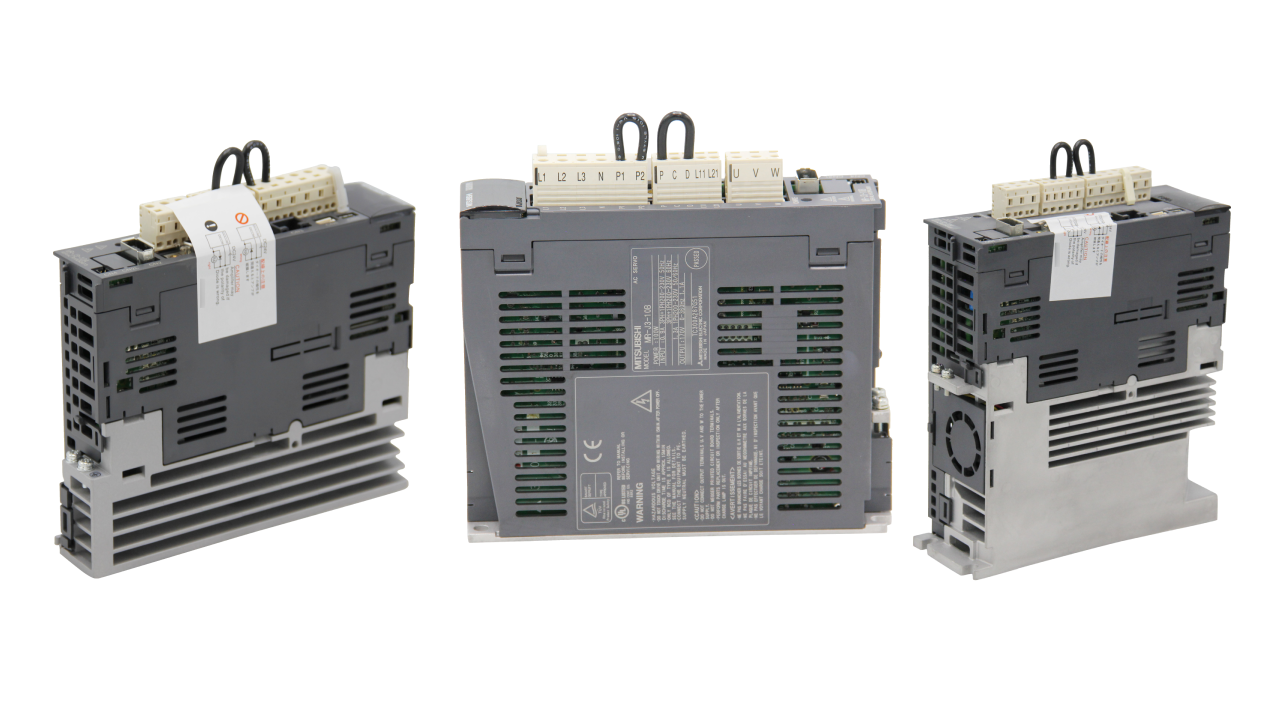
MELSERVO-J5
MELSERVO-J5 is the latest and the most advanced series of the MELSERVO family. Many new features are added in this series, which enhance the functionality and connectivity of the servo system and reduce maintenance efforts.
Servo Amplifiers and Servo Motors
This series offers both 200VAC and 400VAC input and control voltage. The frequency response of 3.5kHz is introduced, the highest in any series. The supported communication protocols include CC-Link IE TSN and EtherCAT®. The servo amplifiers have four different product lines that support control of up to 3 servos simultaneously. The maximum rated output can reach up to 7KW in this series.
MELSERVO-J5 offers two series of servo motors that can cover small to medium capacity servo requirements corresponding to low to medium inertia values. Both servo motor series are IP67 rated and provide 26-bit resolution for the absolute and incremental encoders, which is the highest in any series.
Unique Features
Increasing Maximum Torque: It is possible to increase the maximum torque of the servo motor by combining it with a different, large-capacity servo amplifier. This way, a reduced cycle time and shorter acceleration and deceleration times can be achieved. A space limitation issue and the need to buy a large capacity servo to get higher torque can be avoided using only a large capacity amplifier.
Battery-less Absolute Position Encoder: The HK series rotary servo motors for MELSERVO-J5 come equipped with a battery-less absolute position encoder. This encoder scheme minimizes costs by eliminating the need to purchase, replace, or stock batteries separately. Machines can be transported by air or sea without special handling for lithium metal batteries, saving transportation time. And the position data is safe even if the servo amplifier and the servo motor are separated.
Jerk Acceleration/Deceleration Method: In addition to the Trapezoidal acceleration/deceleration method and the acceleration/deceleration time fixed method, there is now a new jerk acceleration/deceleration method. This method achieves smooth acceleration while shortening the time it takes to reach the target speed.
Vision System Integration: The open integrated network CC-Link IE TSN optimizes the servo and vision systems. The sensor on a printing machine can accurately capture the register marks, moving at high speed to check for printing deviation. The IP-compatible vision sensor can be connected to the same network as CC-Link IE TSN. Following is the summary of the advantages of Vision System Integration. The applications include the inspection of electronic components or beverage containers.
Mark Detection: Mark detection is the function that reads the registration marks on the sheet moving at high speed and latches the current position. The mark detection using the touch probe function compensates for position mismatches of the registration marks due to conditions such as unevenness or slip of the sheet, allowing to cut the sheet at a constant speed at desired positions.
MELSERVO-J4
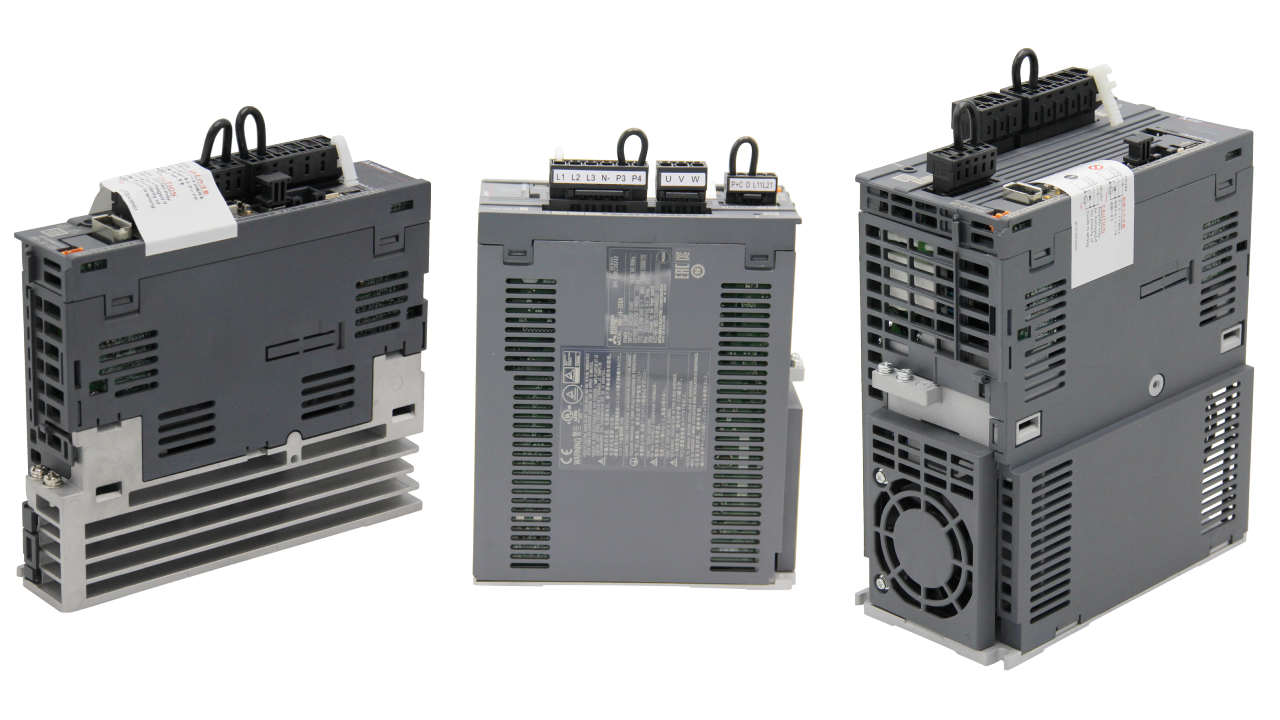
The MELSERVO-J4 series offers high flexibility and performance. This series is undoubtedly the most flexible series that provides a plethora of servo amplifiers, servo motors, and other peripheral equipment for any type and scale of automation system. MESERVO-J4 includes motion controllers, graphic and network terminals, and programmable controllers. This series meets the requirements of various industries, such as the semiconductor industry, LCD manufacturing, and food processing.
Servo Amplifiers and Servo Motors
This series offers 100VAC, 200VAC, and 400VAC input and control voltage, making it the most flexible series. It provides a frequency response of 2.5kHz, which can cover any industrial application. The supported communication protocols include CC-Link IE TSN, EtherCAT®, EtherNet/IP, PROFINET, SSCNETIII/H, and SSCNETIII. The servo amplifiers have eight product lines that support control of up to 3 servos with an option of 100VAC to 400VAC, 24VDC, and 48VDC power supplies. The maximum rated output power can reach up to 55KW for servo amplifiers in this series.
MELSERVO-J4 offers seven servo motors series that cover small to large capacity servo requirements corresponding to low to medium inertia. The servo motors in this series have different certifications based on the model, including IP67, IP65, IP55, and IP44. All of the servo motors in this series are equipped with a high-resolution motor encoder with a 22-bit resolution for both absolute and incremental functions.
Key Features
MELSERVO-J4 offers several important functions, and it truly encapsulates all of the previously proven functionality and features in terms of simplicity, performance, and productivity. Some of the key features are mentioned here.
Advanced Vibration Suppression Control II: Servo motor operation generates two types of vibration, which include vibration of the actual device and vibration produced at the end of the machine arm. The vibration hinders the servo motor from accurately stopping connected equipment at specified or desired positions. Mitsubishi has developed the advanced vibration suppression control II function that deals with vibration problems and diminishes both types.
Robust Filter: Belts and gears are widely used in industrial machines, such as industrial printers and packing equipment. These machine parts are known to cause high inertia, and some mechanism should be devised to avoid its effects on the system performance. For this purpose, robust filters are designed to achieve high responses and stability simultaneously without the need for tuning, thus enhancing overall efficiency.
One-Touch Tuning: The one-touch feature enables users to set devices quickly and easily for maximum performance. The one-touch tuning function also includes automatic tuning of the previously described “advanced vibration suppression control” and “robust filter” features.
MELSERVO-JET
This series is one of the recent servo systems which holds its position in the market firmly based on its powerful and flexible characteristics. This series highlights a simple wiring approach, quick tuning, and consistent dimensions of its servo amplifiers across the range, reducing and simplifying the setup time. Maximum torque of 350% can be achieved using this series’s servo amplifiers and motors. In terms of flexibility, the servo amplifier in this series supports a modern communication interface and a multi-voltage feature.
Servo Amplifiers and Servo Motors
This series offers only 200VAC input and control voltage. It provides a frequency response of 2.5kHz, covering most of the application requirements. The supported communication protocols include CC-Link IE TSN and EtherCAT®. The servo amplifiers have two product series, which provide a rated output of up to 3KW and operate on 200VAC only.
MELSERVO-JET offers two servo motors series that can be employed in small to medium capacity applications with low to medium inertia requirements. The servo motors in this series are either IP67 or IP65 certified. All of the servo motors in this series are equipped with 22-bit resolution absolute and incremental encoders.
MELSERVO-JE
MELSERVO-JE was introduced to add simplicity to the servo system. It was announced with some new features. One was an absolute position detection system configurable via a servo amplifier, and the other was an integrated positioning system that could be used in simple cam and mark detection. In terms of communication system, this series was launched with an SSCNETIII/H full-duplex optical network providing speeds up to 150 Mbps. Other main features of this series include tolerance against power failure, one-touch tuning of servo gains, energy conservation through regeneration, and sink and source connection options.
Servo Amplifiers and Servo Motors
This series, like MELSERVO-JET, offers only 200VAC input and control voltage with a slightly lower frequency response of 2.0kHz. The solely supported communication protocol includes SSCNETIII/H. The servo amplifiers have two product lines that operate on a 200VAC power supply. One product line also supports the Ethernet interface.
MELSERVO-JE offers two servo motors series that can be employed in small to medium capacity applications with low to medium inertia. The servo motors in this series are either IP67 or IP65 certified. All of the servo motors in this series are equipped with a 17-bit incremental encoder.
DO Supply Inc. makes no representations as to the completeness, validity, correctness, suitability, or accuracy of any information on this website and will not be liable for any delays, omissions, or errors in this information or any losses, injuries, or damages arising from its display or use. All the information on this website is provided on an "as-is" basis. It is the reader's responsibility to verify their own facts.