MicroLogix 1200 Selection Guide
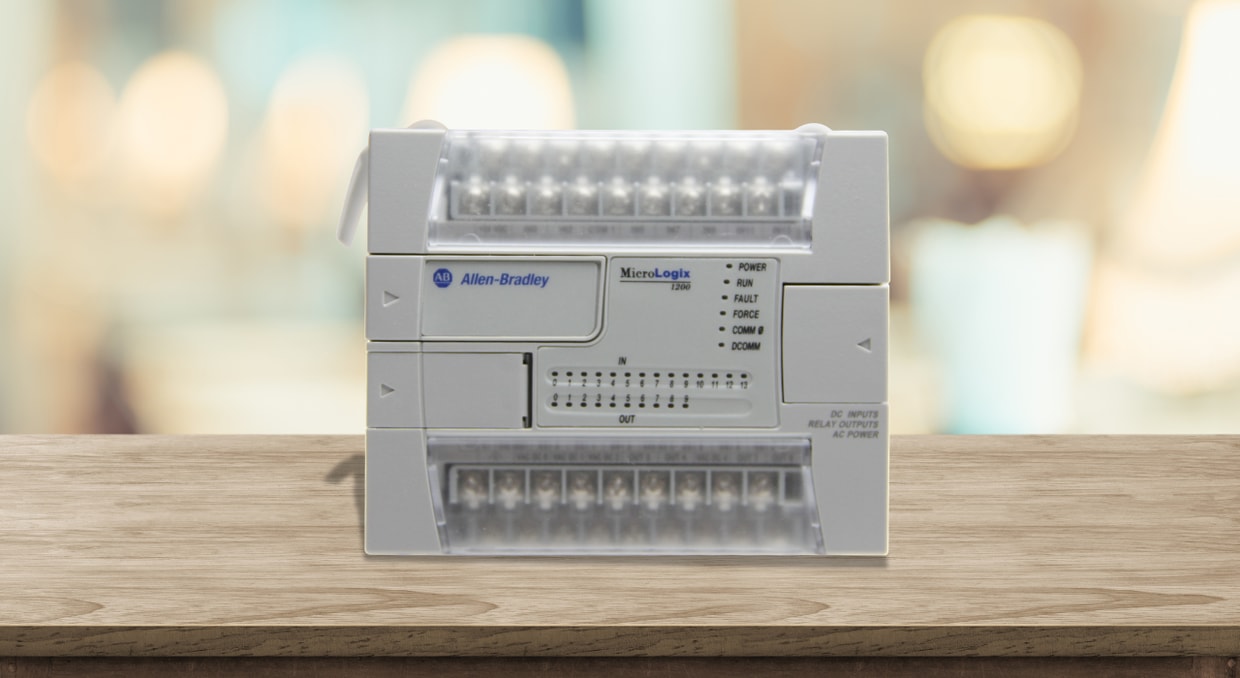
In industrial automation, there are three types of controllers: Those that are replaced because something better came along, those that are swapped out because they finally gave out after years of service, and those that never get replaced at all because nobody could find a good enough reason to mess with what’s working. The MicroLogix 1200 fits right in that last category. These middle-child controllers in the MicroLogix family have been holding down applications for over two decades now, quietly doing their jobs in packaging lines, water treatment plants, material handling systems, and thousands of other installations. These controllers are wired in, commissioned, and essentially forgotten in the best possible way.
Rockwell Automation has long since moved on to newer platforms, but in the automation world, “discontinued” and “gone” are two very different things. What made the MicroLogix 1200 popular in the first place is still what keeps it relevant: expandable I/O, a field-upgradable flash operating system, high-speed counter and pulse output capabilities, and a solid set of communication protocols, all in a compact package that never required a big budget to justify. Whether you’re sourcing a direct replacement for an existing panel or maintaining a fleet of machines that still run on this platform, this guide is built to help you make the right call.
Controller Variants and Specifications
The MicroLogix 1200 comes in either a 24- or 40-point IO size, with three electrical configurations that differ in input and output types and power supply. All controllers also include an 8-pin mini-DIN communication port that supports DF1, DH-485, ASCII, and MODBUS protocols. Each controller also includes a slot for a 1762-MM1 memory module, a 1762-RTC real-time clock, or a combined 1762-MM1RTC. The MicroLogix 1200 itself has 6 KB of total memory (4 KB program and 2 KB data), while the 1762-MM1 memory module provides 8K words of external storage for program backup and transfer rather than expanding the controller’s internal memory.
24-Point Controllers
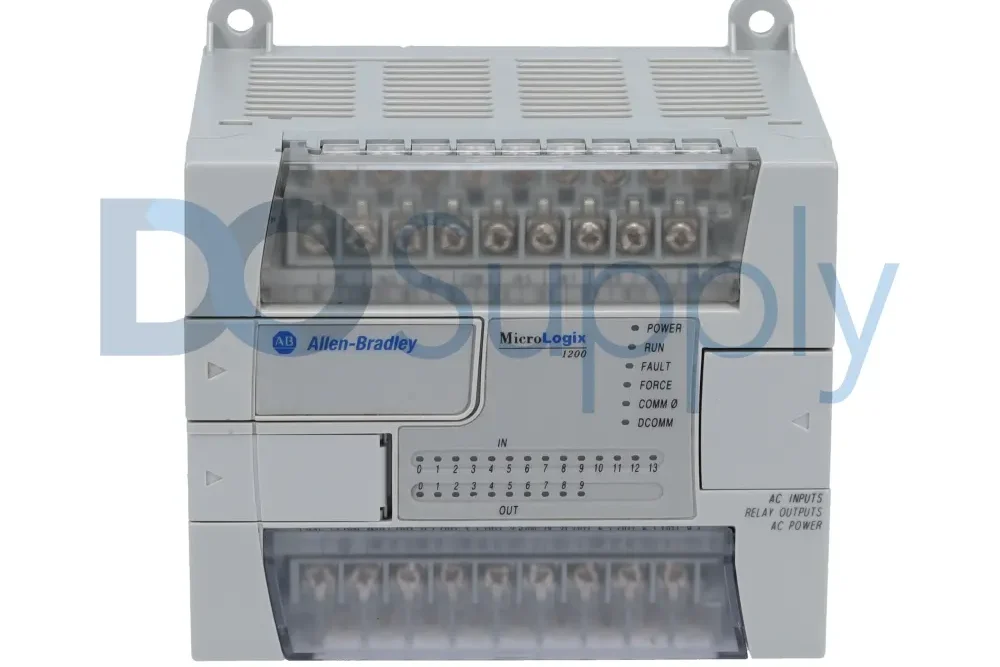
The 24-point controllers measure 90 x 110 x 87 mm (3.5 x 4.33 x 3.43 in.) and are the more compact option when panel space is a concern.
1762-L24AWA
The MicroLogix 1762-L24AWA is the AC-input, AC-powered variant. It accepts 14 x 120V AC inputs and provides 10 relay outputs, which makes it ideal for applications built around AC field devices. This also means there are no high-speed input capabilities on this model, as the inputs are AC. Here is what you can expect with this MicroLogix controller:
- Input power: 120/240V AC (85 to 265V AC range, 47 to 63 Hz)
- Digital inputs: 14 x 120V AC (79 to 132V AC operating range)
- Outputs: 10 relay (2.5A continuous per point at 240V AC)
- Power consumption: 68 VA
- Inrush current: 25A for 8 ms at 120V AC, 40A for 4 ms at 240V AC
1762-L24BWA
The MicroLogix 1762-L24BWA sits right between the BXB and the AWA, as it keeps the 120/240V AC power supply but swaps to 24V DC sinking/sourcing inputs. Ten of those inputs are standard, while four are high-speed-capable, supporting frequencies up to 20kHz. Those fast inputs can be used individually as latching or pulse-catch inputs or combined to form a single high-speed counter with eight modes of operation. The BWA also provides 250 mA of 24V DC sensor power to drive a few proximity or photoelectric sensors without a separate supply. Other specifications are as follows:
- Input power: 120/240V AC (85 to 265V AC range, 47 to 63 Hz)
- Digital inputs: 10 standard 24V DC + 4 high-speed 24V DC (up to 20 kHz)
- Outputs: 10 relay
- 24V DC sensor power: 250 mA, 400 µF capacitance max
- Power consumption: 70 VA
1762-L24BXB
The MicroLogix 1762-L24BXB is the DC variant for the 24-point platform. It runs on 24V DC power, takes the same 10 standard plus 4 high-speed DC inputs, and features a mixed output configuration: 5 relay outputs, 4 standard 24V DC FET outputs, and 1 high-speed 24V DC FET output. That high-speed FET output can be configured for pulse train output (PTO) or pulse width modulation (PWM) at up to 20 kHz, which opens the door to basic motion control and speed regulation applications that the relay-only variants simply can’t handle. You can expect the following for this MicroLogix Controller:
- Input power: 24V DC (20.4 to 26.4V DC, Class 2 SELV)
- Digital inputs: 10 standard 24V DC + 4 high-speed 24V DC (up to 20 kHz)
- Outputs: 5 relay + 4 standard FET + 1 high-speed FET (PTO/PWM capable)
- Standard FET current: 1.0A at 55°C, 1.5A at 30°C per point
- High-speed FET: 100 mA max, turn-on 6 µs / turn-off 18 µs
- Power consumption: 27 W
- Inrush current: 15A for 20 ms at 24V DC
40-Point Controllers
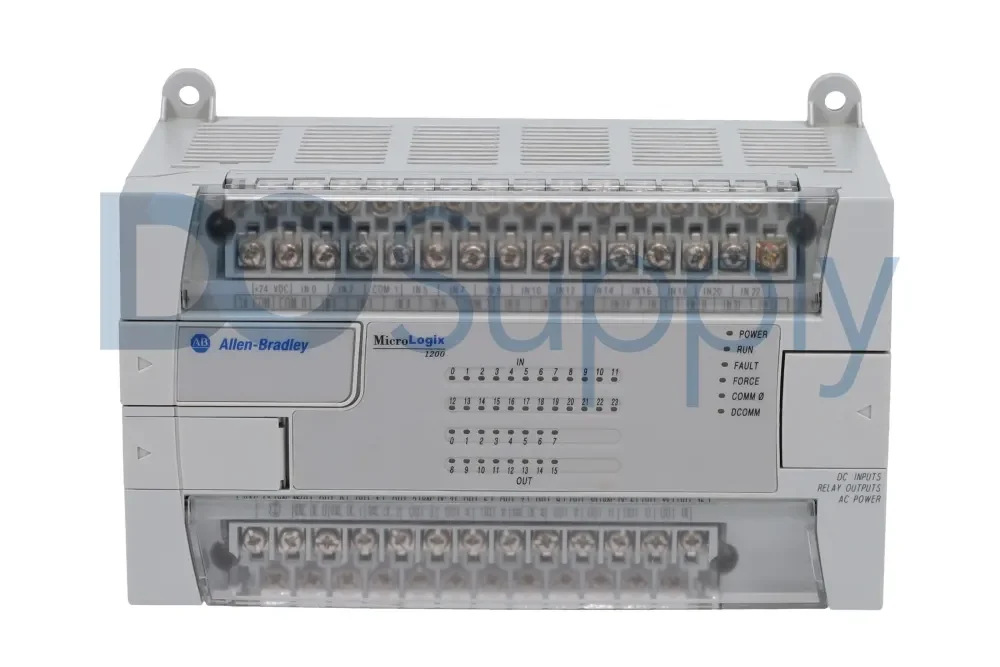
The 40-point controllers are wider at 90 x 160 x 87 mm (3.5 x 6.30 x 3.43 in.) to accommodate those extra I/O points, but share the same depth and height as their 24-point counterparts. These MicroLogix controllers also come with removable terminal blocks, which is a welcome feature when you need to prewire a panel or swap out a controller without re-wiring.
Another feature you gain with the 40-point version is the higher power budget for expansion I/O as well (15 to 16W versus 10.4 to 12W on the 24-point units), so if you’re planning to load up on expansion modules, these give you more headroom.
1762-L40AWA
As you can guess, the MicroLogix 1762-L40AWA is the AC variant of the 40-point IO tree, giving you 24 x 120V AC inputs and 16 relay outputs. Like the 24-point AWA, it has no high-speed input capabilities because the inputs are AC. This is the controller you reach for in larger AC-based systems, such as multi-zone conveyor lines or machine tools with many limit switches and solenoids. Features of the MicroLogix 1762-L40AWA are:
- Input power: 120/240V AC (85 to 265V AC range, 47 to 63 Hz)
- Digital inputs: 24 x 120V AC (79 to 132V AC operating range)
- Outputs: 16 relay
- Power consumption: 80 VA
- Inrush current: 25A for 8 ms at 120V AC, 40A for 4 ms at 240V AC
1762-L40BWA
Moving on to our DC input, AC-powered variant of the 40-point tree, the MicroLogix 1762-L40BWA provides 20 standard 24V DC inputs and 4 high-speed 24V DC inputs, along with 16 relay outputs. On top of that, the sensor output power on this model bumps up to 400 mA, compared to 250 mA on the 24-point BWA, giving you more headroom to power field sensors directly from the controller. Other specs of this MicroLogix controller are:
- Input power: 120/240V AC (85 to 265V AC range, 47 to 63 Hz)
- Digital inputs: 20 standard 24V DC + 4 high-speed 24V DC (up to 20 kHz)
- Outputs: 16 relay
- 24V DC sensor power: 400 mA, 400 µF capacitance max
- Power consumption: 82 VA
1762-L40BXB
This fully DC MicroLogix controller is the most capable unit of the lineup. It mirrors the 24-point BXB concept but scales everything up: 20 standard inputs, 4 high-speed inputs, 8 relay outputs, 7 standard FET outputs, and 1 high-speed FET output with PTO/PWM capability. If your application requires both a large I/O count and high-speed output, this is the one. More specifications for this MicroLogix controller include:
- Input power: 24V DC (20.4 to 26.4V DC, Class 2 SELV)
- Digital inputs: 20 standard 24V DC + 4 high-speed 24V DC (up to 20 kHz)
- Outputs: 8 relay + 7 standard FET + 1 high-speed FET (PTO/PWM capable)
- Power consumption: 40 W
- Inrush current: 15A for 30 ms at 24V DC
The “R” Variants
Every controller listed above is also available with an “R” suffix (for example, 1762-L24BWAR or 1762-L40BXBR). The I/O specs, power supply, and physical dimensions are identical to those of the standard version. The only difference is the addition of a second communication port, called the Programming/HMI port, a dedicated 8-pin mini-DIN connector that supports the DF1 full-duplex protocol only.
This means that you can keep a PanelView or other HMI permanently connected to the Programming/HMI port while using Channel 0 for networking, SCADA, or programming from a laptop. Without the “R,” those tasks all compete for the same single port. It’s a small addition, but in applications where an operator interface needs to stay online while the controller also communicates on a DH-485 or Modbus network, it saves you from constantly swapping cables or adding workarounds.
Though one thing to keep in mind is that the Programming/HMI port is receive-only from the controller’s perspective. The controller can respond to messages sent to it, but it cannot initiate messages through this port. All communication parameters on this port are fixed and cannot be changed by the user.
Expansion I/O Modules
One of the reasons the MicroLogix 1200 has held up so well over time is its ability to scale beyond the base controller. Using up to six 1762 expansion modules, depending on configuration, you can tailor the system to match your exact I/O requirements without having to jump to a larger platform. We do advise you to check the MicroLogix 1200 manual for system loading and heat dissipation requirements.
Digital I/O Modules
- 1762-IA8: 8-point 120V AC digital input module
- 1762-IQ8: 8-point 24V DC digital input (sinking/sourcing compatible)
- 1762-IQ16: 16-point 24V DC digital input (sinking/sourcing)
- 1762-IQ32T: 32-point 24V DC high-density digital input module
- 1762-OA8: 8-point 120/240V AC triac output module
- 1762-OB8: 8-point 24V DC sourcing output module
- 1762-OB16: 16-point 24V DC sourcing output module
- 1762-OB32T: 32-point 24V DC sourcing output module
- 1762-OV32T: 32-point 24V DC sinking output module
- 1762-OW8: 8-point relay output module (AC/DC loads)
- 1762-OW16: 16-point relay output module
- 1762-OX6I: 6-point isolated relay output module
- 1762-IQ8OW6: Combination module with 8 DC inputs and 6 relay outputs
Analog I/O Modules
- 1762-IF4: 4-channel analog input (voltage/current)
- 1762-OF4: 4-channel analog output (voltage/current)
- 1762-IF2OF2: Combination module with 2 inputs and 2 outputs
Temperature Modules
- 1762-IR4: 4-channel RTD/resistance input module
- 1762-IT4: 4-channel thermocouple/millivolt input module
Choosing the Right MicroLogix 1200
With 12 configurations to choose from, the decision boils down to a few practical questions: how many I/O points do you need, what voltage your field devices run on, whether you need that second communication port, and whether you need high-speed outputs.
If your application can get by with 14 inputs and 10 outputs plus expansion, the 24-point controllers save panel space. If you need more embedded I/O or a bigger power budget for expansion modules, go with the 40-point models.
For input type, match the controller to your field devices. AC field devices, such as limit switches and float switches, pair naturally with the “AWA” models. If your sensors run on 24V DC, which is the case in most modern installations, the “BWA” or “BXB” models are the better fit and also provide four high-speed inputs for counting or pulse-catch applications.
Output type is where the biggest functional split happens. Relay outputs on the “AWA” and “BWA” models can switch both AC and DC loads, but are limited in speed. If you need PTO or PWM output for stepper control or speed regulation, the “BXB” models are your only option in this family.
Lastly, if you need a dedicated port for an HMI while Channel 0 handles networking, add the “R” variant to whichever configuration you choose. Whether you pick the MicroLogix 1200 or another automation product, we at DO Supply have you covered. We carry controllers and parts across all MicroLogix product lines, whether you need a direct replacement for a failed unit or just stocking spares to keep your system running. We also offer repair services if you’d prefer to have your existing controller fixed or replaced. Stop by our site today and find the right part for the right price, delivered fast.
DO Supply Inc. makes no representations as to the completeness, validity, correctness, suitability, or accuracy of any information on this website and will not be liable for any delays, omissions, or errors in this information or any losses, injuries, or damages arising from its display or use. All the information on this website is provided on an "as-is" basis. It is the reader's responsibility to verify their own facts.