Navigating the Mitsubishi FREQROL FR Series: A Selection Guide
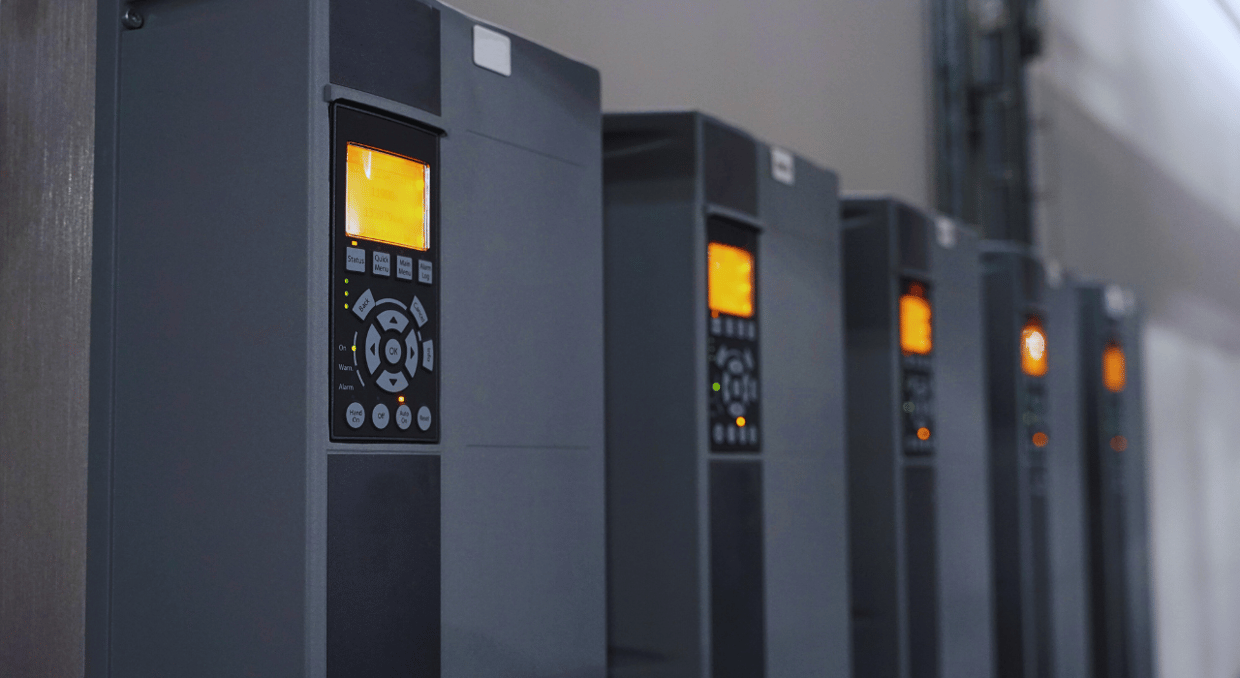
The Mitsubishi FREQROL FR Series offers an extensive lineup of high-performance, high-functionality, and environmentally friendly frequency inverters developed by Mitsubishi Electric Corporation. These inverters boast cutting-edge technologies such as IoT connectivity, Artificial Intelligence, and advanced motor control methods to control motor speed and torque accurately.
Frequency inverters are electronic devices used to control AC motors’ rotational speed and output torque that power a wide range of industrial equipment and machinery, like air-conditioners, pumps, cranes, fans, conveyors, air compressors, hoists, and machine tools. They accomplish this by converting the supplied fixed-frequency, fixed-voltage AC input into an output voltage with variable frequency and amplitude (the output voltage level). By varying the supply voltage frequency to an AC motor, you can control its speed and output torque to meet different load conditions.
Note: If an AC motor is operated directly from an AC power supply system, it can only avail a fixed rotational speed depending on its number of poles and the frequency (Hz) of its input voltage. As such, frequency inverters, like the Mitsubishi FREQROL FR-Series inverters, are used when an AC motor application requires controllable speed.
Selection Criteria
As mentioned, the Mitsubishi FREQROL FR Series provides a broad range of frequency inverter models to meet different application needs. Therefore, several factors should be considered when selecting the correct Mitsubishi FREQROL FR-Series inverter for a particular application. These factors include:
Power Requirements
Power rating is a critical factor to consider when selecting a frequency inverter. It determines the maximum motor horsepower the inverter can handle. This means that the power rating required of the Mitsubishi FREQROL FR-Series inverter you will select depends on the power requirements of the AC motor to be controlled and its load characteristics.
Generally, the power rating of a frequency inverter should match the rated power of the connected AC motor or be about 10% higher to ensure proper performance and avoid overload conditions. For example, a fan powered by a 0.75kW AC motor could use a 0.75kW or 0.825kW Mitsubishi FREQROL FR-Series inverter.
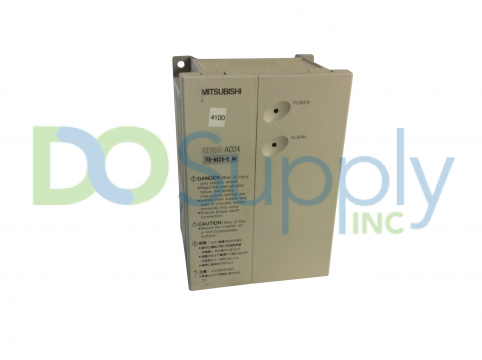
It’s not desirable to select a frequency inverter with a larger power reserve unless your application will need to expand its horsepower capacity in the future. Such a reserve will incur additional costs and may reduce the inverter’s control accuracy.
Voltage Range
Mitsubishi FREQROL FR-Series inverters are available in different voltage classes, namely:
- Single-phase 100V class
- Single-phase 200V class
- Three-phase 200V class
- Three-phase 400V class
- Three-phase 600V class
Therefore, ensure that the voltage range of the Mitsubishi FREQROL FR-Series frequency inverter you intend to select matches your power supply capabilities for proper performance. In other words, the voltage rating and the number of phases of your electrical supply should correspond to the voltage values specified in the datasheet of the frequency inverter you’ve selected, as some FREQROL FR-Series inverters are designed for explicit voltage inputs.
Frequency Range
A good Mitsubishi FREQROL FR-Series inverter should be able to maintain operation within the specified operating frequency range. Typically, the inverter’s output frequency range should match the rated frequency range of the AC motor to be controlled. Also, the frequency stability and resolution of the selected FREQROL FR-Series inverter should be considered to ensure high-speed control accuracy.
Motor Type
Identify the type of AC motor you consider using in your application, i.e., is it a single-phase or three-phase induction motor or permanent magnet (PM) synchronous motor? Different types of Mitsubishi FREQROL FR-Series inverters are designed to work with specific types of AC motors, so it’s important to select an inverter compatible with your application’s motor type.
Load Characteristics
Analyze your application’s load characteristics, including speed variations, peak torque, and starting torque requirements, and if there are any cyclic load variations (e.g., a crane repeatedly lifting materials and goods). This information about the nature of the load to be applied will help you select a Mitsubishi FREQROL FR-Series inverter with the appropriate speed and torque control capabilities.
For example, if the load to be applied will require constant motor operation at peak torque, such as hoists, presses, conveyors, and fixed displacement pumps, be sure to evaluate the duration of the peak load and its allowable value when selecting a Mitsubishi FREQROL FR-Series frequency inverter for such an application.
Control Methods
Choose a Mitsubishi FREQROL FR-Series inverter with the appropriate motor control methods for your application. In essence, a good frequency inverter should provide several motor control techniques.
Common motor control methods available with the Mitsubishi FREQROL FR-Series inverters include:
- Soft-PWM Control: This control technique refers to a software-based Pulse-Width Modulation (PWM) process in which the output pulse width is adjusted to regulate the average output voltage. The speed of the connected AC motor is thus controlled by adjusting the frequency of the inverter’s output waveform to the motor.
Note: In soft-PWM control, the pulse-width modulation signals are generated through software tools, unlike in hardware-based PWM control, where those signals are generated by dedicated microcontroller hardware. Soft-PWM control is suitable for high-performance applications requiring high flexibility in motor speed control.
- Voltage/Frequency (V/F or V/Hz) Control: This control method ensures that the ratio between the primary voltage (V) being applied to the connected AC induction motor and the inverter’s output frequency (F) is constant. In doing so, it maintains a constant motor flux, as the motor’s magnetic field strength is proportional to V/Hz – the ratio of the inverter’s output voltage (V) to its output frequency (Hz).
- General-purpose Magnetic Flux Vector Control: This control technique ensures that a large and stable starting torque can be obtained without the need for a unique motor constant setting or tuning, even in slight motor constant fluctuations. It also helps improve low-speed motor torque by providing voltage compensation.
- Advanced Magnetic Flux Vector Control: This method offers a larger starting torque at low speed. For example, it can provide 3.7K or less (200% at 0.5 Hz) or 5.5K up to 15K (150% at 0.5 Hz).
- Optimum Excitation Control: This control technique continually adjusts the motor’s excitation current to the optimal level to maximize efficiency.
- Sensorless Vector Control: This is a type of flux vector motor control method where the AC voltage supply’s phase, frequency, and amplitude to the connected motor are varied to maintain the motor speed as required.
Control Accuracy
Select a Mitsubishi FREQROL FR-Series inverter whose speed control accuracy matches the accuracy requirements of your application. For instance, for applications requiring high-speed accuracy, like CNC machine tools, selecting a FREQROL FR-Series inverter with high-level control accuracy is important.
Safety Features
Safety is of prime importance when it comes to motor control. Therefore, ensure that the Mitsubishi FREQROL FR-Series inverter you select includes comprehensive protective features, such as thermal overload protection, motor stall prevention, under-voltage/overvoltage protection, and short-circuit protection.
Communication Options
Select a Mitsubishi FREQROL FR-Series inverter that supports multiple communication protocols to realize remote monitoring & control and seamless data interaction between the host computer and your inverter. Also, check the availability of appropriate communication ports in the selected inverter for plugging in optional communication modules.
Listed below are some communication protocols supported by various Mitsubishi FREQROL FR-Series inverters through built-in or optional plug-in communication modules.
- RS-485
- MODBUS RTU
- EtherNet/IP
- EtherCAT
- CC-Link IE Field Network Basic
- CC-Link IE TSN
- CC-Link
- DeviceNet
- SSCNET III
- PROFIBUS-DP
- SSCNET III (/H)
- PROFIBUS-DP (DP-V1)
- LONWORKS
- PROFINET
- FL remote
- MODBUS/TCP
- BACnet/IP
Peripheral Devices
Check the model of the Mitsubishi FREQROL FR-Series inverter you intend to purchase, and select appropriate peripheral devices based on their rated capacity.
Most Mitsubishi FREQROL FR-Series inverter models require the following peripheral devices:
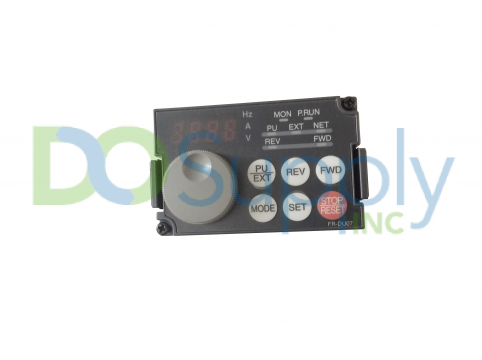
- AC Power Supply: Choose an AC power supply within the permissible power specifications of the FREQROL FR-Series inverter you will use in your application.
- EMC filter (capacitive filter) to reduce air-propagated electromagnetic noise on the inverter’s input side. Note that the EMC filter is a built-in module in some FREQROL FR-Series inverter models.
- Moulded Case Circuit Breaker (MCCB): This safety device protects the inverter’s electrical circuit against overload and short circuit faults. It automatically cuts off the power supply to the inverter whenever an overcurrent condition arises, thereby preventing damage to the inverter. The MCCB must be selected carefully because the Mitsubishi FREQROL FR-Series inverters usually experience a large inrush current at power ON.
- Earth Leakage Circuit Breaker (ELB): This protective device prevents electric shock in high-impedance electrical installations. It detects minute stray voltages on an inverter’s metal enclosures and interrupts the inverter’s electrical circuit if an unsafe voltage is detected.
- Magnetic Contactor (MC): This is an electromagnetic switching device used to switch an electrical circuit “ON” and “OFF”. Note: You should not use the installed magnetic contactor to start and stop a Mitsubishi FR-Series inverter, as doing so will shorten the service life of the inverter.
- Reactors: AC and/or DCreactors have to be used when: (i) the selected Mitsubishi FREQROL FR-Series inverter is installed near a large electrical supply system (500kVA or more, and for some inverter models 1000kVA or more), (ii) there is need to improve the inverter’s power factor, and (iii) it is necessary to suppress power supply harmonics. Failure to use reactors in such cases may result in damaged inverters. Select the most suitable reactor for your inverter system based on the applied motor capacity.
Some of the available Mitsubishi FR-Series reactors include:
- FR-HAL (AC reactor)
- FR-HEL (DC reactor)
- FR-BAL (0.4K to 55K power factor improving AC reactor)
- FR-BEL (5.5K to 55K power factor improving DC reactor)
- Line Noise Filter: Install a ferrite-core noise filter to reduce the electromagnetic noise generated from the selected FREQROL FR-Series inverter. Such noise filters are effective in the frequency range of 1MHz to 10MHz. Examples of available Mitsubishi FR-Series line noise filters are (i) FR-BSF01 and (ii) FR-BLF, which include an integrated common mode choke.
- Radio Noise Filter (Model No. FR-BIF): This capacitive filter is installed to suppress radio noise.
- Programmable Controller: To remotely monitor or operate the chosen FREQROL FR-Series inverter via an Industrial Ethernet (IE) network.
- Approved Safety Relay Module: This module is required to ensure compliance with high-level safety standards.
- USB Connector: A USB (Ver1.1) cable is needed to connect the selected FREQROL FR-Series inverter to a personal computer.
- High Power Factor Converter (Model No. FR-HC2): Used to suppress power supply harmonics in a significant manner.
- Power Regeneration Common Converter (Model No. FR-CV): When installed, it enhances braking capability.
- Brake unit (Model No. FR-BU2) and Resistor unit (Model No. FR-BR, MT-BR5): These two devices allow the selected Mitsubishi FREQROL FR-Series inverter to deliver optimal regenerative braking capability.
- RS-232C – RS-485 Converter: It is required to connect your FREQROL FR-Series inverter to a personal computer with an RS-232C interface.
- RS-485 Terminal Block: It supports the Modbus-RTU (binary) protocol and Mitsubishi inverter protocol, allowing the selected Mitsubishi FREQROL FR-Series inverter to be connected to a programmable controller or personal computer.
Available Mitsubishi FREQROL FR-Series Inverter Models
Outlined below are the most widely used Mitsubishi FREQROL FR-Series inverter models.
FR-A800 Inverter
The Mitsubishi FR-A800 is a high-performance, high-functionality inverter that provides high-speed operation and improved speed response with enhanced Real Sensorless vector control. It supports Ethernet communications via CC-Link IE Time Sensitive Networking (TSN) or CC-Link IE Field Network interfaces.
Also, it features an automatic tuning function that supports various AC induction motors and sensor-less Permanent Magnet (PM) motors. As a result, the FR-A800 inverter can be used with most machinery types, including lifts, winding/unwinding machines, presses, machine tools (grinders, lathe, drilling, and milling machines, etc.), printers, food packaging machines,
The FR-A800 inverter model complies with EU Safe Torque Off (STO) safety standards (SIL3, PLe). Approved safety modules can be added to support higher-level safety standards.
FR-A800 Plus Inverter
The FR-A800 Plus is a dedicated inverter for specialized applications, such as cranes, lifts, and roll-to-roll applications (i.e., winding/unwinding). It’s an upgraded version of the FR-A800 inverter, featuring higher responsiveness, faster operating frequencies, load slippage prevention, and dedicated monitoring functions.
FR-F800 Inverter
This is an enhanced next-generation energy-saving Mitsubishi inverter. It’s available with an advanced optimum excitation control mode—a motor control method that provides a high starting torque and allows significant energy savings during constant-speed motor operation.
The FR-F800 inverter can be monitored or operated from a programmable controller via an Industrial Ethernet network as it supports CC-Link IE TSN and CC-Link IE Field Network communication protocols. In addition, this inverter is equipped with enhanced PID control functions, which makes it ideal for pumps and fans.
FR-E800 Inverter
The FR-E800 is a compact, high-functional Mitsubishi inverter equipped with Artificial Intelligence (AI) technology, which enables AI fault diagnosis and predictive maintenance. Functional safety FR-E800 inverter models comply with IEC 61508 and ISO 13849-1 safety standards to support motor operation using the SLS (Safety-Limited Speed) function.
Ethernet-enabled FR-E800 inverter models support CC-Link IE TSN protocol as standard. Still, they are also compatible with communication protocols of other major global Industrial Ethernet (IE) networks, including BACnet/IP, CC-Link IE Field Basic, EtherCAT, PROFINET, MODBUS/TCP, and EtherNet/IP. These industrial Ethernet protocols allow real-time connection between the Ethernet-enabled FR-E800 inverter and the host IT system, enabling remote or centralized monitoring of inverter operation.
In addition, the FR-E800 inverter series supports various motor control methods, including Vector control, V/F control, Soft-PWM control, Advanced Magnetic Flux Vector control, PM Sensorless Vector control, Optimum Excitation control, and Real Sensorless Vector control, thereby expanding its applications to many systems.
FR-F700PJ Inverter
The Mitsubishi FR-F700PJ is a compact inverter that operates both an IPM (Interior Permanent Magnet) and general-purpose motors. A single parameter setting allows you to switch between the two motor controls. This inverter is equipped with various functions, such as PID control, automatic restart after abrupt power failure, regeneration avoidance, and optimum excitation control, that provide optimal operation for pumps and fans.
FR-F700PJ inverter models are available with line noise filters, radio noise filters (capacitive filters), and power factor-improving DC reactors, which are suitable for air conditioning applications.
FR-CS80 Inverter
The FR-CS80 is a high-performance, easy-to-use, easy-to-maintain, small-body Mitsubishi inverter that provides soft-PWM control, Optimal Excitation control, and General-purpose Magnetic Flux Vector control. With slip compensation and General-purpose magnetic flux vector control, it provides a starting torque of 150% or more at 1 Hz. It features an output frequency range of 0.2 to 400 Hertz.
In addition, this inverter supports the RS-485 communication protocol as standard, enabling high-speed communications of up to 115.2 kbps. It is suitable for applications that require regenerative braking torque when decelerating, such as food packaging machines, wood processing machines, conveyor belts, and spinning machines.
FR-D700 Inverter
The FR-D700 is a simple, compact, and eco-friendly inverter that offers improved reliability with spring clamp terminals and easy maintenance with a shutoff circuit. It is available with an auto-tuning function and the General-purpose magnetic flux vector control that enables reliable operation in applications that require high starting torque (150% at 1 Hertz, 200% at 3 Hertz (3.7K or less with slip compensation)), such as conveyors, hoists, washing machines, lifts, agitators, etc.
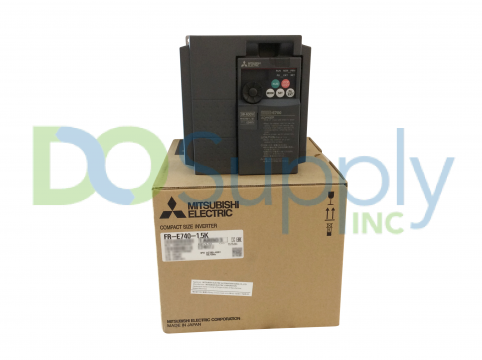
Additionally, this inverter complies with the RoHS Directive, including filter options that reduce the electromagnetic noise it generates, enabling compliance with Japanese harmonic suppression guidelines. It supports Modbus RTU and Mitsubishi inverter protocol, achieving communication speeds of up to 38.4 kbps.
FR-E700 Inverter
This is a powerful, easy-to-use, and compact Mitsubishi inverter that is available with advanced magnetic flux vector control, providing accurate start-ups and large starting torques ((200% at 0.5 Hz (3.7K or less)) for general-purpose industrial machines, such as transfer machines, pressing machines, lifts, packaging machines, and various machine tools.
The FR-E700 inverter supports standard RS-485 (MODBUSRTU and Mitsubishi inverter protocol) communications. However, it’s also available with various plug-in options that support other communication protocols, including LONWORKS, PROFIBUS-DP, CC-Link, FL remote, and DeviceNet. The available plug-in options can add analog outputs/digital inputs to the inverter system.
FR-A701 Inverter
The Mitsubishi FR-A701 high-performance inverter features a built-in power regeneration function that enables exceptional braking capability. Its regenerative braking torque is 100% for continuous operation and 150% for 1 minute. This helps improve the performance of equipment and machines that produce regenerative torque, such as centrifuge separators, elevating machines (e.g., lifts), and various winders and testers.
DO Supply Inc. makes no representations as to the completeness, validity, correctness, suitability, or accuracy of any information on this website and will not be liable for any delays, omissions, or errors in this information or any losses, injuries, or damages arising from its display or use. All the information on this website is provided on an "as-is" basis. It is the reader's responsibility to verify their own facts.