How Cable Length Affects AC Drive Performance

To the untrained eye, wiring a motor to an AC drive, more commonly known as a variable frequency drive, may seem like a simple job of plugging the motor in and routing the wiring to make it look clean. The length of the wires might not even be a concern, because in an ideal world with ideal resistance, it wouldn’t. The problem is that we live in a less-than-ideal world, and the rules of physics are nonnegotiable.
Whether it’s traces on a PCB or wires during a motor install, the longer the connection point, the higher the resistance, heat buildup, and voltage drop. This matters more than you might expect when it comes to installing AC drives. Before getting into it, if you would like to familiarize yourself with how an AC drive works, check out this article here!
Voltage Spikes and Reflected Waves
The inherent design of an AC drive is to output fast voltage pulses rather than a clean sine wave. Each time the AC drive switches, a voltage pulse travels down the motor cable to the motor. With a shorter cable, the pulse will reach the motor quickly and behave predictably. However, with a longer-run cable, the risk of impedance mismatch increases.
Impedance Mismatch
This occurs when the motor cable has its own characteristic impedance, while the motor winding has a different impedance. When a fast-rising voltage pulse reaches the motor terminals, the mismatch can cause part of the pulse to reflect toward the AC drive. While it is intuitive to think that two waves approaching each other would destructively interfere, what happens is that the reflected voltage can add to the incoming pulse at the motor terminals. This increases the peak voltage to which the motor insulation is exposed.
This effect is closely tied to dV/dt, which is the rate of change of voltage with respect to time. A shorter rise time produces a steeper voltage edge, which increases the likelihood of reflected wave stress on long motor leads. In practical terms, the motor may be operating at the correct RMS voltage, but the insulation can still be exposed to repeated high-voltage peaks caused by the AC drive’s fast switching output.
Cable Capacitance and Leakage Current
Long motor leads not only affect the voltage at the motor’s terminals but can also increase the total capacitance between phase conductors and between the conductors and ground. With an AC drive, this matters because the high PWM output is constantly switching on and off at high speed. At high frequencies, that capacitive coupling could allow current to leak to ground instead of flowing only through the motor. As you can imagine, this is far from energy-efficient, and saving money on electricity is probably one of the reasons you bought an AC drive in the first place. This can also cause:
- Excess heating
- Electrical noise
- Nuisance ground-fault trips
- AC drive shutdowns
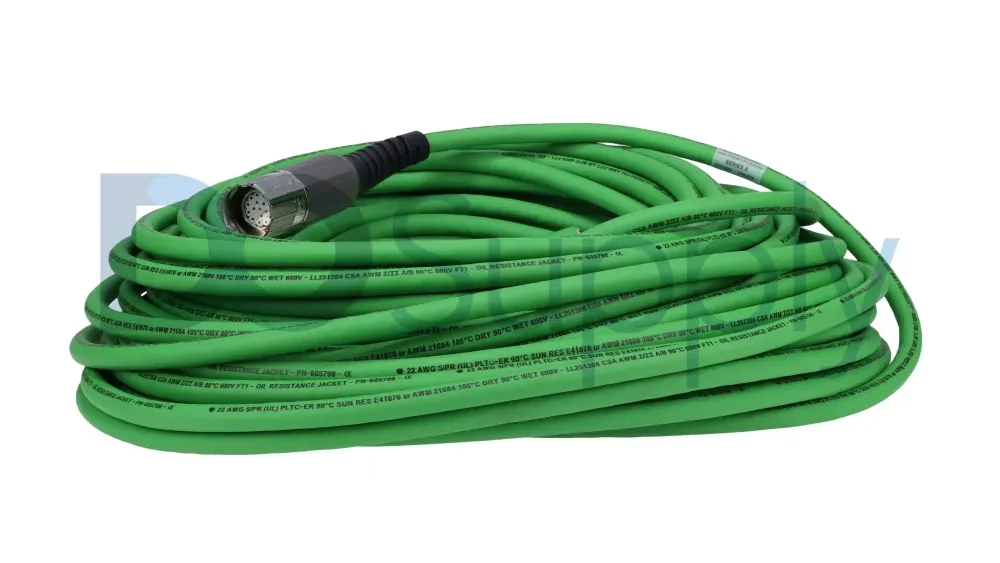
Cable construction also plays a major role in how severe this becomes. A cable’s capacitance is influenced by insulation thickness and dielectric constant. Because of this, a 600 V THHN cable may have significantly higher capacitance than a 2,000 V XLPE-insulated VFD cable, making it one of the main reasons VFD-rated cables are often preferred for longer runs.
As we mentioned in the last section, proper shielding and grounding practices are just as important as the cable itself. High-frequency common-mode current does not always return neatly through small ground conductors. A properly terminated overall shield can provide a lower-impedance return path back to the AC drive, helping reduce EMI, bearing current issues, and interference with nearby controls or communication wiring.
Voltage Drop and Conductor Heating
As we alluded to in the opening of this blog, the total resistance of a cable and the voltage drop will increase as the cable gets longer. If the conductors are undersized or the run is especially long, the motor may see less voltage than expected under load. You can calculate these values with online tools, provided you know the cable material and wire dimensions.
This voltage drop can affect motor performance if it is significant enough. The AC drive may command the correct output voltage, but some of that voltage is lost as heat in the cable before it reaches the motor. This can reduce available torque, increase current demand, and add unnecessary heating to the conductors.
Electromagnetic Interference
Electromagnetic interference is a disruption in an electrical circuit due to electromagnetic induction, electrostatic coupling, or electromagnetic radiation. Since an AC drive uses fast PWM switching, the motor cable carries sharp voltage transitions rather than a smooth sine wave. The longer the cable run, the more opportunity there is for high-frequency noise to couple into nearby wiring or radiate into surrounding equipment.
This can cause not only frustrating problems but also dangerous accidents if the AC drives’ power wires induce voltage and current into the wrong equipment’s wiring. EMI can also show up as unstable analog signals, encoder errors, sensor noise, communication faults, or nuisance alarms that are difficult to trace back to the motor leads.
This risk increases the closer VFD output cables are routed to low-voltage wiring, especially if they are run in parallel for long distances. Wires that can be affected by strong EMI are:
- Analog instrument wiring
- Encoder feedback cables
- Ethernet cables
- PLC I/O wiring
- Sensor circuits
If the cables must cross, doing so at a 90-degree angle is best to minimize noise transfer between them.
Tips on Mitigating Harmful Effects on Your Motor
Factories come in all shapes and sizes, and sometimes there is simply no other way to run a motor without a long cable run from the AC drive. In this case, there are ways to help reduce the harmful effects of longer motor leads.
Correct Cable Length and Output Protection
It is always a good idea to refer to the manufacturer’s manual for the AC drive and motor to determine which cable size to use. These limits exist for a reason and may vary depending on cable type, carrier frequency, motor insulation rating, and whether output protection is installed. If the cable run exceeds the recommended length, an output reactor, dV/dt filter, sine-wave filter, or other filtering device may be needed between the drive and the motor.
Cable Choice Matters
VFD-rated cables are designed to handle the high-frequency effects caused by the AC drives PWM switching much better than conventional power cables. It can help control electrical noise, provide a better grounding path, and reduce the chance of interference with nearby equipment. Not only that, but it can help save on electricity costs.
Shielding and Grounding
Proper shielding and grounding are essential for all electrical setups, not just AC drive installations. A properly shielded VFD cable provides a controlled path for high-frequency noise back to the drive. Without this, EMI can spread through conduit, cabinet grounds, machine frames, or onto nearby wiring. For longer cable runs, it’s essential to keep the entire control system stable.
Separating Motor Wiring from Low-Voltage Wiring
Finally, our last tip is to separate the high-voltage cable running from your AC drive from EMI-susceptible cabling. Encoder cables, analog signals, Ethernet cables, sensor wiring, and PLC I/O should not be bundled with drive output wiring. If power and signal cables have to cross, crossing them at a 90-degree angle can help reduce noise coupling.
Final Thoughts
An improperly routed cable that is too long, according to the AC drives manufacturer, can result in some pretty nasty side effects. Thankfully, much of it can be avoided by taking proper precautions, using the right VFD-rated cables, and being mindful of cable routing.
The best mindset for running this cable is to treat it as part of the drive system, rather than just another wire between two devices. Drive ratings, motor insulation, cable construction, grounding, shielding, routing, and output filtering all need to work together. When they do, AC drives still can perform reliably even when the motor isn’t mounted right next to the cabinet.
If you are experiencing any of the symptoms we discussed today, stop by our store and browse our AC drive accessories. We carry properly rated cables, AC drive filters, and more. We also provide repair services for AC drives, motors, PLCs, and more. Contact our team today to find the replacement parts or repair options needed to keep your system running reliably.
DO Supply Inc. makes no representations as to the completeness, validity, correctness, suitability, or accuracy of any information on this website and will not be liable for any delays, omissions, or errors in this information or any losses, injuries, or damages arising from its display or use. All the information on this website is provided on an "as-is" basis. It is the reader's responsibility to verify their own facts.