Hardware Comparison: Micro 800 Series Controllers
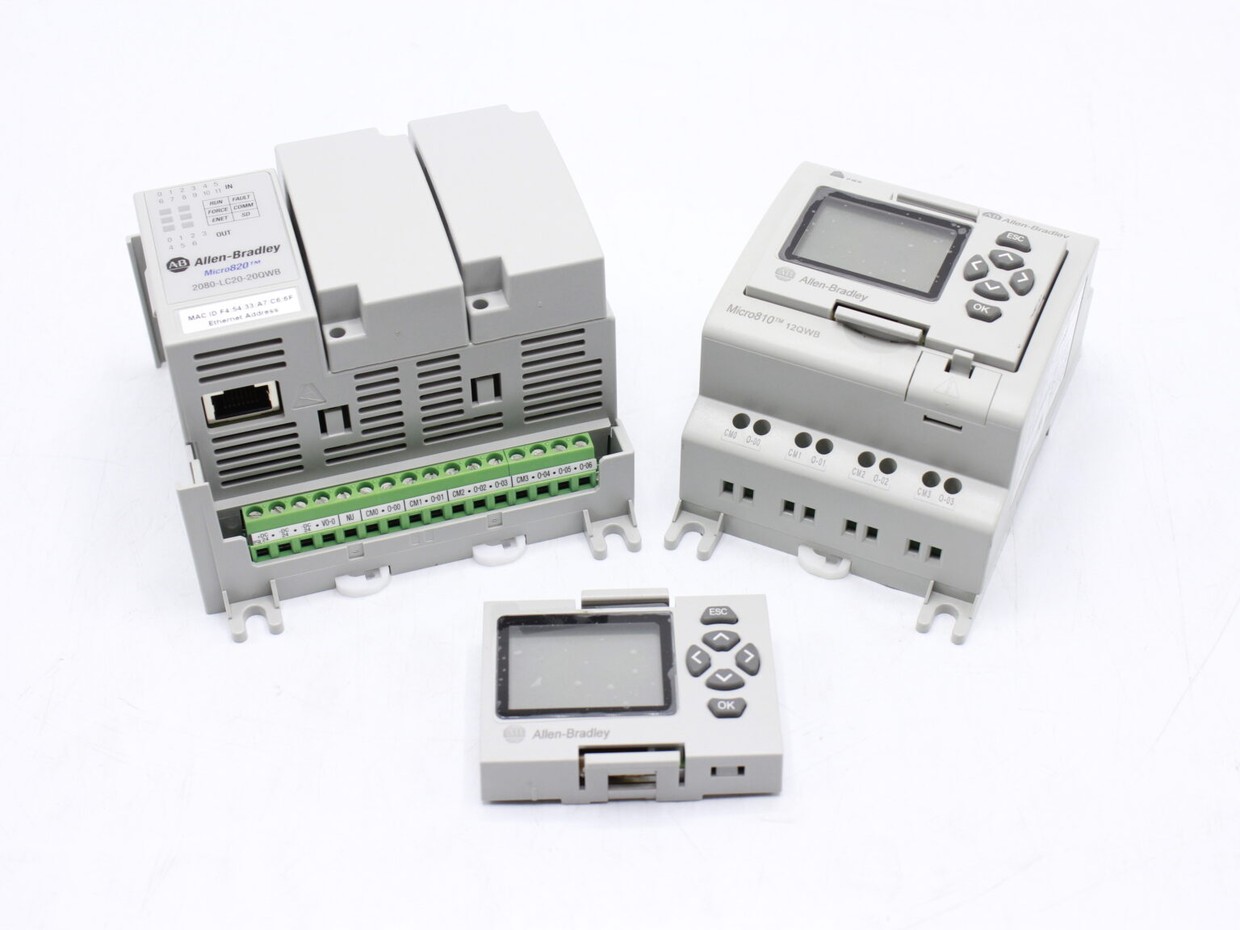
Allen Bradley introduced the Micro 800 family of controllers several years ago, and they are slowly taking over the low-end controller segment for the manufacturer. These controllers are meant for small stand-alone projects, and for OEM’s and machine builders who need a low cost but effective controller. Five series of controllers comprise this family, from the Micro 810 “Smart Relay” to the Micro 870 controller. Each series builds on the previous, with the Micro 820 and 830 series being the smallest of the two (and specialized siblings of each other) and the Micro 850 and 870 including higher functionality and capabilities.
All five series in the Micro 800 family have some common benefits. One of the biggest benefits is being able to program and configure the controllers. From the Micro 820 up to the 870, onboard add-on modules allow for additional IO, memory backups, and numerous other higher feature capabilities. Except for the Micro 810, all are capable of some expansion from their base model, with the Micro 870 capable of utilizing up to 304 digital IO points. Each also has its own unique niche in the family, and each adds capabilities that make the Micro 800 family a very interesting product from Rockwell.
Micro 810
The Micro 810 is the smallest of the controllers and might just be the most interesting of the group. Sporting 8 inputs and 4 outputs, this controller is about the size of a couple decks of playing cards and uses the same logic capabilities as its bigger brethren for the price tag of one timing relay. The controller comes in 12VDC, 24VDC, and 120-240VAC models, with the DC models including 4 inputs that can be used as either digital or analog, and high current relay outputs (2x 8A, and 2x 4A) reducing the number of required parts for a small control system. An onboard Real-Time Clock and an optional LCD display allow this controller to perform some very interesting functions at an extremely interesting price point. The only obvious drawback to the controller is that a special adapter is required to connect the controller to a computer for programming (although the display can be used to program simple programs.)
Micro 820
The Micro 820 is the next step up and begins to show the form factor of the rest of the family. Available in 24VDC or 120VAC models, these 12 input/8 output versions come with integrated Ethernet/IP communications through an onboard RJ45 port, two expansion slots for additional IO, the ability to use 4 inputs and 1 output as analog, program backup and initialization through a micro-SD card, and a matched basic HMI unit for operation and configuration. The integrated Ethernet/IP is a blessing and a curse, it makes for simple connections between components via Ethernet, but can prove frustrating when initially programming and configuring the machine IP address and when troubleshooting unless you’re mindful about how you set up your system. To prevent the initial configuration headaches, using the micro-SD card to install the first project eases a lot of the pain. To aid in troubleshooting, using a small switch (AB’s 1783-US5T is a nice one) to allow for an additional Ethernet port for your computer will save tons of time and the frustration of having to swap cables repetitively.
Micro 830
The Micro 830 is the non-networked sibling to the Micro 820, although the loss of innate network ability is made op for with other functions. The RJ45 port of the Micro 820 is replaced with a USB2.0 port, which is used for programming. The Micro 830 has 4 versions, supporting 10, 16, 24, or 48 IO points (a combination of inputs and outputs.) The Micro 830 comes in 24VDC and 120VAC options, with 24V source or sink transistor outputs or relay outputs available at both voltages. The 24 volt models with transistor outputs support PTO outputs (1 to 3 depending on the controller frame size), allowing for basic positioning control to be performed with these controllers. This controller is set up to run smaller stand-alone machines, with serial communications available to communicate to a local HMI and simple motion control capabilities.
Micro 850 and 870
The Micro 850 and Micro 870 step the Micro family up into larger applications, with the Micro 850 supporting up to 192 IO points and the Micro 870 supporting up to 304 IO points. Both of these controllers look similar, with an RJ45 port for communications, a USB2.0 port for programming, and either 3 slots for add-on modules or 5 slots (Micro850 only). Both controllers support up to 3 PTO outputs for basic positioning and can accept add-on 2085 IO modules to increase their IO capacity. The major difference between the two is the 870 has a larger program capacity, with up to 20,000 steps versus the 10,000 max steps of the Micro850.
For smaller applications, the Micro 800 family of controllers has some definite advantages. In the past few years, there have been steps to integrate these controllers into the larger line of Allen Bradley processors, with integration into Studio 5000 and updates to CCW to make it more like other AB programming suites. As the Micro 800 family is integrated into the overall Allen Bradley line and interfacing between the controllers becomes more seamless, the advantages of using these AB controllers for smaller or standalone applications will be more fully realized.
Specification Comparison Table
| Micro 800 Controller Comparison | |||||
| Controller | Micro810 | Micro820 | Micro830 | Micro850 | Micro870 |
| Onboard IO | 12 | 20 | 10-48 | 24 or 48 | 24 |
| Communications | USB2.0 (with adapter) | RJ45 10/100 Ethernet | USB2.0, RS232/RS485 serial | USB2.0, RS232/RS485 serial, RJ45 10/100 Ethernet | USB2.0, RS232/RS485 serial, RJ45 10/100 Ethernet |
| Plug In Modules | 0 | 2 | 2-5 | 3 or 5 | 3 |
| Max IO | 12 | 35 | 26-88 | 132 or 192 | 304 |
| Power Supply | 12/24VDC or 120/240VAC | 24VDC | 24VDC | 24VDC | 24VDC |
| Basic Instruction Speed | 2.5usec | 0.30usec | 0.30usec | 0.30usec | 0.30usec |
| Max Program Steps | 2k | 10k | 4k-10k | 10k | 20k |
| Data Bytes | 2KB | 20KB | 8-20KB | 20KB | 40KB |
DO Supply Inc. makes no representations as to the completeness, validity, correctness, suitability, or accuracy of any information on this website and will not be liable for any delays, omissions, or errors in this information or any losses, injuries, or damages arising from its display or use. All the information on this website is provided on an "as-is" basis. It is the reader's responsibility to verify their own facts.