PLC vs DCS vs SCADA
PLC
A PLC is an abbreviation of ‘Programmable Logic Controller.’ It is a programmable controller used in process control and manufacturing automation. PLCs replaced the relay logic control system, which was used in the industry for interlocks and sequential operations. The relay logic was a hard-wired system with many limitations, including difficulty tweaking logic control, upgradation, and troubleshooting. A PLC is an easy-to-use programmable device that can be programmed and reprogrammed to adapt to any control requirement. All the wiring, connections, and functions like timer, counter, and advanced math operations are accessible inside the software. PLCs can perform operations ranging from simple standalone tasks to complex machine control processes.
Types of PLC
PLCs can be divided into two types: compact and modular.
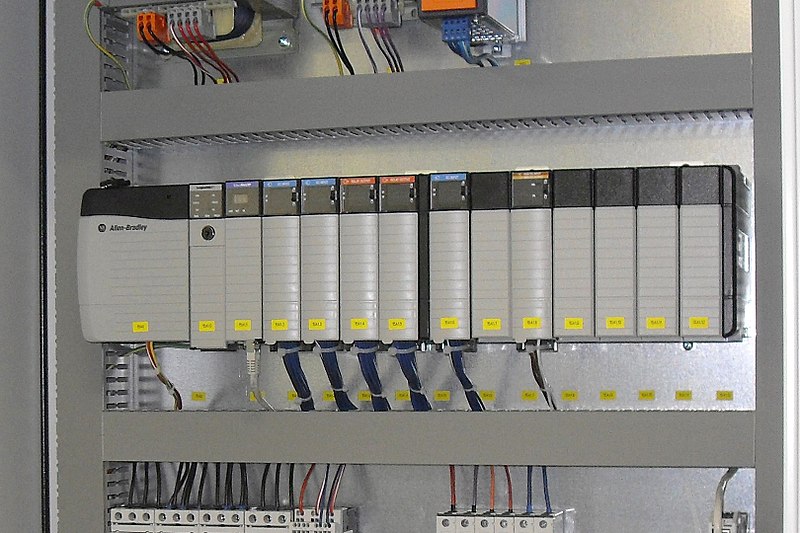
Compact PLCs are small, low-cost, and easy to install. They house all necessary components in a single package, including a fixed number of input and output channels, power supply, communication, and processor unit. However, the functionality of the PLC can be enhanced using compatible external modules.
Modular PLCs are customizable, where a customer can choose a processor, power supply, I/O modules, and communication modules separately as needed for the application.
Components of PLC
Power Supply
A power supply converts AC mains to a low DC voltage to be used to operate modules and the CPU. The type of power supply can be AC and DC based on the PLC model. Generally, 24V DC or 120 VAC power levels are used.
Input and Output Modules
The PLC receives input signals from field devices, which act as sensors. The sensors can be of two types, digital or analog. The digital input signals are in discrete forms, such as push buttons and proximity switches. The analog input signals are continuous signals with a range of values, and examples include pressure transducers and thermocouples.
After processing the input signals based on a written program, the PLC outputs signals to the field devices, which act as actuators. The devices can either have a discrete state of operation, such as lamps and relays, or analog states of operation, such as variable frequency drives (VFDs) and proportional integral derivative (PID) controllers.
The discrete state I/O devices require a digital I/O module, whereas the analog I/O devices require an analog I/O module. Combination I/O modules comprising both digital and analog I/O are also available. The power required by output field devices is provided separately. The channels of the I/O module can be configured for different ranges of voltage or current.
Processing Unit
The processing unit consists of a central processing unit (CPU), Arithmetic Logic Unit (ALU), and a memory module. This is the part of the PLC that stores the user program, processes the inputs, and generates specific output commands using various functions, including timers, counters, and mathematical operations. The features and the amount of memory available for program and storage depend on the model of the PLC. Communication ports, such as serial or LAN, are also available on the front of the CPU module. PLC manufacturing brands offer a range of low to high-performance PLCs based on user requirements.
Programming Device
The programming device consists of a personal computer (PC), a programming cable, and software installed on a PC. The program can be written in different programming languages, such as Ladder Diagram (LD), Function Block Diagram (FBD), Sequential Function Charts (SFC), Instruction List (IL), or Structured Text (ST). The ladder diagram is the most common programming language as it resembles relay logic.
DCS
DCS stands for ‘Distributed Control System.’ It is one step ahead of a PLC. It is suitable for large processes with higher I/O counts and complex industrial processes. The system’s control elements are geographically located over the plant area such that a separate controller controls a machine or equipment related to a small process. All the controllers are linked to each other and other supervisory terminals through a high-speed communication network. DCS, in addition to the control equipment, also features supervisory equipment by the same manufacturer, which simplifies the hardware integration, and adds safety to the control system. Also, a problem at one point in a plant cannot cause the whole process to halt. Manufacturing and processing plants such as food, nuclear, automobile, and oil and gas use the DCS system as it can monitor and control many continuous control loops.
Components of DCS
Engineering Workstation
The engineering workstation is a PC with supervisory software installed on it. The whole DCS system can be monitored and configured through this dedicated piece of software. The software provides functions like I/O point creation, modification in control logic, the configuration of the field device, and documentation.
Operator Station or HMI
The operator station is a PC with another software tool installed that allows monitoring and control of plant process parameters. The operating stations can be one or multiple based on the process requirement or the plant size. The functionality of the operator station can also be divided among multiple stations where they can perform different functions like displaying parameters, displaying trends, data acquiring, and logging and archiving data.
Process Control Units
Process control units are distributed control units over an entire plant area. Every control unit has a separate controller with a powerful CPU and I/O modules to which field devices are connected directly. The information from the connected sensors is processed in these controllers, and the corresponding signals are sent to the actuators based on the control program. There can be multiple process control stations depending on the process conditions.
Communication System
The communication networks are the backbone of the entire DCS. Communication among engineering workstations, operator stations, process control units, and field devices occurs over these networks. The communication network protocols include Field Bus, Profibus, Ethernet, Modbus, DeviceNet, etc. Different networks have their pros and cons, and some of them are preferred over others for different levels of the control system, keeping the need for safety.
Smart Field Devices
Smart field devices and field bus technology are highlighted features of DCS. The smart field devices do not need the controller to process the sensed information; rather, these have dedicated onboard intelligence to perform the task. These devices can directly communicate with the field bus without the need for a controller, which eliminates extra I/O modules from the system.
SCADA
SCADA stands for ‘Supervisory Control and Data Acquisition.’ The SCADA system comprises a piece of software and a remote telemetry unit (RTU). The function of a SCADA system is to acquire data, monitor it, and control plant operations remotely in real-time. The RTU utilizes radio communication to transmit data to the computer in the central control room, where it is displayed using a graphical user interface. SCADA systems are used in several industries, including oil and gas refining, power plants, and water and waste management.
Components of SCADA
Supervisory Computers
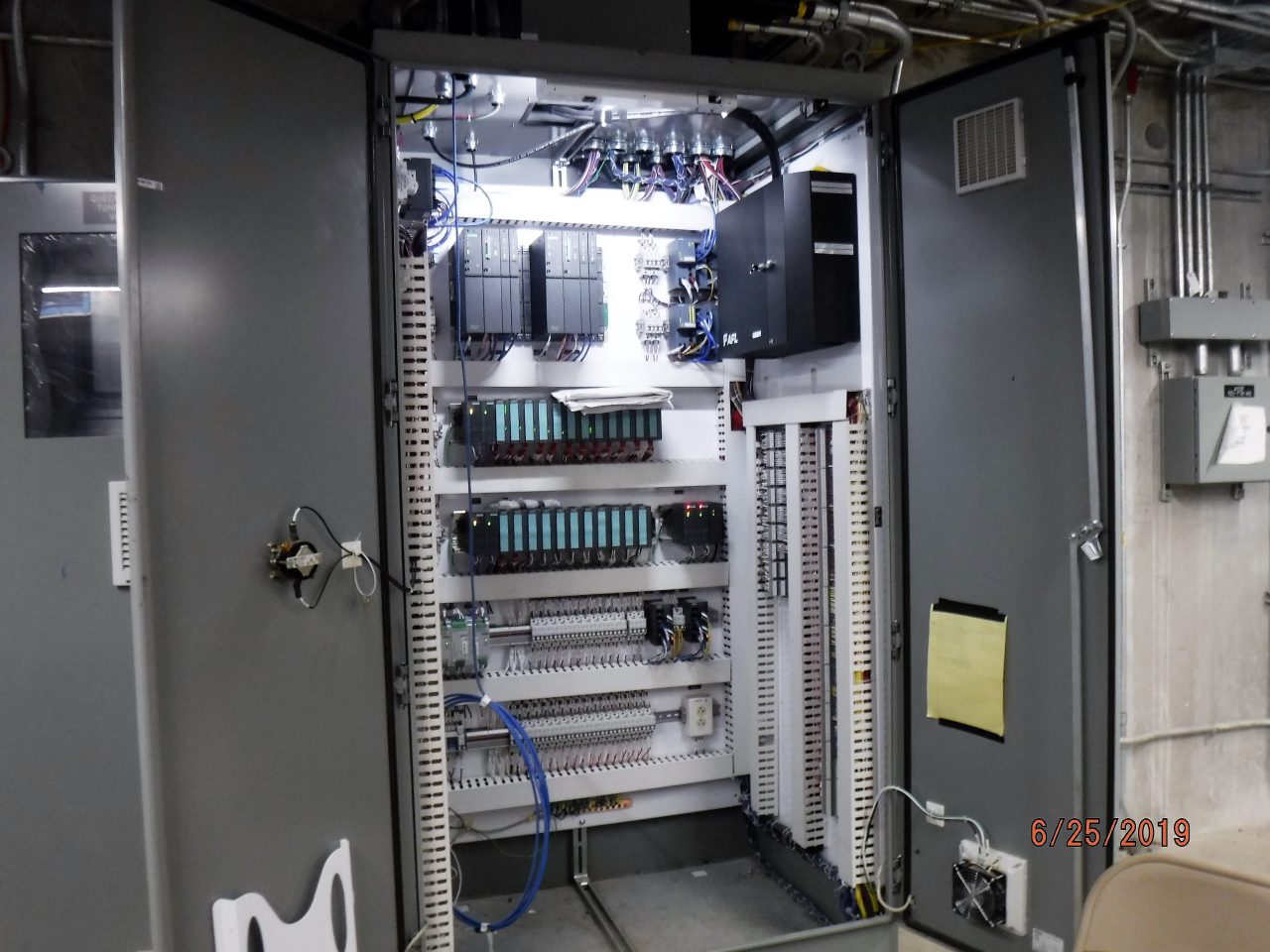
The heart of the SCADA system is a supervisory computer located in a control room near the plant or hundreds of kilometers from the plant site. These are sometimes called Master Terminal Units (MTUs). The supervisory computer receives data about the plant processes, the sensor values, etc., through radio signals. It communicates to the PLCs and sends commands to field devices. The SCADA system also incorporates the Human Machine Interface (HMI) software available on the operator workstations.
Remote Telemetry Units (RTUs)
The RTUs are known as intelligent I/O. These units read the sensor and actuator states in the field and transmit them to the supervisory computer through a communication network.
Programmable Logic Controllers
The PLCs are also connected to the field devices, including sensors and actuators like the RTUs but provide more control and functionality than RTUs. The major difference between RTUs and PLCs is that RTUs have wireless communication capability, while PLCs communicate through wired networks.
Communication Infrastructure
The communication infrastructure includes standard or proprietary communication network protocols through which all major components of SCADA, including supervisory computers, RTUs, and PLCs, are connected and communicate to share information. The data transmission medium may vary between radio, satellite, cable, or a combination of these.
Human Machine Interface
The HMI software is designed for operating personnel. It is a visual representation of the plant being monitored and controlled. Different components of the plant are represented in the form of diagrams, along with states of field devices, alarms, and event information. The critical information is displayed using graphs and illustrations so that it is easy to understand and take immediate action when required.
A DISCUSSION ON SIMILARITIES AND DIFFERENCES BETWEEN PLC, DCS, AND SCADA
PLC is a programmable logic controller out in the field to control machines. It has inputs and outputs, a processor, and software running, which you can connect to and write a control program that can read inputs and based on certain conditions, make changes to outputs.
The SCADA system provides supervisory control and data acquisition. It is a software layer designed to acquire data and control field devices and controllers in the plant centrally. The big thing that SCADA does is it gives you control and alarming functions, but it is central. A SCADA system is generally independent of the manufacturer of the hardware in the field. It can talk to Allen Bradley, Siemens, Emerson, or any other PLC from another manufacturer.
DCS is very similar to SCADA, but it is proprietary and decentralized. The control components of the DCS almost always talk to one another over a super high-speed field Bus; these connections are not direct copper connections or over Ethernet or fiber. DCS system is generally, in most cases, processes specific, and it’s a kind of turnkey process-specific solution. A DCS system has a SCADA component in it, and it has a PLC, oftentimes called a Rio, an RTU, or PLC. It has a hardware component in the field that talks to one another directly. So, multiple RTUs may be placed at different levels of the process. Then there is a massive controller in a control room where the process control is taking place and the program is running. The SCADA layer acts as a node in the system.
SCADA systems can be categorized as data-gathering and DCS as process-oriented. DCS provides control and supervisory features, along with the data presented to the operator. In contrast, SCADA focuses more on data acquisition and its presentation to the control room and the operator. A DCS utilizes a local area network to establish communication between its distributed control components confined over the area of the plant. SCADA utilizes non-local network options to transmit data between the control room and the plant, and these network options are less reliable than the local area network. The DCS is always scanning and displaying process information to the operator, whereas the SCADA system is event-based. It waits for an event to trigger and then reads the parameter values and stores them in a database.
The DCS is an expensive setup compared to PLC, but it has the edge over the functionality it provides. A PLC can control a process, but the operator requires an HMI to graphically monitor or control the process continuously. In contrast, the DCS already includes the whole plant process in its operator stations and SCADA component. Also, the smart field devices that can communicate directly with the field Bus are highly precise specialized pieces of equipment that are expensive too.
For example, in the steel industry, a DCS is used on the rolling mill because the technology requires the program to run a rolling mill to turn a big billet into rebars, and that is a million lines of automation code. So, the manufacturer of the DCS writes the code once, installs all the I/O, the process control center, and the SCADA interface in the control room, connects all components, and adds custom functionality over it, if required. A DCS is almost always a prepackaged control program for process automation.
In contrast to DCS, PLCs and SCADA systems can be thought of as blank slates. By default, it doesn’t have a program on it; you must write it from scratch or load one that is already written. The functionalities of these systems almost overlap each other. A DCS can be understood from other examples, such as the ECM module, the flow control module, and the exhaust control module of an automobile are also DCS. A DCS is built on the PLC and SCADA components basically, but it is generally a complete pre-built solution for a particular industrial process.
Sometimes, PLC and SCADA are compared to a DCS as PLC-SCADA vs DCS. A DCS has all the components that a PLC and SCADA have combined. Additionally, DCS enforces standardization and offers validated software modules, consistency, and modularity. DCS is not flexible, and there are restrictions in place by the manufacturers, which makes it a rigid, proprietary-nature product. Today, more and more DCS configurations are coming to market, providing a complete solution for specific industrial processes.
DO Supply Inc. makes no representations as to the completeness, validity, correctness, suitability, or accuracy of any information on this website and will not be liable for any delays, omissions, or errors in this information or any losses, injuries, or damages arising from its display or use. All the information on this website is provided on an "as-is" basis. It is the reader's responsibility to verify their own facts.