How the Kinetix 6000 Handles Coordinated Motion in Packaging Lines
Packaging lines are a kinetic industrial art show. Each movement of the system is precise, calculated, and performed without the slightest hint of hesitation. Each stage of the performance, from unfolding packaging boxes to the way that a robot arm would tilt the product just slightly into the box before loading it in, demonstrates the ingenuity and forward thinking that is demanded when putting together a system like this. If a beat is missed, the infeed roller stutters, or the sealer jaw closes half a second too early, you don’t just get a crumpled bag; you get downtime, wasted film, product jams, and a line operator with a headache. Coordinated motion is what keeps everything humming, every component moving in sync with the others, like gears in a watch. And for many systems out there, it’s the Kinetix 6000 quietly running that shows. They are tried and tested, and they still take up coordinated motion tasks, and here’s why.
What Does Coordinated Motion Really Mean?
Coordinated motion is about precise, predictable relationships between axes in a system. Position, velocity, and acceleration are all timed down to the millisecond. More advanced machines, such as robotic arms, utilize linear algebra to calculate the different positions its toolhead would be in the x, y, or z plane. Fun fact: This is also how graphics cards for computers work.
In packaging, mechanical tasks are often layered on top of one another, and coordinated motion is designed to keep a system efficient instead of chaotic. Take a form-fill-seal machine. The film feed has to pause at the exact moment the sealing jaw engages. The jaw must finish its motion and retract before the film moves again. And if there’s a knife involved? That axis needs to match the velocity of the moving film just long enough to make a clean cut. None of this works if one motor is even slightly off in timing or position.
Coordinated motion means the system understands these relationships and treats the axes not as individual drives, but as parts of a whole. Instead of issuing separate commands, the controller treats groups of axes as a unit using synchronized profiles, electronic camming, and gear ratios that are maintained in real time.
The Kinetix 6000, when paired with a Logix controller over a SERCOS network, makes this kind of motion both possible and repeatable. Motors no longer guess when to act; they move because the system as a whole decides it’s time.
The Kinetix 6000 Hardware at Work
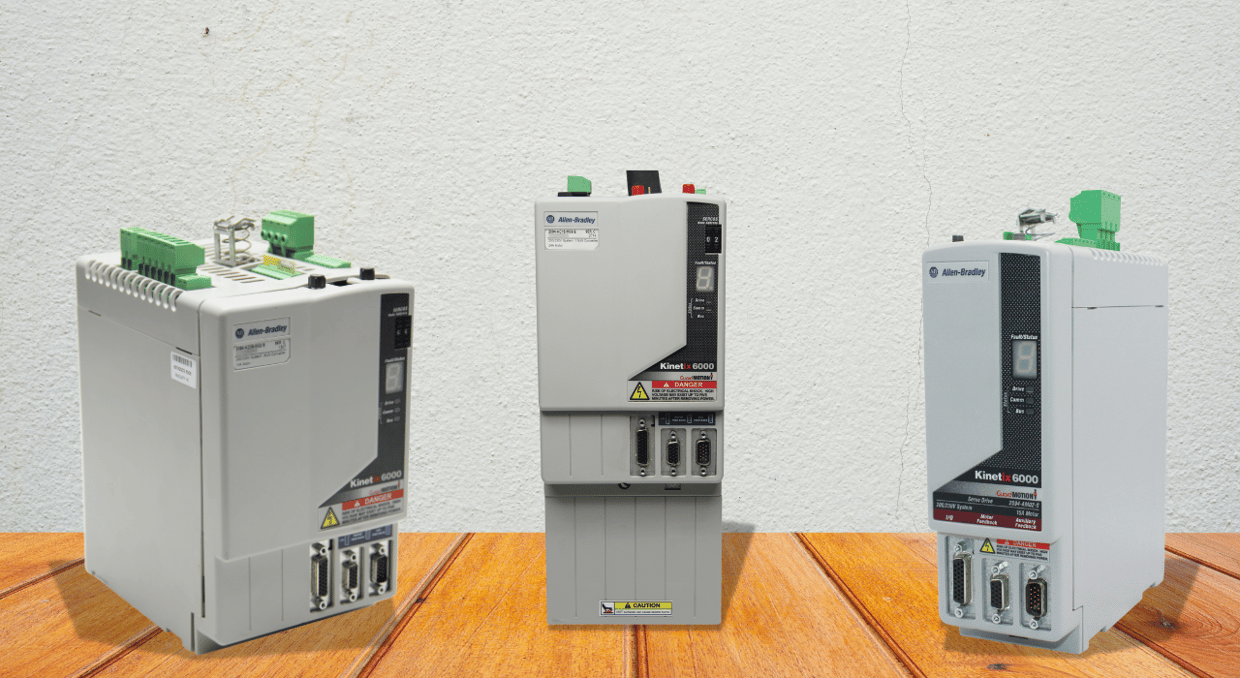
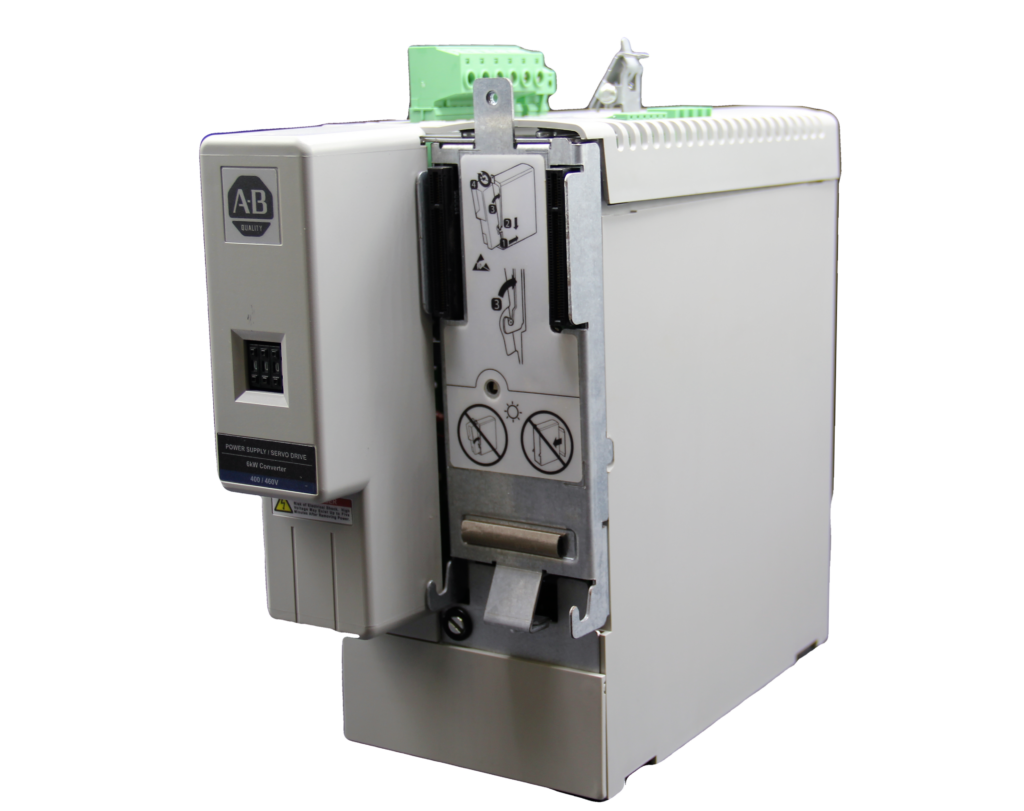
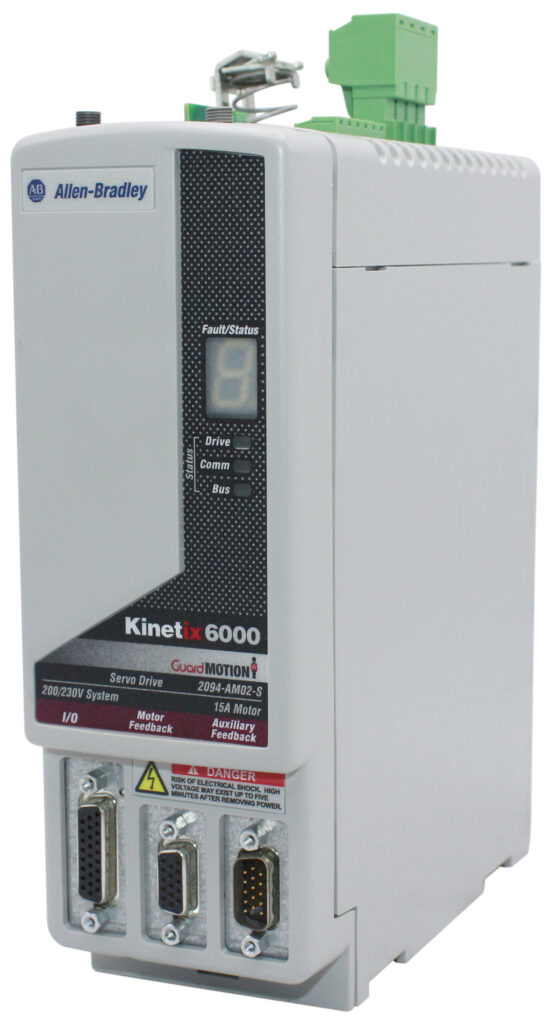
It starts with the Integrated Axis Module (IAM). This unit handles the heavy lifting on the power side, taking in three-phase AC, converting it to DC, and distributing that energy across a common bus. From there, each Axis Module (AM) taps into the bus to power a servo motor, one per axis of motion. The beauty of this setup is that all axes share the same power backbone. That means fewer incoming connections, fewer bulky transformers, and a compact footprint inside the enclosure. You can even install Kinetix 6200 AM modules onto the same 6000 IAM backbone, so long as the modules are electrically compatible and the controller supports both communication types. This allows EtherNet/IP diagnostics, safe speed monitoring, and removable control modules.
Each axis module has its own inverter, feedback interface, and connection to the SERCOS fiber-optic network. Unlike standalone drives, these modules don’t work in isolation. They’re all clocked to the same master timing signal sent from the Logix controller through the IAM, and that synchronization is baked into their hardware.
As a result, a motor on one end of the machine can start or stop based on the real-time position of a motor on the other side without lag, drift, or guesswork. Since all modules are part of the same chassis and power structure, braking energy from one motor can be recycled into another, reducing wasted power and helping the whole system run cooler and more efficiently, though a 2094-BSP2 shunt module or an external passive shunt module will be needed when internal capacity is exceeded.
The physical layout might look simple: IAM on the left, axis modules lined up beside it, maybe a shunt resistor at the end, but that modular simplicity is what makes the Kinetix 6000 so easy to scale and so dependable once it’s wired in.
Putting It All in Motion with Vertical Form, Fill, and Seal Machines
Let’s tie this all in with a vertical form-fill-seal machine example. This process has five general steps, starting with the film unwinding.
Unwinding
At the start of the line, a large roll of material (plastic, aluminum, or whatever the packaging calls for) will go through a maze of rollers to be fed into the seal machine. Depending on the speed of the setup, this can be done intermittently or continuously. A servo controlled by a Kinetix 6000 AM regulates the tension in the unwinding roll with its torque mode or closed-loop velocity control to feed the roll at the right rate.
Dosing
Next comes the product dosing. Precision is demanded to get the exact amounts of solids, liquid, powder, or granules to drop into the bag. In many setups, this happens simultaneously with film movement and is helped by gravity. While the dosing may be mechanically separate, the Logix controller coordinates it with the rest of the motion group. A motor could be installed on a conveyor dropping product into a funnel and governed by a Kinetix drive to ensure the proper amount.
Forming
Then comes the forming shoulder. The film will pass over the form that shapes it into a tubular shape from the previously flat material. Each forming shoulder is tailored to the specific material for packaging.
Film Take-Off
Now we get to the film take-off. While some setups may utilize simple rollers to grip and pull the film downward with static, the higher-speed applications use servos to ensure precision. They must advance the film to the exact right length for each cycle to match the bag size without jerking or slipping. This axis is usually the master in the motion group. Its position becomes the reference for camming, gearing, and registration adjustments. The axis module controls acceleration and deceleration profiles to ensure smooth movement. If the system uses registration marks (e.g., printed graphics), Kinetix works with high-speed inputs to align pulls to those marks with sub-millimeter precision. Electronic gearing allows any following axes (like the cutter or sealer) to stay linked to this master. Usually, the lateral sealing procedure will happen during or after this step.
Sealing and Cutting
Finally, we have sealing and cutting, where it all comes together. The filled bag is given a transverse seal from the sealing jaws and cut with a blade. This is the most dynamic motion in the whole process. A servo-driven sealing jaw needs to accelerate, match the film velocity, clamp, seal, then retract and return, all without interfering with the next pull. Kinetix 6000 handles this using electronic camming, where the sealing jaw’s motion is defined relative to the film axis’s position. This cam profile can be tuned in software for different bag sizes, speeds, or materials. The cutter, if separate, can be run on its own cam, either tied to film travel or synchronized with jaw position.
And because all axes are running on the same DC bus and synchronized through the same SERCOS loop, you get seamless transitions between these high-speed moves with none of the lag, drift, or timing headaches you’d see with asynchronous systems.
Now, you have a filled, formed, and sealed product that will continue downstream, like to be joined with others, packaged, or palletized. Each step of this process follows the same principles as the VFFS machine and offers different opportunities to integrate with the Logix setup.
Coordinating Motion in Cartoning Systems
If the VFFS machine is about vertical timing and product drop, then a cartoner is more like a mechanical puzzle box that has to solve itself on repeat. Flaps must fold, glue heads must fire, pushers extend, and product must arrive at the right place, all while a carton travels down the line at speed.
Infeed Conveyor Synchronization
At the heart of most cartoning machines is a servo-driven infeed conveyor that indexes cartons into position. Every action downstream is locked to this motion. This axis often serves as the master for electronic gearing, with the position of every other axis tied directly to it. The 6000 will ensure that the infeed moves with defined acceleration and dwell profiles, letting other axes perform tasks in sync without collision.
Product Pusher
Once the product reaches the loading station, a servo-driven pusher inserts it into the open carton. This motion must start only when the carton is fully indexed and clear of the flap fold. Rather than relying on time-based delays, the pusher is triggered using position-based logic. The Logix controller monitors the conveyor’s actual encoder value, and when the carton reaches a defined window, the pusher servo executes a move profile. That profile itself is cammed and accelerates to match the carton’s motion, inserting and retracting before the next cycle starts. It’s a simple move, but if mistimed even slightly, it results in product misalignment or crushed cartons.
Flap Folding and Tucking
The front and rear flaps of the carton must be folded and tucked, sometimes while the carton is moving, sometimes in a stop-and-go fashion. These actions are often performed by rotary arms or tuckers. These flap folders are often controlled by rotary servo axes, cammed to the infeed conveyor’s motion. The tucking motion can be precisely shaped using electronic camming: rotate in, hold momentarily, and retract smoothly. These cams can be software-defined and changed without touching the hardware, making product changeovers much faster.
Carton Closing and Discharge
Once the carton is sealed, it exits onto a discharge conveyor, sometimes with a rejection system for poorly formed units. Discharge conveyors can run asynchronously or be tied into the motion group, depending on how sensitive the handoff is. In rejection setups, a paddle or diverter driven by a servo may activate based on inspection results, which can be synchronized with the carton position tracked by the master conveyor.
Final Thoughts
Packaging machines are very intricate pieces of automation that save a lot of manpower. Whether it’s sealing 80 bags a minute or a cartoner folding a dozen flaps in perfect sync, timing failures can lead to damage and downtime. That’s why buying equipment you know you can trust is important.
Here at DO Supply, we specialize in exactly that. We carry many different Kinetix models and can help tailor your order to your specific needs. All it takes is a phone call or email to our specialists to start this process.
DO Supply Inc. makes no representations as to the completeness, validity, correctness, suitability, or accuracy of any information on this website and will not be liable for any delays, omissions, or errors in this information or any losses, injuries, or damages arising from its display or use. All the information on this website is provided on an "as-is" basis. It is the reader's responsibility to verify their own facts.