CNC Machine Parts and Automation: How Allen Bradley Drives Keep Spindle Motors Turning
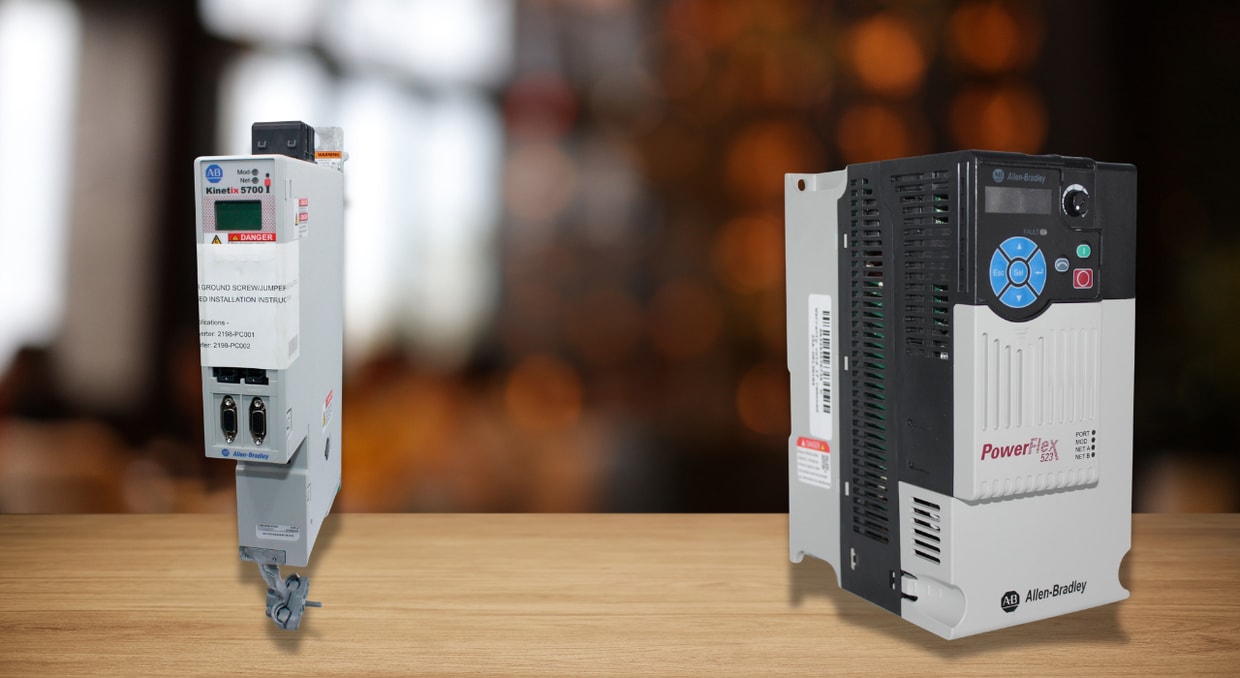
CNC machine parts work together as a precisely coordinated system in modern manufacturing. From ball screws and linear guides to encoders and servo motors, each component plays a critical role, but none more so than the drive system that commands motion. Among the many brands trusted by manufacturers worldwide, Allen Bradley (a Rockwell Automation brand) has become synonymous with reliable, high-performance drive technology. This article explores how Allen Bradley drives integrate with spindle motors and other CNC machine components to deliver the precision and operational uptime that today’s industrial automation demands.
Understanding CNC Machine Parts
CNC machines are complex assemblies of mechanical, electrical, and software components. To understand how drives fit into the architecture, we must understand the major categories of CNC machine parts and their roles.
Mechanical Components
The mechanical backbone of any CNC machine includes:
- Spindle assemblies: The rotating shaft that holds cutting tools or workpieces
- Ball screws and linear guides: They convert rotary motion into precise linear movement
- Turrets and tool changers: They automate the selection and indexing of cutting tools
- Workholding fixtures and chucks: They help in securing parts during machining activities.
These mechanical CNC machine parts define the system’s range of motion, rigidity, and accuracy, but they rely entirely on electrical drive systems to bring them to life.
Electrical and Motion Control Components
On the electrical side, CNC machine parts include:
- Servo motors and spindle motors: They provide the mechanical force and rotation.
- Drive amplifiers: These regulate power delivery to the motors.
- CNC controllers (CNCs): These controllers interpret G-code and send motion commands.
- Encoders and resolvers: They provide real-time feedback on position and speed.
- PLCs and I/O modules: They manage auxiliary functions like coolant, tool changers, and safety interlocks.
Allen Bradley drives slot directly into this ecosystem, functioning as the bridge between the CNC controller’s digital commands and the physical rotation of a spindle or servo axis.
What Allen Bradley Drives Do, and Why It Matters?
Allen Bradley drives are variable frequency drives (VFDs) and servo drives produced by Rockwell Automation. In a CNC machine context, they serve several critical functions:
Speed and Torque Regulation
Spindle motors must operate over a wide speed range, from slow threading to high-speed finishing passes that can exceed 10,000 RPM. An Allen Bradley drive reads the commanded speed from the CNC controller and continuously adjusts the output frequency and voltage to match. This ensures the spindle runs at precisely the right speed without overshooting or hunting.
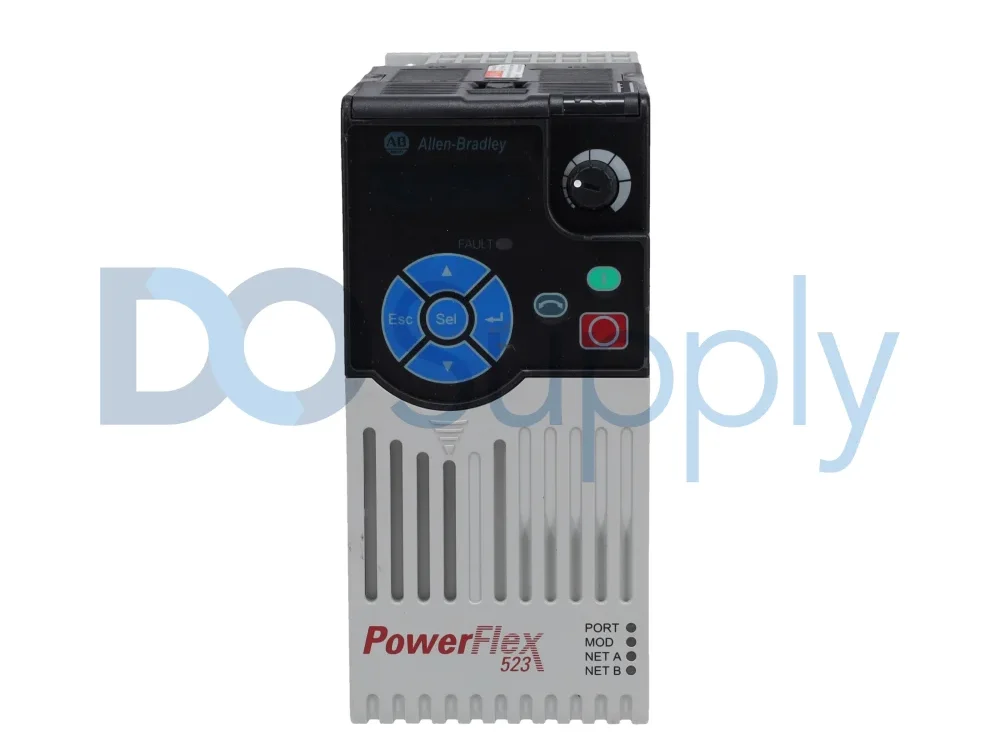
Allen Bradley PowerFlex drives use advanced vector control algorithms to maintain torque accuracy even during rapid speed changes, a critical capability for avoiding chatter and tool breakage during interrupted cuts.
Controlled Acceleration and Deceleration
Abrupt starts and stops put enormous mechanical stress on CNC machine parts, particularly spindle bearings, couplings, and tool holders. Allen Bradley drives support programmable ramp-up and ramp-down profiles, ensuring acceleration and deceleration happen smoothly. This dramatically reduces mechanical wear and extends the service life of adjacent CNC machine parts.
Dynamic Braking and Regenerative Energy
When a spindle decelerates rapidly, the motor acts as a generator. Allen Bradley drives with regenerative capability, which returns energy to the power bus, improving overall energy efficiency. Non-regenerative models use dynamic braking resistors to dissipate the energy safely. Both approaches prevent damaging voltage spikes from propagating into other CNC machine parts or the facility’s power supply.
Fault Detection and Protection
Allen Bradley drives continuously monitor operating parameters, motor current, bus voltage, temperature, and encoder feedback. When an anomaly is detected, the drive can trigger controlled shutdowns, log diagnostic codes, and alert operators through the machine’s HMI or SCADA system. This early-warning capability can prevent a minor issue from cascading into catastrophic damage to other CNC machine parts.
Allen Bradley Drive Product Lines for CNC Applications
Rockwell Automation produces several Allen Bradley drive families relevant to CNC machine parts and spindle control. Each targets a different range of power, performance, and integration requirements.
PowerFlex 520 Series
The PowerFlex 520 series (including the 523 and 525 models) offers compact, cost-effective VFD control for general-purpose spindle and auxiliary motor applications. Key features include:
- EtherNet/IP connectivity for integration with Logix-based CNC and PLC systems
- Built-in EMC filters to reduce interference with other CNC machine parts and control electronics
- Safe Torque Off (STO) function for compliance with machine safety standards
- Removable HIM (Human Interface Module) for convenient parameter copying across multiple drives
PowerFlex 750 Series
For higher-power spindle applications and demanding production environments, the PowerFlex 750 series delivers:
- Power ratings from 0.75 kW to 1500 kW, covering everything from small lathes to heavy machining centers
- Advanced Vector Control (AVC) for precise torque regulation without encoder feedback
- Closed-loop feedback options including incremental encoder, resolver, and absolute encoder
- Modular architecture with optional I/O, feedback, and communication expansion cards
- Integrated bus sharing for energy efficiency across multi-axis machine tool cabinets
If you would like to read more about how the PowerFlex 750 series deals with CNC machine parts in harsh environments, we have a blog here for you!
Kinetix Servo Drives
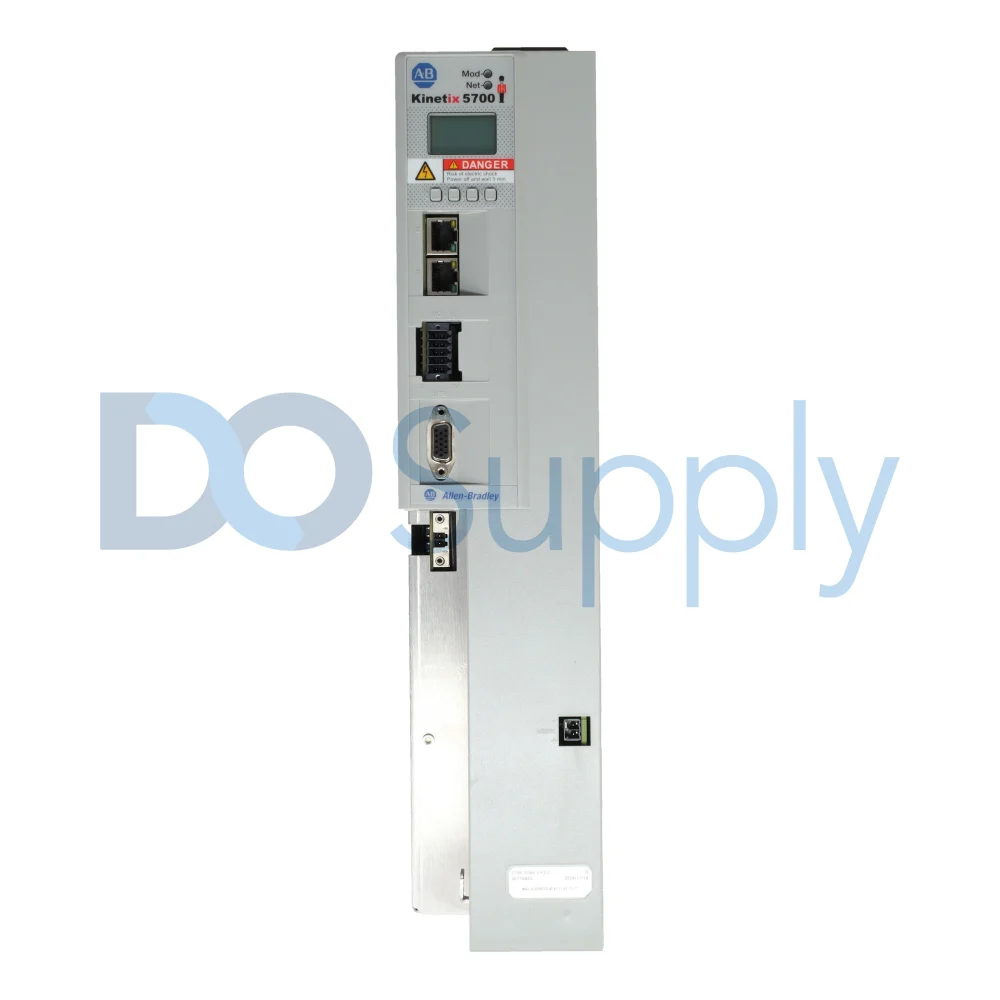
While the PowerFlex family focuses on spindle and general-purpose applications, the Allen Bradley Kinetix series handles servo axes, the X, Y, Z, and rotary axes that position CNC machine parts with micron-level precision.
- Kinetix 5500 and 5700 drives pair with VPC and MP-Series servo motors
- Integrated safety functions, including STO, SS1, and SBC, reduce external safety relay requirements depending on the model
How Allen Bradley Drives Integrate with the CNC Controller
Modern CNC machines use a layered control architecture. Understanding how Allen Bradley drives communicate within this architecture is essential for anyone specifying or maintaining CNC machine parts.
Analog and Digital Signal Control
In legacy machines and many retrofit applications, the CNC controller sends a 0–10V analog signal or ±10V analog reference to the drive’s analog input. The drive maps this signal to a speed or torque command. While simple and reliable, analog control offers limited diagnostic visibility and is susceptible to electrical noise, a significant concern in machine tool environments where VFDs, servo drives, and stepper systems all generate electromagnetic interference.
EtherNet/IP and Digital Fieldbus Control
Contemporary Allen Bradley drives support EtherNet/IP, the industrial Ethernet protocol native to the Rockwell Automation ecosystem. Via EtherNet/IP, the CNC or PLC controller can:
- Send speed and torque reference commands in real time
- Read back actual speed, current, voltage, and temperature data
- Write parameter values for on-the-fly process adjustments
- Trigger and acknowledge fault states without hardwired relay logic
This digital architecture replaces dozens of discrete wires with a single Ethernet cable, simplifying machine design and reducing the number of potential failure points among CNC machine parts.
Maintenance Practices
A proactive maintenance approach extends the life of Allen Bradley drives and protects the downstream CNC machine parts they power. The following practices are widely adopted in well-run machine shops and manufacturing facilities.
Thermal Management
Heat is the primary enemy of drive reliability. Allen Bradley drives include internal temperature sensors and will derate or fault on overtemperature conditions. Best practices include:
- Ensuring adequate cabinet ventilation and correct drive mounting orientation
- Cleaning or replacing air filters on drive enclosures at regular intervals
- Monitoring ambient cabinet temperature, drives typically require inlet air below 40°C (104°F)
- Verifying that heat sinks are unobstructed and fan motors are operating correctly
Drive Parameter Backup
Allen Bradley drives store dozens of application-specific parameters, speed limits, torque limits, acceleration ramps, control mode, and motor nameplate data. When a drive fails and must be replaced, having a current parameter backup dramatically reduces downtime.
Specifying Allen Bradley Drives for CNC Machine Parts
When specifying a drive for a new CNC build or a spindle drive replacement, several factors should guide the selection process.
Power and Current Rating
The drive must be sized to handle both the continuous and peak current demands of the spindle motor. A general rule of thumb is to select a drive rated at 110–125% of the motor’s full-load current to provide adequate headroom for starting and overload conditions common in CNC machining operations.
Control Mode Requirements
Determine whether the application requires:
- V/Hz (volts-per-hertz) control
- Sensorless vector control
- Closed-loop vector control
- Full servo control
Enclosure and Environmental Rating
Machine tool environments are harsh. Coolant mist, metallic dust, and vibration are constant threats. Allen Bradley drives are available in IP20, IP30, and IP54 ratings. For applications where the drive will be mounted close to the machining zone, specifying a higher IP rating or installing the drive in a sealed NEMA 4/12 enclosure protects both the drive and the CNC machine parts it controls.
Final Thoughts
In conclusion, CNC machine parts function as an interconnected system, and the drive is the component that determines how well the rest of the system performs. Allen Bradley drives, spanning the PowerFlex 520, PowerFlex 750, and Kinetix families, provide the speed control, torque regulation, feedback integration, and diagnostics that modern machine tools demand. For machine builders, maintenance technicians, and plant engineers alike, understanding how Allen Bradley drives communicate with spindle motors and interface with other CNC components is fundamental knowledge. Whether commissioning a new machining center, troubleshooting a recurring fault, or planning a retrofit, a working knowledge of drive technology pays dividends in uptime, part quality, and long-term reliability as CNC technology continues to evolve, with more integration between drives, controllers, and industrial IoT platforms, Allen Bradley’s deep ties to the Rockwell Automation software ecosystem position it well to grow with the needs of modern manufacturing. The spindle keeps turning, and the drive is what makes it possible.
Sourcing parts doesn’t need to be difficult or a gamble. That’s why we at DO Supply test all of our products in-house by our technicians and back them with a two-year warranty. We also carry the drives you have read about on hand and are ready to ship them the same day or the next to get your automated project moving. Along with it, we also buy used automation equipment and offer repair services if you would like to have your equipment repaired by our specialists. So give us a call today!
DO Supply Inc. makes no representations as to the completeness, validity, correctness, suitability, or accuracy of any information on this website and will not be liable for any delays, omissions, or errors in this information or any losses, injuries, or damages arising from its display or use. All the information on this website is provided on an "as-is" basis. It is the reader's responsibility to verify their own facts.