90-30 Series vs RX3i Series
The 90-30 series of programmable logic controllers (PLCs) by General Electric (GE) was launched in 1991. This series has been serving automation control requirements of the industry for many years. This series provided flexibility and modularity, making it the primary choice for field professionals. In comparison, the RX3i is a programmable automation controller system, abbreviated as PACSystem, a new and upgraded series of automation controllers that provides a shift towards a more holistic vision of automation. This series is founded on the core abilities of the 90-30 series while providing even further sophisticated capabilities and versatility. Emerson has acquired Intelligent Platforms (Automation Control Systems) from GE which these automation controllers are part.
CPUs
The 90-30 series offers 10 CPU models for standard and high performances applications. The number of discrete I/O ranges from 160 to 4096, the total number of Analog I/O ranges from 62 In/32 Out up to 2048 In/ 512 Out, the user logic memory is 6K bytes for the base model and 246K bytes for high-performance models. The standard CPUs support two programming languages that are Ladder Logic and SGC, whereas the high-performance models also support C. The maximum I/O module slots supported range from 5 to 79. The boolean execution speed ranges from 18ms/K up to 0.22ms/K.
The RX3i offers CPUs with a form factor suitable for installation in a backplane or a standalone form factor in some models. The user memory ranges from 2 MB up to 64 MB. The discrete I/O memory ranges from 16k bits to 32k bits, and Analog I/O memory is 32k Words for all models. The remote I/O devices range from 8-simplex up to 64-simplex and 64 redundant points modules. This series has built-in Ethernet and USB 2.0 ports in all models. Features like memory extension through the memory card and serial interfaces (RS-232 and RS-485) are present in some CPU variants.
Baseplates and Backplanes
The baseplates for the 90-30 series are CPU baseplate, expansion, and remote baseplate. CPU baseplates can be embedded or modular type baseplates. The expansion baseplates can be as far as 15 meters from the CPU baseplate with up to 7 in number. The remote baseplate has similar extension options as the expansion baseplate, except it can be installed up to 213 meters away from the baseplate. All baseplates have a backplane that has a power bus and an I/O communication bus for powering I/O modules and establishing communication, respectively. CPU baseplate has an additional special intelligent module bus for supporting optional modules.
RX3i has a dual-bus universal backplane that supports both PCI and serial I/O modules. PCI modules use the PCI bus, whereas the serial modules or modules from the 90-30 series can employ the serial bus. In addition to the universal backplane, two serial expansion backplanes with support of up to five and ten I/O modules are also available. With the RX3i system, up to seven serial expansion backplanes can be added in any combination of expansion or remote backplanes from RX3i or 90-30 series, with an additional power supply for each backplane necessary to meet the power requirements of modules.
Power Supplies
The 90-30 series has 6 variants of power supplies, each of which can provide up to 30 watts combined output. The output power goes up to 15 watts for 5 VDC, 20 watts for 24 VDC (isolated), and up to 15 watts for 24 VDC relay type output. The input voltage can be from 12 VDC to 125 VDC and from 100 to 240 VAC.
The RX3i offers seven power supply modules divided into two types based on backplane compatibility. IC695 power supplies are for universal backplanes and provide up to 40 watts combined output, whereas IC694 power supplies are for serial backplanes and provide up to 30 watts combined output power. In RX3i, multiple power supplies can be joined to add additional functionalities like load sharing, power supply, and power supply module redundancies. The RX3i offers a wide range of power supplies that support various customer requirements. The power supplies have inputs that range from 85 to 264 VAC, 100 to 300 VDC, or 18 to 30 VDC and provide output voltages as 3.3 VDC, 5.1 VDC, and 24 VDC in different combinations.
The power supplies support short power failures and have built-in over current and voltage protections and fault indications. The ride-through time for both series ranges from 10 ms to 20 ms.
Discrete I/O Modules
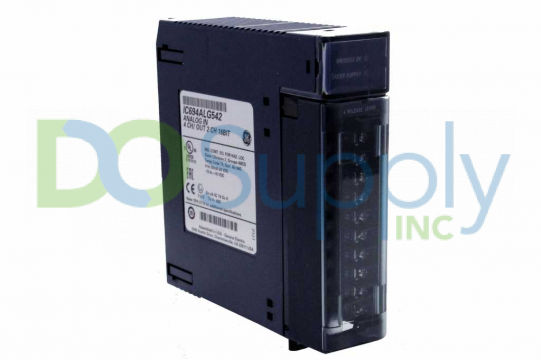
Discrete input modules take inputs in a digital or discrete form, and these modules can be employed for getting inputs from push buttons, proximity, and limit switches. The field device being used as input must have a separate power source.
Discrete Input Modules
There are 12 discrete input modules introduced in the 90-30 series. These modules comprise up to 32-points or channels. The input voltages, these modules accept, are 24 VAC, 120 VAC, 240 VAC, and 24 VDC for different models in diverse combinations. These modules offer positive, negative, or both logic and wiring schemes. A 5/12 VDC module is also available that works on TTL logic. An input simulator module with 8 or 16 points is also available with toggle switches for validating inputs during programming and troubleshooting.
There are 16 discrete input modules available for the RX3i system. The modules are offered in 8, 16, and 32-point I/O. Some modules operate on AC input power (up to 240 VAC), some operate on DC input power (up to 125V), and some have dual input options. The modules can output DC and AC to support field devices based on the model. The modules come with positive and negative logic and support relevant wiring schemes. The output points of the modules are either isolated or grouped with separate common or combined common, respectively. The modules are color-coded in blue or red to represent low-voltage and high-voltage modules, respectively.
Discrete Output Modules
An output device with a discrete ON or OFF function can use discrete output modules. Examples of low-power applications include solenoid excitation, motor starters, and LED indicators. Rather high-power output devices which can be controlled include incandescent and inductive loads.
There are 19 discrete output modules presented in 90-30 series. These modules comprise up to 32 output points. Considering output in voltage, these modules can provide, ranges from 120 VAC, 0.5 A up to 240 VAC, 2 A for AC type, and from 12/24 VDC up to 125 VDC for DC type. These modules offer positive, negative, or both types of logic and wiring schemes along with isolated relay options. A 5/12 VDC module that works on TTL logic can be used for low-power devices like solenoids or relay activations.
RX3i system is offered with 20 discrete output modules. These output modules are available with up to 32 separate outputs. The output voltage can either be an AC voltage of up to 240 V or a DC voltage of up to 125 V. The common point for the channels is isolated through separate fuses, and different short-circuit protections and fault diagnostic options are built-in. High-end modules can bear a load of up to 4 A and 8 A in normally open and normally close configurations.
Discrete Combination I/O Modules
In the 90-30 series, there are two discrete modules that have 8 inputs and 8 outputs each. One module has a 120 VAC input, and the other has 24 VDC input. Both modules have a relay-type output.
Four mixed I/O modules are available in RX3i for specific applications. One module has inputs and outputs points in discrete format with a single point supporting up to 2 A load. The second module can be used for sensing and processing rapid pulse signals and taking action without a CPU intervention. The third module is a high-speed counter module that can count pulses up to 1 MHz with an option to create a complex counter by combining multiple points. The fourth module is an advanced high-speed counter module that can measure pulse counts up to 1.5 MHz. High-speed counter modules have applications in material marking, meter proving, and motion control.
Analog I/O Modules
Analog Input Modules
The modules accept inputs in the form of voltage or current that range from -10 to +10 VDC, 0 to 10 VDC or from -5 to +5 VDC, or 0 to 5 VDC for voltage, and from -20 to +20 mA, 0 to 20 mA or from 4 mA to 20 mA for the current input range.
Four Analog input modules were introduced with 90-30 series. These include a four-channel voltage module with a 4 ms update rate for all channels and a resolution of up to 5 mV, a four-channel current module with a 2 ms update rate and a resolution of up to 4 μA, a sixteen-channel voltage module with 3 ms update rate and a resolution of up to 2.5 mV and a sixteen channel current module with 13 ms update rate and a resolution of up to 4 μA.
There are ten different Analog input modules offered with the RX3i system. Each module is designed keeping in mind modern industrial applications. The voltage resolution these modules can produce is from 5 mV to 0.3125 mV, and the current resolution ranges from 20 μA to 0.625 μA. The combined update rate or refresh rate for all channels is around 5 ms for single-ended input and 3 ms for differential input. The RX3i Analog modules offer features like onboard diagnostics, auto-calibration, alarms, fault, and LED indications.
Analog Output Modules
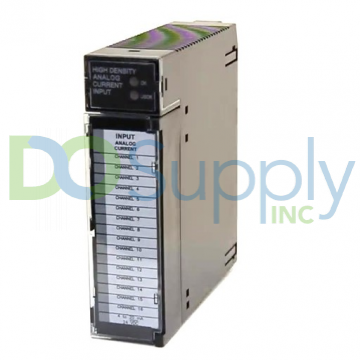
These modules give voltage or current outputs ranging from -10 to +10 VDC or 0 to 10 VDC for voltage and from 0 to 20 mA or from 4 mA to 20 mA for the current output range.
The 90-30 series offers three Analog output modules for controlling output Analog devices. The first module has two channel voltage outputs with 2.5 mV resolution and a 5 ms update interval. The second module has two channel current output with 1 mV/4 μA resolution and a 5 ms update interval, whereas the third module has an eight-channel current and voltage configurable output channels with resolutions up to 0.5 μA and 0.3125 mV and an update interval of 8 ms.
There are five Analog output modules available for the RX3i system with up to 8-points voltage or current configurable outputs. The outputs can either be isolated or non-isolated. The voltage and current resolutions in these Analog output modules reach as good as 0.3125 mV and 0.5 μA, respectively. The selection between two output types can be made by installing a jumper or through the software, based on the model catalog number. Several configuration options, safety, and diagnostic features, and LED indicators are available as built-in functions.
Analog Combination I/O Modules
One combination module is available for 90-30 series with input and output channels in a single unit. Also, it offers current and voltage configurable outputs based on user selection. This is a four-input and two-output channel module with unipolar and bipolar voltage and current configurable inputs and outputs. It offers a current resolution of 0.5 μA and a voltage resolution of 0.3125 mV. The output and input channels update rate is approximately 4 ms and 8 ms, respectively.
There are two Analog modules for the RX3i system which exploit both functionalities in a single unit. Both of these modules are configurable for voltage or current output type. Modules include features like defining the output state on power disruption, a ramp function for output, open circuit, fault diagnosis, scaling, offset, alarms for various conditions, and more.
Other Modules for RX3i System
- A Universal Analog Input module is available, which offers a combined functionality and takes input types including voltage, current, RTD, thermocouple, and resistance with channels configuration.
- Modules with HART Communications are also offered, which use a 4 to 20 mA current range for operation. Digital information like process variables, configuration settings, and device data can be transmitted through the HART signal.
- A thermocouple input module with 6 or 12 isolated channels with support for all types is available. The resolution varies between 11.5 and 16 bits, and temperatures from -270°C up to 2315°C can be measured.
- RTD Input module with Pt, Cu, resistance, Ni, and NiFe type inputs is also provided in the series.
- There are 20 special purpose modules presented in this series that can be used for particular applications to enhance the attributes of the automation system.
Migration from 90-30 Series to RX3i
Emerson recommends that its users of 90-30 upgrade to the new automation controller RX3i PACSystem. The company provides all the tools and guidelines for easy and cost-effective migration. The new series provides higher intelligence, power, safety, and communication features to fulfill modern machine automation requirements from small to higher-scale control applications. A few of the salient features of new controllers are mentioned below.
- Built-in Ethernet, serial, and USB 2.0 ports of communication needs
- Smaller battery packs with higher capacity
- Hot insertion and removal of various I/O modules
- Additional high-speed backplanes, up to 100 times faster
- Compatibility with most of the 90-30 series I/O modules with hot swap feature
- GENIUS LAN conversion to PROFINET for improved performance with minimal disruptions
DO Supply Inc. makes no representations as to the completeness, validity, correctness, suitability, or accuracy of any information on this website and will not be liable for any delays, omissions, or errors in this information or any losses, injuries, or damages arising from its display or use. All the information on this website is provided on an "as-is" basis. It is the reader's responsibility to verify their own facts.