Industrial Automation and the Internet of Things (IoT): How IoT is Transforming Manufacturing
Industrial Automation Overview
In brief, industrial automation is the use of computer-based control systems, such as PLCs, PACs, or robots, and a set of information technologies, like industrial communication systems, ERP (Enterprise Resource Planning), and EDI (Electronic Data Interchange) platforms, to handle different industrial processes and machinery without significant human assistance. Human involvement is replaced using powerful machinery and logical programming commands.
With the increasing need to drive greater manufacturing throughput and reduce production costs, industrial automation is progressively becoming a topic of conversation among manufacturers all over the globe. They are continuously adopting various automation solutions and integrating new Industry 4.0 technologies such as the Internet of Things (IoT), cloud computing & analytics, and Artificial Intelligence (AI) into their manufacturing facilities and throughout their operations to drive greater operational efficiencies.
Internet of Things (IoT) Overview
The term Internet of Things (IoT) describes an interconnection phenomenon where more and more physical objects like consumer electronics, smart devices, home appliances, industrial manufacturing machines, and other items, broadly referred to as “things”, are connected to the Internet. Each interconnected “thing” is called an IoT device and has a Unique Identifier (UID) address and the ability to connect and transfer data over an existing Internet infrastructure.
In the context of industrial automation, IoT is upgraded to the Industrial Internet of Things (IIoT), which is the interconnection of intelligent sensors, motion controllers, IoT gateways, smart actuators, and other similar devices with industrial machines to enhance the efficiency of various industrial processes like manufacturing. IIoT provides a platform to converge global industrial automation systems using powerful smart machines and low-power/low-cost sensing devices to generate “Big Data” by adopting advanced real-time analytics and computing.
Essentially, IIoT strongly focuses on Big Data (high volume, high variety, and high-velocity data), Machine Learning, as well as Machine-to-Machine (M2M), Machine-to-People (M2P), and People-to-Machine (P2M) communication. It goes beyond internetworking, common consumer electronic devices usually associated with the IoT technology to converging Operational Technology (IT) and Information Technology (IT). IT refers to the use of computers and telecommunication systems to create, process, secure, store, retrieve, and transmit all forms of electronic data and information.
While OT refers to the networking of several operational processes and Industrial Control Systems(ICSs), including Programmable Logic Controllers(PLCs), Distributed Control Systems(DCSs), Supervisory Control and Data Acquisition (SCADA) systems, and Human Machine Interfaces (HMIs). The convergence of OT and IT provides manufacturing facilities with greater system integration in terms of optimized productivity and automation, and better visibility of the physical control infrastructures in manufacturing operations. In short, IIoT focuses more on automation and the efficiency of industrial systems.
How Does Industrial IoT Work?
An Industrial IoT ecosystem comprises of web-enabled IoT devices such as processors, smart sensors and actuators, hardware and firmware electronics, communication hardware, system and application software, and the connectivity that enables the IoT devices to link together to monitor, collect, analyze, and exchange data in an industry setup. The interconnected smart IoT devices are very essential in enabling the development of industrial automation systems across manufacturing facilities.
A defining characteristic of connected devices on Industrial Internet of Things networks is that they interchange data without human-to-computer or human-to-human interaction. These connected IIoT devices communicate through IoT gateways, which are physical servers that act as a communication bridge between cloud servers and IoT sensor networks. Simply put, gateways in IIoT networks filter and transmit data from field-level IoT-connected devices to higher-level control devices and software applications. They also help to integrate communication protocols for IIoT networking, manage edge analytics and storage of collected sensor data, and facilitate secure data flow between edge devices and cloud platforms.
A typical Industrial Internet of Things (IIoT) ecosystem consists of:
- Connected intelligent devices that can sense, collect, and store plant data, as well as communicate information about themselves.
- Data communication infrastructures, which are either public and/or private.
- Software applications and analytics that generate actionable information from raw plant data.
- Storage platforms for the data collected by the IIoT-connected devices.
- Human Operators.
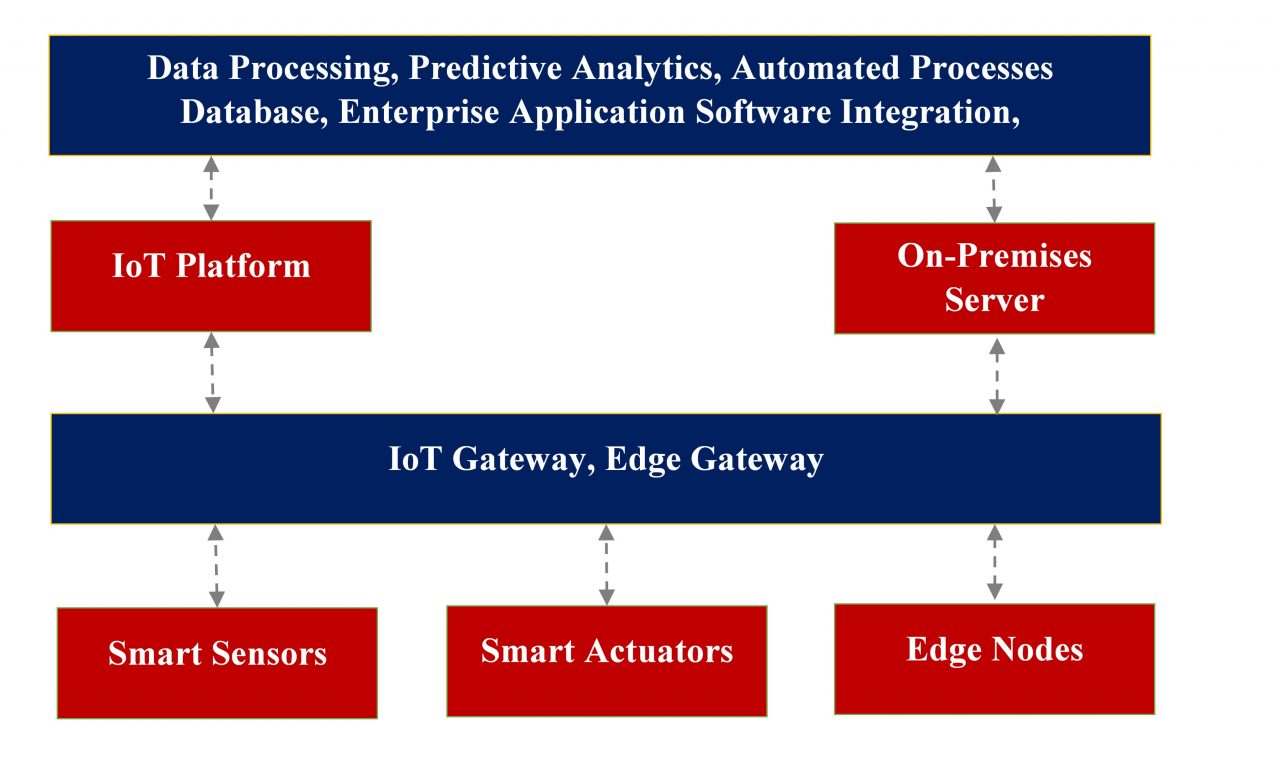
The diagram above illustrates how a typical IIoT ecosystem works. The connected intelligent and edge devices transmit raw plant data directly to the data communication infrastructures, where it is processed and converted into practical information detailing how a specific industrial machinery is operating. The information can then be used to optimize various industrial processes and for predictive maintenance.
Technologies that Enable Use of Industrial IoT in Manufacturing
For an Industrial Internet of Things network to be effective in a manufacturing facility, it must ensure that the connected intelligent devices and assets interconnect with each other and to a central data center like an ERP system. It also must ensure that the data collected and transmitted by the interconnected IIoT devices are well managed, analyzed, stored, and put to good use. To accomplish that, IIoT ecosystems depend on the following technologies:
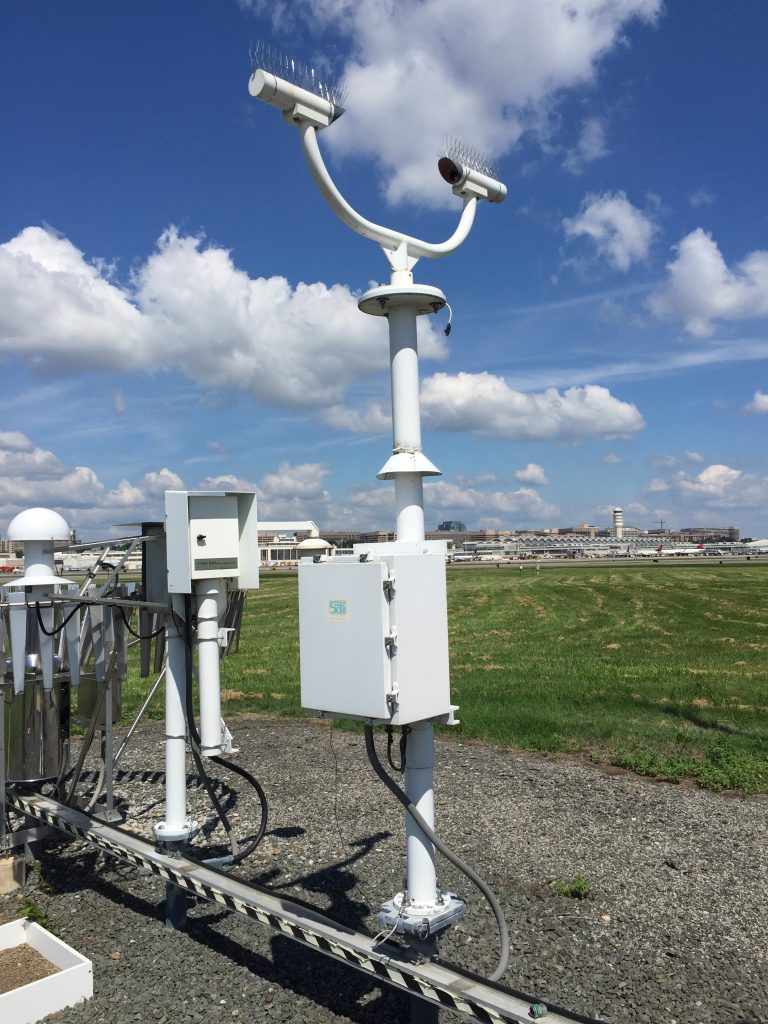
IIoT Sensor Technology: Today, smart sensors are typically embedded into new industrial machinery and manufacturing equipment. But IoT gateway devices such as gauges and cameras can also be fitted in legacy industrial equipment and machinery to allow IIoT connectivity. This lets the connected IIoT devices and assets detect conditions in their working environment like temperature, pressure, or humidity levels, as well as various mechanical conditions such as motor speed, flow rates, fluid levels, output torque, etc. All this data can then be transmitted to a centralized data system via cloud platforms for advanced analytics or processed locally to inform real-time control actions.
Wi-Fi and 5G Connectivity: IIoT networks require a large bandwidth capacity to transmit massive volumes of data generated by manufacturing equipment/machinery and connected IIoT devices. In the past, this has been both enabled and limited by the signal transmission strength of Wi-Fi connectivity.
However, advanced cellular networks like 5G networks are rapidly increasing the bandwidth of IIoT networks to manage “Big Data”, while also reducing network latency and power consumption. As a result, 5G-enabled IIoT networks can support a greater number of smart devices with the ability to send and receive data signals faster for longer battery life and more efficient data processing speeds.
Cloud and Edge Computing Technologies: These computing technologies have greatly enhanced the usability and flexibility of IIoT in manufacturing applications. For example, IIoT networks can leverage the high degree of storage capacity and processing power of cloud computing platforms to meet the demands of critical industrial operations.
Thus, any smart device within such an IIoT network can collect and transmit bigger and more complex data sets. While edge computing focuses on bringing systems that can readily process and analyze that data closer to the IIoT network–bringing them on-premises. This helps reduce IIoT network latency and data transmission delays, allowing the processing of time sensitive IIoT data in real-time.
Artificial Intelligence and Machine Learning: AI and ML technologies make it possible for manufacturing enterprises to process collected IIoT data using advanced and predictive (prescriptive) data analytics. In addition, modern AI-powered databases and Machine Learning algorithms also help manufacturers to manage and make sense of complex, unstructured, and diverse data sets.
Advanced Cybersecurity Standards and Protocols: While most manufacturing industries have strong cyber security measures and tight access protocols around their central control systems and databases, interconnected IIoT devices are at times relatively unprotected. In such cases, the IIoT devices can overexpose a reasonably secure industrial system to more cybersecurity threats. Fortunately, modern-day cybersecurity technologies and protocols are largely keeping pace with the current IoT advancements to fully secure IIoT networks.
Applications of Industrial IoT in Manufacturing
The replacement of human operators by connected IIoT devices in most production processes is completely transforming the face of the manufacturing industry. In a nutshell, the Industrial Internet of Things (IIoT) technology provides manufacturers with new levels of process visibility, control, and numerous production insights.
Let’s take a look at the top use cases of industrial IoT in manufacturing.
Streamlining Production
IIoT connectivity allows manufacturers to access operational data in real-time, enabling them to easily identify production trends and areas of improvement. It also allows real-time monitoring of ongoing production processes while providing critical metrics and insights. This enables timely resolution of production-related issues, automated auditing, and replication of production processes for automated batch production.
Ultimately, real-time monitoring of production processes helps manufacturers to fix operational problems before they occur, which speeds up production and prevents unplanned machine downtimes. Also, IoT-enabled manufacturing machinery and equipment can communicate with each other, allowing for well-coordinated and more streamlined manufacturing processes.
In addition, IIoT connects manufacturing equipment and machines wirelessly to the Internet via Wi-Fi networking or using cellular networks like 5G. This allows remote configuration, monitoring, and control of IIoT-enabled machines and equipment, as well as remote monitoring of production processes. In so doing, intelligent devices connected to IIoT networks and digitally controlled manufacturing equipment can allow production lines to be operated fully remotely. Nonetheless, many manufacturers prefer a more hybrid approach, whereby some sections of a production line are fully automated and/or remotely controlled, while the other sections are semi-automated and manually operated by human workers.
Predictive Maintenance
Predictive maintenance is a proactive maintenance strategy that helps manufacturers to identify and resolve potential operational problems to avoid equipment failures and down-times. For many years, manufacturers have been employing condition-based and time-based approaches to prepare the maintenance schedules of their equipment and machinery. This has often resulted in random equipment failures and unplanned production down-times.
To avoid such ineffective maintenance routines, manufacturers can leverage industrial IoT and data science technologies for predictive maintenance. For example, embedded IoT-enabled sensors in manufacturing equipment can detect any operational malfunctions and alert responsible maintenance technicians to the deteriorating condition of the equipment for further diagnosis and troubleshooting. These sensors calculate the vibration levels, displacement, acceleration, and sound frequencies of the equipment, and they also precisely measure the surrounding temperature, humidity, pressure, etc. to detect if the equipment is operating under normal conditions. Also, integrating IIoT-connected devices with advanced analytics software in manufacturing processes can help anticipate when technical support is required.
Optimizing Quality Control
Effective quality management involves monitoring a vast array of processes and machine parameters influencing product quality. Generally, process reliability and product quality depend on optimal control of various parameters such as the operating temperature, air quality, particulate matter, pressure, and humidity. In the past, quality management in manufacturing facilities was done manually and was often prone to human error. But with the advent of the industrial IoT, manufacturers are now able to track the aforementioned quality parameters with greater accuracy.
IIoT-connected sensors do help collect complete product data through the different stages of a product development cycle. These sensors can also test products at each manufacturing step to determine if their attributes are within the specified quality standards or if they will require reworking. In addition, IIoT-enabled instrumentation and monitoring of manufacturing equipment allow quality assurance (QA) teams to check if and where equipment calibration and configuration diverge from standard settings. This can enable the QA personnel to detect product quality problems at the source and provide measures for improvement in time.
Facilitating Industrial Asset Management
Management of raw materials, manufacturing equipment, and products in a manufacturing facility can be very cumbersome due to changing demands, increasing complexity, and rising costs. However, by using IIoT-connected devices, manufacturers can easily obtain and monitor real-time information regarding all their assets via mobile or web applications. IIoT-based asset management may include:
- Tracking items in warehouses–inventory management
- Monitoring resources during a manufacturing process
- Tracking vehicles delivering raw materials or finished products–fleet management
Thus, by utilizing IIoT connectivity manufacturers can track and optimize their assets at all stages of manufacturing, from the raw material supply chains to the product delivery. Proper asset monitoring and management help in the quick identification and efficient resolution of logistics issues that can adversely affect product quality or time-to-market.
Digital Twins Creation
Digital twins refer to virtual models designed to accurately replicate physical objects, processes, or environments in the real world, and their application in manufacturing facilities can be very useful. The digital twin technology is made possible by the Internet of Things, Machine Learning, Artificial Intelligence, and cloud computing technologies.
With virtual replicas of manufacturing equipment and spare parts, industrial engineers can simulate numerous production processes, conduct experiments, discover performance bottlenecks, and achieve the needed production results without risking or damaging physical assets. Also, digital twins provide an all-inclusive look across an entire production line while it is still in operation for a much better review of its efficiency and performance. For example, if your raw material feeder is slow, a review of the production line’s digital twin could reveal an inefficiency with the material handling equipment.
Benefits of Using IoT in Manufacturing
Improved Decision-Making
IoT-enabled sensors embedded in manufacturing equipment and machinery can monitor equipment/machine performance on a constant basis and gather valuable data. They can then distribute the collected data through robust IIoT networks in real-time. This fast flow of information throughout a manufacturing facility does facilitate data-driven decisions regarding all production functions.
Also, with IoT technology manufacturers are able to gain accurate data-driven insights into the operational performance of individual parts of machines/equipment as well as entire fleets, which results in better-informed and faster decision-making.
Cost Reduction
The most notable expenses that manufacturing companies incur are raw materials, energy, and production losses resulting from downtime. IoT solutions make it possible for manufacturers to automate their production processes, which results in a significant reduction in operational costs.
In addition, IIoT-connected sensors enable predictive maintenance which helps to considerably minimize unplanned machine downtime. These sensors also allow for optimized inventory and asset management, eliminating many possible logistics issues and unnecessary expenses all while improving material handling times for optimized processing efficiency.
Improved Safety
Implementing IoT-enabled sensors in fully functioning IIoT-networked manufacturing operations can help monitor employee and workplace safety. In summary, IoT technology makes it possible to:
- Monitor the physical health of factory employees through wearable IoT solutions.
- Detect risky manufacturing operations that can result in equipment damage or operator injuries.
- Create a safer workplace, by addressing safety problems in potentially hazardous working environments.
- Promptly respond whenever accidents occur on the manufacturing floor.
- Eliminate many workplace accidents by leveraging the data gathered by IIoT-connected sensors.
For example, IoT-enabled NDIR (Non-dispersive infrared) sensors can detect gas leakages and alert the responsible personnel, helping to prevent unsafe workplace conditions and reduce the number of accidents in the manufacturing facility.
Shorter Time-to-Market
Industrial IoT technology gives manufacturing stakeholders the ability to automate and streamline their functions, and therefore achieve greater operational efficiencies which allow for faster and more efficient production processes.
IoT solutions also empower direct communications between factory workers and IIoT network components, enabling real-time access to plant data. This contributes to faster decision-making and improved response to product market fluctuations. As a result, new products can quickly move from design conceptualization to commercialization, allowing for shorter product cycle times. Moreover, IoT technology also provides better insights into supply chain operations, and it improves response time to any form of disruptions.
Reduced Errors
By utilizing industrial IoT solutions manufacturers can digitize nearly every part of their enterprise. This helps reduce manual production operations and entries, thereby eliminating risks of human error – which goes beyond manufacturing and operational errors. As IIoT solutions, such as Machine Learning and AI-enabled programs and machinery, can also reduce the risks of data breaches and cybersecurity caused by human error.
Improved Customer Satisfaction
Great product quality is often the decisive factor that determines the purchasing behavior of potential customers and converts more prospects into loyal customers. IIoT solutions provide manufacturers with predictive maintenance tools and real-time statistical evaluations that help innovate, design, build, maintain, and operate manufacturing facilities more efficiently, resulting in improved quality of end products.
Additionally, IIoT-connected devices in manufacturing eliminate risks of human error and prevent defective products from reaching the market, which remarkably enhances customer satisfaction.
Challenges of Adopting IoT in Manufacturing
The increased accessibility of Industrial Internet of Things solutions presents manufacturers with great opportunities to minimize supply chain disruptions, streamline manufacturing processes, remotely access, and monitor plant data in real-time, and ultimately generate more revenue. However, some manufacturers are still holding back from implementing IIoT technologies in their facilities. What could be the reason behind that? Here are some of the significant challenges associated with the adoption of industrial IoT in manufacturing.
Cybersecurity Concerns
Cybersecurity remains the most significant concern for IoT-connected devices as data is transmitted between numerous network nodes and can be highly vulnerable to cyber-attacks without proper security measures. Today, the exponential growth of IIoT-connected devices in smart manufacturing factories is creating an expanded surface for hacking attacks.
Therefore, manufacturers who are planning to adopt IoT technologies in their facilities should also implement sophisticated cyber-attack prevention measures to avoid data loss, disruption of production processes, theft of intellectual property, comprising employee safety, or other intrusions on the manufacturing floor. Also, legacy manufacturing equipment that incorporates IoT technology should be equipped with modern cybersecurity protocols and defensive tools.
Seamless Integration
Seamlessly incorporating new IoT-enabled devices into an extensive manufacturing infrastructure that’s already set up can be very challenging. Also, providing suitable networking capabilities for IIoT-connected devices can be difficult. To address these problems and achieve seamless integration, manufacturers should consider using intelligent IoT solutions, such as Machine Learning, Artificial Intelligence, digital twins, 5G connectivity, or Augmented Reality.
Regulatory Compliance
The framework of regulations and policies governing IoT-enabled devices can be particularly challenging for most manufacturing stakeholders, and this issue is likely to continue as more and more smart devices and production processes are integrated into IIoT networks. Hence, it’s important for manufacturers to map each IIoT-connected device to the correct regulations to meet the specified regulatory requirements and maintain the required cybersecurity standards.
Skills Gap
Implementation of modern IoT technologies in manufacturing requires qualified IoT specialists and data scientists who understand the new IIoT-based production processes and can manage them. However, with the increasing number of smart manufacturing factories, the skills gap among factory workers is continually growing wider.
Also, it can be difficult for manufacturing industry executives to leverage the capabilities of IoT-enabled sensor technology and make data-driven decisions due to their lack of IoT knowledge and competency. It will therefore be necessary for manufacturing enterprises to implement regular training sessions on the Industrial Internet of Things and other related technologies to address the skills gap problem.
DO Supply Inc. makes no representations as to the completeness, validity, correctness, suitability, or accuracy of any information on this website and will not be liable for any delays, omissions, or errors in this information or any losses, injuries, or damages arising from its display or use. All the information on this website is provided on an "as-is" basis. It is the reader's responsibility to verify their own facts.