How AC Drives Reduce Energy Costs in Industrial Systems
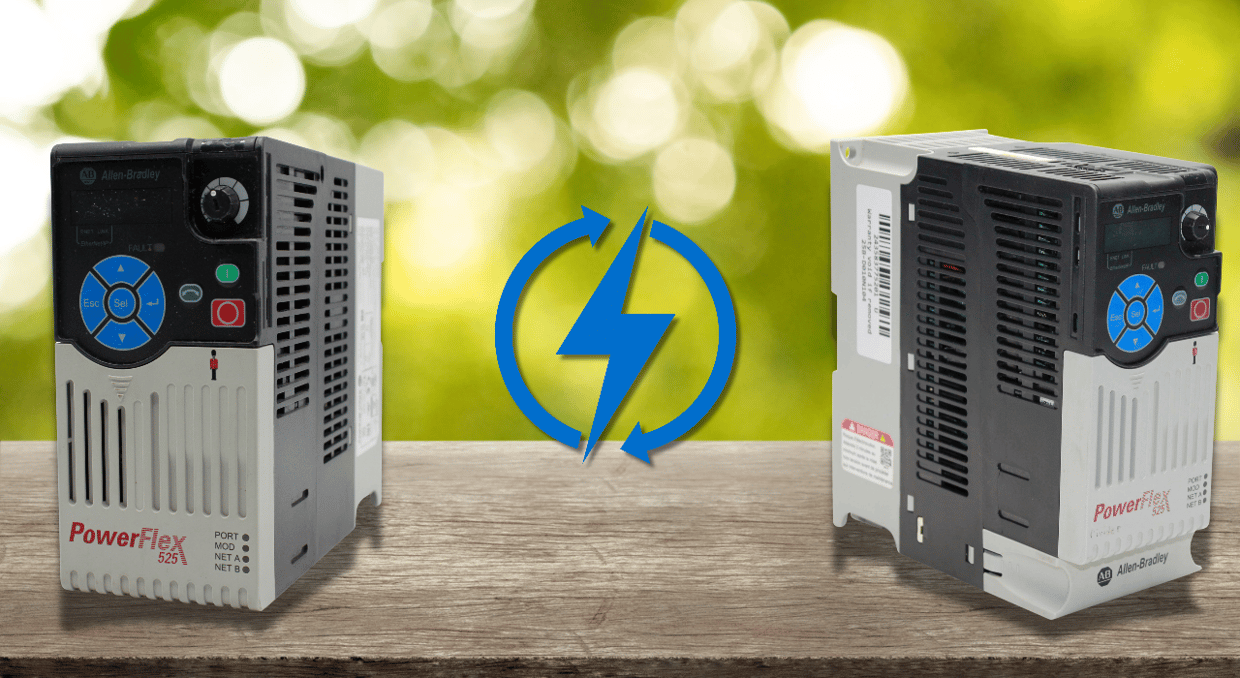
The invention of the variable frequency drive has forever shifted the tide of industrial automation for the better. It introduced a new way to control a motor by varying the AC power frequency fed into it; the higher the supplied frequency, the faster the motor spins. This same concept has been refined over years of real-world data to produce today’s modern AC drives.
While AC drives are chosen for superior motor control performance, they also offer a faster ROI through energy savings, giving users a win-win scenario. While we would like to tell you that plugging an AC drive into your system will cut electricity costs by half, the truth is more nuanced.
The Scale of Electric Motor Energy Consumption
Electric motors are everywhere you look. Check outside your window, and your AC unit has an electric motor. The product conveyors at your local market’s checkout line run on electric motors. Step into an industrial setting and you may spot a centrifuge, large cooling fans, pumps transferring beverages, a conveyor moving product, or even robotic arms sorting boxes for palletization. In fact, a 2020 International Energy Agency analysis shows just how much electricity motor-driven systems can consume across different industrial subsectors. Plastics and rubber were the highest, at about 25%, followed by machinery at roughly 19%, while food, beverage, and tobacco came in at about 17%.
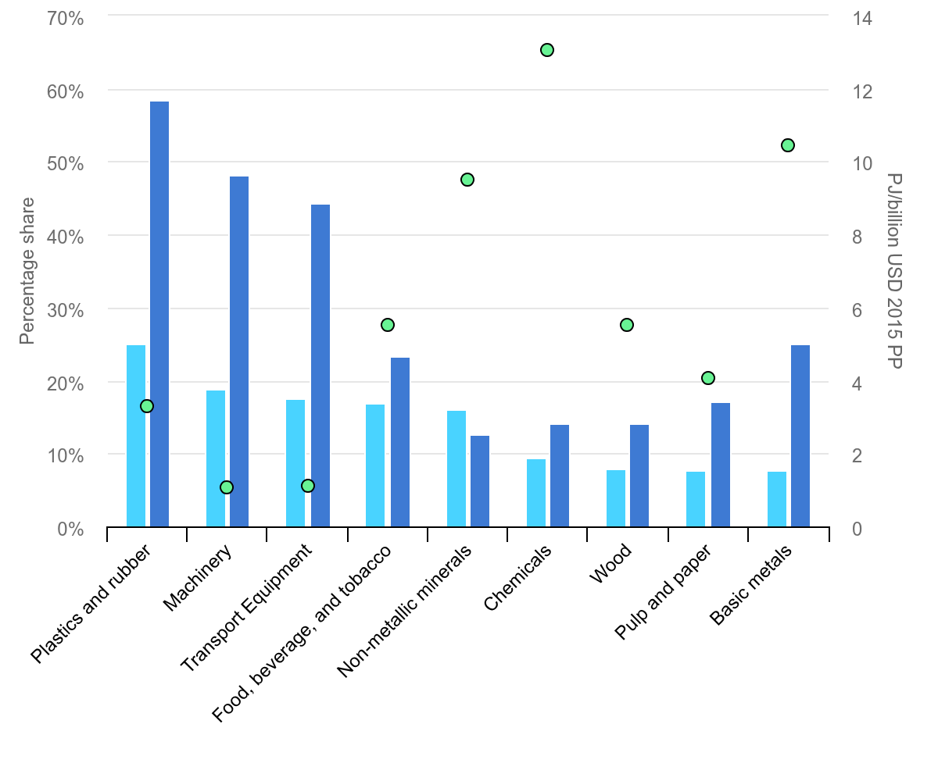
Keep in mind that this research accounts for motor-driven systems as a whole, not just motors controlled by AC drives. Because of this, the energy a facility can save by installing AC drives depends heavily on how its motors are currently controlled and what loads they drive.
Why Motor Control Applications Need to be Optimized
When applications such as pumps and fans are driven by motors using across-the-line starters or soft starters, they’re ran at full power all the time. Artificial means of slowing output, such as throttle valves to drop pressure or dampers to block airflow, are used to tune the desired amount of output from the system.
This creates an obvious inefficiency in the system, as the system reduces the work output already generated by the fan or pump because the motor can’t be slowed down to match the desired output rate. So while the energy reports look fine, as the motors are drawing normal current, power is still being wasted since the excess is artificially burned off in the system.
Affinity Laws and Removing System Inefficiencies
Let’s create a realistic scenario: a beverage company uses a motor constantly at 100% power to drive a pump that pushes its liquid product through a throttling valve that reduces flow by 20% to stay within system bottling limits. When introducing a variable AC drive to the system, a dynamic occurs that compounds energy savings.
At first, the AC drive will eliminate the need for the throttle valve by reducing motor speed by 20% instead. This meets the system’s specifications while theoretically becoming 20% more efficient. Or so it may seem on paper. In reality, the savings are much greater due to the affinity laws.
The affinity laws are a set of mathematical relationships that predict how changes in a pump’s diameter or speed affect performance, and in this instance, how speed relates to efficiency.
The affinity laws describe how changes in pump speed affect flow, pressure, and power:
- Flow changes directly with speed
- Pressure or head changes with the square of speed
- Power changes with the cube of speed
Using our example, P2/P1 = (N2/N1)^3. If the pump speed is reduced to 80% of its original speed. P2/P1 = (0.80)^3, P2/P1 = (0.512), P2 = 0.512P1.
In theory, the pump now requires only about 51% of the original power, representing roughly a 49% reduction in power demand rather than the 20% we originally estimated. If we lower the speed even more, to, let’s say, 50%, the pump will only require 12.5% of the original power.
Soft Starting Capabilities
Soft starters are commonly used in industrial automation settings to reduce the amount of inrush current a system sees when a traditional across-the-line motor kicks on. For variable AC drives, this same benefit comes built into the motor control process.
Rather than immediately applying full line frequency and voltage, the drive gradually ramps the motor up to its commanded speed. This reduces the sudden current spike seen during startup and lowers the mechanical stress on belts, couplings, gearboxes, pumps, and anything else connected to the motor.
Now, soft starting itself is not where most of the energy savings come from. A motor may spend only a few seconds accelerating before running for hours at a time, so reducing startup current won’t suddenly cut a facility’s electric bill in half. The bigger benefit comes from reducing electrical demand, mechanical shock, and wear on the system over time. For applications that frequently start and stop, these savings can begin to add up much faster.
Power Quality and Harmonic Mitigation
One downside to AC drives and energy savings is power quality. A traditional six-pulse AC drive does not draw current from the incoming power source as a perfect sine wave. Instead, it pulls current in pulses as the drive charges its internal DC bus. This creates harmonics that can feed back into the electrical system.
If harmonic distortion becomes excessive, it can cause additional heating in transformers, cables, and other electrical equipment, and create problems for more sensitive devices connected to the same power system. So while an AC drive may be saving a considerable amount of energy at the motor, a poorly designed installation can create inefficiencies elsewhere in the system. We also have an article going over harmonics, which you can find here.
Reducing Harmonics
Thankfully, several manufacturers address this in their AC drive designs and provide components to help mitigate it. Line reactors, DC-link chokes, harmonic filters, multipulse rectifiers, and active harmonic filters can all reduce the amount of distortion sent back onto the line.
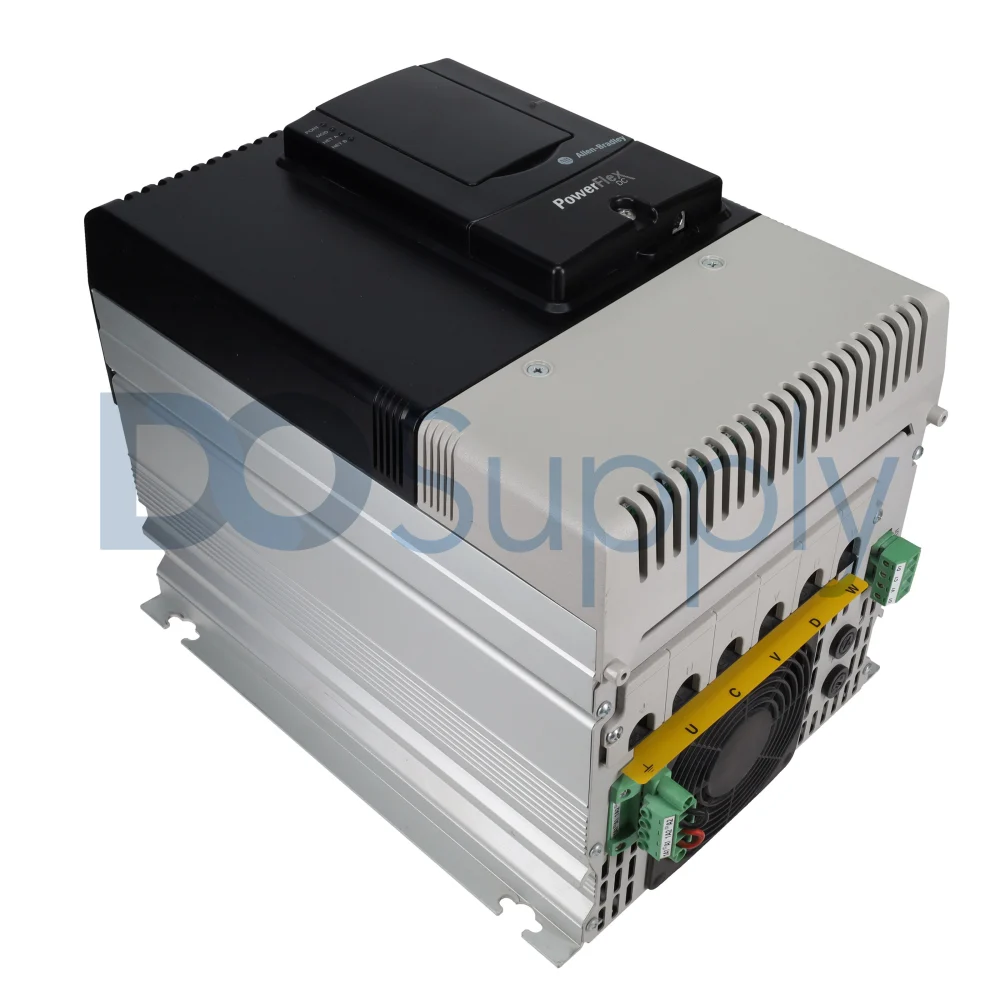
Design-wise, more advanced drives may instead use what is known as an active front end, or AFE, like the (discontinued) PowerFlex 700AFE. Rather than using a traditional diode rectifier on the drive’s input side, an AFE actively controls how it draws current from the incoming AC source. This lets the drive significantly reduce harmonic distortion while keeping the power factor much closer to unity.
Regenerative Energy Savings
On the topic of active front-end AC drives, their design usually pairs nicely with regenerative functionality, adding even more energy savings for specific applications. Normally, electrical energy flows from the AC drive into the motor, causing the motor to spin and perform work. However, in certain situations, the motor can do the opposite and start producing electrical energy.
Let’s say we have a large centrifuge spinning at full speed. A significant amount of energy is stored in that rotating mass, and when it’s time to slow the centrifuge down, that energy has to go somewhere. When connected to an AC drive with regenerative capabilities, that rotational energy can transfer back into the motor, causing it to briefly work as a generator. That excess power can be converted from mechanical energy to electrical energy and sent into the drive’s DC bus to be used by other drives in a shared DC bus system, or diverted back into the grid.
This can be achieved in many different applications, such as:
- Cranes and hoists
- Elevators
- Centrifuges
- Conveyors with declining loads
- Test stands
- Winders and unwinders
- Large machines with high rotating inertia
The key point is that regeneration provides meaningful savings only when there is energy available to recover. Installing a regenerative drive on an application that rarely decelerates or overhauls its motor won’t provide much benefit. We also have another article going over the differences between regenerative and non-regenerative drives here.
Final Thoughts
Ultimately, how much energy an AC drive can save depends almost entirely on the application it controls. When installed in an application that already operates at full speed and full load all day, it will actually cost money due to a ~3% efficiency loss. On the other hand, take that same drive and install it on a centrifugal pump that spends most of its time with its output throttled down, and the affinity laws can produce a substantial reduction in power demand.
Other factors to consider include how often the motor starts and stops, whether the load frequently regenerates energy, how many hours the system operates each day, and how much electricity costs at that facility.
So while we can’t give a blanket estimate of how much you can save by installing X amount of AC drives in your system, we can help you find the right AC drive to install. We at DO Supply are a trusted supplier of industrial automation equipment, including both regenerative and non-regenerative AC drives from brands you can trust. We also carry supporting accessories and add-ons, such as communication cards and matching PLCs. Call us today, and we can help your facility save money with the right AC drive.
DO Supply Inc. makes no representations as to the completeness, validity, correctness, suitability, or accuracy of any information on this website and will not be liable for any delays, omissions, or errors in this information or any losses, injuries, or damages arising from its display or use. All the information on this website is provided on an "as-is" basis. It is the reader's responsibility to verify their own facts.