Omron CJ2 vs Mitsubishi FX
The choice of a programmable logic controller (PLC) can be critical in today’s changing industrial automation environment, affecting the efficacy and efficiency of automation solutions in various sectors. Omron’s CJ2 and Mitsubishi’s FX series are two major PLC competitors that have established themselves as reliable answers for different automation requirements. In this article, We will thoroughly tour the technical specifications of Omron CJ2 and Mitsubishi FX PLCs. We strive to give a detailed and data-driven comparison by diving deeply into their capabilities and working scenarios, enabling us to understand how their properties are different or similar. Here, we will discuss their operating voltage, operational and rated currents, communication protocols, compatibility with other devices, operating temperature, humidity, processing speed, storage, dimensions, display functions, certifications, cyber security features, and programming languages.
Voltage Requirement:
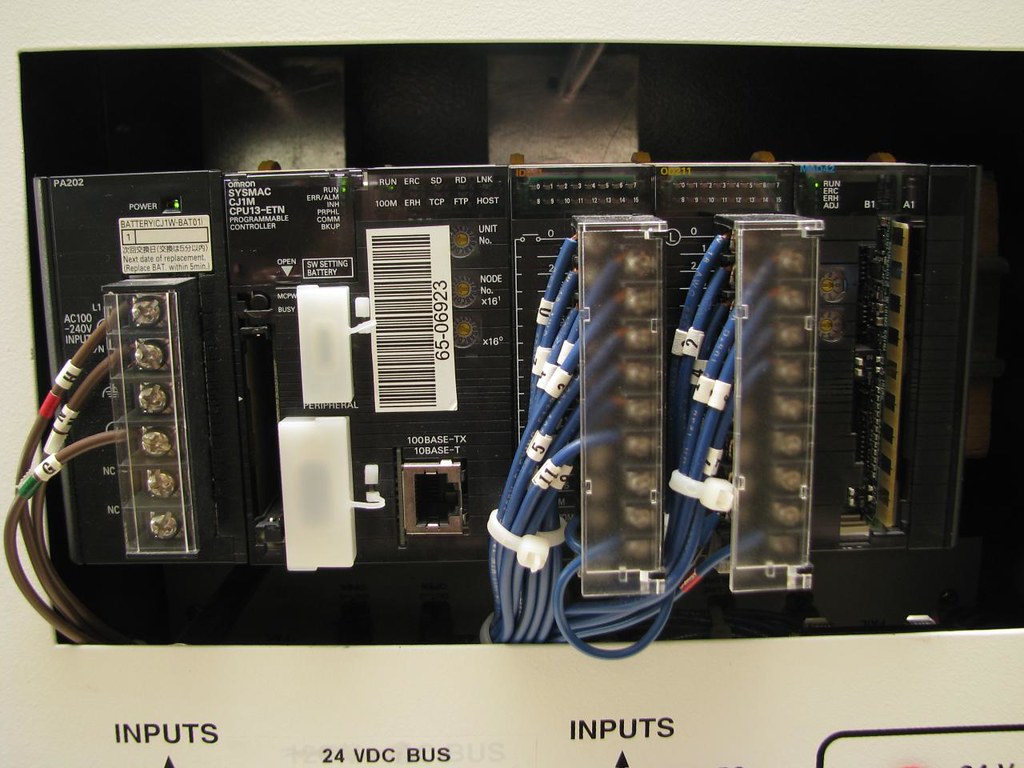
The CJ2 family of PLCs from Omron are renowned for their flexibility in supporting various application needs and voltage requirements. The standard CPUs of this series and modules often offer a wide range of voltage options, with popular choices including 100-240V AC (120 Vac, 208 Vac, 220 Vac, and 230 Vac), making them appropriate for various industrial settings. Additionally, some modules and CPUs, like the Omron CJ2M-CPU3#, run on 24V DC power and provide a balanced mix of processing power and voltage compatibility for specific applications with low-voltage DC power sources. Similarly, the standard CPUs and modules of the Mitsubishi FX series also run on a 100-240V AC power supply range. Furthermore, the Mitsubishi FX series offers modules like the FX3U-32DP-IF, designed for seamless integration into applications where a 24V DC power source is readily available for applications with specific voltage requirements, such as those utilizing the same power source.
Operational and Rated Current:
The operational and rated currents of the Omron CJ2 Series and Mitsubishi FX Series PLCs are different. The operating current of Omron CJ2 Series PLCs typically ranges from 0.2 to 0.7 amps, whereas the rated current of their modules might change depending on the particular module type and configuration. For instance, the operational current of the CJ2M-CPU13 CPU unit is around 0.2A, and the rated current of its I/O ports is mainly in the range of 0.2-0.4A but mostly depends on the type of configurations in use. The CJ1W-ID261 Input Modules also have a rated input current of 7.5mA per point. In contrast, the operational current of Mitsubishi FX Series PLCs ranges from 0.2 to 1.0 amps, with the rated current capabilities of the modules varied depending on the kind and configuration of the modules. While the FX3U-32MT/ES Digital Output Module has a rated output current of 0.5A per point at 24V DC, the FX3U-48M CPU unit works with an operational current of about 0.6A at 100-240V AC. The FX3U-64MRES, a high-speed counter module from Mitsubishi, has a rated current of 0.65A. To guarantee the efficient operation of industrial automation applications, choosing suitable modules with the proper current ratings is essential.
Communication Protocols and Compatibility:
The CJ2 Series PLCs from Omron are incredibly adaptable for sophisticated automation systems because they provide a wide range of communication possibilities. They are compatible with various industrial equipment and networks because of their compatibility with several communication protocols, including Ethernet/IP, Modbus RTU/TCP, EtherCAT, DeviceNet, and Profinet. These PLCs excel in compatibility, seamlessly integrating with a variety of gadgets from Omron’s portfolio and those made by other companies. They are a popular option for various industrial applications due to their versatility. The CJ2 Series Ethernet/IP Module (CJ2M-CPU3-EIP) and CJ2 Series Profinet Module (CJ2M-CPU31-EIP) are two examples of communication modules that emphasize their potential to simplify communication and increase interoperability with diverse industrial equipment.
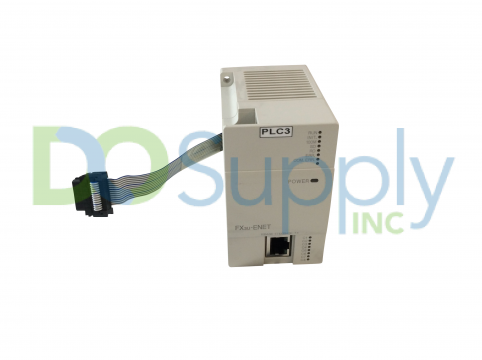
Although dependable, Mitsubishi’s FX Series PLCs focus on core standards and have fewer communication protocols. Modbus RTU, RS-232, RS-485, CC-Link, and, in specific devices, Modbus TCP/IP are among the supported protocols. For instance, Mitsubishi FX Series PLCs support RS-232, RS-485, CC-Link, and Modbus RTU through the FX3U-485ADP-MB module, FX3U-232ADP-MB module, and FX3U-485-BD module, respectively. Additionally, several FX Series PLC models may be set up for Modbus TCP/IP communication, boosting connection with appropriate hardware and networks using modules like the FX3U-ENET-ADP-MB, making them adaptable for various industrial applications. These PLCs are a top choice for Mitsubishi-centric automation systems due to their high interoperability with the company’s unique products, including servo motors, inverters, and HMI panels.
Operating Temperature and Humidity:
Omron CJ2 Series PLCs are suited for a variety of industrial situations since they are designed to function efficiently throughout a wide temperature range, often ranging from 0°C to 55°C (32°F to 131°F). If condensation is prevented, these sturdy PLCs can operate in environments with relative humidity levels ranging from 10% to 95%. Notably, Omron enhances its capability with specialized modules like the CJ2 Temperature Regulate Module, illustrated by the CJ2M-CPU3A, which allows users to regulate operations requiring precise temperature control while observing the designated operating temperature range. In contrast, the Mitsubishi FX Series PLCs offer a relative humidity range of around 5% to 95%, with the provision of non-condensing situations, and maintain identical working temperature standards, generally extending from 0°C to 55°C (32°F to 131°F). The FX series offers modules like the FX3U-4DA-ADP, an analog output module designed for managing various processes and further aligned with the prescribed temperature and humidity requirements to help control these environmental constraints.
Processing Speed and Storage:
The processing speeds available from the Omron CJ2 Series PLCs vary depending on the CPU unit used. High-performance iterations may execute instructions astoundingly quickly, frequently within the range of nanoseconds or low microseconds for each step. In contrast, basic models give processing rates within the range of microseconds per instruction. For instance, the CJ2M-CPU34 CPU unit, which serves applications needing swift and accurate control, has a remarkable execution time of around 0.04 microseconds per basic instruction. Additionally flexible, the CJ2 Series’ storage memory capacity varies depending on the CPU arrangement and memory setup. These PLCs generally have memory capacities between 5K and 256K words, allowing for substantial program and data storage. Furthermore, the CJ2 SD Memory Card Module (CJ2M-MD261) equips users to use SD memory cards, whose storage sizes generally range from 1GB to 32GB, boosting data management and storage capabilities for various industrial applications.
With processing rates ranging from milliseconds to low microseconds per basic command, Mitsubishi FX Series PLCs are ideally suited for a wide range of industrial applications. This enables them to provide accurate and effective control. For instance, the FX3U series features execution rates per basic instruction of about 0.065 milliseconds, ensuring quick response in various automated activities. The FX Series has memory capacities ranging from 2K words to 64K words for program and data storage, meeting program complexity and data requirements. The storage memory capacity varies based on the exact model and setup. Additionally, with supported SD card sizes ranging from 512MB to 8GB, the FX3U SD Memory Card Module (FX3U-FLROM-16) enhances data storage and management capabilities. The capabilities of the FX Series are enhanced by this module, which meets the demands of applications that call for data storage and analysis in commercial environments.
Dimensions and Display Functions:
Omron CJ2 Series PLCs are available in various sizes, allowing for small and large base units to accommodate multiple application needs. Depending on the particular CPU unit and extension modules put into the system, these PLCs’ size can change. The CJ2M-CPU3A CPU unit, for example, has manageable proportions, measuring around 90mm (W) x 80mm (H) x 75mm (D). Moreover, the Dimensions of the CJ2 Analog Output Module (CJ2W-AD081-V1) are around 37mm (W) x 90mm (H) x 75mm (D). With dimensions of roughly 90mm (W) x 80mm (H) x 75mm (D), the CJ2 Position Control Unit (CJ2H- CPU66-EIP) can be smoothly incorporated into the PLC system for accurate motion control applications.CJ2 Series PLCs often have rudimentary display functionality, such as LED indicators and a tiny digital display. Omron provides modules like the CJ2 Display Modules, typified by the CJ2M-MD211, which contribute to more extensive and detailed displays, providing improved monitoring and diagnostics to improve display capabilities.
Mitsubishi FX Series PLCs’ small and space-saving design makes them adaptable for use in various industrial environments. The FX3U-16MR/ES CPU unit, for instance, has dimensions that are around 100mm (W) x 90mm (H) x 75mm (D), reflecting the series’ tiny form factor. Dimensions may vary somewhat across various versions. The PLCs in this series typically have simple LED indicators for system status updates. However, some versions also have a tiny digital display for monitoring and diagnostics, giving users access to critical data about the PLC’s performance. Mitsubishi provides FX Series HMI panels, such as the GT2104-RTBD type, that can be easily linked with FX Series PLCs to give improved visual monitoring and control capabilities. This increases the series’ adaptability to fulfill various industrial automation requirements.
Certifications and Compliance:
PLCs from the Omron CJ2 Series are built to adhere to several international certifications and requirements for quality, safety, and environmental compliance. These certifications are UL (Underwriters Laboratories) for safety, RoHS (Restriction of Hazardous Substances) compliance for environmental responsibility, or CE (Conformité Européene) for compliance with European safety requirements.
The Mitsubishi FX Series PLCs are similarly made to fulfill various international safety and quality certification criteria. To guarantee that the items meet safety requirements, these might include CE certification for European markets and UL certification for American markets. Mitsubishi prioritizes adherence to the WEEE (Waste Electrical and Electronic Equipment) and RoHS guidelines for environmental responsibility.
Cyber Security Features:
With sophisticated features, including user authentication, role-based access control, password protection, data encryption, and compatibility for secure communication protocols, the Omron CJ2 Series is renowned for its strong cybersecurity safeguards. These features are intended to increase the security of industrial control systems and defend them from outside intrusion and online dangers. For instance, the CJ2 protection Controller Unit (CJ2M-CPU31-EIP) adds a layer of protection, making it ideal for applications with strict cybersecurity needs. This level of protection is essential, particularly in sectors where data integrity and system dependability are critical. On the other hand, the Mitsubishi FX Series PLCs also emphasize cybersecurity with elements like password protection and access restrictions. The FX Series might not provide the same level of sophisticated cybersecurity capabilities as the CJ2 Series, even though these characteristics help increase control systems’ overall security. However, the Mitsubishi FX Series’ FX3U Security Adapter Module (FX3U-485-BD) has adequate cybersecurity capabilities.
Programming Languages:
Ladder Logic (LD), Structured Text (ST), Function Block Diagram (FBD), and Sequential Function Chart (SFC) are supported by both the Mitsubishi FX series and the Omron CJ2 series. For instance, the CJ2 Position Control Unit (CJ2H-CPU65-EIP) enables accurate motion control programmable using Structured Text, while the CJ2 Digital Input Module (CJ1W-ID211) enables digital input signal processing using Ladder Logic. The CJ2 Temperature Control Module (CJ2M-CPU3A) is configurable using Function Block Diagrams and excels in situations needing accurate temperature control. The CJ2 Communication Module (CJ2M-CPU3-EIP) enables Ethernet/IP communication with various industrial equipment. It is programmable using Structured Text (ST), whereas the CJ2 Analog Input Module (CJ2W-AD081-V1) supports analog input data acquisition using the Sequential Function Chart (SFC) language. For instance, the Ladder Diagram language offers digital output capabilities by the FX3U Digital Output Module (FX3U-16DT-ES). The FX3U Analog Output Module (FX3U-4DA-ADP) may be programmed using Structured Text and supports analog output. The FX3U High-Speed Counter Module (FX3U-4HSX-ADP) may be configured using a Function Block Diagram for high-speed counting applications.
Final Thoughts
In conclusion, the comparison between the Omron CJ2 Series and Mitsubishi FX Series PLCs highlights the significance of picking the appropriate programmable logic controller to satisfy the unique requirements of industrial automation applications. Both series demonstrate their advantages and versatility, giving them solid options in the market. While Mitsubishi’s FX Series adheres to normal 100-240V AC power and offers particular modules for 24V DC applications, Omron’s CJ2 Series provides fantastic flexibility in voltage needs, catering to various industrial environments. The two series’ different operating and rated currents highlight the significance of module selection for effective operation. With support for a wide range of protocols, Omron’s CJ2 Series excels in communication flexibility, boosting interoperability with various industrial equipment. Mitsubishi’s FX Series, on the other hand, focuses on fundamental communication protocols and distinguishes them from being compatible with their unique goods, such as servo motors and HMI panels. Both series are suitable for various industrial applications since they function successfully throughout a wide temperature range. In contrast to Mitsubishi’s FX Series, Omron’s CJ2 Series offers variable processing rates for a variety of industrial applications. Both series provide substantial memory and data storage possibilities. While Mitsubishi’s FX Series benefits from the FX3U SD Memory Card Module for data storage and analysis, Omron improves data storage with the CJ2 SD Memory Card Module. With specialized modules improving display capabilities, the size and display functions of the CJ2 Series offer versatility for diverse applications. In contrast, Mitsubishi’s FX Series offers a small, space-saving design appropriate for a range of industrial settings. Both series have received certifications and worldwide standards for environmental responsibility, quality, and safety. Omron’s CJ2 Series has several cybersecurity features that offer strong protection. In contrast, Mitsubishi’s FX Series concentrates on password protection and access limits for higher security. Both series’ support for a variety of programming languages satisfies a range of programming requirements, enabling them to meet the needs of varied applications. Ultimately, the choice between Omron’s CJ2 Series and Mitsubishi’s FX Series PLCs depends on the particular demands and preferences of industrial automation applications, and making an educated choice requires a thorough study of their technical characteristics.
DO Supply Inc. makes no representations as to the completeness, validity, correctness, suitability, or accuracy of any information on this website and will not be liable for any delays, omissions, or errors in this information or any losses, injuries, or damages arising from its display or use. All the information on this website is provided on an "as-is" basis. It is the reader's responsibility to verify their own facts.