How Environment Affects Soft Starter Performance
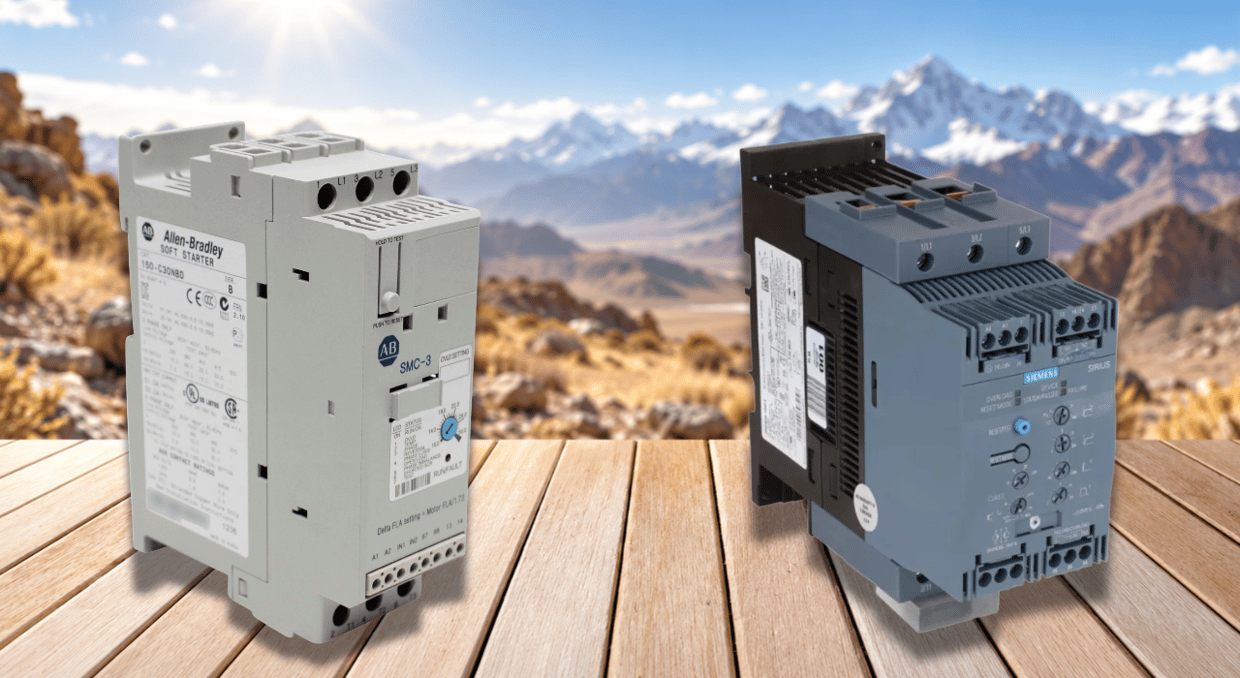
Every soft starter rating is based on a defined set of assumptions about ambient conditions, and those assumptions no longer hold once conditions change and the rated current can no longer be taken at face value. Specifying engineers and maintenance staff need to understand how ambient conditions interact with a soft starter’s thermal and dielectric limits in order to avoid nuisance trips, accelerated part wear, and outright failure. Manufacturer data from ABB, Siemens, Schneider Electric, and Rockwell Automation all point to the same underlying truth: a soft starter’s nameplate rating is a starting point, not a guarantee, once temperature, altitude, humidity, contamination, or vibration depart from standard test conditions. Understanding these factors is essential for correctly sizing and installing a soft starter in real-world operating environments.
Environmental Conditions Impact
A soft starter’s current rating is assessed at a reference temperature; typically, this is 40 degrees C. This figure reflects the temperature at which the internal SCRs and control electronics can carry rated current within their maximum temperature tolerance. Anything that limits the starter’s ability to shed heat, whether high ambient temperature, thinner atmosphere, or a poorly ventilated enclosure, raises the risk of exceeding that tolerance if current is not reduced accordingly. This relationship is critical when deciding where to install a soft starter, since ambient temperature and altitude relative to sea level both affect how much heat the unit can safely dissipate. The same relationship applies in dry, poorly regulated environments where neither temperature nor altitude is well controlled.
Ambient Temperature and Current Derating
Ambient temperature is the most direct environmental factor affecting soft starter output, since it narrows the margin between normal operation and the internal semiconductors’ maximum allowable temperature.
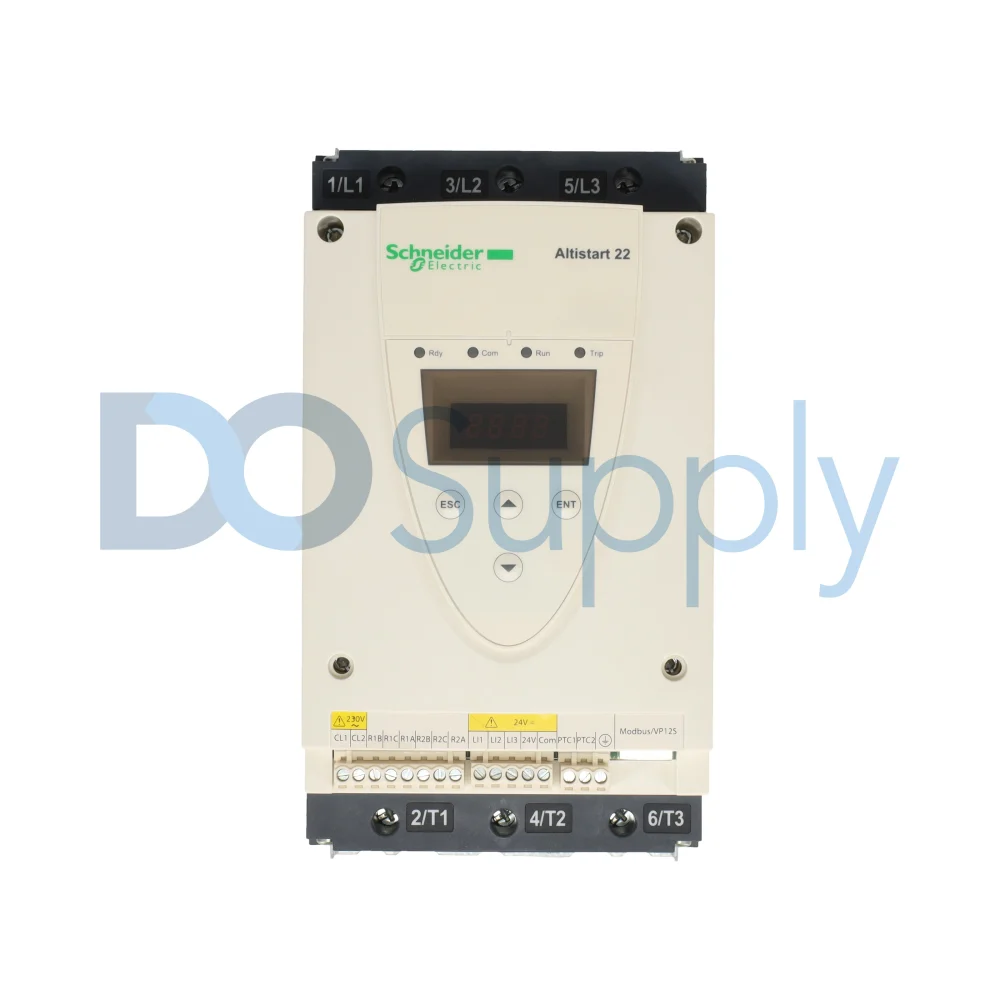
ABB PSTX
ABB’s PSTX documentation specifies that current must be derated once ambient temperature rises above 40°C, and again as altitude exceeds 1,000 meters. The PSTX documentation also warns against direct sunlight on the enclosure — a factor often overlooked, since ABB notes that enclosure heating from solar exposure and poor ventilation can raise internal temperature independently of the surrounding air.
Schneider Electric Altistart 22/48
Schneider Electric provides one of the clearest numerical illustrations of temperature derating. While the Altistart 22 is rated for installation at 40°C, current capacity must be derated by 2.2% for every degree Celsius above that, up to an average temperature of 60°C. This linear derating gives engineers a precise calculation method, rather than the vaguer guidance of simply “oversizing for the extra heat.”
Altitude: Cooling and Dielectric Strength
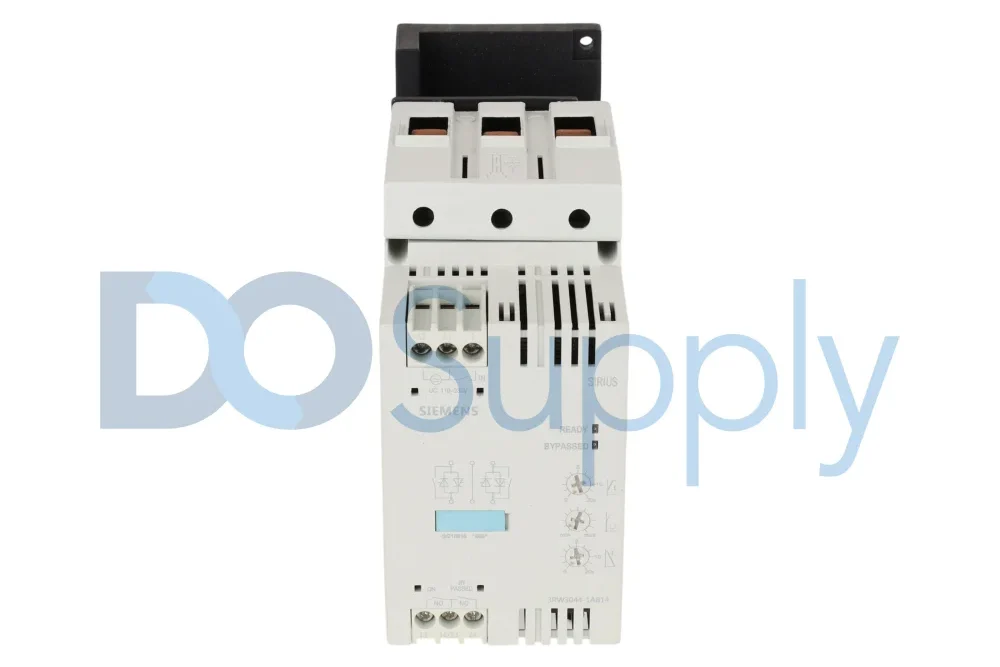
Siemens SIRIUS 3RW30/3RW40
Siemens guidelines for the SIRIUS 3RW30 and 3RW40 soft starters allow operation up to 1000 meters altitude without restriction, but require a current reduction once installation exceeds 1,000 meters above sea level because of reduced air density and lower cooling capacity. Siemens adds a separate condition unrelated to thermal derating: above 2,000 meters, rated output voltage must also be reduced, since thinner air has a lower dielectric strength and reduced insulating capacity for components carrying working voltage. Altitude, then, affects not only cooling but also the clearance needed for safe power flow and insulation — a distinction often overlooked when altitude is treated as simply another form of temperature derating.
Rockwell Automation SMC-50
Rockwell Automation’s documentation for the SMC-50 notes that reduced heatsink efficiency at higher altitudes requires derating above 2,000 meters. Rockwell has developed a tool that accounts for this within an overall thermal model that considers not only ambient temperature and altitude but also motor full-load amps, locked-rotor amps, start time, run/off time, and heatsink configuration. This approach is more effective because it connects environmental conditions with duty cycle and starting stress, rather than treating ambient temperature and altitude as isolated derating factors; thermal stress on a soft starter that is started frequently at altitude compounds in ways a simple ambient-temperature derating table cannot capture.
Beyond Temperature and Altitude
Although temperature and altitude dominate soft starter derating discussions, other environmental stresses documented by manufacturers also warrant close attention during installation planning.
Enclosure Ventilation
Heat generated internally by switching SCRs and control components can build up inside a poorly ventilated panel even when the surrounding room temperature is favorable. ABB’s application notes on enclosure ventilation reinforce that a soft starter’s internal environment is critical to operation, not just the ambient air temperature.
Humidity and Condensation
Schneider Electric specifications for the Altistart 48 list humidity as a distinct environmental characteristic separate from temperature. Moisture ingress and condensation compromise insulation integrity and can corrode components, creating a failure mechanism distinct from thermal overload that requires separate risk mitigation through enclosures and climate control.
Dust, Pollution and Corrosive Environments
Pollution degree is specified as part of the environmental grading in the Altistart 48 documentation. Contamination from industrial dirt or corrosive atmospheres degrades cooling surfaces, component insulation, and enclosure integrity over time, making pollution degree a relevant selection criterion in industrial environments subject to airborne particulates and chemically reactive fumes.
Vibration and Mechanical Environment
Vibration and shock are also specified as a category in the Altistart 48 documentation, which makes sense given that soft starters are typically installed close to the large motors, pumps, fans, and compressors they control. Sustained vibration from adjacent rotating machinery can affect connection integrity and component life over the soft starter’s operational service.
Comparing Manufacturer Derating Approaches
Comparing how ABB, Schneider Electric, Siemens, and Rockwell Automation handle temperatures above 40°C and altitudes above 1,000 meters is worthwhile, since their published methods are not identical. ABB and Siemens both define thresholds — 40°C and 1,000 meters, respectively — beyond which derating begins, without offering the linear per-degree formula Schneider provides for the Altistart 22. Siemens goes further by extending its reference manual to voltage derating above 2,000 meters to account for dielectric strength, a consideration outside the scope of the current-based derating described for ABB and Schneider. Rockwell’s SMC-50 is the most distinct, folding altitude and temperature into a consolidated thermal calculation alongside duty-cycle factors within its Thermal Wizard tool, rather than presenting environmental factors as a standalone derating table. For an engineer specifying or troubleshooting a soft starter, this means a given derating percentage or altitude threshold cannot be assumed to carry over consistently between product ranges or manufacturers.
Conclusion
Far from a secondary consideration in soft starter selection, environmental conditions determine how much current a soft starter can safely carry and, at altitude, how much voltage it can safely withstand. Ambient temperatures above 40°C require current derating, according to ABB, Schneider Electric, and Siemens documentation. At altitudes above 1,000–2,000 meters, reduced cooling capacity requires a similar reduction, as shown across all four manufacturers examined here; above 2,000 meters, reduced dielectric strength also requires voltage derating, according to Siemens. Enclosure ventilation, humidity, pollution degree, and vibration each introduce failure mechanisms distinct from simple thermal overload, and manufacturers address each separately in their documentation. Rockwell’s Thermal Wizard illustrates that environmental effects compound with duty cycle and starting frequency rather than acting in isolation. Any soft starter installation outside a temperature-controlled, sea-level, low-vibration environment should prompt a review of the relevant manufacturer’s environmental derating documentation before finalizing sizing.
If your soft starter isn’t performing well in your system’s environment, or you need a properly sized unit derated for high altitude, DO Supply has what you need. We offer repair services, backed by our two-year warranty, to bring faulty equipment back to life. We are also a fantastic source of soft starters from Schneider Electric, Rockwell Automation, Siemens, and Eaton Cutler-Hammer. If you think that a soft starter may not be the right choice, we also go over that here if you would like to read more. Give us a call today!
DO Supply Inc. makes no representations as to the completeness, validity, correctness, suitability, or accuracy of any information on this website and will not be liable for any delays, omissions, or errors in this information or any losses, injuries, or damages arising from its display or use. All the information on this website is provided on an "as-is" basis. It is the reader's responsibility to verify their own facts.