MicroLogix Applications: Compact Control in Packaging, HVAC, and OEM Machines
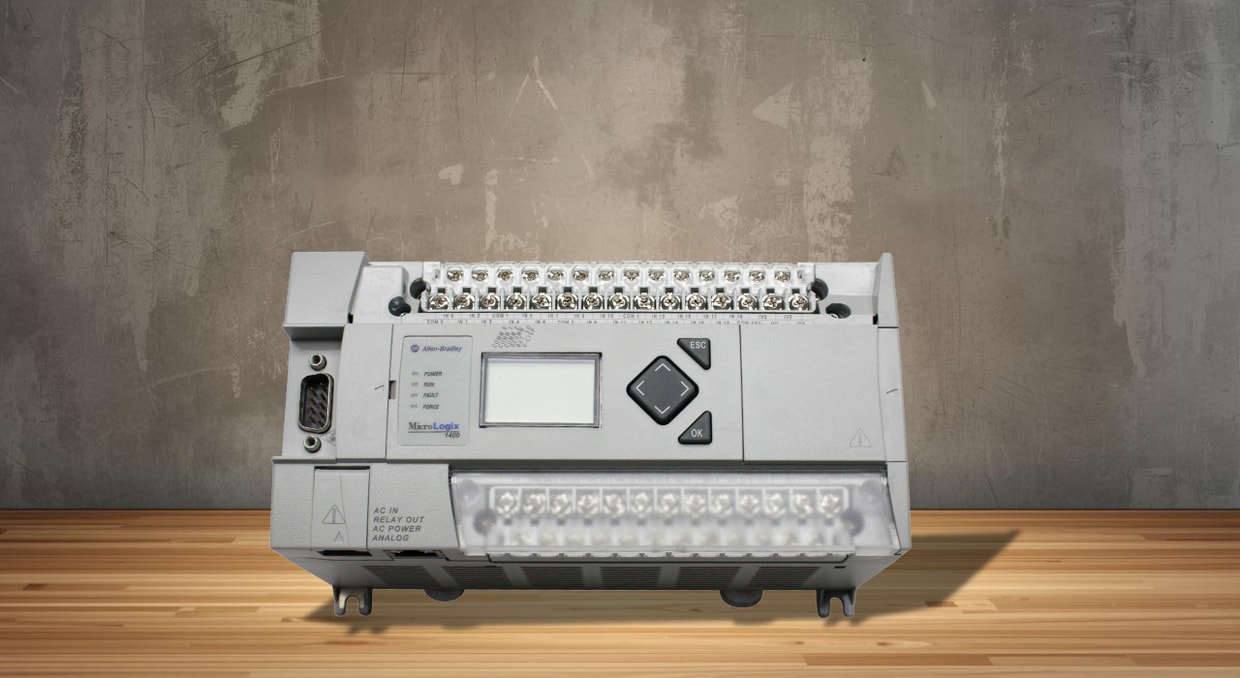
MicroLogix is a line of compact programmable logic controllers developed by Allen-Bradley, a Rockwell Automation brand. These controllers are engineered for applications that require reliable discrete and analog control within constrained panel space and limited budgets. Across industries such as packaging, HVAC, and OEM machine building, MicroLogix has established itself as a practical control solution.
This article examines how MicroLogix controllers are deployed across these three application domains, covering the specific control functions they perform, the hardware features that make them suitable, and the engineering considerations that come with selecting and implementing them.
MicroLogix Overview
The MicroLogix family includes five primary models: the 1000, 1100, 1200, 1400, and 1500. Each model varies in I/O count, memory capacity, communication capabilities, and processing speed. The MicroLogix 1000 is the most basic, handling simple relay-replacement tasks with fixed I/O. The MicroLogix 1500 sits at the top of the family with modular I/O expansion, higher memory, and support for more complex instruction sets. If you would like a more in-depth look at the MicroLogix, we have a hardware selection guide for the 1400 here and for the 1500 here.
All models use ladder diagram logic as their primary control language. Function block and structured text are not natively supported, which can be a limitation for engineers accustomed to IEC 61131-3 multi-language control standards. That said, the platform itself is mature and well understood, with a large installed base, making troubleshooting knowledge and real-world examples easy to find.
Communication options vary by model. The MicroLogix 1100 and 1400 include onboard EtherNet/IP ports, enabling integration with Rockwell’s Connected Components architecture and direct connectivity to SCADA systems and HMIs without additional communication modules. DH-485 and RS-232 ports are standard across most models and support Modbus RTU, DF1, and ASCII protocols, which are commonly required in legacy system integration and third-party device communication.
The I/O architecture includes both fixed on-board I/O and, on the 1200, 1400, and 1500 models, expansion I/O slots that accept specialty modules for analog, thermocouple, RTD, high-speed counter, and relay output functions. Analog inputs on the MicroLogix 1400 support 0–10V and 4–20 mA signal ranges, which cover most industrial sensor types.
MicroLogix in Packaging Machines
Packaging machinery is one of the highest-volume application areas for MicroLogix controllers. The control requirements in packaging involve coordinated sequencing of multiple actuators, real-time monitoring of process variables, and deterministic timing, all of which fall within MicroLogix’s operational capabilities.
Form-Fill-Seal Machines
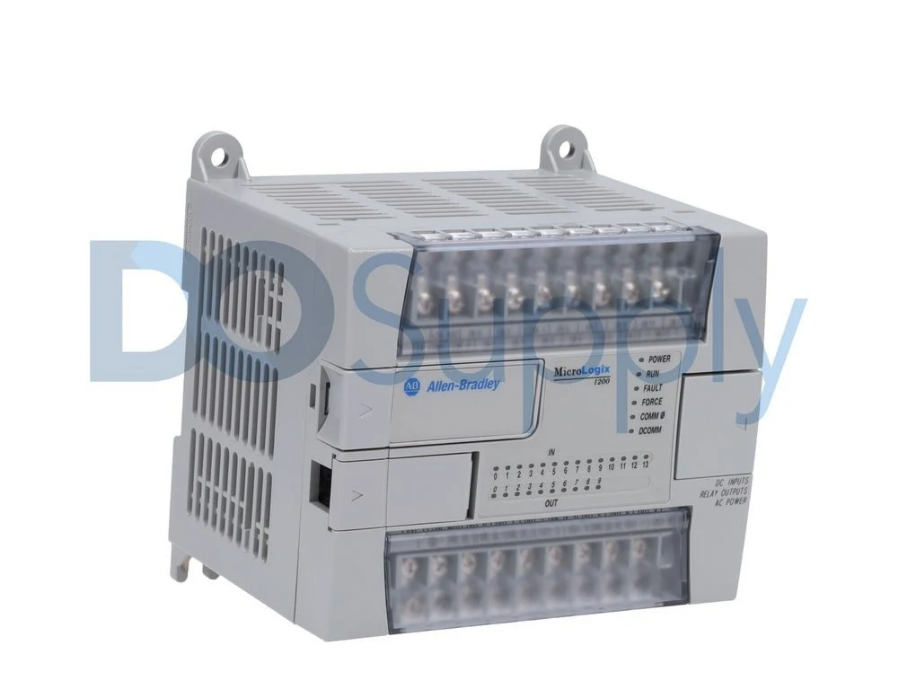
In vertical and horizontal form-fill-seal machines, the MicroLogix controller manages film drive timing, jaw temperature regulation, fill volume monitoring, and cutter synchronization. The sealing jaw temperature is typically controlled through a PID loop using a thermocouple or RTD input module. Film tension and registration mark detection are handled via high-speed counter inputs or interrupt-driven routines, enabling the controller to respond within milliseconds to film position signals.
Volumetric or gravimetric fill systems interface with the MicroLogix through analog inputs. The controller reads the output from a load cell amplifier or flow meter, compares it against a setpoint stored in a data table, and triggers the fill valve or auger motor accordingly. Overfill and underfill conditions are flagged as faults and logged to the controller’s data file for operator review.
Conveyor and Sorting Systems
MicroLogix controllers are frequently used in conveyor control applications where the product must be routed, gapped, or sorted based on upstream sensor data. Photoeye and proximity sensor inputs trigger output states that control divert gates, stop gates, or reject mechanisms. Variable frequency drives connected through analog output channels allow the controller to regulate conveyor speed in response to downstream buffer levels or upstream production rates.
Product counting is handled through high-speed counter modules or onboard HSC inputs available on the MicroLogix 1200 and 1400. Counts are accumulated in integer data files and compared against batch targets, with outputs triggering downstream equipment when the target count is reached.
MicroLogix in HVAC Systems
HVAC control is another well-established application domain for MicroLogix. While large commercial facilities often use dedicated building automation systems running BACnet or LonWorks, many HVAC equipment manufacturers and mechanical contractors use MicroLogix for unit-level control in applications where a full BAS controller would be over-engineered and more expensive than required.
Air Handling Unit Control
In air handling unit applications, the MicroLogix controller manages supply and return fan speeds via analog output signals to VFDs, controls chilled water and hot water valve positions via analog outputs, and monitors mixed air, supply air, and return air temperatures via analog inputs. Humidity sensors and CO2 sensors feed into the controller for demand-controlled ventilation logic.
Economizer control is implemented through comparison logic that evaluates outdoor air enthalpy or dry-bulb temperature against return air conditions. When outdoor conditions are favorable, the controller modulates the outdoor air damper to maximize free cooling and reduce mechanical cooling load. The MicroLogix handles enthalpy calculations internally using floating-point math instructions when an analog enthalpy sensor is connected, or approximates it using dry-bulb temperature limits when only a temperature sensor is available.
Rooftop Unit Sequencing
For packaged rooftop units, MicroLogix manages compressor staging, condenser fan cycling, and crankcase heater control. Compressor protection logic includes time delays to minimize off-time, anti-short-cycle protection, and lockout on repeated high- or low-pressure trips. The controller reads the discharge and suction pressures from transducers and uses these values to determine whether a refrigerant fault condition exists.
Communication with building automation systems is typically achieved through a Modbus RTU gateway or a third-party BACnet MS/TP-to-Modbus bridge. The MicroLogix controller maps its data registers to Modbus holding registers, which the gateway then translates into BACnet objects readable by the BAS. This approach adds integration complexity but is a practical workaround given that MicroLogix does not natively support BACnet.
Data Logging and Fault Tracking
The MicroLogix 1400 includes an onboard data log function that records up to 100 samples of selected data values at configurable intervals. This is useful in HVAC applications for tracking runtime hours, fault occurrences, and setpoint deviations over time.
MicroLogix in OEM Machines
OEM machine builders represent one of the largest segments of MicroLogix users. For manufacturers producing machines in medium to high volumes, the per-unit controller cost directly impacts product margins. MicroLogix offers a control capability that satisfies the majority of OEM machine requirements at a cost point that larger modular PLC platforms cannot match.
Control Architecture for OEM Applications
OEM machines typically require a self-contained control architecture in which the PLC, I/O, HMI, and drive interfaces are integrated within the machine’s control panel. MicroLogix supports this architecture through its compact footprint, onboard I/O, and direct connectivity to Allen-Bradley PanelView Component HMIs. The MicroLogix 1100 communicates with PanelView Component terminals over EtherNet/IP, eliminating the need for a separate communication module, simplifying panel wiring, and reducing component count.
For machines with higher I/O demands, the MicroLogix 1500 with local I/O expansion modules supports configurations up to several dozen I/O points while remaining within a compact panel footprint. Specialty modules for stepper motor control, PID loop execution, and thermocouple measurement allow OEM builders to handle application-specific requirements without migrating to a larger platform.
Motion and Process Control
OEM machines often require coordinated control of multiple axes or precise regulation of process variables. MicroLogix handles single-axis open-loop motion control through pulse output instructions that drive stepper motor drives. For applications requiring feedback, encoder inputs on the MicroLogix 1200 and 1400 allow the controller to track position and implement basic closed-loop positioning through ladder logic.
PID control is implemented using the PID instruction within its dedicated software. Each PID block manages one control loop, with tuning parameters, proportional gain, integral time, and derivative time, stored in a dedicated control file. Multiple PID loops can run simultaneously, with the execution rate determined by the controller’s scan time and program size.
Diagnostics and Serviceability
For OEM builders, the controller’s serviceability in the field is a significant factor in platform selection. When a fault occurs, the controller captures the fault code, timestamp, and program state at the time of the fault, which gives field technicians a starting point for diagnosis without requiring the machine to reproduce the fault condition.
Engineering Considerations and Limitations
MicroLogix is not appropriate for every application. Several technical limitations must be evaluated during the system design phase.
Memory capacity is constrained across the MicroLogix family. Program memory ranges from approximately 1K words on the MicroLogix 1000 to 32K words on the MicroLogix 1500. Applications with large instruction sets, extensive data-logging requirements, or complex subroutine structures may exceed available memory, requiring either program optimization or migration to a higher-capacity platform, such as the CompactLogix.
Scan time performance is adequate for most discrete control and slow analog control applications. Still, MicroLogix is not suitable for high-speed motion control or applications requiring sub-millisecond response times. The interrupt-driven input functionality available on some models mitigates this for specific high-speed input events, but the overall scan-based execution model imposes inherent latency.
Final Thoughts
In conclusion, MicroLogix controllers occupy a well-defined position in the industrial control landscape: compact, cost-effective, and capable of handling the discrete and analog control requirements found in packaging machinery, HVAC equipment, and OEM machines. Their integration with the Rockwell Automation software and hardware ecosystem, combined with broad protocol support and a large installed base, makes them a practical and supportable choice for applications within their technical envelope. Engineers specifying MicroLogix should evaluate memory requirements, I/O architecture, communication needs, and product lifecycle status against the application’s specific demands to confirm a fit before committing to the platform.
Whether you’re putting together a new HVAC system or designing a pick-and-place system, let us be your source of MicroLogix PLCs. We carry dozens of different MicroLogix PLCs, expansion I/Os, and add-ons here at DO Supply. If it’s not entirely apparent what controller your project may need, no problem, give our support team a call or an email, and we will be glad to assist. Thank you for reading.
DO Supply Inc. makes no representations as to the completeness, validity, correctness, suitability, or accuracy of any information on this website and will not be liable for any delays, omissions, or errors in this information or any losses, injuries, or damages arising from its display or use. All the information on this website is provided on an "as-is" basis. It is the reader's responsibility to verify their own facts.