MicroLogix 1100 Selection Guide
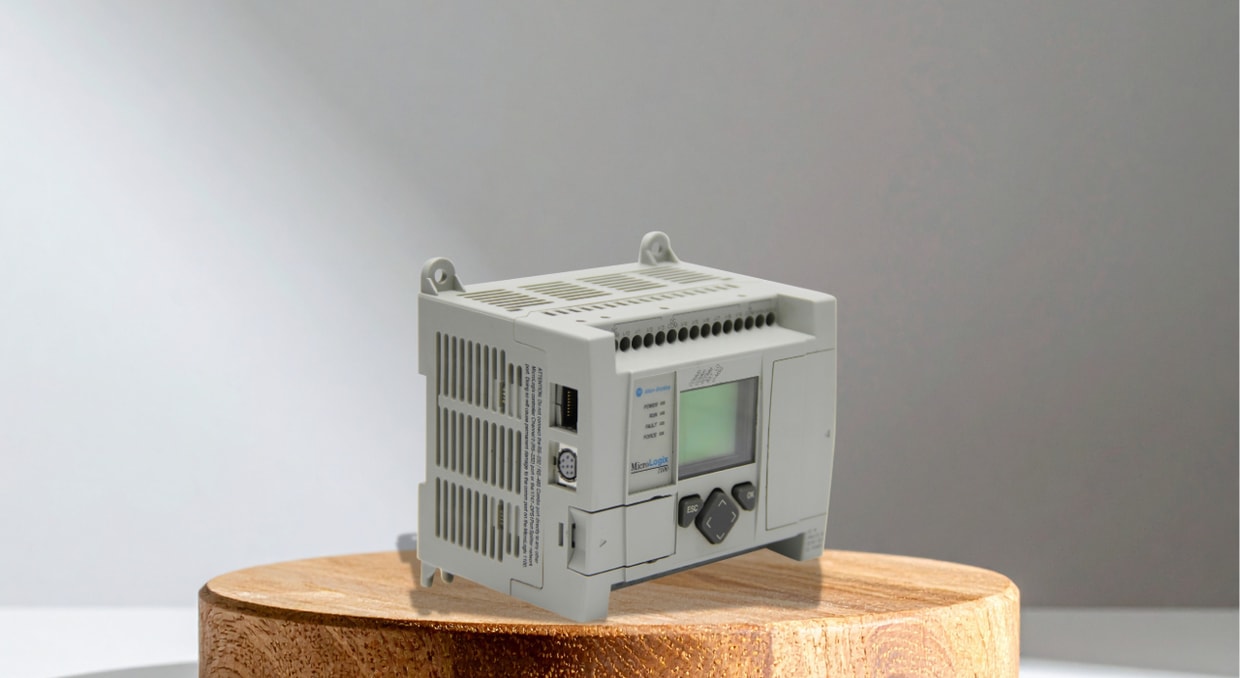
If you’re considering a compact controller for a small to mid-scale automation project, the Allen-Bradley MicroLogix 1100 deserves a close look. While it may be a legacy system, the MicroLogix 1100 still strikes a balance between capability and footprint, giving engineers a robust feature set without the overhead of a larger platform.
The Micrologix 1100, at its core, is a fixed I/O programmable controller built around 18 onboard I/O points: 10 digital inputs, 2 analog voltage inputs (0-10V DC), and 6 discrete outputs. What sets it apart from this class of controller is the inclusion of a built-in Ethernet/IP port alongside an isolated RS-232/RS-485 combination port, an onboard LCD display with keypad, a real-time clock, and support for up to four 1762 expansion I/O modules.
While the MicroLogix 1100 series has only four controllers, we will go over each one, the expansion I/O lineup, and common applications to help you select the right configuration for your project.
Controller Variants and Specifications
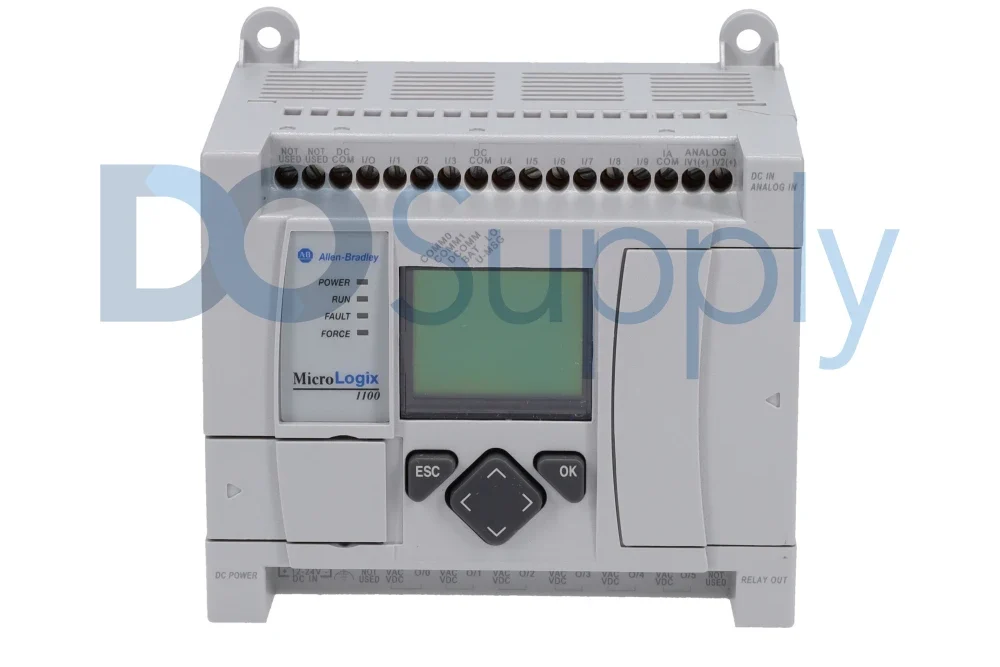
As we mentioned before, there are four controllers in the MicroLogix 1100 lineup, all having the same dimensions of 90 x 110 x 87 mm or 3.5 x 4.33 x 3.43in HxWxD and sharing the same 18-point I/O footprint: ten digital inputs, two analog voltage inputs (0 to 10V DC), and six discrete outputs. Where the controllers differ is in power supply voltage, input signal type, and output configuration.
1763-L16AWA
The 1763-L16AWA is the AC-powered AC-input variant. It runs on 120/240V AC power and accepts 120V AC digital inputs, making it a natural fit for installations that already have AC field devices. All six outputs are individually isolated relays, which gives you the flexibility to switch a mix of AC and DC loads without worrying about shared commons between output groups. Other specifications include:
- Input power: 120/240V AC (100 to 240V AC range, -15%/+10%)
- Digital inputs: 10 x 120V AC (79 to 132V AC operating range)
- Analog inputs: 2 x 0 to 10V DC, 10-bit unsigned integer, ±1.0% accuracy
- Outputs: 6 individually isolated relays
- Inrush current: 25 A for 8 ms at 120V AC, 40 A for 4 ms at 240V AC
1763-L16BWA
Moving on to our next controller, the 1763-L16BWA keeps the same 120/240V AC power supply but swaps the inputs over to 24V DC. This MicroLogix controller is better suited when the power infrastructure is AC, but your field devices, such as proximity sensors, photoelectric sensors, and push buttons, are running on 24V DC. Four of those ten inputs are high-speed-capable, supporting frequencies up to 40 kHz. These high-speed inputs can be used individually for pulse catch or latching inputs, or combined to form a high-speed counter.
The BWA also provides 250 mA of 24V DC sensor power directly from the controller, which is a nice touch for smaller systems where running a separate sensor power supply would be overkill. Other specifications are as follows:
- Input power: 120/240V AC (100 to 240V AC range, -15%/+10%)
- Digital inputs: 6 standard 24V DC + 4 high-speed 24V DC (up to 40 kHz)
- Analog inputs: 2 x 0 to 10V DC, 10-bit unsigned integer, ±1.0% accuracy
- Outputs: 6 individually isolated relays
- Inrush current: 25 A for 8 ms at 120V AC, 40 A for 4 ms at 240V AC
1763-L16BBB
The MicroLogix 1763-L16BBB is the all-DC variant and is the most distinct controller in the lineup. It runs on 24V DC power, takes 24V DC sinking/sourcing inputs (again with four high-speed inputs up to 40 kHz), and has a unique output configuration. Instead of six relays, the BBB gives you two isolated relays, two standard 24V DC FET outputs, and two high-speed 24V DC FET outputs.
Those two high-speed FET outputs can operate as pulse-train output (PTO) or pulse-width modulation (PWM) channels, which opens the door to basic motion-control and speed-regulation applications that the relay-only variants simply cannot handle. The high-speed FET outputs have a turn-on time of just 6 µs and a turn-off time of 18 µs, compared to the 10 ms switching time on the relay outputs.
You can expect:
- Input power: 24V DC (-15%/+10%), Class 2 SELV
- Digital inputs: 6 standard 24V DC + 4 high-speed 24V DC (up to 40 kHz)
- Analog inputs: 2 x 0 to 10V DC, 10-bit unsigned integer, ±1.0% accuracy
- Outputs: 2 isolated relays + 2 standard FET + 2 high-speed FET (PTO/PWM capable)
- High-speed FET turn-on/turn-off: 6 µs / 18 µs
- Inrush current: 15A for 20ms at 24V DC
1763-L16DWD
Last but not least, the MicroLogix 1763-L16DWD rounds out the family with a wider DC input voltage range. It accepts 12 to 24V DC power, which is useful in environments where the available supply voltage might not be a clean 24V, such as battery-powered equipment, mobile machinery, or solar-powered remote installations. The digital inputs also accept the same 12 to 24V DC range, with four high-speed inputs rated up to 40 kHz. It also matches the BWA output-isolated relay output configuration, with the same hazardous and ordinary location ratings. Other specifications include:
- Input power: 12 to 24V DC (-15%/+10%), Class 2 SELV
- Digital inputs: 6 standard 12/24V DC + 4 high-speed 12/24V DC (up to 40 kHz)
- Analog inputs: 2 x 0 to 10V DC, 10-bit unsigned integer, ±1.0% accuracy
- Outputs: 6 individually isolated relays
- Inrush current: 15A for 20ms at 24V DC
Common Features Across All Variants
Regardless of which MicroLogix 1100 controller you use, the hardware platform is identical in physical size and built-in features, including an LCD with a four-button keypad, two built-in trimpots, and a built-in real-time clock. Communication is handled through two ports: an isolated RS-232/RS-485 combination port (Channel 0) and a 10/100 Mbps Ethernet port (Channel 1), which supports EtherNet/IP with CIP explicit messaging. The Ethernet port also hosts an embedded web server for monitoring module information, TCP/IP configuration, diagnostics, and the data table memory map through a standard web browser.
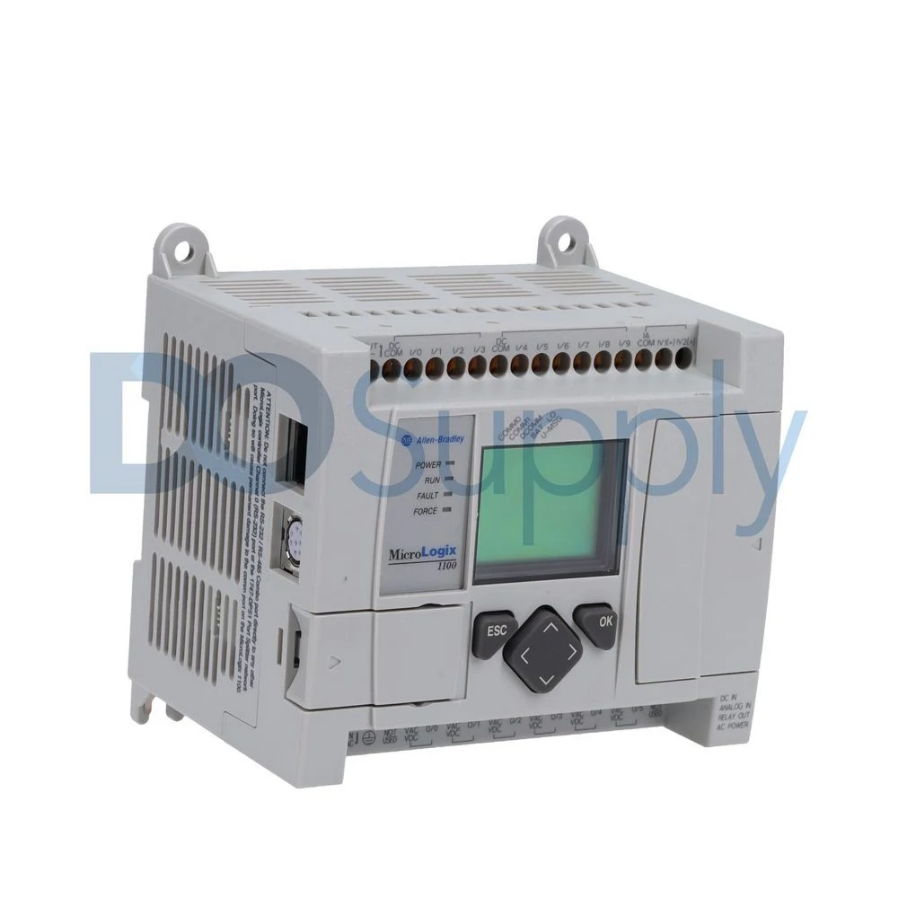
Program and data memory (8K) are nonvolatile and are battery-backed (1763-BA ). An optional memory module (1763-MM1, 128 KB) provides backup and program transfer capability between controllers. All variants also support up to four 1762-series expansion I/O modules. Other specs you will find are:
- Operating temperature: -20 to +65°C (-4 to +149°F)
- Storage temperature: -40 to +85°C (-40 to +185°F)
- Relative humidity: 5 to 95% noncondensing
- Vibration: 10 to 500 Hz, 5 g, 0.015 in. max peak-to-peak
- Certifications: UL Listed for Class I, Division 2, Groups A, B, C, D; cUL; CE; RCM
- Expansion I/O: up to 4 x 1762-series modules (any combination)
- Analog input specs (all variants): 210 kΩ impedance, 10.5V overvoltage protection, non-isolated with logic
Choosing the Right MicroLogix 1100 for Your Application
With four controllers with the same I/O count and feature set, the decision really comes down to three questions: What voltage does your power supply run at? What voltage are your field devices running on? And do you need high-speed outputs?
If You Have an All-AC Application
If your application is built around AC field devices and an AC power source, the MicroLogix 1763-L16AWA is a straightforward choice. It keeps everything on the same voltage, which simplifies wiring and eliminates the need for a separate 24V DC supply just to power your inputs. This is common in older installations, building automation, and simple machine control, where the field devices are things like limit switches, contactors, and pilot lights that run on 120V AC.
For Those with Mixed Power
If your power infrastructure is AC but your sensors and field devices are 24V DC, then the MicroLogix 1763-L16BWA bridges that gap. The four high-speed inputs also make this a good fit for applications that need basic counting or pulse-catch functionality, such as pharmaceutical drug dispensing or encoder feedback, without stepping up to a DC power supply.
For an All 24V DC System
Now, if your entire system runs on 24V DC and you need high-speed output capability, the 1763-L16BBB is the only option in this MicroLogix family. The PTO and PWM functions on outputs 2 and 3 make it the go-to for applications involving stepper motor control, variable speed fan or pump regulation, or any situation where you need precise pulse output.
If Your DC Power isn’t Stable
If your DC supply isn’t a stable 24V, the MicroLogix 1763-L16DWD gives you the flexibility to run anything from 12 to 24V DC. This makes it the natural pick for mobile equipment, battery-backed systems, solar installations, or anywhere the supply voltage might sag or fluctuate outside the tighter 24V DC tolerance window that the BBB requires. The trade-off is that you lose the FET/PTO/PWM output capability of the BBB and go back to all-relay outputs.
One last thing to keep in mind is that all 1762-series expansion modules are compatible, and they communicate using the same protocols, so your choice of base controller doesn’t lock you into future expandability.
Final Thoughts
The MicroLogix 1100 is one of those controllers that earns its place in the panel by doing exactly what it needs without overcomplicating things. For small-scale standalone machines, simple process control, building automation, and remote monitoring applications, the combination of built-in Ethernet, an LCD for local diagnostics, and a compact 18-point I/O base gives you a lot of capability in a small footprint. Then there’s the fact that they come with both an RS-232/RS-485 combo port and a 10/100 Ethernet port, keeping you from choosing between legacy serial devices and modern network connectivity. You can have both at the same time, which is especially helpful in factories where older equipment still needs to talk to newer infrastructure. If you would like to read up on common MicroLogix applications, we have an article here just for that!
If you are looking for a supplier for MicroLogix controllers and 1762-series expansion modules, then look no further than DO Supply. We offer controllers and accessories from all MicroLogix lines to keep these legacy systems running strong. On top of that, we also offer repair services if you would like yours fixed or replaced. So if you’re in the market for a MicroLogix platform or any other automation-related products, stop by our site today!
DO Supply Inc. makes no representations as to the completeness, validity, correctness, suitability, or accuracy of any information on this website and will not be liable for any delays, omissions, or errors in this information or any losses, injuries, or damages arising from its display or use. All the information on this website is provided on an "as-is" basis. It is the reader's responsibility to verify their own facts.