MicroLogix 1000 Selection Guide: How to Choose the Right Allen-Bradley PLC
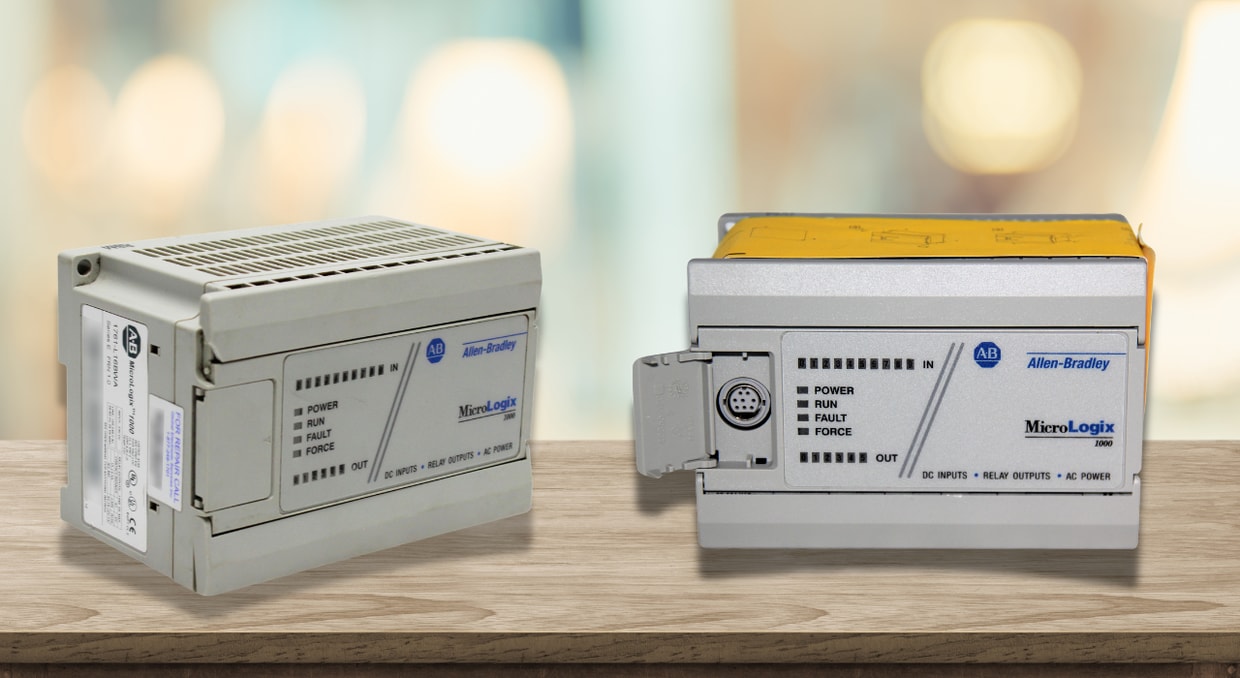
The Allen-Bradley MicroLogix 1000 has been around the block for a while, long enough to be a seasoned veteran before some of today’s engineers even start their first internship. Rockwell Automation has since discontinued the line, but if you’ve spent any time in the field, then you know that “discontinued” doesn’t mean gone. In fact, these little fixed I/O controllers are still working in packaging lines, HVAC systems, conveyor controls, and countless other applications where they were originally installed and never gave anyone a reason to rip them out.
That being said, there are still several reasons to pick these controllers for your project. Whether you’re sourcing a drop-in replacement for an existing system or maintaining a fleet of legacy machines, this guide is for you. We’ll walk through the part number system, the different I/O configurations, power supply options, and output types so you can confidently select the right MicroLogix 1000 for your application.
Understanding the Part Number System
If you have ever stared at a MicroLogix catalog number, such as 1761-L32BWA, and wondered what all those numbers and letters mean, then you’re not alone. Thankfully, Rockwell had built a pretty logical naming convention into the MicroLogix 1000 line once you know how to read it.
First, every MicroLogix 1000 catalog number starts with 1761, which is the bulletin number for the entire MicroLogix 1000 family. After the dash, here’s what the rest means:
- L: This tells you that it’s a controller, rather than a cable or accessory
- 10/ 16/ 20/ 32: This is the total digital I/O point count. It also determines the unit’s physical size.
- A/ B/ N: The input type. “A” means 120V AC inputs, “B” means 24V DC sink/source inputs, and “N” indicates 24V AC/DC inputs. The “N” option was introduced in later series revisions and is only available on the 16-point models.
- W/ B/ A/ X: The output type. “W” is relay. “B” indicates primarily 24V DC solid-state (FET) outputs, typically combined with 2 relay outputs depending on the model. “A” is a 120/240V AC triac, also with 2 relay outputs in the mix. And “X” is a relay/24V DC FET combo found only on the 1761-L10BXB, another later-revision addition.
- A/ B: Power supply. “A” means 120/240V AC-powered; “B” means 24V DC-powered.
- -5A: If you chose a 20-point model, it will come with this final suffix, indicating that it includes 5 analog channels (four inputs, one output) on top of the digital I/O.
Once this naming convention is in your head, you can glance at any MicroLogix 1000 part number and know what you’re dealing with. It’s also worth noting that communication is handled through RS-232 with DF1 protocol and optional DH-485 networking via interface modules.
Choosing Your I/O Size
The MicroLogix 1000 comes in four I/O sizes, and picking the right one starts with a rather simple question: how many field devices do you need to connect to it?
10-Point
The 10-point controllers are the smallest of the bunch, offering six DC inputs and four outputs, and measuring 120mm (4.72 in) L, 73mm (2.87 in) W, and 80mm (3.15 in) H. These little controllers are a go-to for really compact applications, such as a small pump skid, a simple conveyor gate, or anywhere space is limited. The original lineup includes the L10BWA and L10BWB, both of which have relay outputs. The L10BXB came later, which swaps two of those relay outputs for 24V DC FET outputs, which is handy if you need to switch a couple of DC loads at higher speeds than a relay can manage.
16-Point
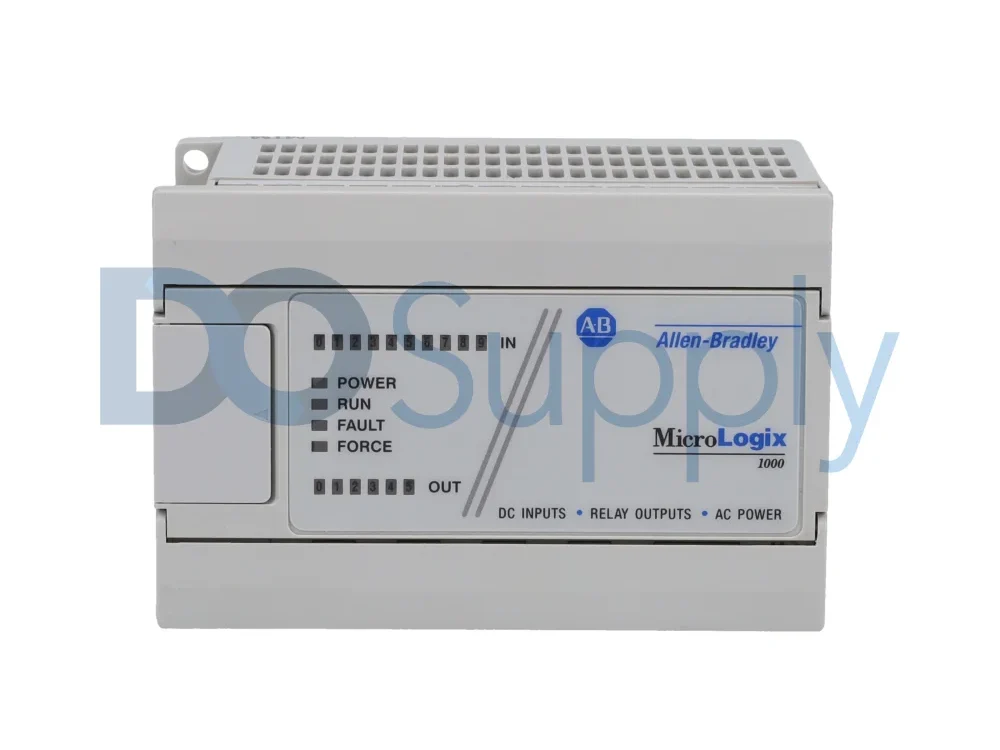
This is the sweet spot for the MicroLogix 1000 controllers. It comes with 10 inputs and 6 relay outputs, which covers the majority of standalone machine control applications without taking up much more panel space. The 16-point family also offers the widest variety of electrical configurations: AC inputs, DC inputs, and even 24V AC/DC inputs on the later-revision “N” models (L16NWA and L16NWB). You’ll also find the FET output option here with the L16BBB.
These controllers fit nicely in packaging equipment, small assembly stations, HVAC air handlers, or basic material handling systems.
20-Point
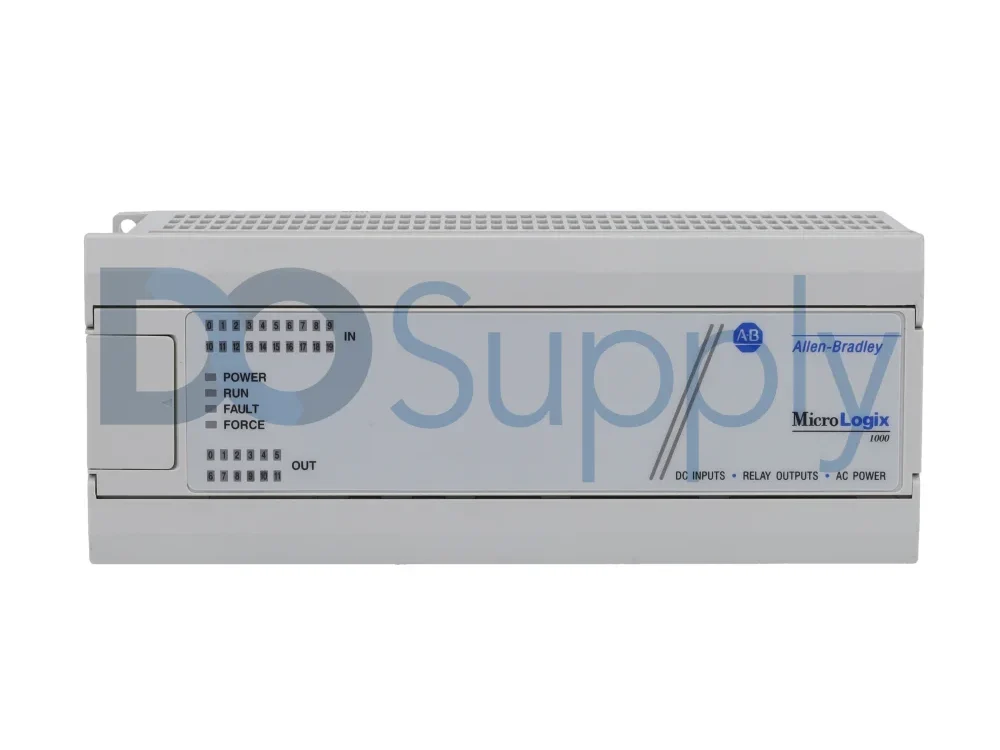
These controllers are the analog specialists in the MicroLogix 1000 lineup, designated by the “-5A” suffix. Here, you will get 12 digital inputs, eight relay outputs, four analog inputs, and one analog output, for a total of 25 I/O points. Interestingly enough, they also share the same form factor as the 32-point I/O model. You can typically find these controllers in small process control applications, such as temperature monitoring on a furnace or flow control on a blending skid.
These are your only options within the MicroLogix 1000 family if your application needs to read 4-20mA transmitters or output a 0-10V signal. Available in three flavors: AC input with AC power (L20AWA-5A), DC input with AC power (L20BWA-5A), and DC input with DC power (L20BWB-5A).
32-Point
Finally, we have the 32-point controllers, which pack 20 inputs and 12 outputs into the largest form factor. This controller is what you pick if you need maximum I/O density in a fixed controller, allowing it to fit in applications such as larger conveyor systems, multi-zone packaging lines, or machine tools with many sensors. The 32-point controllers also come with relay, FET, and triac outputs. Just remember that the MicroLogix 1000 has no expansion capability, so if 32 points isn’t enough, it’s time to look at a MicroLogix 1100 or 1400.
Matching Electrical Compatibility
Now that you have figured out the best I/O size, it’s time to decide on electrical compatibility. You need to match the controller’s power supply, input voltage, and output type to what’s actually in your panel and out in the field.
Power Supply
Matching the power supply is the most straightforward. The “A” suffix denotes controllers that run on 120/240V AC, which, if you just wire them to your panels’ control power transformer, you’d be good. The “B” suffix controllers run on 24V DC, making them a natural fit for systems already built around a 24V DC bus, or for mobile and battery-backed applications where AC isn’t available. The AC-powered units also provide a 24V DC sensor power output (200 mA max), which is a nice touch for powering a handful of proximity sensors or other low-draw field devices without a separate supply.
Input Types
When it comes to input types, it all depends on what your field devices are putting out. The “A” models accept 120V AC inputs, which you will typically see in older installations or applications wired with limit switches on AC relay panels, float switches, pressure switches, etc. The “B” models take 24V DC sink/source inputs, which is the more common choice in modern installations and gives you compatibility with most proximity sensors, photoelectric sensors, and 24V DC pilot devices. Then there are the “N” models (16-point only), which accept 24V AC/DC inputs for greater flexibility if you happen to have a mix of AC and DC field devices. However, these aren’t as common as straight AC or DC versions.
Output Types
Output types are where things get a little more interesting. Relay outputs (“W”) are the most versatile as they can switch AC or DC loads up to 240V AC or 125V DC. However, their trade-off is both speed and lifespan, since you’re dealing with physical contacts. FET outputs (“B”) are solid-state 24V DC sourcing outputs that switch must faster and last longer, but are limited to DC loads only. These units also include 2 relay outputs for any AC loads you might need to handle. Triac (“A”) is the AC equivalent of a FET. Like the FET models, triac units also include 2 relay outputs. And the oddball L10BXB gives you a 2-and-2 split of relay and FET outputs on a 10-point controller.
Analog I/O
Analog capability is exclusive to the 20-point “-5A” models. You get 4 analog inputs (two voltage (0-10V) and two current (0-20 / 4-20mA)) plus one configurable analog output that can do either 0-10V or 4-20mA. Resolution is 16-bit on the inputs and 15-bit on the output, which is more than adequate for most small process applications. One thing to keep in mind: the controller doesn’t provide loop power for analog inputs, so you’ll need an external supply for your transmitters.
Final Thoughts
The MicroLogix 1000 may be a legacy system, but it’s far from obsolete in practice. Thousands of these controllers are still running in the field, providing simple, reliable control in a compact package. All it really takes to select the right one for your application is to get familiar with the part numbers and match the proper electrical configuration.
To recap: start with your I/O count, match your power supply and input voltage to what’s in the panel, pick the output type that fits your loads, and if you need analog, make sure you’re looking at the 20-point “-5A” models. It’s really that straightforward once you know what all those letters mean.
If you’re in the market for a MicroLogix 1000, we at DO Supply have you covered! We sell MicroLogix 1100 controllers, accessories, and other MicroLogix parts. On top of that, we strive to be your go-to source for drives, motors, and other automation equipment. If you would like to read up more on the MicroLogix line, we have a blog here about applications they fit in for your reference.
Come visit us at our store today and find the right PLC for the right price, delivered fast!
DO Supply Inc. makes no representations as to the completeness, validity, correctness, suitability, or accuracy of any information on this website and will not be liable for any delays, omissions, or errors in this information or any losses, injuries, or damages arising from its display or use. All the information on this website is provided on an "as-is" basis. It is the reader's responsibility to verify their own facts.